High-entropy nanozymes: a frontier toward next-generation high-performance nanozymes
Authors
Meng-Qi He, Yuting Gong, Ran Wang, Ping Liu, Bing Fang, Yixuan Li, Pengjie Wang, Imamdin Chandio, Ruoxiao Xie, Hong-bin Sun, Huiyuan Guo, Qionglin Liang, Fazheng Ren, Yongjian Ai*
- aMOE Key Laboratory of Precision Nutrition and Food Quality, Department of Nutrition and Health, China Agricultural University, Beijing, China
- bState Key Laboratory of Respiratory Health and Multimorbidity, Institute of Basic Medical Sciences Chinese Academy of Medical Sciences, School of Basic Medicine Peking Union Medical College, Beijing, China
- cMOE Key Laboratory of Bioorganic Phosphorus Chemistry & Chemical Biology, Laboratory of Flexible Electronics Technology, Department of Chemistry, Center for Synthetic and Systems Biology, Tsinghua University-Peking University Joint Centre for Life Sciences, Tsinghua University, Beijing, China
- dDepartment of Materials, Design and Manufacturing Engineering, School of Engineering, University of Liverpool, Liverpool, UK
- eDepartment of Chemistry, College of Science, Northeastern University, Shenyang, China.
* Correspondence: Address: Yongjian Ai, MOE Key Laboratory of Precision Nutrition and Food Quality, Department of Nutrition and Health, China Agricultural University, Beijing 100193, China. Email: ayj@cau.edu.cn (Y. Ai).
MedMat · 2026 · Vol. 3 · No. 1 · pp. 1-5
Translations
Long abstracts in additional languages. The English article is the version of record.
中文zh-Hans
纳米酶作为一类结合纳米材料特性与类酶催化功能的革命性人工酶,已重塑了催化科学并弥合了有机与无机催化剂之间的鸿沟。其 transformative potential(变革潜力)已获得 IUPAC 和 CAS 的高度认可,被列为“十大新兴技术”之一。尽管现有研究展示了可调节结构、高稳定性及低成本等优势,但传统纳米材料面临活性位点密度低和结构异质性的局限。本文旨在探讨从常规纳米材料向单原子催化剂演进的必然性,并重点介绍一种突破单一金属位点限制的新范式——高熵合金纳米酶(HEAzymes),以解决催化可调性问题,推动生物医学、环境监测及绿色化学领域的重大挑战应对。
本综述系统梳理了 HEAzymes 的合成策略与表征框架。合成方法主要分为“自上而下”和“自下而上”两类:前者通过物理或化学能量将块体材料破碎为纳米结构(如球磨、脱合金化),虽工艺简单但难以精确控制粒径;后者利用分子前驱体构建,能更灵活地调控尺寸、形貌及晶体结构。HEAzymes 的设计核心在于引入五种或以上主金属元素形成固溶相,其独特性能源于四大协同效应:高构型熵锁定单相结构并允许难熔元素过饱和;严重晶格畸变生成粗糙能量景观以增强力学与耐腐蚀性;多元素扩散缓慢抑制蠕变与氧化;以及“鸡尾酒”效应通过调节吸附能至萨巴蒂尔最优值,优化电子结构与电荷转移。
研究发现,HEAzymes 已成功模拟过氧化物酶(POD)和超氧化物歧化酶(SOD)等天然酶的活性。其高熵框架不仅提供了卓越的结构稳定性,还通过组分设计实现催化性能的精细调控。机制上,多元素协同作用使吸附能优化至萨巴蒂尔最优值,移动 d 带中心并加速电荷转移,从而释放创纪录的催化活性。这种设计克服了单一金属位点催化剂的可调性限制,实现了电子结构与中间体吸附的全面优化。目前,HEAzymes 在肿瘤免疫治疗、抗炎组织再生、病原体检测及污染物降解等领域已展现出巨大应用潜力,标志着纳米酶设计进入深度跨学科融合的新阶段。
尽管 HEAzymes 展现了革命性的前景,但现有合成方法仍存在局限性:自上而下的物理法(如激光烧蚀、磁控溅射)常导致粒径分布宽或产率低;自下而上法则需克服规模化生产的挑战。本文作为一篇观点性综述,总结了当前在合成路径选择与表征技术上的进展,并指出未来工作需在保持高熵结构稳定性的同时,进一步提升纳米颗粒的分散性与表面性质控制精度。随着对构型熵、晶格畸变及扩散动力学机制理解的深入,HEAzymes 有望成为下一代高性能催化材料的核心平台,推动从实验室研究向实际应用的转化。
Françaisfr
Les nanozymes constituent une classe révolutionnaire d'enzymes artificielles combinant les propriétés des nanomatériaux à la catalyse de type enzymatique, remodelant ainsi la science du catalyseur et comblant le fossé entre les catalyseurs organiques et inorganiques. Leur potentiel transformateur a valu aux nanozymes une reconnaissance majeure, incluant leur classement parmi les « 10 technologies émergentes » par l'IUPAC en 2022. Cependant, malgré leurs avantages tels que la stabilité élevée et le faible coût, les nanomatériaux conventionnels souffrent d'une densité de sites actifs limitée et d'hétérogénéité structurelle. Cette perspective vise à présenter une évolution rationnelle vers des catalyseurs mononucléaires puis vers les alliages à haute entropie (HEA), introduisant ainsi un nouveau paradigme pour surmonter les limitations de la tunabilité dans le design des nanozymes et répondre aux défis en biomédecine.
L'approche décrite repose sur une revue systématique des méthodes de synthèse, notamment les voies « top-down » (fragmentation physique ou chimique de matériaux massifs) et « bottom-up » (construction à partir de précurseurs moléculaires). Les HEA sont définis comme des solutions solides contenant cinq éléments métalliques principaux en proportions quasi-équimolaires. Leur conception exploite quatre effets fondamentaux : l'entropie configurationnelle élevée qui verrouille les phases uniques et permet la sursaturation d'éléments immiscibles ; une distorsion de réseau sévère créant un paysage énergétique rugueux pour améliorer la ténacité et retarder la corrosion ; une diffusion lente des éléments multiples supprimant le fluage et l'oxydation ; et un effet « cocktail » synergique optimisant les énergies d'adsorption vers l'optimum de Sabatier.
Les résultats principaux indiquent que les HEAzymes ont réussi à mimer efficacement les activités enzymatiques naturelles, telles que la peroxydase (POD) et la superoxyde dismutase (SOD). Leur cadre à haute entropie offre une stabilité structurelle exceptionnelle tout en servant de plateforme versatile pour le réglage fin des performances catalytiques via la conception compositionnelle. L'analyse scientifique interprète cette performance record comme résultant d'une optimisation collective des énergies d'adsorption et du déplacement du centre de bande-d, accélérant ainsi le transfert de charge. Ces avancées permettent aux HEAzymes de surpasser les limitations des catalyseurs plus simples et ouvrent la voie à des applications prometteuses en immunothérapie tumorale, régénération tissulaire anti-inflammatoire et dégradation de polluants environnementaux.
En conclusion, bien que les HEAzymes représentent un changement de paradigme majeur, des limitations subsistent dans le contrôle précis de la taille et de la morphologie lors des synthèses « top-down », qui peuvent conduire à l'agglomération. Les méthodes « bottom-up » offrent plus de précision mais nécessitent encore d'être optimisées pour une production à grande échelle. Cette perspective souligne que les travaux futurs doivent se concentrer sur le raffinement des techniques de synthèse et la compréhension approfondie des mécanismes cinétiques complexes, tels que l'effet cocktail et la distorsion du réseau. L'intégration interdisciplinaire continue est essentielle pour transformer ces matériaux prometteurs en solutions catalytiques économiques et stables pour les applications biotechnologiques et environnementales de demain.
Españoles
Las nanoenzimas constituyen una clase revolucionaria de enzimas artificiales que combinan propiedades nanomateriales con catálisis tipo enzimática, reconfigurando la ciencia catalítica y cerrando la brecha entre catalizadores orgánicos e inorgánicos. Su potencial transformador ha merecido un reconocimiento destacado, siendo nombradas una «Tecnología Emergente Top 10» por IUPAC y una frontera de química en 2022. Sin embargo, a pesar de ventajas como la estabilidad y el bajo costo, los nanomateriales convencionales enfrentan limitaciones críticas como baja densidad de sitios activos e heterogeneidad estructural. Esta perspectiva tiene como objetivo presentar la evolución racional hacia catalizadores mononucleares y finalmente hacia aleaciones de alta entropía (HEA), introduciendo un nuevo paradigma para superar las restricciones de sintonización en el diseño de nanoenzimas y abordar desafíos en biomedicina.
El enfoque descrito se basa en una revisión sistemática de los métodos de síntesis, clasificándolos principalmente en enfoques «top-down» (fragmentación física o química de materiales masivos) y «bottom-up» (construcción a partir de precursores moleculares). Las HEA se definen como soluciones sólidas que incorporan cinco o más elementos metálicos principales en proporciones casi equimolares. Su diseño aprovecha cuatro efectos fundamentales: la alta entropía configuracional que bloquea las fases únicas y permite una sobresaturación masiva de elementos inmiscibles; la severa distorsión reticular que genera un paisaje energético rugoso para mejorar la tenacidad y retardar la corrosión; la difusión lenta multielemental que suprime el fluencia y oxidación; y el efecto «cóctel» sinérgico que optimiza las energías de adsorción hacia el óptimo de Sabatier.
Los hallazgos principales indican que los HEAzymas han logrado imitar eficazmente actividades enzimáticas naturales, como la peroxidasa (POD) y la superóxido dismutasa (SOD). Su marco de alta entropía no solo proporciona una estabilidad estructural excepcional, sino que también sirve como plataforma versátil para el ajuste fino del rendimiento catalítico mediante el diseño composicional. La interpretación científica explica este desempeño récord como resultado de un efecto colectivo donde cinco o más elementos ajustan las energías de adsorción y desplazan el centro d-band, acelerando la transferencia de carga. Estos avances permiten a los HEAzymas superar las limitaciones de catalizadores más simples y abren camino a aplicaciones prometedoras en inmunoterapia tumoral y degradación de contaminantes.
En conclusión, aunque los HEAzymas representan un cambio paradigmático mayor, persisten limitaciones en el control preciso del tamaño y la morfología durante las síntesis «top-down», que pueden conducir a aglomerados. Los métodos «bottom-up» ofrecen más precisión pero requieren optimización para producción escalable. Esta perspectiva subraya que los trabajos futuros deben centrarse en refinar las técnicas de síntesis y comprender mejor mecanismos cinéticos complejos como el efecto cóctel y la distorsión reticular. La integración interdisciplinaria continua es esencial para transformar estos materiales prometedores en soluciones catalíticas económicas y estables, posicionando a los HEAzymas como una frontera hacia nanoenzimas de próxima generación con alto rendimiento.
日本語ja
ナノzymes(ナノ酵素)は、ナノ材料の特性と類酵素触媒機能を組み合わせた革新的な人工酵素であり、有機および無機触媒間のギャップを埋め、酵素学のパラダイムを変容させています。IUPAC や中国科学院により「トップ 10 エマージングテクノロジー」に選出されるなど高い評価を得ていますが、従来のナノ材料は活性点密度の低さと構造的不均一性に直面しています。本稿では、単原子触媒への進化がもたらす調製性の限界を克服し、5 つ以上の主金属元素を含む固溶相である高エントロピー合金(HEA)を利用した新しい設計パラダイム「高エントロピーナノ酵素(HEAzymes)」の導入と、その生物医学・環境分野における応用可能性について概説します。
本稿は HEAzymes の合成法および特性評価枠組みを体系的にレビューしています。合成アプローチは、「トップダウン」法(塊状材料の物理的または化学的分断)と「ボトムアップ」法(分子前駆体からの構築)に大別されます。HEA は 5 つ以上の主元素が近等モル比で混合された固溶溶液として定義され、その卓越した性能は4つの相補的な効果に基づいています:熱力学的に単一相を固定し不混和元素の過飽和を可能にする高構成エントロピー;転位や亀裂を防ぎ耐食性を向上させる著しい格子歪み;クリープと酸化を抑制する遅い多元素拡散;そして吸着エネルギーをサバティアー最適値に調整して電子構造を最適化する相乗的「カクテル効果」です。
主要な知見として、HEAzymes はペルオキシダーゼ(POD)やスーパーオキサイドジスムターゼ(SOD)などの天然酵素活性を効果的に模倣できることが示されています。高エントロピー構造は卓越した構造的安定性を提供すると同時に、組成設計を通じて触媒性能の微調整が可能な汎用プラットフォームとして機能します。科学的解釈では、5 つ以上の元素が集団的に吸着エネルギーを最適化し d-バンド中心をシフトさせることで電荷移動を加速させ、記録的な触媒活性を発揮することが解明されています。これにより、単純な触媒の限界を超え、腫瘍免疫療法や抗炎症組織再生、病原体検出など多様な分野で大きな可能性を示しています。
本稿は HEAzymes の現状と将来展望を論じていますが、トップダウン法(球磨、脱合金化等)では粒径分布が広く、ボトムアップ法でも大規模生産における制御の難しさといった課題が残されています。特に、単分散したナノ粒子を得るための精密なサイズ・形態制御は依然として技術的ハードルです。今後の研究では、構成エントロピーや格子歪みなどのメカニズム理解を深めつつ、合成プロセスのスケーラビリティと表面性質の制御精度向上に注力する必要があります。この分野が深く統合された学際的な時代を迎える中で、HEAzymes は次世代の高性能ナノ酵素として、経済的で安定した触媒ソリューションを提供する重要な役割を果たすことが期待されます。
العربيةar
تُعدّ النانو-إنزيمات فئة ثورية من الإنزيمات الاصطناعية التي تجمع بين خصائص المواد النانوية والتحفيز الشبيه بالإنزيم، مما أعاد تشكيل علم التحفيز وسد الفجوة بين المحفزات العضوية وغير العضوية. وقد حظيت هذه التقنية باعتراف رفيع المستوى، حيث صنفتها IUPAC ضمن «أهم 10 تقنيات ناشئة» في عام 2022. ومع ذلك، وعلى الرغم من مزايا مثل الاستقرار العالي والتكلفة المنخفضة، فإن المواد النانوية التقليدية تواجه قيوداً جوهرية تتمثل في كثافة مواقع نشطة منخفضة وعدم تجانس هيكلي. يهدف هذا المنظور إلى استعراض التطور العقلاني نحو المحفزات أحادية الذرة ثم سبائك عالية الإنتروبيا (HEA)، مقدماً نموذجاً جديداً للتصميم يتجاوز قيود القابلية للتعديل في تصميم النانو-إنزيمات، بهدف معالجة التحديات الكبرى في الطب الحيوي والمراقبة البيئية.
يركّز هذا العمل على مراجعة منهجية لطرق التصنيع والتصنيف، حيث تُقسّم طرق التحضير بشكل أساسي إلى نهج «من الأعلى للأسفل» (تفتيت المواد السائبة) و«من الأسفل للأعلى» (البناء من سلائف جزيئية). تُعرّف سبائك عالية الإنتروبيا بأنها محاليل صلبة تحتوي على خمسة عناصر معدنية رئيسية أو أكثر بنسب شبه متساوية. وتستند خصائصها الفريدة إلى أربعة تأثيرات أساسية: إنتروبيا تكوينية عالية تثبت الأطوار الأحادية وتسمح بتشبع فائق للعناصر غير القابلة للامتزاج؛ تشوه شبكي شديد يولد منظر طاقة وعراً لتعزيز المتانة وتأخير التآكل؛ انتشار بطيء متعدد العناصر يكبح الزحف والأكسدة؛ وتأثير «الكوكتيل» التآزري الذي يضبط طاقات الامتزاز نحو الأمثل حسب ساباتير، محققاً نشاطاً تحفيزياً قياسياً.
تشير النتائج الرئيسية إلى أن النانو-إنزيمات عالية الإنتروبيا (HEAzymes) نجحت في محاكاة فعالية الإنزيمات الطبيعية مثل بيروكسيداز السوبر أوكسيدات. إن إطارها عالي الإنتروبيا لا يوفر استقراراً هيكلياً استثنائياً فحسب، بل يعمل أيضاً كمنصة متعددة الاستخدامات لضبط الأداء التحفيزي الدقيق من خلال التصميم التركيبي. وتفسر الدراسة العلمية هذا الأداء القياسي على أنه نتيجة لتأثير جماعي حيث تضبط خمسة عناصر أو أكثر طاقات الامتزاز وتحول مركز نطاق d-، مما يسرع نقل الشحنة. وقد فتحت هذه التطورات آفاقاً واعدة في مجالات مثل العلاج المناعي للورم وتجديد الأنسجة المضاد للالتهابات واكتشاف مسببات الأمراض.
في الختام، ورغم أن النانو-إنزيمات عالية الإنتروبيا تمثل تحولاً نموذجياً كبيراً، إلا أن هناك قيوداً قائمة تتعلق بالتحكم الدقيق في الحجم والشكل أثناء طرق التصنيع «من الأعلى للأسفل»، والتي قد تؤدي إلى تكتل الجسيمات. بينما توفر الطرق «من الأسفل للأعلى» دقة أكبر، فإنها لا تزال بحاجة لتحسين قابلية التوسع للإنتاج الصناعي. تؤكد هذه المنظورة أن العمل المستقبلي يجب أن يركز على تحسين تقنيات التصنيع وفهم الآليات الحركية المعقدة مثل تأثير الكوكتيل والتشوه الشبكي بشكل أعمق. إن التكامل متعدد التخصصات المستمر ضروري لتحويل هذه المواد الواعدة إلى حلول تحفيزية اقتصادية ومستقرة، مما يضع النانو-إنزيمات عالية الإنتروبيا في طليعة الجيل القادم من المحفزات فائقة الأداء.
Keywords
Full Text
1. Introduction
Nanozymes are a revolutionary class of artificial enzymes that combine nanomaterial properties with enzyme-like catalysis. Their emergence has reshaped catalytic science, bridging the gap between organic and inorganic catalysts and transforming paradigms in enzymology[1]. This transformative potential has earned nanozymes high-profile recognition, including being named a “Top 10 Emerging Technology” by IUPAC and a “Top 10 Chemistry and Materials-Science Frontier” by the Chinese Academy of Sciences in 2022. Advances in nanotechnology, analytical chemistry, and computation have enabled the construction of diverse nanozymes. Compared to natural enzymes, they offer advantages such as tunable structures, scalable synthesis, low cost, easy modification, high stability, and stimuli-responsive activity. Scientific consensus views nanozymes not only as a powerful complement but also as a potential successor to natural enzymes in future applications[2]. With their ability to provide efficient, stable, and economical catalytic solutions, nanozyme research is now in an era of deep interdisciplinary integration, poised to tackle major challenges in biomedicine, environmental monitoring, and green chemistry[3].
Recent advances in nanozyme development have seen a rational evolution from conventional nanomaterials to ultrafine nanoparticles, sub-nanometer clusters, and ultimately to single-atom catalysts[4,5]. Conventional nanomaterials face limitations like low-active site density and structural heterogeneity, driving the evolution toward single-atom catalysts for maximal atomic efficiency. However, their reliance on a single metal site restricts catalytic tunability. This has spurred the emergence of high-entropy alloys, which incorporate multiple principal elements into a solid-solution phase. This design creates diverse neighboring active sites and enables synergistic effects. These effects collectively optimize electronic structure and intermediate adsorption, allowing high-entropy nanozymes (HEAzymes) to overcome the limitations of simpler catalysts and represent a true paradigm shift in nanozyme design[6]. Because their conceptual introduction in 2004, high-entropy alloys, defined as solid solutions of 5 or more principal metallic elements in near-equimolar ratios (5%–35% each), have garnered significant interest. Their unique properties stem from 4 core effects: high configurational entropy, severe lattice distortion, sluggish diffusion, and a synergistic “cocktail” effect. Their exceptional performance stems from four mutually reinforcing pillars: the high configurational entropy that thermodynamically locks single-phase solid solutions and permits massive supersaturation of otherwise immiscible elements; the severe lattice distortion that generates a rugged energy landscape, pinning dislocations, deflecting cracks and continuously re-forming an element-rich passivation film, thereby delivering high strength, superior fracture toughness and markedly retarded corrosion; the sluggish multielement diffusion that exponentially raises hopping barriers, suppressing creep, grain growth and oxidation by orders of magnitude; and the synergistic “cocktail” effect in which 5 or more principal elements collectively tune adsorption energies to the Sabatier optimum, shift the d-band center and accelerate charge transfer, unleashing record catalytic activity.
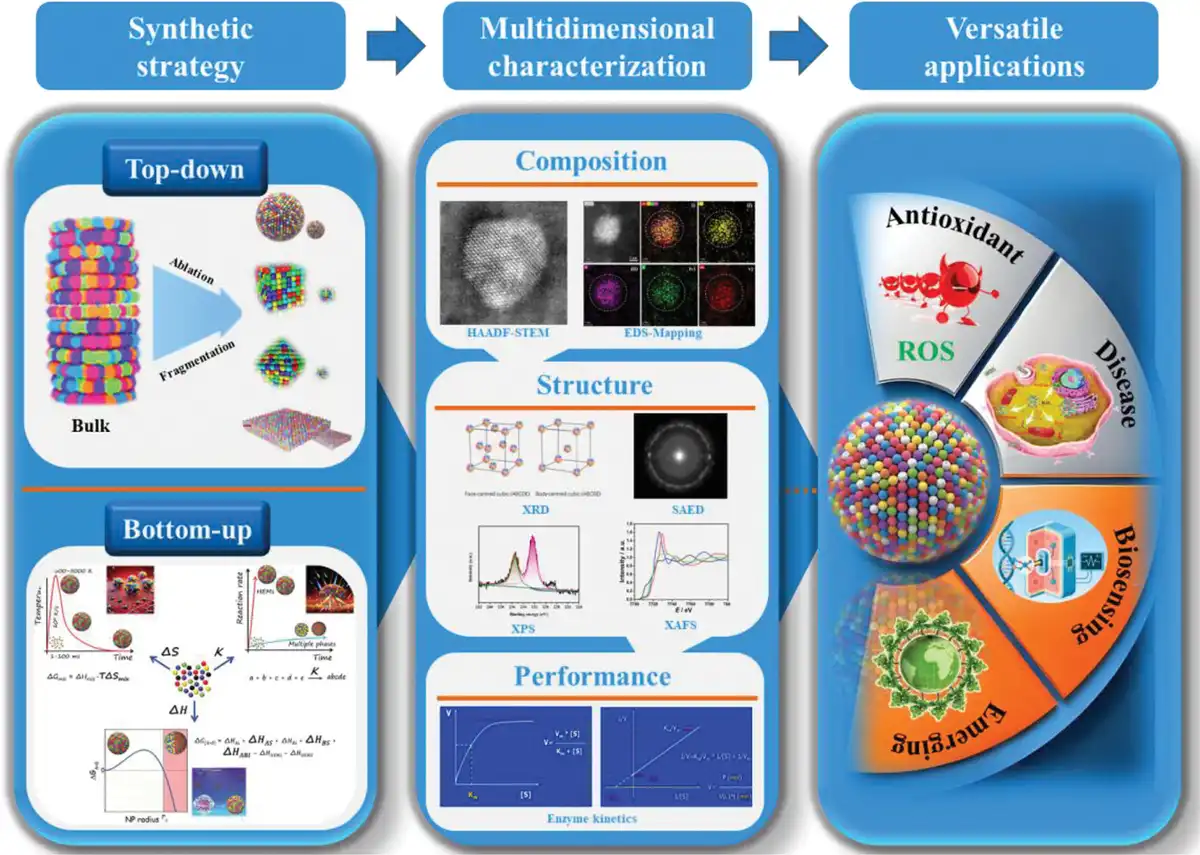
To date, HEAzymes have been developed to effectively mimic natural enzymatic activities, such as peroxidase (POD) and superoxide dismutase (SOD). Their high-entropy framework not only provides exceptional structural stability but also serves as a versatile platform for fine-tuning catalytic performance through compositional design. Owing to these advantageous properties, HEAzymes have shown considerable promise across diverse fields, including tumor immunotherapy, anti-inflammatory tissue regeneration, pathogen and biomarker detection, and environmental pollutant degradation. Considering these advances, this perspective reviews recent progress in the synthesis methods, characterization techniques, and practical applications of HEAzymes (Figure 1).
Figure 1.
Synthesis, characterization, and applications of HEAzymes.
2. Synthetic methods for HEAzymes
The investigation of synthesis methods for HEAzymes serves as a fundamental prerequisite and a critical pathway for technological advancement in this field. The synthesis is broadly classified into “top-down” and “bottom-up” approaches. Top-down methods start with bulk high-entropy materials and break them down into nanostructures using physical or chemical energy, offering the advantage of relatively simple processes[7]. In contrast, bottom-up methods construct nanoparticles from molecular precursors via chemical reactions, which more readily yield well-dispersed isolated particles and allow for fine control over size, shape, composition, and crystal structure[8]. In this subsection, the top-down and bottom-up synthesis methods for HEAzymes are summarized.
2.1 Top-down methods
The top-down synthesis pathway primarily involves the physical or chemical “fragmentation” of bulk materials. Among the prevalent top-down physical fabrication techniques, each method exhibits distinct characteristics and inherent limitations[9]. Ball milling accomplishes alloying and grain refinement via high-energy mechanical collisions, valued for its operational simplicity, yet it offers inadequate control over final particle size and morphology. Dealloying produces porous nanoframes through the selective dissolution of specific elements from a precursor alloy, although precise tailoring of porosity and composition remains challenging. Arc or spark discharge employs an electrode evaporation–condensation mechanism to rapidly synthesize nanoparticles with tunable compositions; however, the resulting particles generally exhibit large dimensions and a broad size distribution. Laser ablation utilizes ultrashort pulses to irradiate a target, enabling the generation of ultrafine particles, but its scalability is hindered by low yield and substantial equipment costs. Sputter deposition achieves atomic deposition onto a substrate through ion bombardment, allowing precise control over composition and dimensions, yet it necessitates a vacuum environment and seldom yields well-dispersed, isolated nanoparticles directly. In summary, top-down approaches often lack the precision required to control the size, morphology, and surface properties of isolated nanoparticles, frequently leading to agglomerated nanocrystalline grains or bulk structural powders.
2.2 Bottom-up methods
The bottom-up strategy starts from precursors such as metal salts or complexes, enabling precise control through the chemical “self-assembly” of nanoparticles in solution or gas phases[10]. The carbothermal shock method fixes the high-entropy phase via millisecond-level Joule heating and rapid quenching, producing small particles around 5 nm but requiring a conductive substrate. The aerosol droplet method uses atomized droplets as microreactors for continuous pyrolysis, favoring scalability but typically yielding polycrystalline products. Sonication-assisted and microwave-assisted wet-chemical methods promote reduction and nucleation through cavitation effects or selective heating, respectively; they are operationally simple but may compromise particle uniformity. Electrodeposition achieves co-deposition of metal ions by modulating voltage, allowing precise compositional design but being limited to conductive substrates. Pyrolysis/calcination obtains supported particles in one step by high-temperature decomposition of precursor-support mixtures, albeit with high energy consumption and a tendency for sintering. Solvothermal/hydrothermal methods facilitate reduction and crystallization in a sealed, high-pressure environment, effectively tuning morphology and crystal phase, but the process cannot be interrupted once initiated. Colloidal chemical synthesis offers the most flexible and controllable pathway by precisely regulating nucleation and growth kinetics in solution, enabling the customized fabrication of nanoparticle size, morphology, composition, and even metastable structures.
Although the synthesis of HEAzymes has established 2 major strategic systems, it still faces challenges such as precise control, scalability, and sustainability. Future efforts should focus on developing hybrid synthesis and external-field regulation technologies to achieve atomic-level precision in fabrication, expanding new component systems involving nonprecious metals and defect engineering, and integrating machine learning for inverse design. Additionally, advancing continuous green processes and in situ monitoring will facilitate the transition toward a new stage of customizable, high-performance rational manufacturing, thereby supporting their broad applications.
3. Characterization methods for HEAzymes
Following the synthesis of HEAzymes, comprehensive characterization of their physicochemical properties is essential to confirm whether they satisfy the structural and compositional criteria for classification as HEAzymes. The validation of a synthesized nanomaterial as a HEAzyme depends on systematic verification of its composition, phase structure, elemental distribution, and relevant functional properties. The core validation criteria are as follows: (1) compositionally, the material must contain at least 5 principal metallic elements, each with an atomic percentage ranging from 5% to 35%; (2) structurally, it should form a single solid-solution phase; and (3) in terms of elemental distribution, homogeneous mixing at the nanoscale without significant phase segregation should be achieved[11]. This section reviews the analytical methods and corresponding evidence used to verify these criteria.
3.1 Compositional characterization
Compositional characterization aims to verify the multiprincipal-element, near-equi-atomic composition of the material[12]. Bulk analysis techniques (e.g., ICP-MS, AES) provide the average chemical composition, while microscale analysis (e.g., point, line, and area scans via SEM/TEM-EDS) reveals local compositional information. Among these, High-Angle Annular Dark-Field Scanning Transmission Electron Microscope coupled with EDS mapping allows for the intuitive confirmation of elemental homogeneity at the nanoscale. For ultimate resolution, atom probe tomography can resolve 3D elemental distributions at the atomic scale, serving as a definitive technique for assessing the randomness of the solid solution.
3.2 Structural characterization
The core objective of structural characterization is to verify the single-phase solid solution and the “high-entropy effect” at the crystallographic level[13]. Key methods include XRD for determining the single-phase crystal structure, where significant peak broadening serves as direct evidence of lattice distortion; electron diffraction and HRTEM for confirming the single-phase nature at the microscale and for observing distortions and defects; synchrotron radiation/neutron diffraction for precise analysis of atomic occupancy and local structural distortions; and APT for identifying short-range order at the atomic scale. Collectively, these analyses elucidate the essential features of HEAzymes: a single-phase solid solution and severe lattice distortion.
3.3 Performance characterization
Performance characterization provides corroborating evidence for the high-entropy nature by evaluating the material’s unique functional profile, primarily covering 2 aspects: Catalytic Performance, assessed through enzyme-like kinetics, multienzymatic activity profiling, and electrochemical tests to verify the “cocktail effect” and enhanced activity; and Stability and Durability, evaluated via thermal analysis, exposure tests under extreme conditions (pH/salinity), and cycling experiments to reveal the sluggish diffusion effect and structural robustness. Performance characterization serves as the crucial link connecting compositional and structural features to ultimate application value[14].
Although the current characterization system for HEAzymes is relatively comprehensive, it must evolve to meet the increasingly complex demands of material design and application. Future efforts should focus on establishing an integrated characterization paradigm that is multiscale, multimodal, dynamic, and in situ. This includes, for example, integrating multisource data with machine learning to construct quantitative structure–activity relationship maps; developing real-time, operation-condition dynamic characterization techniques; establishing standardized evaluation systems tailored to different application scenarios; and promoting the construction of high-throughput automated characterization platforms. These advances will deepen scientific understanding and accelerate the translation of materials into practical applications.
4. Application progress of HEAzymes
As shown in Table 1, the development of nanozymes exhibits a progression from conventional materials to rationally designed systems. Conventional nanozymes, relying on intrinsic material properties, remain the mainstream for applications. Single-atom nanozymes, featuring atomically dispersed active sites, provide exceptional efficiency and well-defined structures for mechanistic exploration. Representing an emerging paradigm, HEAzymes leverage multielement synergy and AI-driven design to achieve unprecedented compositional tunability, advancing on a complementary trajectory to single-atom nanozymes. These characteristics provide a versatile platform for diverse applications[15]. To enable scientists in related fields to more rapidly understand and utilize HEAzymes, thereby promoting advancements in this area, this section briefly discusses their progress in antioxidant therapy, disease treatment, biosensing, and other emerging fields.
Table 1
The core feature, design, advantages, challenges, and relationship of HEAzymes with other nanozymes.
| Feature dimension | Conventional nanozymes | SAzymes | HEAzymes |
|---|---|---|---|
| Core Feature | Intrinsic catalytic activity of the material, relying on surface chemistry. | Atomically dispersed metal active centers, maximizing atomic utilization. | Multiprincipal-element (≥5) mixing in near-equi-atomic ratios, pursuing a synergistic “cocktail effect.” |
| Design | Initially driven by empirical discovery and screening. | Rational design, precisely tailoring the coordination environment of metal centers to mimic natural enzymes. | High-throughput exploration of complex compositional space, utilizing AI and robotics for multiobjective optimization. |
| Advantages | Relatively simple preparation; well-studied catalytic mechanisms. | High catalytic efficiency; well-defined structure; facilitates mechanistic studies. | Infinitely tunable composition and properties; potential to surpass single-component materials. |
| Challenges | Low-active site density; catalytic efficiency and selectivity often inferior to natural enzymes. | Difficult synthesis; challenges with stability under high temperatures or harsh environments. | Complex synthesis control; extremely intricate structure–property relationships; reliant on advanced algorithms for design. |
| Relationship | The dominant material system in current applied research. | An exemplary achievement of the rational design paradigm, not a replacement for the former. | A future-oriented new material system, developing in parallel with single-atom nanozymes. |
HEAzymes, high-entropy nanozymes; SAzymes, single-atom nanozymes.
4.1 Antioxidant
HEAzymes show significant potential in antioxidative research due to multielement synergy and tunable electronic structures. They can mimic natural antioxidant enzymes (e.g., SOD, CAT, GPX) to efficiently scavenge ROS/RNS and regulate oxidative stress pathways such as ferroptosis[16]. Through defect engineering or doping, their catalytic activity and electron transfer can be precisely modulated, enabling synergistic or dynamically switchable antioxidant functions. This programmability offers a powerful platform for intervening in oxidative stress-related diseases.
4.2 Disease treatment
HEAzymes leverage their unique structural advantages to outperform conventional nanozymes. For anti-infection therapy, enhanced POD-like activity converts endogenous H2O2 into toxic radicals, improving bactericidal efficiency. In chronic wound healing, their multienzyme mimicry clears diverse ROS, breaking the oxidative stress cycle and accelerating tissue repair when integrated with biomaterials[17]. In oncology, they respond to the tumor microenvironment, inducing synergistic cell death via mechanisms like Cu proptosis. Surface modification enables targeted delivery, advancing precision therapy. For neurological inflammation, they block the oxidative-inflammatory cascade by regulating pyroptosis, highlighting their role as a transformative platform for next-generation intelligent therapeutics.
4.3 Biosensing
HEAzymes offer unique value in biosensing by combining the stability and functional of nanomaterials with enhanced catalytic properties. They overcome natural enzyme limitations and enable high-performance, multifunctional sensing platforms. Key advances include: combined detection and degradation of environmental pollutants; enhanced sensitivity in portable diagnostics; discriminative multi-biomarker detection; and logic-gate controlled specific imaging[18]. Despite challenges in efficiency, mechanism, and standardization, their advantages in stability, signal amplification, and intelligent detection chart a promising path for next-generation biosensing technologies.
4.4 Other emerging areas
In emerging fields, HEAzymes provide novel tools for regulating complex biochemical processes through multienzyme mimicry. Their stability under extreme conditions supports applications in environmental biotechnology, deep-sea, and space exploration. Tunable catalytic activity enables smart responses to specific microenvironments, advancing precision medicine and drug delivery. In green technology, multielement synergy enhances catalytic efficiency and reduces energy consumption, paving the way for sustainable manufacturing and chemical processes[19,20].
5. Future research prospects
The field of nanozymes was inaugurated in 2007, and its formal establishment as an independent, interdisciplinary discipline, nanozymology, was marked by the publication of the seminal treatise “Nanozymology” in 2020. The concept of HEAzymes was first proposed in 2023. The strategic importance of this field has been further emphasized by the World Economic Forum, which included nanozymes in its 2025 list of “Top Ten Emerging Technologies.”
Despite the rapid progress in recent years, research on HEAzymes remains in its early stages and faces several critical challenges. Key limitations include synthetic difficulties, such as limited controllability and scalability; catalytic performance that still falls short of natural enzymes in terms of activity and selectivity; and an incomplete mechanistic understanding of phenomena such as the “cocktail effect” and its role in synergistic catalysis. The absence of standardized evaluation protocols further hinders progress. A paradigm shift from empirical exploration to rational design is now underway. This new approach integrates artificial intelligence and high-throughput screening for predictive design, employs advanced synthesis techniques to improve uniformity, and utilizes in situ characterization coupled with machine learning to elucidate dynamic catalytic mechanisms. Performance assessment must also evolve from simple activity tests to multidimensional evaluation using advanced biological models like organoids and organ-on-a-chip. Future translation of this technology depends on establishing universal standards, exploring novel material systems via microfluidics for high-throughput platforms, engineering HEAzymes for enhanced selectivity and biosafety, and expanding their applications in biomedicine and environmental catalysis. Ultimately, the development of “digital platforms” for fostering of deep interdisciplinary collaboration will be crucial to bridge the gap between foundational research and practical applications[21].
Acknowledgements
This work was financially supported by the National Natural Science Foundation of China (Grant Nos. 82574366, 22304099, and 82304442), the National Key R&D Program of China (Grant Nos. 2023YFC3504401 and 2022YFA1103403), Chinese Academy of Medical Sciences Innovation Fund for Medical Sciences (Grant Nos. 2024-I2M-3-013 and 2023-I2M-2-001), Beijing Natural Science Foundation (Grant Nos. L256002), Beijing Outstanding Young Scientist Program (Grant No. JWZQ20240101019), Young Elite Scientist Sponsorship Program of the Beijing Association for Science and Technology (Grant Nos. BYESS2023166 and BYESS2024140), State Key Laboratory of Respiratory Health and Multimorbidity Special Fund (Grant No. 2060204), and China Postdoctoral Science Foundation Funded Project (Grant Nos. 2023T160372, 2022M711779, and BX20220160).
Conflicts of interests
The authors declare that they have no conflicts of interest.
Data availability statement
The data that support the findings of this study are available from the corresponding author upon reasonable request.
Author contributions
Meng-Qi He and Yuting Gong designed the structure and wrote the manuscript with inputs from all authors. Ran Wang, Ping Liu, Bing Fang, Yixuan Li and Pengjie Wang investigation, project administration, resources. Hong-bin Sun, Huiyuan Guo, Qionglin Liang, Fazheng Ren, and Yongjian Ai revised the manuscript, funding acquisition, conceptualization, and supervision. The manuscript was written through contributions of all authors. All authors have given approval to the final version of the manuscript.
References
- [1] Zhang R, Jiang B, Fan K, et al. Designing nanozymes for in vivo applications. Nat Rev Bioeng. 2024;2:849–868.
- [2] Zhang Y, Wei G, Liu W, et al. Nanozymes for nanohealthcare. Nat Rev Method Primer. 2024;4:36.
- [3] Ai Y, Hu Z, Liang X, et al. Recent advances in nanozymes: from matters to bioapplications. Adv Funct Mater. 2022; 32: 2110432.
- [4] Sun Y, Dai S. Synthesis of high-entropy materials. Nat Synth. 2024;3:1457–1470.
- [5] Luo M, Xie Z, Li H, et al. Physics-informed, dual-objective optimization of high-entropy-alloy nanozymes by a robotic AI chemist. Matter. 2025;8:102009.
- [6] Ai Y, He M, Sun H, et al. Ultra-small high-entropy alloy nanoparticles: efficient nanozyme for enhancing tumor photothermal therapy. Adv Mater. 2023; 35: 2302335.
- [7] Kar N, Skrabalak SE. Synthetic methods for high-entropy nanomaterials. Nat Rev Mater. 2025;10:638–653.
- [8] He M, Ai Y, Hu W, et al. Recent advances of seed-mediated growth of metal nanoparticles: from growth to applications. Adv Mater. 2023;35:2211915.
- [9] Cao G, Liang J, Guo Z, et al. Liquid metal for high-entropy alloy nanoparticles synthesis. Nature. 2023;619:73–77.
- [10] Yao Y, Huang Z, Xie P, et al. Carbothermal shock synthesis of high-entropy-alloy nanoparticles. Science. 2018;359:1489–1494.
- [11] Ai Y, Wang Z, Shi W, et al. Atomic-level high-entropy nanozymes enable remarkable endogenous targeted catalysis and enhancing tumor photothermal therapy. Adv Mater. 2025;37:2502322.
- [12] Yang L, He R, Chai J, et al. Synthesis strategies for high entropy nanoparticles. Adv Mater. 2025; 37: 2412337.
- [13] Moniri S, Yang Y, Ding J, et al. Three-dimensional atomic structure and local chemical order of medium- and high-entropy nanoalloys. Nature. 2023;624:564–569.
- [14] Feng J, Yang X, Du T, et al. Transition metal high-entropy nanozyme: multi-site orbital coupling modulated high-efficiency peroxidase mimics. Adv Sci. 2023;10:e2303078.
- [15] Xue P, Chang Y, Wang C, et al. High-entropy antibacterial materials. MedMat. 2025:10.1097/mm9.0000000000000026.
- [16] Ding C, Min J, Tan Y, et al. Combating atherosclerosis with chirality/phase dual-engineered nanozyme featuring microenvironment-programmed senolytic and senomorphic actions. Adv Mater. 2024;36:2401361.
- [17] Li D, Ha E, Zhu Y, et al. Alternating current pre-treatment enhances multi-enzymatic activity of high-entropy alloy nanozymes that regulate metabolism for effective tumor immunotherapy. Nat Commun. 2025;16:11542.
- [18] Lin H, Ke L, Wang S, et al. DFT-guided design of a multi-enzyme mimetic high-entropy nanozyme for cascaded glutathione detection and point-of-care testing. Adv Sci. 2025;13:e15765.
- [19] Wang C, Yuan F, Yan Z, et al. High entropy 2D layered double hydroxide nanosheet toward cascaded nanozyme-initiated chemodynamic and immune synergistic therapy. J Am Chem Soc. 2025;147:136–148.
- [20] Du Y, He Z, Chen C, et al. Pathogenesis-guided nanozymes: from design to therapy for gastrointestinal inflammation. MedMat. 2025.
- [21] Yao Y, Dong Q, Brozena A, et al. High-entropy nanoparticles: synthesis-structure property relationships and data-driven discovery. Science. 2022;376:eabn3103.
This article is available under Open Access.
© 2026 The Authors