Artificial intelligence empowering innovative research and development in medical materials: prospects from model algorithm breakthroughs to precision transformation
Authors
Kun Lu*, Qunbo Ying, Yong Dai, Qiang Yan, Shutong Wang, Yalin Wang, Feilong Wang, Gaoxiang Huang, Tao Wang, Fengyan Chen, Xuxiu Tao, Pingping Wang, Qian Fan, Chenyin Lin, Songtao Li*, Xiang Liu*
- aClinical Research Center, The 924th Hospital of the Chinese People’s Liberation fl Army Joint Logistic Support Force, Guilin, Guangxi, China
- bWuhan Eastlake University, Wuhan, Hubei, China.
* Correspondence: Address: Kun Lu, Clinical Research Center, The 924th Hospital of the Chinese People’s Liberation Army Joint Logistic Support Force, Guilin 541000, China. Email: 18818260520@139.com (K. Lu); Songtao Li, Clinical Research Center, The 924th Hospital of the Chinese People’s Liberation Army Joint Logistic Support Force, Guilin 541000, China. Email: thoughtli@sina.com (S. Li); Xiang Liu, The 924th Hospital of the Chinese People’s Liberation Army Joint Logistic Support Force, Guilin 541000, China. Email: 450186499@qq.com (X. Liu). Kun Lu and Qunbo Ying contributed equally to this work and should be considered co-first authors.
MedMat · 2026 · Vol. 3 · No. 1 · pp. 46-55
Abstract
Traditional medical material development relies on trial-and-error experimentation and lengthy clinical trials, resulting in prolonged cycles, high costs, and limited success rates. This model not only severely hampers research and development efficiency but also struggles to rapidly address the urgent demand for new materials in the medical field. Artificial intelligence (AI) technology, by integrating multimodal data with advanced algorithms, is breaking through this bottleneck. This paper systematically reviews the application progress of AI across the entire medical material development chain, focusing on 3 core scenarios: “AI-driven molecular material design,” “biocompatibility prediction,” and “personalized material customization.” Through comparative analysis of differences in technical approaches and methodological frameworks among global research groups, it deeply elucidates the key challenges currently facing the field and offers forward-looking perspectives. “biocompatibility prediction,” and “personalized material customization.” By comparing and analyzing differences in technical approaches and methodological frameworks among global research groups, it deeply elucidates key challenges in the field and prospectively outlines future directions for the convergence of AI and medical materials. This aims to provide a systematic framework for innovative development in medical materials.
Translations
Long abstracts in additional languages. The English article is the version of record.
中文zh-Hans
传统医疗材料的研发模式长期依赖试错性实验与漫长的临床试验周期,导致研发效率低下、成本高昂且成功率有限。这种滞后机制不仅严重阻碍了科研进程,更难以迅速响应医学领域对新型生物材料日益迫切的需求。本文旨在系统性地综述人工智能技术在突破这一瓶颈中的应用进展,通过整合多模态数据与先进算法,探索从分子设计到临床转化的全链条创新路径。文章聚焦于“AI驱动的材料分子设计”、“生物相容性预测”及“个性化材料定制”三大核心场景,试图构建一个能够指导未来医疗材料创新的系统性框架,以解决当前研发模式中的关键痛点。
本研究采用综述与比较分析相结合的方法论,深入梳理了全球主要研究团队在人工智能赋能医疗材料领域的技术路径与方法学差异。文章并未进行新的实验操作,而是对现有文献进行了深度合成,重点剖析了不同算法模型在处理复杂生物数据时的优劣对比。通过系统性地归纳“AI驱动分子设计”中的生成式模型应用、“生物相容性预测”中的数据整合策略以及“个性化定制”中的患者特异性参数匹配机制,本文详细阐述了各技术环节的方法论框架。这种跨团队、多视角的对比分析旨在揭示当前主流技术在处理材料结构-性能关系时的具体实现方式及其局限性。
综述发现,人工智能通过融合多模态数据与高级算法,正在重塑医疗材料的研发范式。在分子设计层面,AI模型显著提升了新材料发现的效率;在生物相容性预测方面,基于大数据的机器学习方法展现出比传统实验更快速的筛选能力;而在个性化定制领域,精准匹配患者生理特征的材料生成策略初具雏形。然而,分析也深刻揭示了当前面临的挑战:全球各研究组在技术路线上存在显著差异,数据标准化程度不足以及算法可解释性欠缺仍是制约行业发展的关键瓶颈。这些发现表明,尽管AI展现出巨大潜力,但其在复杂生物环境中的实际转化仍面临诸多科学不确定性。
本文提出的系统性框架为医疗材料的创新开发提供了重要的理论指导与方向指引,强调了人工智能与传统材料科学的深度融合是未来突破的关键。文章明确指出,当前领域在数据共享、算法标准化及临床验证机制方面仍存在显著局限性,亟需建立统一的评估标准以推动技术落地。展望未来,随着多模态数据的进一步丰富和算法模型的持续迭代,AI与医疗材料的融合将向更高精度的转化医学迈进。本文呼吁全球科研界加强合作,共同攻克上述挑战,以实现从模型突破到精准转化的全面跨越,最终满足临床对新型高效生物材料的迫切需求。
Françaisfr
Le développement traditionnel des matériaux médicaux repose largement sur l'expérimentation par essais et erreurs ainsi que sur des essais cliniques de longue durée, entraînant des cycles prolongés, des coûts élevés et un taux de réussite limité. Ce modèle entrave sévèrement l'efficacité de la recherche et du développement tout en peinant à répondre rapidement aux demandes urgentes de nouveaux matériaux dans le domaine médical. L'intelligence artificielle (IA), en intégrant des données multimodales avec des algorithmes avancés, est en train de briser ce goulot d'étranglement. Cet article vise à examiner systématiquement les progrès de l'application de l'IA tout au long de la chaîne de développement des matériaux médicaux, en se concentrant sur trois scénarios clés : « conception moléculaire de matériaux pilotée par IA », « prédiction de biocompatibilité » et « personnalisation de matériaux ». L'objectif est d'établir un cadre systématique pour le développement innovant dans ce domaine.
Cette revue adopte une approche méthodologique comparative, synthétisant les travaux de groupes de recherche mondiaux pour analyser leurs différences en termes d'approches techniques et de cadres méthodologiques. Plutôt que de présenter des expériences nouvelles, l'étude se concentre sur la synthèse critique des stratégies existantes dans trois domaines centraux : l'utilisation de modèles génératifs pour la conception moléculaire, les algorithmes prédictifs basés sur le big data pour évaluer la biocompatibilité et les systèmes d'adaptation personnalisée tenant compte des spécificités du patient. L'article détaille comment ces différentes équipes abordent la relation structure-propriété des matériaux via l'intégration de données multimodales, offrant ainsi une vue d'ensemble nuancée des cadres techniques actuels utilisés pour surmonter les limites des méthodes traditionnelles.
Les résultats principaux indiquent que l'intelligence artificielle permet désormais de transformer radicalement le processus de découverte et de développement des matériaux médicaux. L'analyse révèle que les approches basées sur l'IA surpassent souvent les méthodes empiriques en termes d'efficacité pour la conception moléculaire et la prédiction rapide de la biocompatibilité, tout en ouvrant la voie à une personnalisation précise adaptée aux besoins cliniques individuels. Cependant, le texte met également en lumière des défis majeurs : il existe des disparités significatives dans les approches techniques entre les groupes mondiaux, soulignant un manque d'harmonisation et de standardisation des données qui freine l'avancée collective du domaine.
La signification de cette étude réside dans la proposition d'un cadre systématique pour guider le développement innovant des matériaux médicaux à travers une convergence plus profonde entre l'intelligence artificielle et les sciences des matériaux. Les limitations actuelles, notamment en matière de données non standardisées et de manque d'interprétabilité des algorithmes, sont clairement identifiées comme des obstacles critiques nécessitant une attention urgente. À l'avenir, la recherche devra se concentrer sur le renforcement de ces cadres méthodologiques pour faciliter la transition vers une transformation précise dans les applications cliniques. En conclusion, cet article esquisse des perspectives prospectives où la convergence réussie de l'IA et des matériaux médicaux pourrait répondre aux besoins non satisfaits du secteur médical grâce à un développement plus rapide et plus efficace.
Españoles
El desarrollo tradicional de materiales médicos depende en gran medida de la experimentación por ensayo y error, así como de ensayos clínicos prolongados, lo que resulta en ciclos largos, costos elevados y tasas de éxito limitadas. Este modelo no solo obstaculiza severamente la eficiencia de la investigación y el desarrollo, sino que también lucha para abordar rápidamente las demandas urgentes de nuevos materiales en el campo médico. La tecnología de inteligencia artificial (IA), al integrar datos multimodales con algoritmos avanzados, está rompiendo este cuello de botella. Este artículo revisa sistemáticamente los avances en la aplicación de IA a lo largo de toda la cadena de desarrollo de materiales médicos, centrándose en tres escenarios clave: «diseño molecular de materiales impulsado por IA», «predicción de biocompatibilidad» y «personalización de materiales». El objetivo es proporcionar un marco sistemático para el desarrollo innovador.
Este estudio emplea una metodología de revisión comparativa, sintetizando los trabajos de grupos de investigación globales para analizar sus diferencias en enfoques técnicos y marcos metodológicos. En lugar de presentar nuevos experimentos, la obra se centra en la síntesis crítica de estrategias existentes en tres áreas centrales: el uso de modelos generativos para el diseño molecular, métodos basados en big data para evaluar la biocompatibilidad y sistemas de adaptación personalizada que consideran las especificidades del paciente. El artículo detalla cómo estos diferentes equipos abordan la relación estructura-propiedad de los materiales mediante la integración de datos multimodales, ofreciendo una visión general matizada de los marcos técnicos actuales utilizados para superar las limitaciones de los métodos tradicionales.
Los hallazgos principales indican que la inteligencia artificial está permitiendo transformar radicalmente el proceso de descubrimiento y desarrollo de materiales médicos. El análisis revela que los enfoques basados en IA a menudo superan a los métodos empíricos en términos de eficiencia para el diseño molecular y la predicción rápida de biocompatibilidad, abriendo camino hacia una personalización precisa adaptada a las necesidades clínicas individuales. Sin embargo, el texto también destaca desafíos mayores: existen disparidades significativas en los enfoques técnicos entre grupos globales, señalando una falta de armonización y estandarización de datos que frena el avance colectivo del campo.
La importancia de este estudio radica en la propuesta de un marco sistemático para guiar el desarrollo innovador de materiales médicos a través de una convergencia más profunda entre la inteligencia artificial y las ciencias de los materiales. Las limitaciones actuales, particularmente en cuanto a datos no estandarizados y falta de interpretabilidad algorítmica, se identifican claramente como obstáculos críticos que requieren atención urgente. En el futuro, la investigación deberá centrarse en fortalecer estos marcos metodológicos para facilitar la transición hacia una transformación precisa en aplicaciones clínicas. En conclusión, este artículo esboza perspectivas prospectivas donde la convergencia exitosa de IA y materiales médicos podría satisfacer las necesidades insatisfechas del sector médico gracias a un desarrollo más rápido y eficiente.
日本語ja
従来の医療材料の開発は、試行錯誤的な実験と長期にわたる臨床試験に依存しており、その結果として開発サイクルの長期化、高コストおよび限られた成功率という課題が生じています。このモデルは研究開発効率を著しく阻害するだけでなく、医学分野における新規材料への切実な需要に対して迅速に対応することが困難です。人工知能(AI)技術は、多様なデータを統合し高度なアルゴリズムを活用することで、このボトルネックを打破しつつあります。本稿では、医療材料の開発チェーン全体にわたるAIの応用進展を体系的にレビューするとともに、「AI駆動型分子材料設計」、「生体適合性予測」、および「個別化された材料のカスタマイズ」という3つの主要なシナリオに焦点を当てています。
本研究は、世界の各研究グループ間における技術的アプローチと方法論的枠組みの相違点に関する比較分析を通じて、AIが医療材料開発においてどのように機能しているかを解明するレビュー形式を採用しています。具体的な実験や数値データの提示ではなく、既存の研究知見を統合・合成し、分子設計段階での生成モデルの利用、生体適合性評価におけるデータ駆動型手法の適用、および患者固有パラメータに基づくカスタマイズ戦略の実装方法について詳細に論じています。このアプローチにより、異なる研究グループがどのように多様データを処理し、材料構造と性能の関係性を解明しようとしているのかという方法的な枠組みを明確にしています。
主要な知見として、AI技術の統合によって医療材料の開発パラダイムが変容しつつあることが示されました。分子設計においては発見効率の向上、生体適合性予測では従来の実験手法よりも迅速なスクリーニング能力、個別化カスタマイズ領域では患者特性に合わせた精密なマッチングの可能性などが確認されています。しかし同時に、分野全体が直面している重要な課題も深く解明されており、特にグローバルな研究グループ間での技術的アプローチの顕著な差異やデータ標準化の不備、アルゴリズムの解釈可能性の欠如といった点が開発を阻むボトルネックとして浮き彫りになっています。
本稿で提示された体系的枠組みは、医療材料における革新的な開発のための指針となり、AIと材料科学の融合が未来突破のカギであることを強調しています。現在の分野にはデータ共有やアルゴリズム標準化、臨床検証メカニズムに関する顕著な限界が存在し、技術の実用化を推進するために統一された評価基準の確立が急務であると指摘されています。将来展望として、多様データの充実とモデルの継続的進化により、AIと医療材料の融合はより高精度な変換医学へと進展すると予測されます。本論文は、これらの課題に共同で取り組むよう国際的な研究コミュニティを呼びかけ、最終的に臨床における新型高効率生物材料への切実な需要に応えるための包括的な飛躍を目指しています。
العربيةar
يعتمد التطوير التقليدي للمواد الطبية بشكل كبير على التجريب بالخطأ والصواب، بالإضافة إلى فترات تجارب سريرية طويلة الأمد، مما يؤدي إلى دورات مطولة وتكاليف باهظة ومعدلات نجاح محدودة. هذا النموذج لا يعيق كفاءة البحث والتطوير فحسب، بل يواجه صعوبة في تلبية الطلب العاجل على مواد جديدة في المجال الطبي بسرعة. إن تكنولوجيا الذكاء الاصطناعي (AI)، من خلال دمج البيانات متعددة الوسائط مع الخوارزميات المتقدمة، تكسر هذه العقبة. يراجع هذا المقال بشكل منهجي التقدم المحرز في تطبيق الذكاء الاصطناعي عبر سلسلة تطوير المواد الطبية بأكملها، مع التركيز على ثلاثة سيناريوهات أساسية: «تصميم مواد جزيئية مدفوع بالذكاء الاصطناعي»، و«التنبؤ بالتوافق الحيوي»، و«التخصيص الشخصي للمواد». يهدف العمل إلى تقديم إطار منهجي للتطوير المبتكر في هذا المجال.
تعتمد هذه الدراسة على نهج تحليلي مقارن، حيث تقوم بتركيب أعمال مجموعات بحثية عالمية لتحليل الاختلافات في النهج التقنية والأطر المنهجية. بدلاً من عرض تجارب جديدة، يركز المقال على التركيب النقدي للاستراتيجيات الحالية في ثلاثة مجالات رئيسية: استخدام النماذج التوليدية لتصميم الجزيئات، والخوارزميات القائمة على البيانات الضخمة لتقييم التوافق الحيوي، وأنظمة التكيف المخصص التي تأخذ في الاعتبار الخصائص الفردية للمريض. يوضح المقال بالتفصيل كيف تتعامل هذه الفرق المختلفة مع علاقة بنية المواد وخصائصها من خلال دمج البيانات متعددة الوسائط، مما يوفر نظرة شاملة للأطر التقنية الحالية المستخدمة للتغلب على قيود الطرق التقليدية.
تُظهر النتائج الرئيسية أن تقنية الذكاء الاصطناعي تتيح الآن تحويل نموذج اكتشاف وتطوير المواد الطبية بشكل جذري. يكشف التحليل عن أن النهج القائمة على الذكاء الاصطناعي تتفوق غالبًا في الكفاءة لاكتشاف الجزيئات والتنبؤ السريع بالتوافق الحيوي مقارنة بالطرق التجريبية، مما يفتح الباب أمام تخصيص دقيق يتناسب مع الاحتياجات السريرية الفردية. ومع ذلك، يشير النص أيضًا إلى تحديات كبيرة: توجد اختلافات ملحوظة في النهج التقنية بين المجموعات البحثية العالمية، مما يشير إلى نقص في التوحيد القياسي للبيانات يعيق التقدم الجماعي للمجال.
تكمن أهمية هذه الدراسة في اقتراح إطار منهجي لتوجيه التطوير المبتكر للمواد الطبية من خلال تقارب أعمق بين الذكاء الاصطناعي وعلوم المواد. يتم تحديد القيود الحالية، لا سيما فيما يتعلق بغياب توحيد البيانات وقلة قابلية تفسير الخوارزميات، بوضوح كعوائق حرجة تتطلب اهتمامًا عاجلًا. في المستقبل، يجب أن يركز البحث على تعزيز هذه الأطر المنهجية لتسهيل الانتقال نحو تحويل دقيق في التطبيقات السريرية. وفي الختام، يرسم هذا المقال آفاقاً مستقبلية حيث يمكن للتقاطع الناجح بين الذكاء الاصطناعي والمواد الطبية تلبية الاحتياجات غير الملباة في القطاع الطبي بفضل تطوير أسرع وأكثر كفاءة.
Keywords
Full Text
1. Introduction
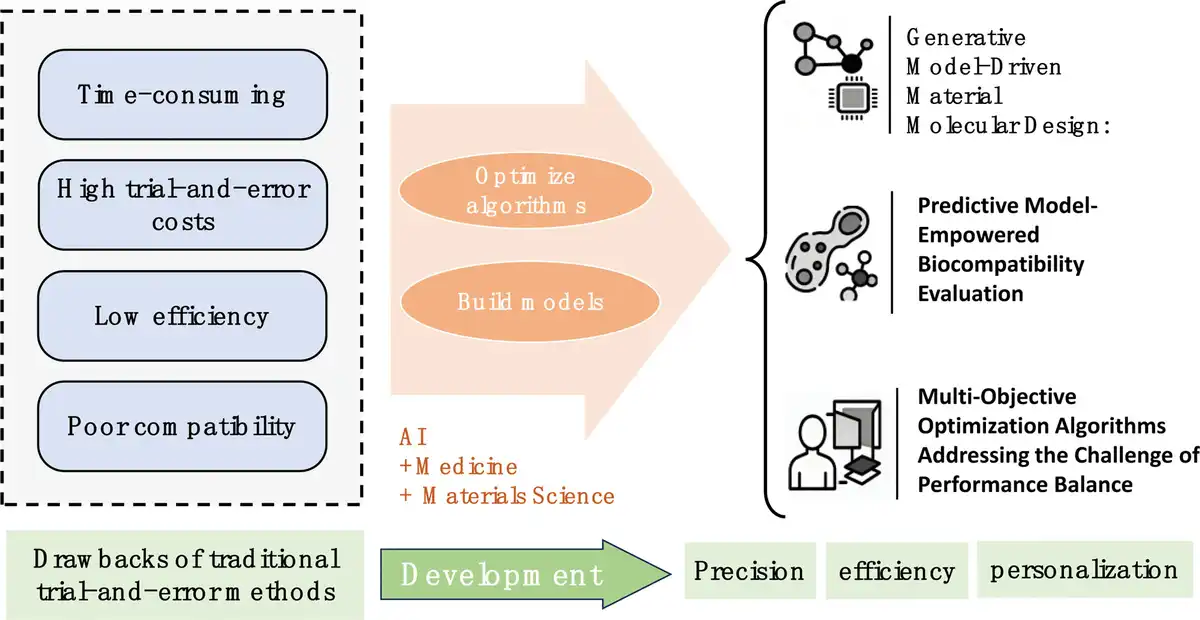
Medical materials serve as the fundamental substances in fields such as medical devices, tissue engineering, and drug delivery. They can be used for diagnosing, treating, repairing, or replacing diseased tissues and organs in living organisms, as well as enhancing physiological functions[1]. Their development must balance biocompatibility, functionality, and clinical applicability. Traditional research and development (R&D) models face inherent limitations, whereas artificial intelligence (AI) technology offers breakthrough solutions across the entire process—from molecular design to clinical translation. This article focuses on AI’s innovative applications in medical materials R&D, addressing traditional development challenges, and explores how it drives the field toward precision, efficiency, and personalization (Figure 1).
Figure 1.
Overview diagram of AI in medical material research and development.
2. Traditional models suffer from inherent limitations such as lengthy cycles and high failure rates
Conventional medical material R&D relies on trial-and-error driven “experiential development,” exhibiting 3 critical flaws[2]:
(1) Extremely lengthy R&D cycles: The average development period exceeds 10 years. The entire process—from molecular screening and performance testing to clinical validation—involves repeated experimental iterations, significantly prolonging the technology transfer pathway. This makes it difficult to meet the urgent clinical demand for new materials, and there is a lack of efficient predictive tools.
(2) Exorbitant overall costs: Trial-and-error expenses account for over 70% of total R&D investment. Approximately 90% of candidate materials ultimately fail due to critical issues like insufficient biocompatibility, subpar mechanical properties, or degradation rates incompatible with clinical requirements. These failures often stem from inadequate data-driven prediction of core material performance in early stages, resulting in substantial waste of human and material resources.
(3) Limited innovation scope: Traditional R&D approaches struggle to systematically uncover the complex interrelationships between a material’s molecular composition, microstructure, macroscopic properties, and in vivo biological responses. The process heavily relies on researchers’ accumulated experience, leading to blind exploration within the material chemistry space. This hinders breakthroughs beyond known material systems and prevents the efficient design of novel materials with multidimensional superior performance.
Consequently, core bottlenecks in traditional medical material R&D—including prolonged cycles, high costs, and difficulties in multiproperty synergistic optimization—have become critical barriers to innovation in the field, urgently requiring breakthroughs through efficient technological approaches.
3. Targeted optimization solutions and technical pathways via AI technology
Thus, AI—leveraging its core strengths in integrating multisource heterogeneous data, uncovering complex correlation patterns, enabling precise performance prediction, and achieving efficient multiobjective optimization—has emerged as the pivotal technological support for overcoming traditional medical material R&D bottlenecks and driving innovation in the field. The following sections will detail optimization solutions addressing core pain points through 3 core technical pathways: generation, prediction, and optimization (Table 1).
Table 1
Comparative analysis of the 3 core technologies.
| AI technology’s breakthrough value | Traditional pain points | Central principle or fundamental mechanism |
|---|---|---|
| Generation model (MatGAN, GNNs) | Long cycle, difficult to explore chemical space | Without relying on experimental trial and error, new material molecular structures with target properties can be directly generated through algorithms, compressing the “material design cycle” from years to weeks |
| Optimized algorithms (NSGA-II, Bayesian optimization) | Balancing multiple properties (such as mechanical, degradation, and compatibility) is difficult | Breaking through the limitations of “empirical trade-offs,” efficiently exploring the “multi-objective performance space” through algorithms, and precisely balancing multidimensional indicators such as biocompatibility, mechanical strength, and degradation rate |
| Prediction models (ImmunoMat, GAT, MD+AI) | Biocompatibility screening is inefficient | Replace traditional animal/in vitro experiments with a method that uses multiomics data and AI models to preidentify candidate materials with low biocompatibility and high immune risk, significantly reducing the failure rate from 90% |
AI, artificial intelligence; GAT, graph attention network; GNNs, graph neural networks; MatGAN, material generative adversarial network; MD, molecular dynamics; NSGA-II, nondominated sorting genetic algorithm.
3.1 Generative models driving molecular design in materials: efficiently overcoming bottlenecks in chemical space exploration
As a core AI technology (Table 1) driving materials innovation, generative models leverage deep learning algorithms[3] to uncover intrinsic correlations between material structures and properties. This enables a shift from empirical trial-and-error to rational design, offering a revolutionary pathway for efficiently exploring vast chemical spaces and precisely constructing novel medical materials.
Building upon massive material datasets, generative models learn latent distribution patterns of molecular structures through algorithmic learning. They can directly generate novel molecular structures with targeted properties. Their core advantage lies in eliminating reliance on traditional experimental trial-and-error, significantly enhancing the efficiency of chemical space exploration and the precision of material design.
Currently, the most mature generative models applied in medical material design fall into 2 categories: composite models like material generative adversarial network (MatGAN), which fuse variational autoencoders (VAE)[4] and generative adversarial networks (GAN)[5]; and graph neural networks (GNNs)[6], optimized for graph-structured data. Both models achieve efficient exploration of unknown chemical spaces by capturing the correlation between structural features and properties of material molecules. However, they complement each other in data processing approaches and applicable scenarios, jointly advancing medical material design toward intelligent and precise development. The following sections will detail the technical architecture, training logic, and typical applications of MatGAN and GNNs in medical material design.
3.1.1 MatGAN model: material molecular generation via VAE-GAN fusion
In recent years, deep learning models have garnered widespread attention across numerous fields due to their exceptional performance in classification and prediction tasks[7]. Among these, the “Material Generative Adversarial Network (MatGAN)” proposed by the Massachusetts Institute of Technology research team offers an innovative solution for medical material molecular design. This technology effectively integrates the technical strengths of both GANs and VAEs. By combining the limitations of either model, it demonstrates outstanding performance in polymeric medical material design, becoming a core tool for achieving precise generation of novel material molecular structures.
From a technical perspective, as a key branch of generative models, VAEs fundamentally uncover latent structural features within data. An encoder maps input material data into a low-dimensional latent space, from which Gaussian distributions are sampled. A decoder then reconstructs these sampled latent vectors into new data samples, providing the foundational framework for “generating” material molecular structures. GANs, conversely, accomplish their core task through 2 adversarial network models: the generator constructs novel material molecular structures, while the discriminator evaluates the consistency between generated structures and real material data. The dynamic adversarial optimization between these 2 components enhances the authenticity of generated samples. Taking biodegradable sutures as an example, the model design workflow diagram is as follows (Figure 2):
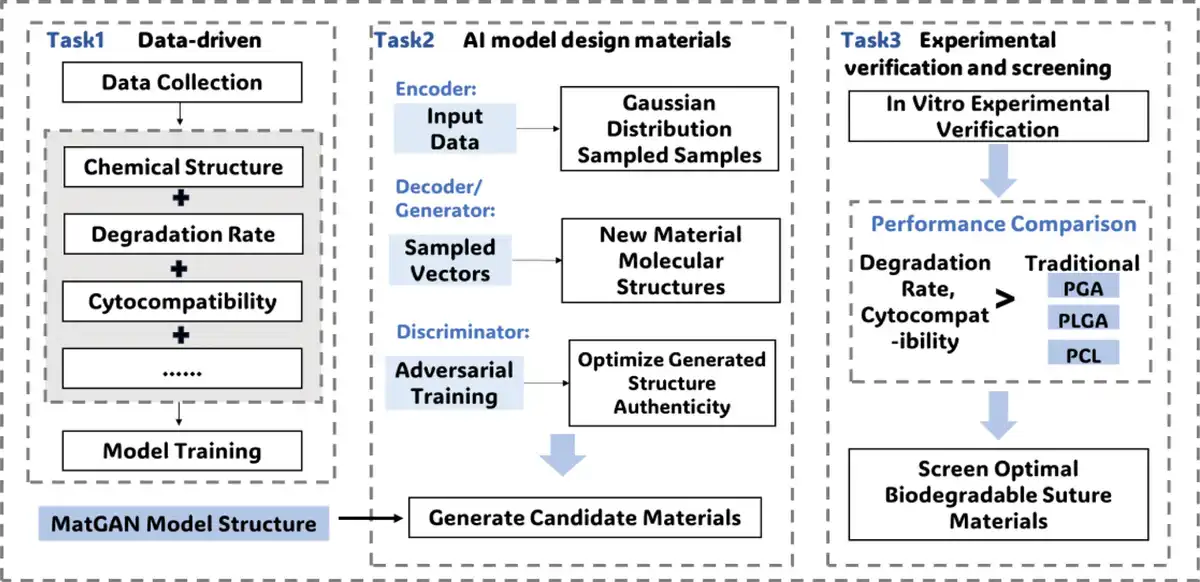
Figure 2.
MatGAN model design workflow for degradable sutures.
Although both VAE and GAN can be used independently for material data augmentation, each model has distinct limitations: VAE-generated samples often suffer from insufficient diversity, while GANs are prone to pattern collapse due to training instability. Therefore, MatGAN constructs a composite architecture by integrating VAE and GAN, incorporating the latent variables from VAE into the generation and discrimination processes of GAN. This approach retains VAE’s capability to extract latent features from material data while leveraging GAN’s adversarial training to enhance model convergence, ultimately achieving superior generation quality and performance.
During actual model training, researchers first collected multidimensional data on known biomedical polymers to construct a standardized training dataset. The training process involves the encoder converting input material structure data into low-dimensional latent vectors, while the decoder generates novel material molecular structures based on these vectors. Subsequently, the discriminator evaluates the similarity between generated structures and real data, enabling the model to progressively learn the intrinsic mapping between material structure and properties through iterative optimization.
In the design and application of biodegradable sutures, the MatGAN model has demonstrated significant practical value: It successfully generated 10 candidate materials. In vitro experiments confirmed that these novel materials exhibit significantly superior degradation rates and cellular compatibility compared to traditional suture materials such as poly(glycolic acid), poly(lactic-co-glycolic acid), and polycaprolactone (PCL)[8]. They also possess the mechanical strength and biosafety required for clinical applications, providing an efficient technological pathway for the innovative development of absorbable sutures.
3.1.2 GNNs model: graph structure-driven complex material design
Metal-organic frameworks (MOFs), as a novel class of organic-inorganic hybrid polymeric materials[9], feature structures assembled from metal ions and organic ligands. Their unique structural characteristics confer significant advantages: On 1 hand, they possess extremely high specific surface areas. On the other hand, they feature diverse pore structures and tunable chemical properties. These characteristics endow MOFs with immense application potential across multiple fields, including gas storage, adsorption, and separation, as well as drug delivery systems—an area of significant importance in medicine.
The crystal structure of MOFs inherently possesses graph-like properties, naturally representing a graph: each node corresponds to a fundamental building block of the MOF, while edges represent chemical bonds or intermolecular interactions between nodes. Both nodes and edges are assigned feature vectors containing physicochemical information. This structural representation aligns perfectly with the core strengths of GNNs in processing graph data, laying a crucial foundation for GNN applications in MOF design.
The key to GNNs’ efficient processing of MOF graph data lies in the message-passing mechanism of their graph convolutional layers: First, this mechanism performs weighted aggregation of a node’s own features and those of its neighbors, enabling dynamic updates to node representations. Subsequently, through the stacking of multiple graph convolutional layers, GNNs overcome local structural constraints to effectively capture long-range atomic interactions within MOF structures while precisely identifying complex structural patterns. Finally, a weighted sum operation is performed on the nodes themselves to integrate the global structural information of the MOFs[10].
In the practical design of MOFs as drug carriers, the technical advantages of GNNs are fully translated into tangible R&D efficiency: the research team used structural data of known MOFs and their corresponding drug loading capacities as training samples. Through model training, GNNs learned the intrinsic correlation between MOF structural features and drug loading capabilities. The trained model possesses 2 core functions. First, rapid prediction capability enables accurate forecasting of novel MOFs’ drug loading capacity without time-consuming experimental validation. Second, it enables reverse design capabilities, guiding MOF structural optimization based on predefined drug-loading target properties. For instance, in practical research, scientists can adjust pore sizes by modifying organic ligands or metal node types, while GNNs precisely predict how these changes affect drug-loading capacity, thereby aiding the design of MOFs with specific pore sizes and superior loading capabilities. The mechanism of GNN-based drug-loading prediction is illustrated in the figure below (Figure 3):
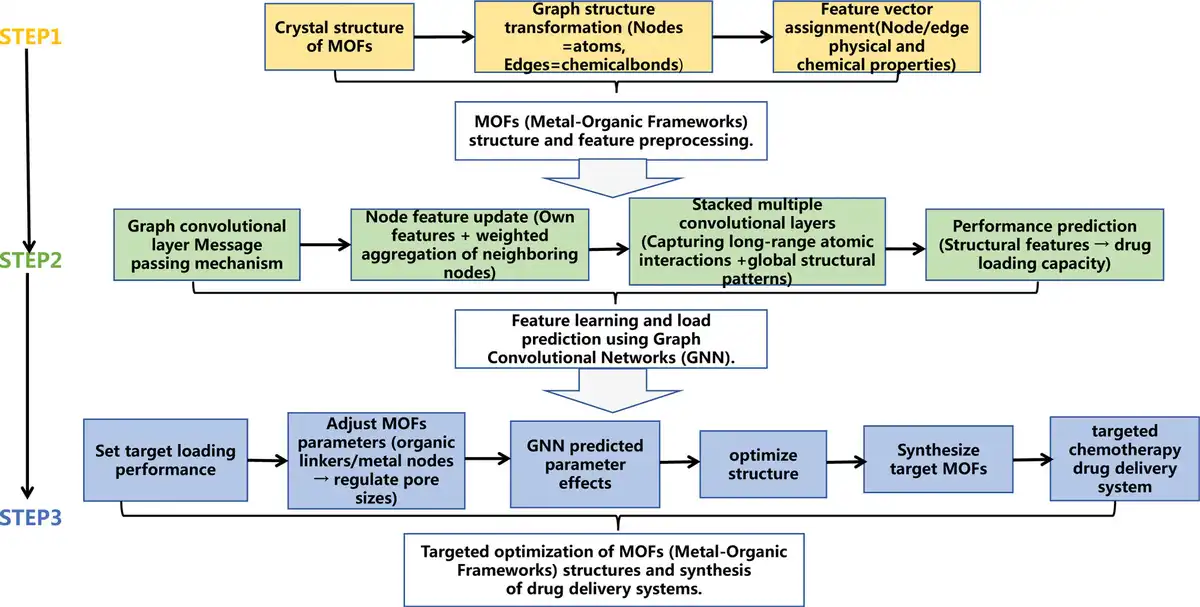
Figure 3.
Mechanism of GNN predicting drug loading.
These MOFs, optimized through GNN-based design, are subsequently synthesized in laboratories into actual materials. They are further utilized to construct highly efficient targeted chemotherapy drug delivery systems, with the ultimate goal of enhancing drug accumulation at tumor sites, thereby providing critical material support for precision cancer therapy.
3.1.3 Breakthrough value and application prospects of generative models
Through technical pathways like MatGAN and GNNs, generative models have achieved 3 core breakthroughs in medical material design: First, they compress the material design cycle from years to weeks, significantly boosting R&D efficiency; Second, they overcome traditional R&D reliance on known chemical spaces by algorithmically generating novel molecular structures, expanding the boundaries of medical material innovation; Third, they enable precise presetting of material properties, ensuring generated materials better align with clinical demands in aspects like biocompatibility and functional specificity. These breakthroughs not only effectively address core challenges in traditional medical material R&D—long cycles, high costs, and innovation constraints—but also provide systematic solutions for material innovation in critical fields such as biodegradable medical devices and efficient drug delivery systems. This propels medical material R&D into a new era of data-driven intelligence[11].
3.2 Predictive models empowering biocompatibility assessment: enabling high-throughput precision screening
Biocompatibility is a critical indicator for the clinical application of medical materials[12], directly determining the safety and efficacy of implants or medical devices. AI predictive models integrate multidimensional biological data with advanced algorithms to establish 2 core technical pathways: * Omics-Data-Driven Immunoresponse Modeling and Molecular Dynamics (MD). The integration of these approaches with AI not only addresses the efficiency limitations of traditional experiments but also enhances assessment accuracy, redefining the paradigm of biocompatibility evaluation.
3.2.1 Omics data-driven immune response modeling: precisely capturing material-organism interaction patterns
Implantable medical devices often trigger host immune responses upon insertion into the human body. Macrophage-mediated inflammatory processes are key factors leading to implant failure. Rejection reactions and secondary infections frequently cause poor wound healing, sometimes resulting in fibrotic encapsulation around the implant. This ultimately leads to implant dysfunction or necessitates surgical removal[13]. Addressing this core challenge, AI models achieve precise prediction and regulation of material immunocompatibility by uncovering correlations between omics data and immune responses.
The ImmunoMat model developed by Stanford University researchers exemplifies this approach. Based on evolutionary algorithms that simulate the immune system’s learning process, its core logic unfolds through “feature extraction – correlation modeling – predictive application”:
First, surface analysis techniques capture detailed surface chemical feature vectors of material samples. Concurrently, macrophages are cocultured with material samples in vitro. Total cellular RNA is extracted and sequenced to obtain transcriptome data. After normalization, key gene expression profiles associated with immune activation are identified. Next, using material samples with known surface chemical features and corresponding macrophage transcriptome responses as the training set, a mapping relationship is established from material surface chemical features to macrophage transcriptome characteristics and immune activation scores. This process focuses on learning the correlation patterns between surface chemical groups, structures, and macrophage polarization directions. Finally, inputting the surface chemical characteristics of novel candidate materials enables the prediction of their induced macrophage transcriptome alterations and immune activation levels. In practice, this approach has successfully avoided 3 highly inflammatory candidate materials, providing efficient guidance for designing highly biocompatible implant materials. The schematic diagram of the predictive model is as follows (Figure 4):
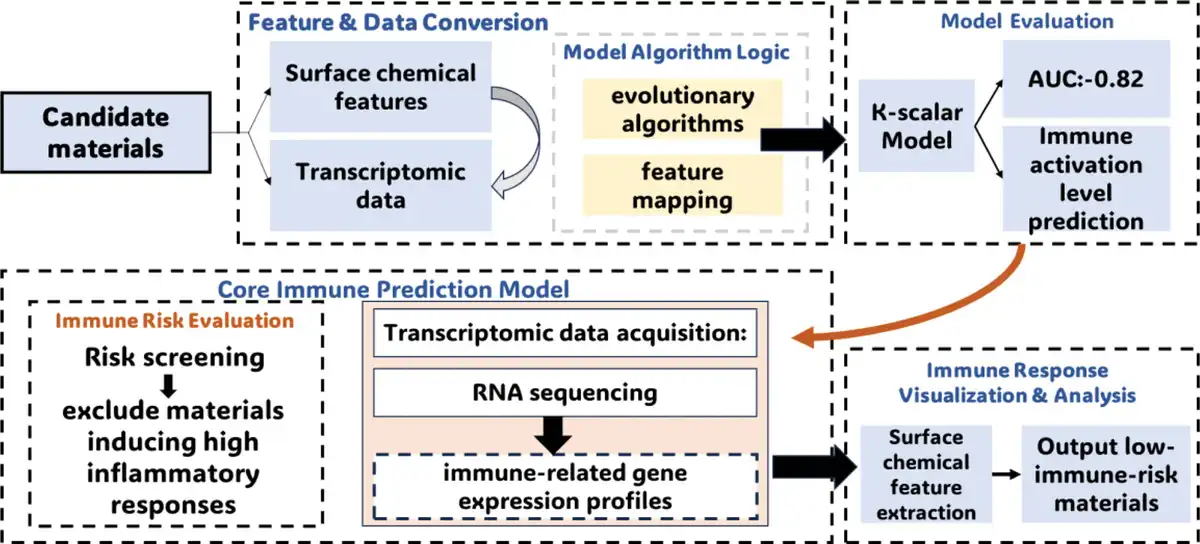
Figure 4.
ImmunoMat model prediction process for medical materials.
This omics data-driven approach is equally applicable to optimizing the immunocompatibility of specific materials. Take titanium alloys, widely used in orthopedics and dentistry, as an example. While they offer advantages such as high strength, corrosion resistance, and fundamental biocompatibility[14], postoperative fibrous encapsulation consistently impacts long-term stability. Research indicates that implant surface roughness and protein adsorption profiles are key factors regulating macrophage polarization and inflammatory responses—a correlation often overlooked in traditional R&D. To address this, the research team employed machine learning to construct a predictive model: First, they collected titanium alloy samples with varying surface characteristics, quantifying their surface roughness, protein adsorption profiles, and corresponding macrophage polarization data. Then optimized the model through cross-validation to reveal the intrinsic link between surface properties and macrophage polarization. This ultimately established design rules for “immunologically friendly” titanium alloys based on optimized surface characteristics, effectively reducing the incidence of postoperative fibrous encapsulation. This further validates the universality of omics-data-driven models in assessing material immunocompatibility.
3.2.2 Molecular dynamics and AI integration: atomic-level prediction of biomolecular interactions
Beyond macroscopic immune responses, microscopic interactions between materials and biomolecules (eg, proteins, DNA) constitute a core dimension of biocompatibility assessment. For instance, thrombosis induced by blood-material contact directly correlates with fibrinogen adsorption on material surfaces and platelet interactions[15]. While MD simulations can reproduce such microscopic interactions, traditional MD suffers from low efficiency and challenging data interpretation. The integration of AI technology overcomes these limitations, enabling atom-level precision prediction and optimization.
Consider the optimization of blood compatibility for PCL nanofibers: As a semicrystalline polyester, PCL offers excellent mechanical properties, biocompatibility, and degradability, making it a common material for nanofibers used in tissue engineering scaffolds or drug delivery systems[16]. However, its blood compatibility remains suboptimal.
In this study, the integration of deep learning and MD simulations[17] formed an efficient optimization pathway: First, MD simulations reproduced the interaction process between PCL nanofibers and fibrinogen under physiological conditions and various surface states, generating multidimensional raw data including molecular motion trajectories, atomic coordinates, binding energies, hydrogen bonds, and hydrophobic interactions. Subsequently, the data undergoes cleaning and normalization to extract key features such as binding site atom types, interaction distances, and peak energy changes, converting them into structured vectors processable by deep learning models; A convolutional neural network deep model[18] tailored for molecular structure and dynamic temporal data is constructed. Trained with “material surface features + MD interaction data” as input and binding strength patterns as output, it captures the mapping relationship between material surface properties and biomolecular binding efficacy. Finally, the model rapidly predicts the effectiveness of different surface modification schemes, identifies optimal strategies, and significantly reduces platelet adhesion rates. The schematic is illustrated below (Figure 5):
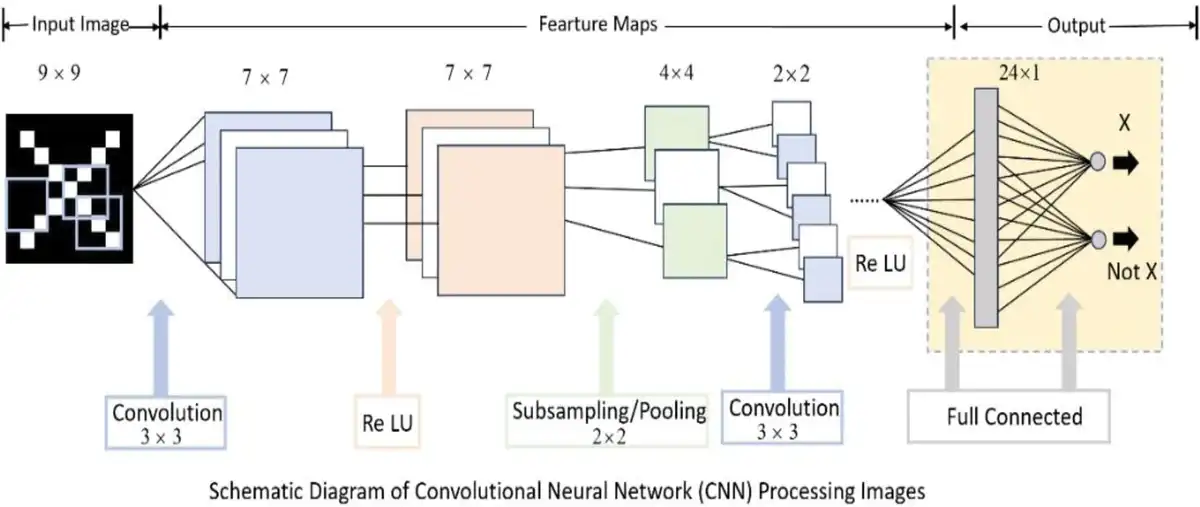
Figure 5.
Working mechanism of convolutional neural networks.
Similarly, the graph attention network (GAT) model offers an innovative approach for assessing the clotting risk of blood-contacting materials. Polyethylene glycol (PEG), valued for its excellent biocompatibility and anticoagulant properties, is commonly used as a surface coating for blood-contacting materials[19]. Its clotting risk is directly correlated with surface chemical composition, functional group types, and topological structure—characteristics that can be naturally represented as graph-structured data comprising nodes and edges.
The GAT model proposed by the Tsinghua University research team achieves precise prediction of clotting propensity by analyzing interactions between material surface chemistry and clotting factors: it takes the graph representation of a material’s surface chemistry as input and outputs the clotting time for the target material. Leveraging graph convolutional operations with attention mechanisms, it effectively captures the differential contributions of distinct chemical regions on the material surface to clotting risk. Data augmentation and regularization techniques employed during model training enhance generalization capabilities. When screening PEG coating schemes, the model identifies low-risk options with longer clotting times, thereby constructing a clotting risk database for blood-contacting materials and significantly improving the efficiency and accuracy of blood compatibility assessment.
3.2.3 Breakthrough value and application prospects of predictive models
AI predictive models revolutionize traditional biocompatibility assessment paradigms through 2 technical pathways: omics data-driven approaches and MD integration. On 1 hand, models like ImmunoMat and GAT achieve breakthroughs in replacing experiments, substantially reducing reliance on animal testing and lowering evaluation costs. On the other hand, the models’ high-throughput processing capability enables parallel screening of tens to hundreds of candidate materials, compressing the evaluation cycle from weeks to days. Simultaneously, precise predictions eliminate approximately 90% of low-compatibility candidates, significantly boosting R&D efficiency and providing critical technical support for the translation of medical materials from laboratory to clinical application.
3.3 Multiobjective optimization algorithms solve performance balancing challenges: synergistically enhancing material comprehensive efficiency
Clinical application of medical materials requires simultaneous fulfillment of multidimensional performance demands such as mechanical strength, biodegradability, and immunological inertness, with inherent conflicts among certain metrics. Traditional R&D relies on empirical trial-and-error methods, which struggle to quantify the balance between conflicting performance metrics while suffering from lengthy development cycles and high resource consumption. AI multiobjective optimization algorithms efficiently explore the “multi-objective performance space.” Their core objective is to rapidly converge and uniformly distribute the algorithmic population within the nondominated optimal region of the problem, enabling precise identification of optimal solutions that balance multiple properties. This provides a systematic technical pathway for synergistically enhancing the comprehensive performance of materials (Figure 6).
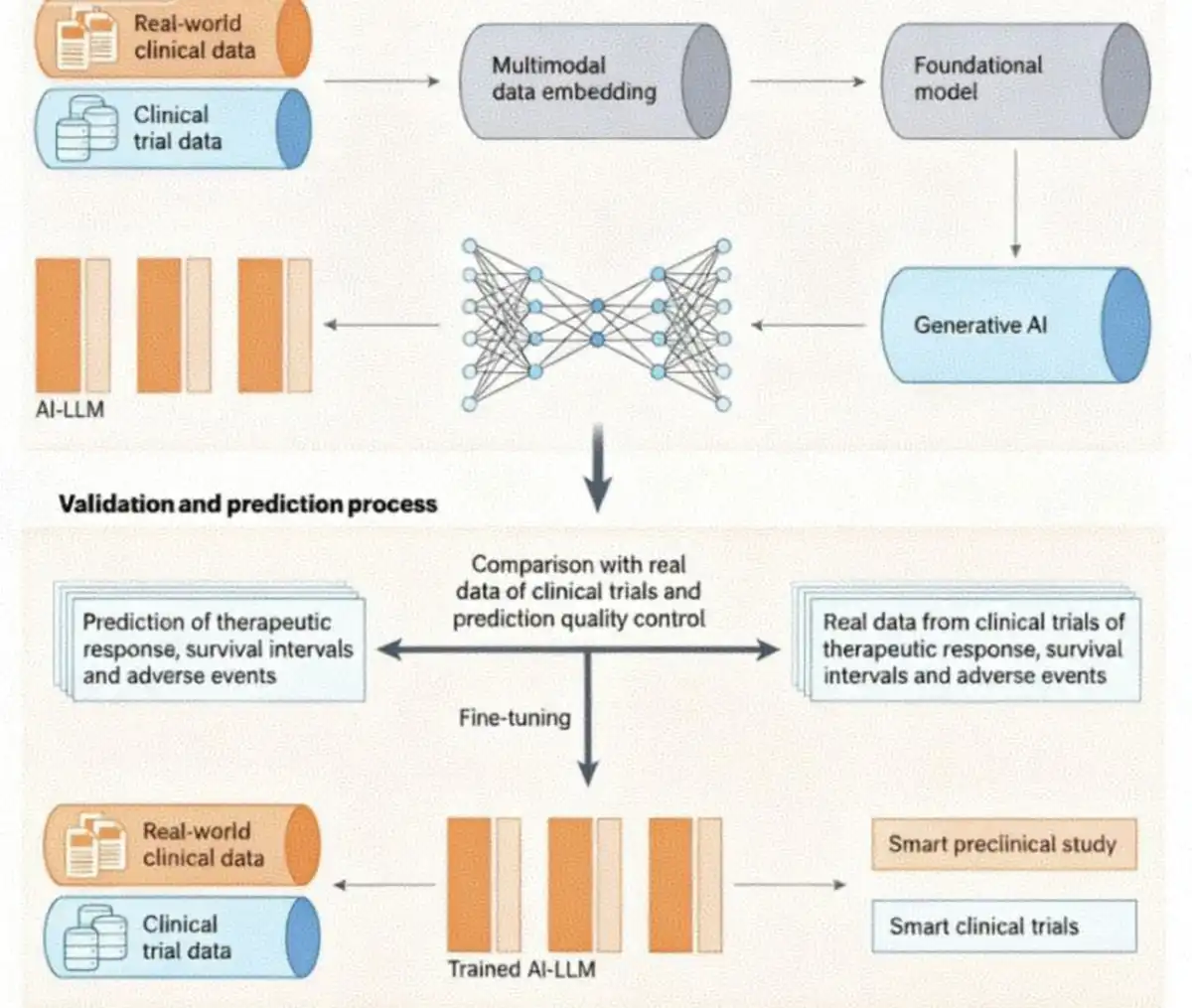
Figure 6.
Model learning and training process.
3.3.1 NSGA-II algorithm: efficient exploration of multiobjective nondominated optimal solutions
The nondominated sorting genetic algorithm (NSGA-II)[20] has become a classic tool for solving the challenge of balancing multiple material properties, leveraging its core advantage of “non-dominated sorting combined with elite retention strategy.” Its key value lies in rapidly screening optimal designs that are not dominated by other solutions, while ensuring the stability of optimal solutions during iterations through elite retention. This algorithm has demonstrated significant practical value in both orthopedic implant and biodegradable polymer scaffold design.
In orthopedic implants, traditional standardized devices often fail to adapt to patients’ unique skeletal morphology, density, and mechanical environments, leading to adverse events like fracture, loosening, deformation, and infection. For instance, Wang Hong’s team found that material defects and design flaws accounted for 72% of adverse events in Guangdong Province’s orthopedic implants[21]. To address this issue, the BioMatch system developed by Massachusetts General Hospital integrates patient computed tomography scans, bone density data, and personalized mechanical requirements. Utilizing the NSGA-II algorithm, it intelligently optimizes orthopedic implants: the algorithm rapidly screens design solutions, balancing mechanical load capacity and bone ingrowth characteristics through nondominance ordering, while an elite retention strategy ensures each iteration preserves optimal solutions for continuous refinement. The generated implant 3D models are manufactured using high-precision 3D printing techniques such as selective laser sintering and fused deposition modeling, and must undergo rigorous quality control and sterilization. Clinical trials demonstrate that implants designed by this system exhibit a postoperative loosening rate of only 6%, representing a 40% reduction compared to traditional designs, establishing a technical paradigm for multiperformance synergistic optimization of orthopedic implants.
3.3.2 Bayesian optimization: precision navigation in complex design spaces
As a key AI approach for multiobjective optimization, Bayesian optimization balances exploration of unknown parameter spaces with exploitation of known optimal regions through Gaussian Process Surrogate models. This enables rapid identification of optimal solutions balancing multiple performance metrics without exhaustively traversing all parameter combinations. It demonstrates remarkable efficiency in complex material designs like hydrogel dressings. Its core logic involves constructing a surrogate model based on minimal initial experimental data, dynamically selecting the next most promising experimental plan through function evaluation, and iteratively optimizing until target performance is achieved—fundamentally overcoming the efficiency bottlenecks of traditional trial-and-error approaches.
In designing multifunctional hydrogel dressings for chronic wound healing, a research team at Germany’s Fraunhofer Institute employed Bayesian optimization to explore complex design spaces, targeting core multiobjective optimization metrics of moisture retention, breathability, and antimicrobial properties[22].
The research workflow specifically included:
(1) Initial parameter pool construction: Collecting hydrogel preparation parameters (varying crosslinking degrees and component ratios) alongside corresponding performance data.
(2) Establishing a surrogate model: Training a Gaussian process model using initial data to quantify parameter influences on performance metrics and predict uncertainty.
(3) Iterative screening: Selecting “regions with optimal predicted performance” or “regions with highest model uncertainty” via the acquisition function for experimentation, progressively narrowing down optimal parameter combinations;
(4) Performance validation: Conduct multidimensional testing on hydrogel dressings prepared with optimized parameters, including mechanical properties, freeze-thaw stability, self-healing characteristics, biocompatibility, and wound healing promotion[23]. Clinical trials demonstrate that the novel hydrogel dressing designed by this algorithm reduces dressing change cycles by approximately 30 days compared to traditional dressings, significantly alleviating patient discomfort and medical burden. Its synergistic multiperformance effects far exceed those of products designed using traditional trial-and-error methods.
In developing personalized hydrogel dressings for diabetic wounds, the Huazhong University of Science and Technology research team further integrated Bayesian optimization with individual patient data. Diabetic wound healing faces unique challenges, including significant blood glucose fluctuations, high infection risks, and complex microenvironments, making traditional dressings inadequate for personalized needs due to their lack of dynamic adaptability. The team first collected extensive clinical data from diabetic patients, using machine learning to uncover correlations between blood glucose variability and wound infection risk, as well as drug demand thresholds[24]. Subsequently, employing Bayesian optimization algorithms, they designed the network structure and drug loading scheme of the dynamically responsive hydrogel with multiple objectives: glucose responsiveness, precise drug release, and wound repair efficiency. The optimized hydrogel reversibly adjusts its pore size in response to ambient glucose concentration: when blood glucose rises to a preset threshold, the network pores expand to accelerate the release of hypoglycemic and anti-infective drugs; When blood glucose returns to normal ranges, the pore size shrinks to slow drug release and prevent side effects. Animal experiments confirmed that this smart dressing improves infection control efficiency by 50% compared to traditional dressings and can adapt to individual patients’ blood glucose fluctuation patterns, offering a new solution for personalized chronic wound treatment.
3.3.3 Breakthrough value and application prospects of multiobjective optimization algorithms
AI multiobjective optimization algorithms, through technical approaches like NSGA-II and Bayesian optimization, not only resolve the traditional challenge of balancing multiple properties in medical materials but also drive the development of medical materials toward precision and personalization by integrating with patient-specific data and organ-on-a-chip technologies[25]. As multimodal data integration capabilities advance, these algorithms will achieve full-process automation from molecular design and performance prediction to clinical adaptation, providing more robust material support for precision medicine.
4. Global AI-driven medical materials research landscape: global trends, core challenges, and ecosystem development
The deep integration of AI and medical materials is reshaping technological boundaries and application scenarios in healthcare. From accelerating material development to enabling precise clinical implementation, AI technologies inject revolutionary momentum into the medical materials industry by innovating technical paradigms, optimizing data flow, and bridging translation pathways. Simultaneously, it faces multifaceted challenges including crossdomain collaboration and compliance/security, with a diverse ecosystem gradually emerging globally.
4.1 Core research trends
4.1.1 Technological paradigm: from “trial-and-error iteration” to “intelligent design”
Deep learning is currently primarily applied to material property prediction. By constructing neural network models that simulate correlations between material microstructure and biocompatibility/mechanical properties, it significantly shortens R&D cycles. Multialgorithm fusion continues to optimize processes, with machine learning used for material screening and quality control, while big data technology integrates research patents and market data to enhance R&D efficiency. Personalized customization emerges as a core direction. By analyzing patient medical histories and other data[26], AI facilitates the development of tailored orthopedic implants, cardiac stents, and similar products, enabling treatment plans that better align with individual needs.
4.1.2 Data sharing: advancing toward a “standardized collaboration” model
Crossinstitutional data alliances are accelerating, with global research institutions and medical device companies jointly building and sharing databases. These platforms integrate multidimensional information including material R&D data, clinical application feedback, and production process parameters. The industry is progressively exploring technical solutions like data anonymization and tiered access permissions to maximize data value while ensuring compliance. Data and algorithms iterate synergistically, with extensive real-world data training significantly enhancing model accuracy[27]
4.1.3 Clinical translation: building a “rapid transformation” pathway
Clinical needs drive R&D in reverse. AI analyzes clinical diagnosis and treatment data to uncover unmet demands, precisely guiding the functional design and performance optimization of medical materials. Intelligent acceleration of the translation process leverages AI to optimize clinical trial protocols, predict efficacy, and assess risks, shortening the timeline from laboratory to clinical application. Multiscenario integrated applications are being deployed, with AI-empowered products like intelligent surgical robots and personalized therapeutic consumables accelerating adoption across orthopedics, cardiovascular medicine, oncology, and other fields.
4.2 Core challenges in the current context
4.2.1 Data barriers: format inconsistencies and labeling gaps
Data serves as the core foundation for AI model training, yet inconsistent data formats remain a widespread issue. Datasets from different laboratories, hospitals, or research phases exhibit variations in recording formats, storage methods, and measurement units. This necessitates extensive manual cleaning and conversion for centralized analysis, increasing R&D costs while introducing potential data errors[28]. Simultaneously, the absence of standardized annotations hinders the application of supervised learning models, ultimately creating data silos. This increases the difficulty of developing and training AI models, weakens their transferability and robustness across different scenarios, and obstructs the achievement of deep learning and model optimization objectives.
4.2.2 Clinical translation bottlenecks: lengthy validation cycles and high costs
Clinical trials are crucial for verifying the safety and efficacy of medical materials in humans. While AI can accelerate early stage R&D, clinical validation remains a bottleneck throughout the entire process. Many promising AI design proposals are terminated midway due to excessive time and financial investment, hindering the rapid translation of innovative outcomes into clinical practice[29].
4.2.3 Ethical and regulatory challenges: “black box” and regulatory lag
The deep application of AI in medical material design raises ethical and regulatory issues[30]. First, the “black box” problem—if AI-designed materials cause adverse reactions or long-term complications, tracing the root cause becomes difficult, potentially endangering patient safety and triggering a crisis of trust in AI medical products. Second, regulatory lag—existing regulations lack clear guidance and approval standards, leading to lengthy and inefficient product approval cycles that hinder industry development while undermining patients’ rights to access safe and effective innovative products.
Academic and industrial communities are currently addressing the “black box” problem through multiple dimensions[31]. At the methodological level, interdisciplinary tools are introduced to deconstruct computational logic, or physical information machine learning is employed to incorporate physical constraints. At the model architecture level, “white box” algorithms are selected, or techniques like SHAP values and LIME are used to interpret black box models.
4.3 Ecosystem development
4.3.1 Core participants
In recent years, numerous international research institutions, medical device organizations, and clinical institutions have collaborated to build ecosystems. Research institutions lead foundational algorithm development and material property studies, providing the industry with source innovations. Medical device companies handle technology commercialization and product manufacturing, while technology firms provide AI algorithms and data processing support, forming a collaborative “algorithm + material + manufacturing” model[32]. Clinical institutions offer feedback on clinical needs and trial scenarios, validate product safety and efficacy, and drive technology implementation. Regulatory and service bodies establish industry standards, compliance rules, and ethical guidelines, providing services such as approval oversight and intellectual property protection.
4.3.2 Ecosystem collaboration mechanisms
Joint laboratories and technology transfer platforms accelerate the conversion of research outcomes into clinical products, achieving deep integration among industry, academia, research, and application. Transnational institutions break geographical and institutional barriers through data alliances and technical collaborations, pooling global innovation resources to establish worldwide resource-sharing networks. Governments guide capital market investment in AI medical materials through industrial support policies and research funding, enhancing policy and financial backing.
5. Future trends
Future AI medical materials R&D will transcend reliance on single data sources or models. Instead, it will leverage large-scale, multisource, heterogeneous data to build comprehensive models. These models will not only interpret materials’ chemical genomic data but also deeply learn from vast biomedical literature to uncover implicit knowledge on material-biological interactions. They will also integrate patient clinical trial feedback data. This fusion of multimodal large models will significantly enhance AI’s reasoning capabilities and knowledge breadth, potentially enabling full-process automation from initial molecular design and structural optimization to biocompatibility prediction, in vivo behavior simulation, and ultimately clinical indication determination[33].
Personalized medicine represents a crucial future direction for healthcare, so medical material development should also serve personalized medical needs[34]. A key future breakthrough lies in designing a closed-loop “organ-on-a-chip-AI” system. AI models continuously refine, adjust, and optimize procedures based on real-time data through iterative cycles, forming a closed-loop “organ-on-a-chip-AI” system. This enables more precise personalized medical material design and validation, drastically shortening the path from laboratory to clinical application and tailoring the most suitable implants or dressings for individual patients.
Future AI will not only focus on material performance and biocompatibility but also consider the entire material lifecycle. AI will design more environmentally friendly medical materials, ideally selecting fully biodegradable or easily recyclable options. Factors like biodegradability and eco-friendliness will serve as key constraints or objective functions in AI optimization, driving medical materials toward sustainability. As human society advances, environmental protection will coexist with humanity[35].
6. Conclusion
This paper addresses the core challenges in traditional medical material development—extended R&D cycles, high costs, high failure rates, and difficulties in balancing multiple properties—by systematically presenting breakthrough AI solutions: Generative models (MatGAN, GNNs) efficiently explore material chemical spaces; predictive models (ImmunoMat, GAT, MD+AI) enable high-throughput screening for biocompatibility; multiobjective optimization algorithms (NSGA-II, Bayesian optimization) resolve performance trade-offs. These 3 technical pathways span the entire R&D chain while highlighting global research groups’ distinct technical approaches and industrialization disparities.
Current AI-driven medical materials R&D still faces challenges such as inconsistent data formats, clinical translation bottlenecks, and lagging ethical oversight. However, future evolution will advance in 3 key directions: full-process automation using multimodal large models, closed-loop personalized customization through “organ-on-a-chip-AI” integration, and green sustainable design. In summary, AI is reshaping the foundational logic of medical materials R&D. Despite existing challenges, it will inevitably become the core engine for breaking through field bottlenecks and supporting precision medicine development through technological iteration and deepened interdisciplinary collaboration.
Acknowledgments
Guangxi Zhuang Autonomous Region Key Laboratory; National Natural Science Foundation of China (Grant No. 81703085); and China Postdoctoral Science Foundation (Grant No. 2018M630995). We extend our gratitude to all team members for their collaborative efforts.
Conflicts of interests
The authors declare that they have no conflicts of interest.
Data availability statement
All obtained data are publicly available.
References
- [1] Huang H, Chen Y. Materials medicine and medical materials. J Inorg Mater. 2022;37(11):1151–1169.
- [2] Liu Z, Da Z, Hongya L, et al. Application potential of integrating traditional medical ophthalmoscopy with artificial intelligence in medicine. Integr Technol. 2025;10:1–20. Available at: https://link.cnki.net/urlid/44.1691.T.20251029.1418.002. Accessed December 7, 2025.
- [3] Zhang Y, Chengcheng F, Qi X, et al. Deep learning classification of COVID-19 Raman spectra enhanced by CGAN. Spectrosc Spectral Anal. 2024;44(08):2273–2278.
- [4] Zhenling LI, Panpan X, Qiangqiang G, et al. Self-encoder and K-means quantization-based reconfigurable smart surface assisted key generation. Front Inf Technol Electron Eng. 2025;26(08):1486–1501.
- [5] Jinquan H, Huihua Y, Guoliang Z, et al. A GAN semi-supervised regression approach for predicting wool content in waste textile samples. Spectrosc Spectral Anal. 2024;44(05):1417–1424.
- [6] Jiao Z, Zhang C, Liu Y, et al. High-performance prediction of high-entropy alloy catalysts for carbon dioxide reduction based on graph neural networks. Chin J Catal. 2025;71(04):197–207.
- [7] Ziming Li, Bin C, Yufei H, et al. Refined mapping of basic land use types in Chinese cities based on multimodal deep learning and multi-source geospatial data (EULUC-China Version 2.0) (English). Sci Bull. 2025;70(18):3029–3041.
- [8] Shao W. Application research on degradable biomedical polymer materials. Contem Chem Eng Res. 2024;16(16):116–118.
- [9] Zefan S, Guangxun Z, Yuping LI, et al. Metal-organic frameworks as functional materials for biomedical applications (English). Sci China Mater. 2026;69:1–33. Available at: https://link.cnki.net/urlid/10.1236.TB.20251205.1140.008. Accessed December 7, 2025.
- [10] Zeng D. Research and application of graph network learning methods. Univ Electron Sci Technol China. 2024;11:1.
- [11] Fei W, Tao S, B?ck T, et al. Knowledge-guided collaborative cooperation and joint evolution of generative models: a development blueprint for the post-large model era. Engineering. 2025;44(01):87–100.
- [12] Zhang H, Xin C, Tianxin W, et al. Research progress on artificial ligaments in anterior cruciate ligament reconstruction: from biocompatibility to bioactivity. Engineering. 2025;46(03):47–59.
- [13] Ng LW, An J, Chua KC. Application of 3D printing technology in medical devices and tissue engineering: processes, materials, and regulatory requirements (English). Engineering. 2024;36(05):146–166.
- [14] Yang F. Multimodal medical data fusion technology and applications. J Shandong Univ (Med Ed). 2025;63(08):17–40.
- [15] Dan Li, Jingxian W, Xiaoli L, et al. Novel Strategy for antithrombotic modification of blood-contacting materials: constructing fibrinolytic active surfaces. J Polym Sci. 2016;1(07):850–859.
- [16] Cheng BX, Wang MQ, Ding ZQ, et al. Synthesis and properties of polycaprolactone and polycarbonate-type polyurethanes. J Polym Sci. 2024;55(10):1346–1355.
- [17] Jin L, Kaiqiang LI, Tinghua Y. Effect of MD simulation loading temperature on the machined surface of Ni3Al-based alloys (English). Rare Met Mater Eng. 2024;53(04):1011–1020.
- [18] Qing X, Jiawei T, Xuemeng L, et al. Research on graded diagnosis method for brain glioma based on convolutional neural network and Raman spectroscopy. Spectrosc Spectr Anal. 2025;45(08):2247–2252.
- [19] Zhil LI, Dezhong Z. Preparation of hyperbranched polyethylene glycol via reversible addition-breaking chain transfer radical polymerization of polyvinyl monomers and its application in stem cell Culture. J Chem High Educ Inst. 2025;46(07):154–161.
- [20] Yang Q, Ziyu LI, Rodríguez-Kesslerbr PL, et al. Deep neural networks combined with transfer learning and genetic algorithms accelerate global optimization of metal cluster structures (English). Chin J Chem Phys. 2024;37(03):321–341.
- [21] Chen HH, Deng LH, Wang LZ, et al. First-principles calculations of mechanical properties for NbTaTiZr-based multicomponent alloy orthopedic implant materials. Rare Met Mater Eng. 2021;50(11):3949–3956.
- [22] Abdullaev UM, Jeon W, Kang Y, et al. Data-driven framework based on machine learning and optimization algorithms for predicting oxide-zeolite composite catalyst systems and reaction conditions for olefin production from synthesis gas (English). Chin J Catal. 2025;74(07):211–227.
- [23] Ma YQ, Li Z, Zheng GB, et al. Advances in nanofiber-reinforced hydrogels. Prog Chem. 2024;36(10):1594–1606.
- [24] Xiao WY, Wan QZ, Zhang YK, et al. Mechanically stable self-pumping oil-water hydrogel dressing with oriented microchannels for accelerated diabetic wound healing (English). Sci China (Mater). 2024;67(09):2995–3002.
- [25] Zhu Y, Lijun C, Hanxu C, et al. Organ-on-a-chip research for biomedical applications (English). Sci Bull. 2022;67(11):1108–1111.
- [26] Wei X. Research on deep learning-based multimodal medical image fusion algorithms. Anhui Univ Sci Technol. 2025;2:1.
- [27] Yang L, Zekun L, Juntao Y, et al. Theoretical logic and practical exploration of medical science data sharing. J Med Inform. 2025;46(06):37–42.
- [28] Lianhong H, Xiqing Z. On establishing a deep sharing mechanism for artificial intelligence data in the public domain. J Cent South Univ (Soc Sci Ed). 2024;30(06):33–48.
- [29] Wei Q, Zhuoyao G, Weimin T, et al. Development and validation of an automated ultra-widefield fundus image enhancement system for clinical diagnosis: a cross-regional multicenter study (English). Engineering. 2024;41(10):179–188.
- [30] Zhong W, Xiaoru H. Ethical regulation progress in medical synthetic biology. Life Sci. 2025;37(08):1054–1063.
- [31] Yang J, Cheng Z. The black box problem of medical artificial intelligence algorithms: ethical challenges and resolution approaches. Chin Sci Bull. 2023;68(13):1604–1610.
- [32] Wang C, Pusheng W. Evolutionary research on multi-stakeholder co-construction of translational medicine innovation ecosystems. Chin Soft Sci. 2025;2(06):75–87.
- [33] Char DS, Shah NH, Magnus D. Implementing machine learning in health care — addressing ethical challenges. N Engl J Med. 2018;378(11):981–983. DOI: 10.1056/NEJMp1714229
- [34] Liu Y, Hui B, Huan T, et al. Gene expression profile analysis for drug discovery and precision medicine. Prog Biochem Biophys. 2016;43(10):923–935.
- [35] Tao LI. Applications of biodegradable polymeric synthetic materials in the medical field. Mod Plast Process Appl. 2023;35(05):51–55.
This article is available under Open Access.
© 2026 The Authors