Advances in materials and actuation strategies for wearable medical robotics: optimization for biomedical applications
Authors
Jing Fang, Yue Li, Lei Shi*
- aSchool of Artificial Intelligence, Dalian Maritime University, Dalian, China
- bDepartment of Mechanical Engineering, Kennesaw State University, Marietta, Georgia.
* Correspondence: Address: Lei Shi, Department of Mechanical Engineering, Kennesaw State University, 1100 South Marietta Pkwy SE, Marietta, GA 30060. Email: lshi@kennesaw.edu (Lei Shi).
MedMat · 2025 · Vol. 2 · No. 4 · pp. 195-218
Abstract
The human musculoskeletal system, refined over millions of years of evolution, enables highly adaptive and efficient movement. However, aging, neuromuscular disorders, and physical injuries can severely impair mobility, necessitating advanced assistive technologies. While conventional approaches such as surgery, rehabilitation training, and pharmacological treatments remain widely used, they are often costly, time-intensive, and associated with potential risks. Wearable robotics has emerged as a promising alternative, offering personalized movement assistance, rehabilitation support, and mobility augmentation. Early wearable robots, particularly rigid exoskeletons, demonstrated potential in assisting movement but were hindered by excessive weight, mechanical rigidity, and misalignment with natural biomechanics, limiting their practicality. Recent advancements in flexible wearable robotics, leveraging Bowden cable transmissions and thermoplastic polyurethane-based actuators, have sought to overcome these challenges. However, critical limitations—including low torque output, energy inefficiency, and challenges in actuator integration—remain significant barriers to widespread adoption. This review provides a comprehensive analysis of recent advancements in biomechanical modeling, flexible actuator technologies, and simulation-driven optimization methods for wearable medical robotics. It highlights the need for a unified theoretical framework to improve design efficiency, control adaptability, and real-time human–robot interaction. This review uniquely integrates biomechanical modeling with optimization strategies, offering a holistic approach to enhance wearable robotics for medical applications. Addressing these challenges could enable wearable robotics to evolve into highly efficient, intelligent, and seamlessly integrated assistive systems, transforming rehabilitation, industrial support, and human augmentation.
Translations
Long abstracts in additional languages. The English article is the version of record.
中文zh-Hans
人类肌肉骨骼系统经过数百万年的进化,实现了高度适应性和高效的运动能力。然而,衰老、神经肌肉疾病和身体损伤会严重损害这种移动性,迫切需要先进的辅助技术。尽管手术、康复训练和药物治疗等传统方法仍被广泛使用,但它们往往成本高昂、耗时且伴随潜在风险。可穿戴机器人作为一种有前景的替代方案应运而生,能够提供个性化的运动辅助、康复支持和行动增强功能。早期的刚性外骨骼虽然展示了协助运动的潜力,但受限于过重的重量、机械刚性与自然生物力学不匹配等问题,其实际适用性受到限制。本综述旨在全面分析近期在生物力学建模、柔性执行器技术及仿真驱动优化方法方面的进展,以解决上述挑战并推动可穿戴医疗机器人的发展。
本文深入探讨了基于鲍登电缆传动系统和热塑性聚氨酯(TPU)基执行器的最新技术突破,这些创新旨在克服早期刚性外骨骼的局限性。综述重点分析了生物力学建模与柔性材料设计的结合策略,强调了利用仿真驱动优化方法在提升设计效率和控制适应性方面的关键作用。文章特别指出,当前的研究正致力于解决低扭矩输出、能源效率低下以及执行器集成困难等核心问题。通过整合这些先进的材料与传动机制,研究者试图构建更轻便、更符合人体工学的系统,从而为可穿戴医疗机器人提供更坚实的理论基础和技术支撑,以应对复杂的生物力学环境。
本综述的综合分析表明,将生物力学建模与优化策略相结合是提升可穿戴机器人性能的关键途径。研究发现,尽管柔性执行器在减轻重量和提高灵活性方面取得了显著进展,但低扭矩输出和能源效率问题仍然是阻碍其广泛采用的主要障碍。科学解释指出,缺乏统一的理论框架限制了设计效率和实时人机交互能力的进一步提升。通过系统梳理现有文献,文章揭示了当前技术在模拟驱动优化方面的潜力与不足,强调了建立统一模型对于协调材料特性、传动机制与控制算法的重要性,这对于实现高效的人体运动辅助至关重要。
本研究的显著意义在于提出了一种整体方法,旨在将可穿戴机器人发展为高度智能且无缝集成的辅助系统,从而彻底改变康复训练和人体增强领域。然而,必须承认当前技术仍面临执行器集成挑战和能源效率低下的局限性,这些是未来研究亟需攻克的难题。未来的工作应聚焦于完善统一的理论框架,以优化设计流程并提高系统的实时响应能力。通过解决这些关键挑战,可穿戴机器人有望在医疗康复、工业支持及人体增强应用中发挥更大作用,成为真正高效且智能的辅助工具,为改善人类生活质量提供强有力的技术保障。
Françaisfr
Le système musculo-squelettique humain, affiné par des millions d'années d'évolution, permet un mouvement hautement adaptatif et efficace. Cependant, le vieillissement, les troubles neuromusculaires et les blessures physiques peuvent gravement altérer la mobilité, nécessitant des technologies d'assistance avancées. Bien que les approches conventionnelles telles que la chirurgie, l'entraînement de rééducation et les traitements pharmacologiques restent largement utilisées, elles sont souvent coûteuses, chronophages et associées à des risques potentiels. La robotique portable est apparue comme une alternative prometteuse, offrant une assistance personnalisée au mouvement, un soutien en réadaptation et une augmentation de la mobilité. Les premiers robots portables, notamment les exosquelettes rigides, ont démontré leur potentiel mais étaient entravés par un poids excessif, une rigidité mécanique et un désalignement avec la biomécanique naturelle, limitant ainsi leur praticabilité.
Cette revue analyse en détail les avancées récentes dans le domaine de la robotique flexible, s'appuyant sur des transmissions à câbles Bowden et des actionneurs à base de polyuréthane thermoplastique (TPU) pour surmonter ces défis. L'approche met l'accent sur une intégration approfondie du modélisation biomécanique avec les stratégies d'optimisation pilotées par simulation, visant à améliorer l'efficacité de la conception et l'adaptabilité du contrôle. Le texte examine spécifiquement comment ces matériaux flexibles et mécanismes de transmission cherchent à résoudre les problèmes inhérents aux systèmes rigides tout en abordant des limitations critiques comme le faible couple moteur et l'inefficacité énergétique. L'objectif est d'établir une base solide pour la conception de dispositifs plus légers et mieux alignés sur la biomécanique humaine.
L'analyse complète révèle que, malgré les progrès significatifs dans les technologies d'actionneurs flexibles, des barrières critiques subsistent, notamment un faible couple de sortie, une inefficacité énergétique et des défis complexes liés à l'intégration des actionneurs. L'interprétation scientifique souligne la nécessité impérieuse d'un cadre théorique unifié pour améliorer l'efficacité du design et les interactions homme-robot en temps réel. La revue met en évidence que l'absence de ce cadre commun limite actuellement le potentiel de ces systèmes, rendant difficile une adoption généralisée malgré leur promesse initiale. L'intégration holistique proposée vise à combler cet écart entre la théorie biomécanique et les stratégies d'optimisation pratique.
La signification fondamentale de cette synthèse réside dans l'offre d'une approche globale pour transformer la robotique portable en systèmes d'assistance hautement efficaces, intelligents et intégrés sans couture. Toutefois, des limitations importantes demeurent, notamment concernant le couple faible et les difficultés d'intégration qui freinent encore une adoption massive. Les travaux futurs devront se concentrer sur l'établissement de ce cadre théorique unifié pour optimiser la conception et renforcer l'adaptabilité du contrôle en temps réel. En adressant ces défis, il est possible que la robotique portable évolue vers des outils révolutionnaires capables de transformer non seulement la rééducation médicale mais aussi le soutien industriel et l'amélioration humaine, offrant ainsi une solution technologique robuste pour les besoins futurs en santé et mobilité.
Españoles
El sistema musculoesquelético humano, refinado a lo largo de millones de años de evolución, permite un movimiento altamente adaptativo y eficiente. Sin embargo, el envejecimiento, los trastornos neuromusculares y las lesiones físicas pueden deteriorar gravemente la movilidad, haciendo necesarias tecnologías avanzadas de asistencia. Aunque enfoques convencionales como cirugía, entrenamiento de rehabilitación y tratamientos farmacológicos siguen siendo ampliamente utilizados, a menudo son costosos, intensivos en tiempo y conllevan riesgos potenciales. La robótica portátil ha surgido como una alternativa prometedora que ofrece asistencia personalizada al movimiento, apoyo en la rehabilitación y aumento de la movilidad. Los primeros robots portátiles, particularmente los exoesqueletos rígidos, demostraron potencial pero se vieron obstaculizados por un peso excesivo, rigidez mecánica y desalineación con la biomecánica natural, limitando su practicidad.
Esta revisión analiza en profundidad las innovaciones recientes que aprovechan transmisiones de cable Bowden y actuadores basados en poliuretano termoplástico (TPU) para superar estos desafíos. El enfoque se centra en integrar modelos biomecánicos con estrategias de optimización impulsadas por simulación, buscando mejorar la eficiencia del diseño y la adaptabilidad del control. Se examinan específicamente las limitaciones críticas actuales, como una baja salida de par motor, ineficiencia energética y dificultades en la integración de actuadores que persisten a pesar de los avances en materiales flexibles. El objetivo es establecer un fundamento sólido para sistemas más ligeros y mejor alineados con la biomecánica humana mediante el uso combinado de estos mecanismos avanzados.
El análisis integral revela que, aunque ha habido progresos significativos en las tecnologías de actuadores flexibles, barreras críticas como una baja salida de par motor e ineficiencia energética siguen siendo obstáculos importantes para su adopción generalizada. La interpretación científica subraya la necesidad imperiosa de un marco teórico unificado para mejorar tanto la eficiencia del diseño como la interacción humano-robot en tiempo real. Al revisar sistemáticamente la literatura existente, el artículo destaca que la falta de este marco común limita actualmente el potencial de estos sistemas y dificulta una adopción masiva a pesar de su promesa inicial. La integración holística propuesta busca cerrar esta brecha entre la teoría biomecánica y las estrategias prácticas de optimización.
La importancia fundamental de esta síntesis radica en ofrecer un enfoque integral para transformar la robótica portátil en sistemas de asistencia altamente eficientes, inteligentes e integrados sin fisuras. Sin embargo, persisten limitaciones significativas relacionadas con el bajo par motor y los desafíos de integración que frenan aún su adopción masiva. El trabajo futuro deberá centrarse en establecer este marco teórico unificado para optimizar el proceso de diseño y fortalecer la capacidad de respuesta del sistema en tiempo real. Al abordar estos desafíos, es posible que la robótica portátil evolucione hacia herramientas revolucionarias capaces de transformar no solo la rehabilitación médica sino también el apoyo industrial y la mejora humana, ofreciendo así una solución tecnológica robusta para las necesidades futuras de salud y movilidad.
日本語ja
人類の筋骨格系は数百万年にわたる進化によって洗練され、非常に適応性が高く効率的な運動を可能にしています。しかし、老化、神経筋疾患、および身体的外傷は移動能力を著しく損ない、高度な支援技術の必要性を生じさせています。従来の手術、リハビリテーション訓練、薬物療法などのアプローチはまだ広く使用されていますが、しばしば高コストで時間がかかり、潜在的なリスクも伴います。ウェアラブルロボティクスはこの課題に対する有望な代替手段として登場し、個別化された運動支援やリハビリテーションサポートを提供しています。初期の剛性のあるエクソスケルトンは運動補助の可能性を示しましたが、過度な重量、機械的剛性、および自然な生体力学との不一致により実用性が制限されていました。本レビューはこれらの課題を解決するための包括的な分析を提供します。
この論文では、ボウデンケーブル伝達機構と熱可塑性ポリウレタン(TPU)ベースのアクチュエータを活用した柔軟ウェアラブルロボティクスの最新進展に焦点を当てています。アプローチは、生体力学モデリングとシミュレーション駆動型最適化戦略の統合にあり、設計効率と制御適応性の向上を目指しています。特に、低トルク出力、エネルギー効率の欠如、およびアクチュエータ統合における課題といった重要な限界が克服されるべき点として強調されています。柔軟な材料と伝達メカニズムを組み合わせることで、より軽量で生体力学的に適合したシステムの構築が可能となり、ウェアラブル医療ロボティクスに対する理論的基盤と技術的支援が強化されます。
本レビューの主要な知見は、生体力学モデリングと最適化戦略を統合することがウェアラブルロボットの性能向上への鍵であることを示しています。柔軟アクチュエータにおける重量軽減や柔軟性向上の進歩にもかかわらず、低トルク出力とエネルギー効率の問題が広範な採用に対する依然として大きな障壁となっています。科学的解釈では、設計効率とリアルタイムの人機インタラクション能力をさらに高めるためには統一された理論的枠組みが必要であると指摘されています。既存文献の体系的整理を通じて、シミュレーション駆動最適化における可能性と限界が明らかにされ、材料特性、伝達機構、制御アルゴリズムを調整するための統合モデル構築の重要性が強調されます。
本研究の意義は、ウェアラブルロボティクスを高度に効率的で知的かつシームレスな支援システムへと進化させる包括的アプローチを提供することにあります。しかし、アクチュエータ統合の難しさやエネルギー効率の低さといった限界は今なお存在し、今後の研究が克服すべき課題です。将来的には、設計プロセスの最適化とシステムのリアルタイム応答能力向上のために統一された理論枠組みを確立することに注力する必要があります。これらの重要な課題に対処することで、ウェアラブルロボティクスは医療リハビリや産業支援、人間拡張においてより大きな役割を果たし、真に効率的で知的な補助ツールとして進化することが期待されます。
العربيةar
نظام العضلات والعظام البشري، الذي تم صقله على مدى ملايين السنين من التطور، يمكن الحركة التكيفية والفعالة للغاية. ومع ذلك، فإن الشيخوخة واضطرابات الجهاز العصبي العضلي والإصابات الجسدية قد تضر بشدة بالقدرة على التحرك، مما يستلزم تقنيات مساعدة متقدمة. في حين أن الأساليب التقليدية مثل الجراحة وتدريب إعادة التأهيل والعلاجات الدوائية لا تزال مستخدمة على نطاق واسع، إلا أنها غالبًا ما تكون مكلفة وتستغرق وقتًا طويلاً وترتبط بمخاطر محتملة. وقد ظهرت الروبوتات القابلة للارتداء كبديل واعد يوفر مساعدة مخصصة للحركة ودعمًا لإعادة التأهيل وتعزيز القدرة الحركية. أظهرت الروبوتات القابلة للارتداء المبكرة، وخاصة الهياكل الخارجية الصلبة، إمكاناتها في المساعدة على الحركة لكنها عانت من وزن زائد وصلابة ميكانيكية وعدم محاذاة مع الميكانيكا الحيوية الطبيعية، مما حدّ من عمليتها.
يركز هذا الاستعراض بشكل متعمق على التطورات الحديثة التي تستفيد من أنظمة نقل الكابلات البودن (Bowden) والمشغلات القائمة على البوليمر الحراري (TPU) للتغلب على هذه التحديات. يركز النهج على دمج النمذجة الميكانيكية الحيوية مع استراتيجيات التحسين المدفوعة بالمحاكاة، بهدف تحسين كفاءة التصميم وقابلية التحكم. يتم فحص القيود الحرجة الحالية عن كثب، مثل انخفاض عزم الدوران وانخفاض الكفاءة الطاقة وصعوبات تكامل المشغلات التي لا تزال قائمة رغم التقدم في المواد المرنة. يهدف هذا العمل إلى تأسيس أساس متين لأنظمة أخف وزنًا ومتوافقة بشكل أفضل مع الميكانيكا الحيوية البشرية من خلال الاستخدام المشترك لهذه الآليات المتقدمة.
تُظهر التحليلات الشاملة أن دمج النمذجة الميكانيكية الحيوية مع استراتيجيات التحسين هو المفتاح لتحسين أداء الروبوتات القابلة للارتداء. على الرغم من التقدم الكبير في تقنيات المشغلات المرنة فيما يتعلق بتخفيف الوزن وزيادة المرونة، إلا أن مشاكل انخفاض عزم الدوران وانخفاض الكفاءة الطاقة لا تزال عقبات كبيرة أمام التبني الواسع النطاق. يشير التفسير العلمي إلى الحاجة الملحة لإطار نظري موحد لتحسين كفاءة التصميم وقدرات تفاعل الإنسان مع الروبوت في الوقت الفعلي. من خلال المراجعة المنهجية للأدبيات الحالية، يسلط المقال الضوء على أن غياب هذا الإطار المشترك يقيد حاليًا إمكانات هذه الأنظمة ويجعل التبني الجماعي صعبًا رغم وعودها الأولية.
تكمن الأهمية الأساسية لهذا التلخيص في تقديم نهج شامل لتحويل الروبوتات القابلة للارتداء إلى أنظمة مساعدة عالية الكفاءة وذكية ومتكاملة بسلاسة. ومع ذلك، لا تزال هناك قيود كبيرة تتعلق بانخفاض عزم الدوران وصعوبات التكامل التي تعيق التبني الواسع حتى الآن. يجب أن يركز العمل المستقبلي على إنشاء هذا الإطار النظري الموحد لتحسين عملية التصميم وتعزيز قدرة النظام على الاستجابة في الوقت الفعلي. من خلال معالجة هذه التحديات، يمكن للروبوتات القابلة للارتداء أن تتطور إلى أدوات ثورية قادرة على تحويل إعادة التأهيل الطبي والدعم الصناعي وتحسين الإنسان، مما يوفر حلاً تكنولوجيًا قويًا للاحتياجات المستقبلية في مجال الصحة والحركة.
Keywords
Full Text
1. Introduction
The human musculoskeletal system has evolved over hundreds of millions of years, resulting in a highly sophisticated and adaptable structure capable of supporting a wide range of movements[1]. However, mobility can be compromised by factors such as aging, neuromuscular disorders, and physical injuries. Even individuals in peak physical condition—such as athletes, mountaineers, and military personnel—constantly seek to enhance their movement capabilities. To restore, maintain, or augment mobility, researchers across disciplines—including medicine, sports science, and biomechanics—have explored a variety of strategies, including surgical interventions, pharmacological treatments, and rehabilitation programs. While these conventional approaches have proven effective, they often come with significant drawbacks, such as high costs, long recovery periods, and potential health risks. In response, wearable robotics has emerged as a promising alternative, offering innovative solutions to enhance mobility while mitigating these limitations[2].
The earliest wearable robotic systems were exoskeletons—rigid, frame-based devices powered by conventional actuators such as electric motors and hydraulic systems[3]. One of the earliest examples, the Hardiman, was developed in the 1960s by General Electric with support from the US Department of Defense[4]. Designed to enhance human strength, this system enabled users to lift loads of up to 682 kg, significantly increasing the lifting capacity of soldiers. Despite their potential, exoskeletons have faced several limitations, including excessive weight, high costs, and rigid mechanical structures that interfere with natural biomechanics. The added mass and inertia from traditional actuators and rigid frames can disrupt natural movement patterns and pose safety concerns, particularly when misalignments between the exoskeleton joints and the human body cause discomfort or secondary injuries. Additionally, the precise control required to synchronize rigid actuators with human motion presents further challenges, limiting their widespread adoption.
To address these limitations, researchers have increasingly focused on flexible wearable robots, which offer advantages in safety, portability, and cost-effectiveness[5]. The key to these systems lies in their actuation mechanisms. Among the widely used flexible actuators in wearable robotics are McKibben pneumatic artificial muscles and Bowden cable actuators, both of which improve compliance compared with rigid alternatives[6]. However, these actuators primarily generate linear motion, often requiring additional mechanical components—such as linkages and gears—to convert linear forces into rotational torques for joint assistance. This conversion process reduces energy transmission efficiency and adds to system weight. In recent years, researchers have explored novel flexible actuators incorporating advanced materials and innovative structural designs, including electrically responsive polymers[7], fiber-reinforced bending actuators[8], and origami-based actuators[9]. However, many of these emerging technologies still present challenges, such as high-voltage operation requirements or the need for high-pressure actuation, raising safety concerns for practical use. A promising alternative is thermoplastic polyurethane (TPU)[10], a lightweight and cost-effective material commonly found in consumer products such as airbags. TPU-based actuators, which operate at low pressures and can be easily shaped, have already been implemented in wearable devices designed to assist shoulder and knee joint movements[11]. Despite these advances, flexible wearable robotics remains in its early stages, with technical challenges such as airflow constraints in flexible actuators and insufficient output torque requiring further research.
Another critical challenge in wearable robot development is optimizing their design[12]. Traditional approaches rely on empirical knowledge, human movement analysis, iterative prototyping, and participant trials to refine designs. While effective, these methods are highly specialized, resource-intensive, and time-consuming. Conducting human trials also carries inherent risks, and evaluating performance in extreme environments remains a challenge. A promising alternative is simulation-driven optimization, which has been widely adopted in fields such as aerospace and automation. By integrating computational modeling into wearable robot design, researchers can accelerate development cycles, reduce costs, and improve overall system safety. Although early studies have explored simulation-based optimization[13] in wearable robotics, most efforts have focused on refining control strategies for specific devices. A comprehensive approach that integrates kinematic, material, and control parameter optimization remains underdeveloped. Establishing a unified computational framework that accounts for these interdependent factors would facilitate the development of wearable robots tailored to diverse user needs.
Beyond individual device optimization, a broader challenge lies in the integration of wearable robotics with real-world environments. Wearable robots must function seamlessly in diverse conditions, adapting to user-specific needs while ensuring long-term reliability. This requires advancements in real-time sensing, adaptive control, and user-centered design. Current systems often rely on preprogrammed movement patterns, limiting their ability to dynamically adjust to the wearer’s biomechanics. Future developments should focus on integrating artificial intelligence (AI) and machine learning algorithms to enhance real-time adaptability and predictive control, ensuring that wearable robots can intelligently respond to changes in movement and load distribution.
Furthermore, a key consideration in wearable robotics is user experience and long-term usability. Many existing designs prioritize mechanical performance while overlooking human factors such as comfort, usability, and aesthetics. To encourage widespread adoption, future research must focus on minimizing device weight, improving material breathability, and refining attachment mechanisms to reduce pressure points and discomfort. Biomechanically inspired designs that closely mimic human muscle movement may offer a pathway to developing next-generation wearable robots that feel more like natural extensions of the body.
Building on these priorities, recent developments underscore the rapid convergence of wearable robotics with soft-material engineering, vision-based perception, and context-aware control. Portable inflatable soft exosuits for industrial and rehabilitative applications[14], scene-aware perception systems for exoskeleton navigation[15], and perspectives on integrating vision into wearable robots[16] illustrate the growing sophistication of modern designs. Concurrently, comprehensive reviews of actuation materials and architectures[17] and wearable/implantable soft robots[18] highlight emerging opportunities for cross-disciplinary innovation.
The future of wearable robotics will likely be shaped by interdisciplinary collaboration across engineering, medicine, and biomechanics. Advances in biohybrid actuators, which integrate living tissue with synthetic materials, could provide the next breakthrough in wearable robotics, offering actuators that replicate the efficiency, compliance, and energy efficiency of biological muscles. Additionally, breakthroughs in soft robotics and biomimetic design could lead to exosuits that more effectively assist movement without imposing unnatural constraints on the wearer. Addressing these challenges will require sustained research and development efforts, as well as the integration of novel technologies such as real-time physiological monitoring and AI-enhanced control strategies.
At the core of wearable robot design and optimization lies a fundamental understanding of the biomechanics and control mechanisms of the human musculoskeletal system. Analyzing its structure, kinematics, dynamics, energetics, and neuromuscular control provides the theoretical foundation necessary to develop effective robotic solutions for movement augmentation. Mathematical and physical models enable a systematic approach to studying human motion, guiding the design and refinement of wearable robotic systems.
In summary, the field of wearable robotics faces 3 major challenges: (1) the lack of a well-established theoretical foundation for optimization design; (2) the absence of a standardized, systematic approach to optimizing wearable robots; and (3) the need for improved flexible actuators and their integration into wearable systems. This review aims to address these challenges by providing a comprehensive overview of recent advancements in wearable robotics, focusing on four key areas: (1) the biomechanics and neuromuscular control of the human musculoskeletal system; (2) optimization methodologies for wearable robots, including antagonistic joint actuation and control using McKibben-type pneumatic muscles; (3) advances in flexible actuation technologies; and (4) the design and integration of flexible wearable robotic systems. By exploring these aspects, this review provides insights into the next steps required to advance wearable robotic technology, ultimately paving the way for more effective, adaptable, and widely accessible movement assistance solutions.
2. Biomechanics modeling of human motion for wearable robotics: structure, dynamics, energetics, and control
2.1 Modeling the human motion system for wearable robotics design and optimization
A comprehensive understanding of the human motion system, including its structural, kinematic, dynamic, energetic, and control mechanisms, serves as the foundation for designing and optimizing wearable robots. In modeling this system, higher model complexity generally results in greater anatomical fidelity but also significantly increases computational demands. Thus, researchers must carefully balance model accuracy with computational efficiency when selecting an appropriate modeling approach.
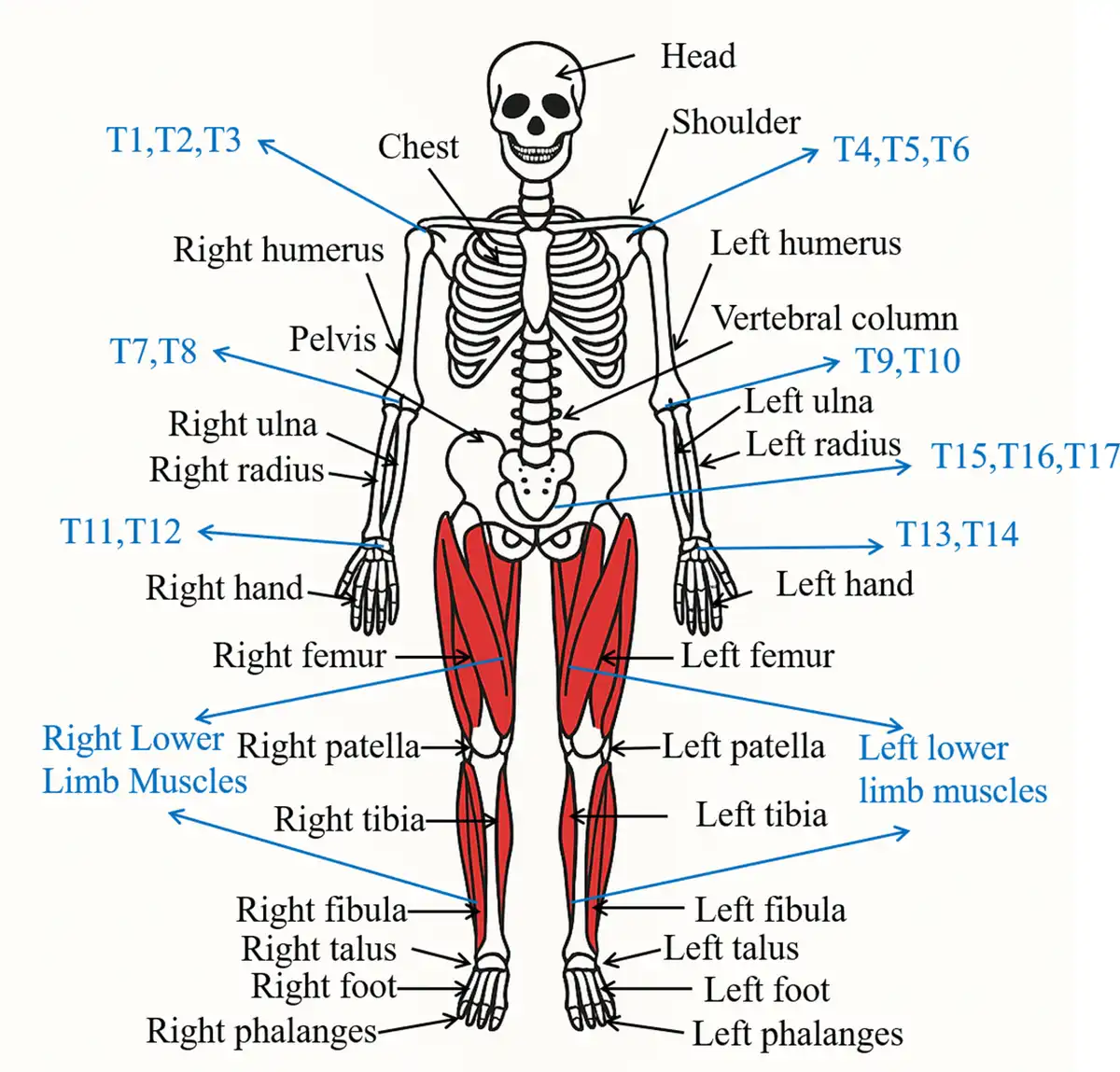
One of the simplest representations is the torque-driven human motion system model, such as the 17 torque actuators (T1, T2, …, T17) of the upper limb and trunk, which is frequently used in structural design and optimal control simulations of wearable robots[19]. While this model enables rapid computation, its biological realism is low, as it does not accurately reflect the true structure of the human motion system.
At the opposite end of the spectrum, the muscle finite element model-driven human motion system provides high-fidelity simulations by incorporating finite element analysis to model muscle function. This approach enables a highly detailed representation of muscle–tendon interactions, allowing for precise characterization of muscle strain, stress distribution, and energy dissipation under various loading conditions. However, this method requires significant computational resources and is often impractical for real-time applications, limiting its use in the development of assistive wearable technologies[20–21–22].
A middle-ground approach utilizes Hill-type muscle models in combination with 3-dimensional skeletal models, making it the most commonly adopted framework for human motion analysis and wearable robot development. This hybrid methodology enables an effective balance between computational efficiency and biological accuracy. In this method, the human motion system is represented as a multi-rigid-body structure actuated by Hill-type muscles, incorporating muscle contraction dynamics while maintaining relatively low computational overhead. Several well-established models exist within this framework, including:
A musculoskeletal model designed for simulating cycling and high-speed running[23].
A customized musculoskeletal model optimized for analyzing squatting mechanics[24].
The TLEM 2.0 dataset, which provides detailed musculoskeletal geometry for lower-limb modeling[25].
The full-body musculoskeletal model is widely used for human gait analysis (illustrated in Figure 1)[26].
Figure 1.
Conceptual schematic of the human skeletal driver system drawn by the authors.
Since the human motion system is typically modeled as a multi-rigid-body system actuated by various types of actuators, its kinematic and dynamic behavior can be described using the fundamental principles of multi-rigid-body system mechanics. However, given the large number of interconnected rigid bodies, traditional 3-dimensional vector-based methods—commonly used in robotics—result in complex and cumbersome calculations[27–28–29].
To streamline these computations, researchers have adopted a 6-dimensional spatial coordinate system to represent the motion variables of each rigid body. The corresponding dynamic equations in 6-dimensional coordinates are then derived, facilitating efficient inverse and forward dynamics analysis of the human motion system. This formulation enhances computational efficiency by reducing redundant calculations associated with large-scale multibody dynamics.
To further improve efficiency, the recursive Newton–Euler method and chain-body algorithm have been employed to solve dynamic equations, significantly reducing computational burdens associated with large-scale musculoskeletal simulations[30,31]. These advancements provide significant potential for real-time motion analysis and optimization in wearable robotics applications.
Future research should prioritize the integration of real-time sensor feedback into these models to facilitate adaptive control mechanisms in wearable robotics. Additionally, exploring machine learning-based surrogate modeling techniques could provide opportunities for expediting inverse dynamics analysis, leveraging data-driven approaches to approximate complex biomechanical behavior with reduced computational cost. Leveraging high-fidelity musculoskeletal models in conjunction with real-time physiological data could enable the development of predictive frameworks capable of dynamically modifying robotic assistance based on user-specific movement patterns and fatigue levels. Achieving this level of adaptability will be essential for optimizing user comfort, enhancing performance, and ensuring the long-term practicality of wearable robotic devices.
2.2 Energy consumption modeling of the human motion system
Energy consumption modeling of the human motion system encompasses 2 primary components:
Generalized power, work, and energy modeling: This method involves computing generalized power by multiplying generalized velocity and generalized force, followed by integration. It provides a mathematical representation of how energy is transferred within the musculoskeletal system, which is critical for analyzing mechanical efficiency and energy expenditure during movement[32].
Muscle metabolic energy consumption modeling: This approach is inherently more complex as it accounts for biochemical energy expenditure. In 2003, Umberger at Arizona State University introduced a model for estimating human muscle energy consumption[33]. This model was later refined by Uchida and colleagues at Stanford University in 2016, improving its accuracy in quantifying metabolic energy expenditure[34].
Muscle energy modeling is particularly important in wearable robotics, as energy-efficient design directly impacts the endurance and usability of assistive devices. Various metabolic cost functions have been developed to estimate energy expenditure during movement, including oxygen consumption rates, ATP hydrolysis models, and electromyographic (EMG) signal-based approaches[32–33–34]. These models allow for more precise energy optimization strategies in wearable robots, ensuring that assistance is provided with minimal metabolic burden to the user.
Further advancements in energy modeling involve integrating real-time physiological measurements, such as heart rate variability and respiratory rate, into predictive frameworks. By continuously monitoring metabolic markers, wearable robots can dynamically adjust their actuation strategies to optimize energy efficiency based on user fatigue levels and exertion states.
2.3 Modeling the human motion control system
The human motion system is a highly redundant system, meaning that multiple muscle activation patterns can produce the same motion. This redundancy makes it extremely challenging to infer neural control signals and muscle excitations from observed movements. Addressing this challenge requires integrating optimization and control methodologies.
Figure 2 summarizes the tendon–muscle dynamics we adopt: muscles are represented as path actuators that exert force along specified lines of action; antagonistic sets of actuators combine to generate the net joint moments that drive motion. Following Millard et al.[35], each muscle–tendon unit includes a passive elastic tendon in series with a muscle modeled by an active contractile element, a passive elastic element, and a viscous damper, with muscle force governed jointly by neural activation dynamics and contraction dynamics.
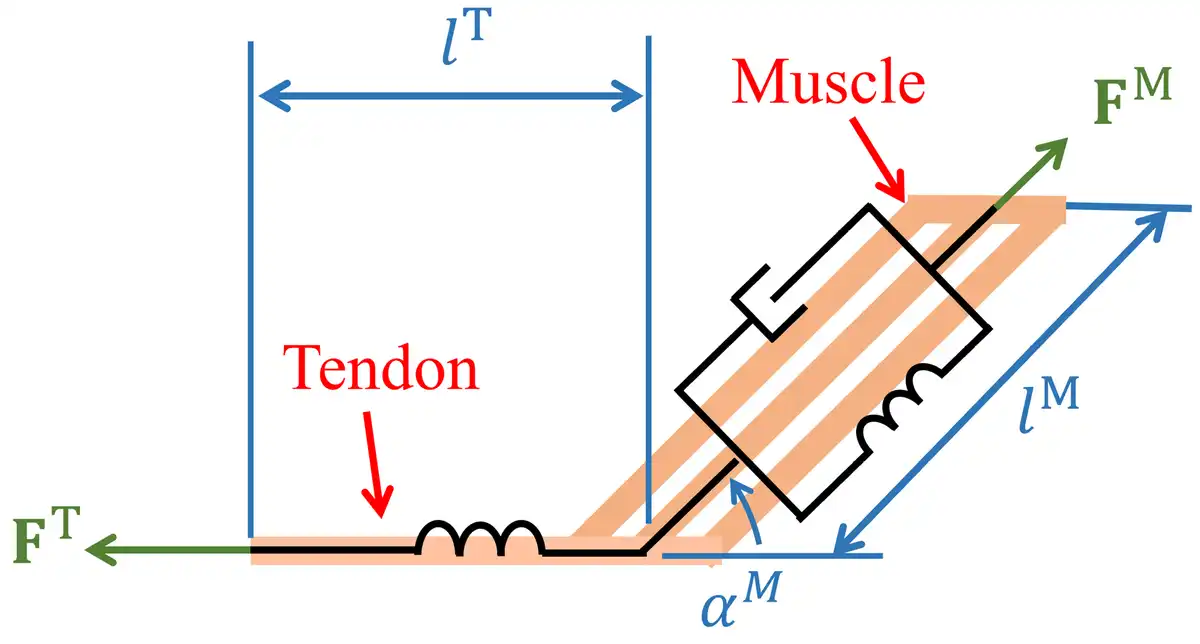
Figure 2.
Author-created schematic of the simplified model of the muscle–tendon system, informed by Millard et al.[35].
Early approaches relied on dynamic optimization techniques, where muscle excitation levels were treated as optimization variables, and the objective was to minimize the discrepancy between simulated and experimental human motion data[36–37–38]. However, when incorporating numerous muscles with complex excitation patterns, solving this optimization problem becomes computationally infeasible due to the large number of state equations requiring full numerical integration.
To mitigate this challenge, researchers have explored 2 primary strategies:
Reducing the number of muscles included in the model to decrease computational complexity while maintaining biomechanical realism[36,39].
Simplifying muscle control signals to limit the number of optimization variables required for simulation[38].
Despite these simplifications, dynamic optimization techniques still demand extensive computational resources, often requiring thousands of iterations of state equation integration. To alleviate this computational burden, inverse approaches have been proposed. Yamaguchi and colleagues[38] developed an inverse method to directly solve for muscle forces, though this approach does not inherently account for muscle properties and requires additional optimization steps to resolve muscle redundancy. Kaplan introduced a second-order dynamic optimization method, utilizing discrete state equations to enhance computational efficiency. However, this method is difficult to implement as it requires manually deriving first- and second-order derivatives of state equations concerning control variables[37].
A more recent and computationally efficient technique is computed muscle control (CMC), which has been widely adopted in biomechanical simulations. Compared with traditional dynamic optimization approaches, CMC offers significant performance advantages by integrating feedforward and feedback control strategies with static optimization algorithms. Unlike dynamic optimization, CMC requires only a single integration of the model’s state equations while still enabling accurate tracking of experimental kinematics. Thelen and colleagues[40,41] at Stanford University have been instrumental in advancing CMC research, using it to validate human motion simulations—such as walking—against experimental data
Beyond CMC, researchers have also explored direct collocation optimization algorithms to model human muscle control. This method has been successfully implemented by Lee and Umberger[42] and De Groote and colleagues[43]. However, while direct collocation enables the simultaneous optimization of large-scale models, the approach remains computationally demanding due to the substantial number of optimization variables involved.
Future research in this area should explore hybrid control strategies that integrate physiological feedback into computational models, allowing for adaptive and context-aware motion control in wearable robotics. Combining control theory with neural network-based predictive models may further enhance real-time motion assistance, paving the way for more intuitive and responsive robotic systems.
3. Optimization methods for wearable robot design
The design process of wearable robots has traditionally followed a concept verification approach, where a prototype is first developed and then evaluated through experimental testing. This methodology relies heavily on the designer’s engineering expertise, statistical data on human motion, and experimental results from test subjects. However, because prototypes must be iteratively refined, this approach is costly and time-consuming. Additionally, it involves human trials, which pose inherent risks, particularly when evaluating wearable robots in extreme environments.
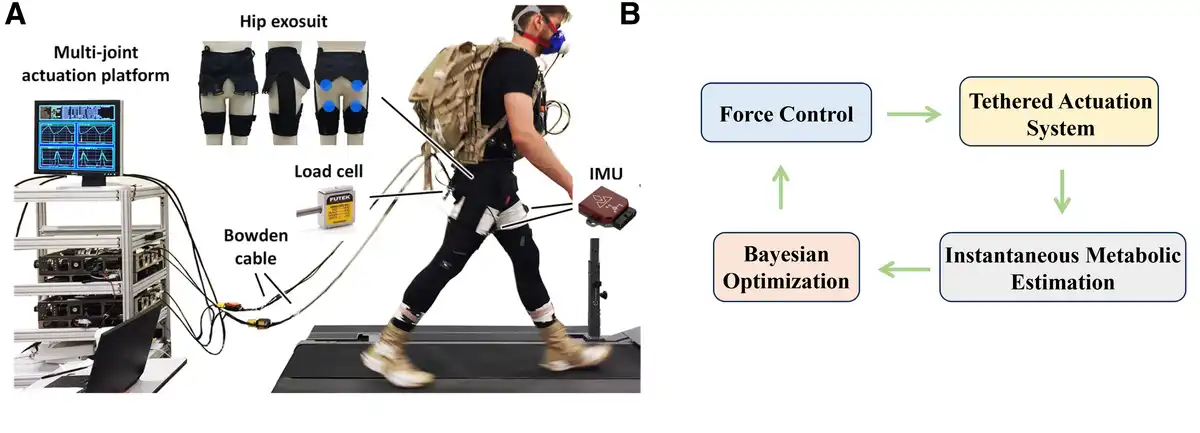
A well-documented example of this method is the development of an unpowered exoskeleton, as reported in Nature[44]. To determine the optimal spring stiffness, the researchers constructed 5 series of exoskeletons with different stiffness values and conducted human trials with 9 healthy participants under 7 distinct experimental conditions. Similarly, when optimizing the control strategies of wearable robots for different users, adjustments are often made based on the designer’s engineering intuition and experimental observations[47,48] as illustrated in Figure 3. However, as the number of control parameters in wearable robots increases[45,49] as illustrated in Figure 3[50], and as user variability becomes more pronounced, this manual adjustment approach becomes increasingly impractical[51].
3.1 Simulation-based optimization for wearable robots
To overcome the limitations of physical prototyping and human experimentation, simulation-based design, also known as virtual prototyping, has emerged as a powerful alternative for wearable robot development. This approach leverages computational simulations to iteratively optimize wearable robots, significantly improving design efficiency and reducing costs. Virtual prototyping enables rapid quantitative analysis of numerous design configurations across diverse simulated scenarios, minimizing the need for physical prototypes and extensive human trials.
By employing physics-based simulations, designers can systematically test different actuation strategies, material compositions, and biomechanical interactions, ensuring that wearable robots meet performance objectives while maintaining user safety and comfort. Advanced simulation environments allow researchers to integrate realistic human musculoskeletal models, control strategies, and interaction forces to refine design parameters before fabrication[46].
Several examples illustrate the advantages of simulation-based design, including:
Wearable robots optimized through simulation to assist in load-bearing walking[52].
Simulated ideal wearable robots designed to enhance running performance[53].
Simulation-based wearable robots aimed at reducing metabolic cost during walking in elderly individuals[54].
Early applications of simulation-based design primarily focused on wearable robots for passive users, where the wearer’s initiative was minimally considered. For instance, early studies optimized the design and control of hand exoskeletons[55] and developed leg exoskeletons for rehabilitation training[56]. However, as wearable robotics technology has evolved, the target user population has expanded, and human–robot interaction has become increasingly integral. This is particularly relevant for flexible wearable robots, where the user’s active engagement must be incorporated into the design process[57]. Consequently, research efforts have shifted toward HITL optimization methods for wearable robots[46,58–59–60] as illustrated in Figure 3.
Building on these advances, recent simulation-to-hardware pipelines have demonstrated the ability to train and deploy exoskeleton assistance strategies without HITL tuning, achieving substantial metabolic reductions[61]. Integrated frameworks combining physical modeling with AI-driven policy learning have been shown to shape high-performance wearable robots for both restoration and enhancement of human function[62]. In upper-limb applications, personalized machine learning-based controllers improved impaired arm function across diverse user populations[63], while novel control formulations based on regulating virtual energy have emerged for coordinated human–exoskeleton locomotion[64].
3.2 HITL optimization for wearable robots
The HITL optimization approach treats the human body and the wearable robot as a coupled system, integrating human biomechanics and robotic dynamics to define optimization objectives and constraints. Optimization algorithms are then employed to identify the optimal design parameters for the wearable robot. Since this method involves solving a complex, nonlinear coupled dynamics problem, computational demands are substantial, making the optimization process highly challenging.
Unlike traditional optimization approaches, HITL optimization continuously adapts to real-time physiological feedback, enabling wearable robots to dynamically adjust their assistance levels based on user movement patterns and energy expenditure. This adaptability makes HITL particularly well-suited for rehabilitation applications, as assistive devices can be personalized for each user’s specific needs and motor capabilities.
To improve computational efficiency, researchers have increasingly drawn inspiration from machine learning-based optimization techniques. For example, Felt et al.[65] examined 3 different optimization algorithms—steady-state cost mapping, instantaneous cost mapping, and instantaneous cost gradient search—to optimize the design of active prostheses, orthoses, and exoskeletons based on dynamic estimation and response surface modeling. However, in many cases, the exact relationship between control parameters and metabolic costs remains unknown, leading to risks of overfitting and bias in optimization results[66,67].
A more robust alternative is Bayesian optimization, which extends traditional response surface methodologies by employing nonparametric regression models and principled data selection strategies[68,69]. Ding et al.[46] and Kim et al.[70] successfully applied Bayesian optimization to the HITL design of flexible wearable robots, demonstrating its effectiveness in refining control strategies. However, most of the existing HITL optimization studies based on Bayesian optimization have focused exclusively on optimizing control schemes for specific wearable robots, relying on partial human trials. These studies do not comprehensively integrate mechanical configuration and material properties into the optimization process.
Future work in HITL optimization should explore multiobjective optimization strategies that balance biomechanical efficiency, user comfort, and energy expenditure. Additionally, integrating physiological markers such as EMG signals, heart rate variability, and metabolic cost estimations into HITL optimization frameworks could further enhance adaptability and robustness. A more comprehensive framework incorporating both real-time and predictive optimization strategies would enable wearable robots to provide truly personalized and adaptive assistance.
3.3 Future directions: generalized HITL optimization
To fully leverage the potential of HITL optimization, it is essential to develop a generalized HITL framework that can simultaneously optimize:
Material properties, ensuring that wearable robots are lightweight, durable, and adaptable.
Geometric configurations, refining the robot’s structure for enhanced comfort and biomechanical compatibility.
Control parameters, improving efficiency and adaptability across diverse user populations.
A truly generalized HITL optimization method would allow for the simultaneous fine-tuning of these 3 aspects, tailoring wearable robot designs to meet the specific needs of different users. This holistic approach would enhance the adaptability, efficiency, and user comfort of wearable robotic systems, paving the way for next-generation assistive and augmentative technologies.
Beyond conventional biomechanical metrics, future research should explore integrating cognitive and neuromuscular factors into HITL optimization. By incorporating neural control models and brain–computer interface (BCI) technologies, wearable robots could be designed to respond more intuitively to user intent, further enhancing user-robot synergy.
Additionally, advancing real-time adaptive learning algorithms within the HITL framework will allow wearable robots to refine their assistance strategies over time. By continuously learning from user movement patterns and physiological signals, assistive devices can evolve dynamically, improving long-term rehabilitation outcomes and enhancing daily usability for individuals with mobility impairments.
Future studies should also focus on developing standardized HITL optimization protocols to ensure reproducibility and cross-study comparisons. A unified approach to optimization in wearable robotics would accelerate progress in this field, fostering more effective and widely accessible robotic assistance solutions.
4. Design and control of McKibben-type pneumatic muscle-driven antagonistic joints
To enhance safety and user-friendliness in direct human–robot interactions, many robotic systems utilize McKibben-type pneumatic artificial muscle-driven antagonistic joints as their primary rotational mechanisms. These joints are widely applied in various domains, including medical robotics[71], wearable exoskeletons[72], and robotic manipulators[73,74]. The inherent flexibility and lightweight nature of McKibben-type pneumatic artificial muscle-driven antagonistic joints provide several advantages, such as collision mitigation, energy storage, and reduced contact forces between the robot and its environment during operation. However, these same properties introduce significant complexities in dynamic modeling and control, further compounded by the uncertainties associated with human–robot interactions, making precise control and modeling of these joints particularly challenging.
In response to these challenges, researchers have pursued innovative actuator integrations and control strategies. Recent designs have expanded the capabilities of McKibben-type actuators by integrating them with other soft robotic technologies. For example, Cacucciolo et al.[75] introduced an electrically-driven soft fluidic actuator that combines stretchable pumps with thin McKibben muscles, enabling lightweight, portable actuation without external pneumatic sources. This approach retains the compliance and high force-to-weight ratio of McKibben muscles while improving autonomy and wearability, making it highly suitable for mobile or wearable robotic applications (Figure 4A). In parallel, Li et al.[76] developed a musculoskeletal bipedal lower-limb robot driven by McKibben-type muscles and controlled via a spring-loaded inverted pendulum (SLIP) model. This system demonstrated stable and efficient walking through a combination of accurate dynamic modeling and model-based gait control, underscoring the potential of McKibben-type antagonistic joints for legged locomotion (Figure 4B, C).
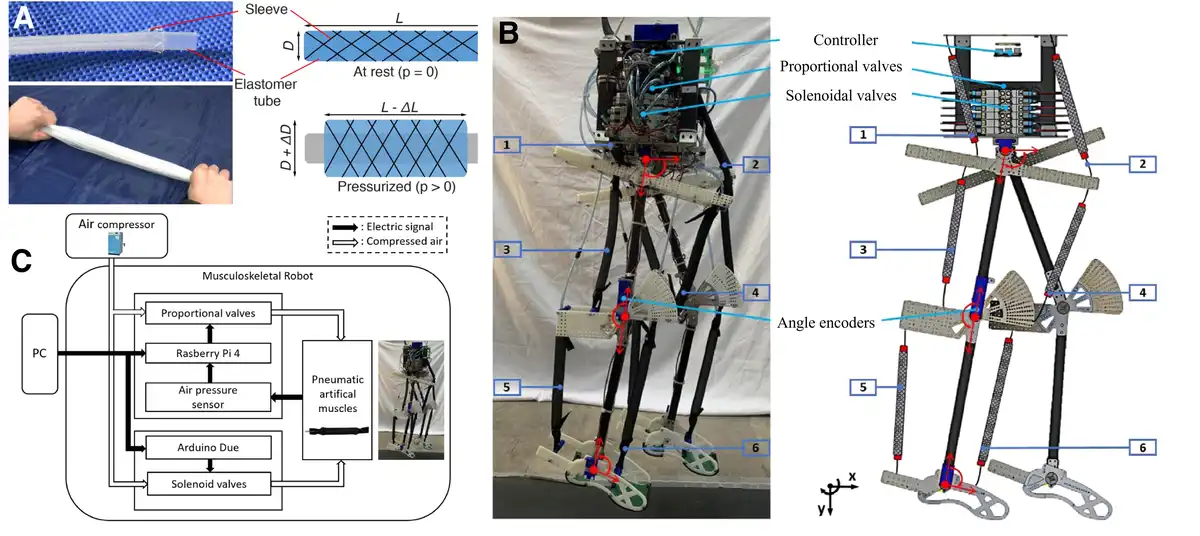
Figure 4.
(A) McKibben muscles illustration. Adapted from Cacucciolo et al.[75] Copyright 2020, The Authors. (B) Bipedal pneumatic musculoskeletal lower-limb robot developed based on the SLIP model. Adapted from Li et al.[76] under CC BY 4.0. (C) The control system of the lower-limb robot[76]. Copyright 2024, The Authors.
4.1 Model-free and model-based control approaches
To achieve accurate control of robots driven by flexible actuators, roboticists have explored both model-free and model-based control strategies. The choice between these 2 approaches largely depends on the specific application requirements, computational constraints, and the degree of modeling accuracy needed.
4.1.1 Model-free control methods
Model-free control techniques offer an intuitive approach that does not require explicit dynamic modeling. Instead, these methods directly utilize feedback-based control mechanisms to regulate joint motion. Among the most widely used model-free control approaches are proportional-integral-derivative (PID) controllers and their improved variants, such as:
A PID controller designed for climbing robots actuated by pneumatic artificial muscles[77].
A fuzzy logic-based controller for pneumatic artificial muscle systems[78,79].
A nonlinear neural network PID controller for robotic manipulators using pneumatic artificial muscles[80,81].
These methods are particularly beneficial in scenarios where obtaining an accurate dynamic model is impractical due to time-varying system properties and unknown disturbances. However, model-free control methods often require extensive parameter tuning and may struggle with handling nonlinearities and hysteresis effects present in McKibben-type pneumatic artificial muscles. Although they eliminate the need for intricate dynamic models, they suffer from feedback delays and do not fully exploit the underlying physical properties of the system. Consequently, while they offer a practical solution, they may not be optimal for high-performance control tasks.
4.1.2 Model-based control methods
Compared with model-free approaches, model-based control strategies typically offer superior performance by leveraging system dynamics for enhanced precision. These methods include:
Feedforward-based dynamic surface control[84].
Adaptive backstepping control[85].
Gain regulation control[86].
Model-based control approaches utilize system identification techniques to derive mathematical representations of actuator dynamics, enabling more accurate and responsive control schemes. The SLIP model-based gait controller developed by Li et al.[76] exemplifies how model-based methods can yield stable locomotion in McKibben-driven legged systems. However, the inherent nonlinearities, hysteresis, and unpredictable disturbances in McKibben-type pneumatic artificial muscle-driven antagonistic joints make accurate modeling highly challenging. These complexities limit the effectiveness of traditional model-based control methods and necessitate the development of advanced compensation strategies to account for model uncertainties.
4.2 Advancements in model-based control compensation strategies
To improve model-based control techniques, researchers have pursued advancements in 2 key areas: enhancing modeling techniques for McKibben-type pneumatic artificial muscles and developing compensation strategies for model-based control.
4.2.1 Enhancing modeling techniques for McKibben-type pneumatic artificial muscles
Several methodologies have been proposed to improve the accuracy of dynamic models, including:
Theoretical modeling approaches, which derive system dynamics based on first-principle physics laws[87].
Phenomenological modeling techniques, which use empirical data to develop models that approximate system behavior[88,89].
Active modeling strategies, which incorporate real-time learning techniques to continuously update model parameters during operation[90].
Despite substantial progress in these areas, existing models still contain unknown uncertainties and time-dependent parameters, which are difficult to identify through experimental data alone. A key challenge remains in achieving a balance between model accuracy and computational efficiency, as overly complex models may introduce excessive latency in real-time control applications. The integration of stretchable pump technology with thin McKibben muscles, as demonstrated by Cacucciolo et al.[75], introduces new design parameters—such as embedded pumping dynamics—that future models will need to capture accurately.
4.2.2 Developing compensation strategies for model-based control
In response to the limitations of current models, researchers have introduced compensation strategies to enhance control performance. Notable contributions include:
Cascade position control with hysteresis compensation for McKibben-type pneumatic artificial muscles, introduced by Minh et al.[91].
Dynamic compensation strategies to address hysteresis effects, improving tracking accuracy and response time, proposed in 2012[92].
More recently, researchers have developed innovative compensation methods, such as:
Guaranteed cost control techniques, which ensure system stability under bounded uncertainty conditions[93].
Feedforward torque control methods for dynamic compensation, which predict actuator response based on estimated external forces[71].
Model-based active control approaches, which integrate learning-based adaptation mechanisms to compensate for time-varying model inaccuracies[94].
4.3 Model predictive control for pneumatic muscle-driven joints
Model predictive control (MPC)[95] is a powerful framework for handling multi-input, multioutput systems with constraints, enabling real-time predictions to adjust control actions dynamically. Its ability to explicitly incorporate actuator limits, safety constraints, and performance objectives makes it well-suited for antagonistic joints driven by McKibben-type pneumatic artificial muscles. However, pneumatic muscle-driven joints exhibit strong nonlinearities, hysteresis, and time-varying parameters, which impose stringent model accuracy requirements[96] and can degrade predictive performance.
4.3.1 Mathematical formulation
In discrete time, an MPC problem[95] can be expressed as
where contains joint states (eg, angle, angular velocity, and chamber pressures), are valve or pump commands, and model’s disturbances. Over a prediction horizon , the quadratic program solved at each control step is:
where , , and are positive semidefinite weight matrices for tracking, smoothness, and terminal error, and penalizes soft-constraint violations. In antagonistic McKibben joints, this framework allows explicit incorporation of joint torque/angle limits, pressure bounds, and rate constraints, while updating model matrices from either physics-based identification or data-driven estimation.
4.3.2 Applications in wearable robotics
This general MPC framework has been applied in several wearable robotic contexts. Laguerre-based MPC has been implemented in upper-limb rehabilitation robots, achieving accurate trajectory tracking with reduced computational load[97]. In lower-limb systems, Jammeli et al.[98] integrated explicit MPC with a nonlinear disturbance observer, improving tracking accuracy and reducing assistance torque compared with PID control. Cao et al.[99] integrated nonlinear MPC with an echo state Gaussian process model to handle hysteresis and nonlinearities. MPC has been used in tremor suppression applications, where model-based prediction enables precise and adaptive assistance[100]. Switching-MPC based on piecewise-affine models has been validated for McKibben muscle systems, demonstrating applicability to constrained joint control tasks[101].
4.3.3 Adaptive MPC variants
To mitigate model inaccuracies and time-varying effects, several adaptive MPC approaches have been proposed:
Tube-MPC for robust control, which constrains system deviations within a predefined uncertainty set[102].
Chance-constrained MPC, which accounts for uncertainties in control parameters and ensures stability under probabilistic constraints[103].
Model reference adaptive control, which continuously adjusts MPC models based on real-time feedback[104].
While these strategies improve robustness, they also increase computational complexity and require substantial tuning expertise, which can limit their adoption in real-time wearable applications.
4.3.4 Implementation loop
A typical implementation loop involves:
[1] Sensing: joint angle, velocity, and chamber pressure (inertial measurement unit (IMU), encoders, pressure transducers).
[2] State estimation: Extended Kalman filter or disturbance observer.
[3] Prediction: update model with latest parameters.
[4] Optimization: solve the quadratic program (QP) for .
[5] Actuation: send updated valve or pump commands.
Figure 5 illustrates this process, integrating trajectory and constraint inputs, prediction modeling, optimization, actuation, sensing, and state estimation into a real-time control loop.
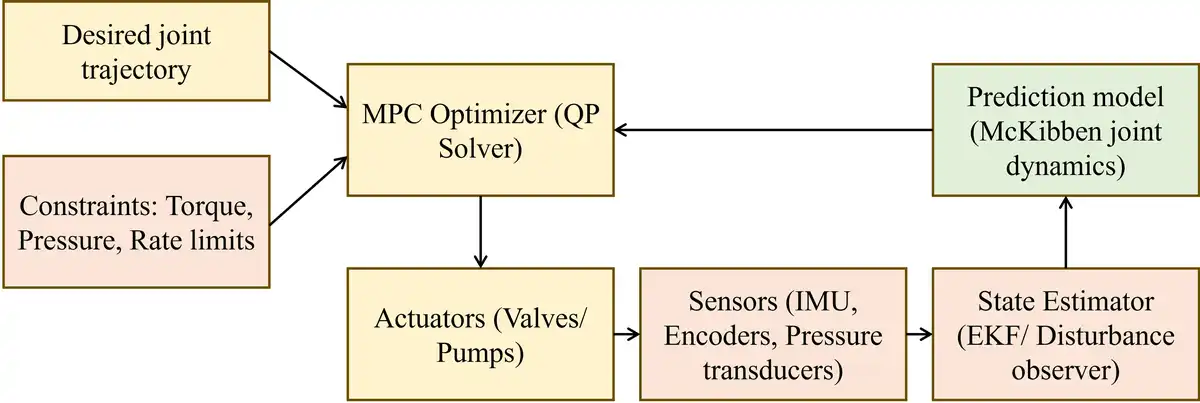
Figure 5.
MPC framework for McKibben-type pneumatic muscle-driven joints, showing trajectory and constraint inputs, prediction modeling, QP-based optimization, actuation, sensing, and state estimation for real-time, constraint-aware control.
4.4 AI-driven approaches for MPC optimization
With the advancements in AI, many data-driven MPC techniques have been developed to address the model uncertainty challenges associated with pneumatic muscle-driven antagonistic joints. Some notable AI-driven MPC approaches include:
Neural network-based MPC for piezoelectric actuators, which learns actuator dynamics from historical data[105].
Reinforcement learning-based MPC controllers for robotic arms, which continuously refine control policies through trial-and-error learning[106].
Echo state network-based MPC for flexible exoskeletons, which leverages reservoir computing to model complex system dynamics efficiently[99].
Beyond these examples, recent AI-assisted MPC work has landed directly in wearable contexts. Laguerre-based MPC has been deployed on an upper-limb rehabilitation robot with low computation and strong tracking performance, making real-time implementation practical[97]. For lower-limb devices, disturbance-rejection MPC augmented with an extended-state observer improves robustness to human-induced uncertainties[107], and MPC has also been used clinically motivated for tremor suppression in a wrist exoskeleton[108]. Related formulations include robust tube-based nonlinear model predictive control (NMPC) demonstrated on a hybrid knee exoskeleton[109] and Koopman-based MPC variants tailored to tremor dynamics with online model updating[110]. On the learning side, deep models embedded inside MPC can replace hard-to-identify dynamics while retaining constraint handling[111]; similarly, data-driven predictive control frameworks have been proposed to synthesize gaits directly from measured trajectories without explicit plant models[112]. Complementary to these model-based approaches, sim-to-real reinforcement learning shows how learned assistance policies can transfer to hardware and reduce metabolic cost[61], with musculoskeletal-model reinforcement learning (RL) providing convergent evidence for robust locomotion controllers[113]. In parallel, HITL optimization with machine learning surrogates personalizes controller parameters in real time[114], including sample-efficient preference-based tuning for ankle assistance[115], EMG-informed HIL on a portable hip exoskeleton[116], and preferential multiattribute Bayesian optimization for exoskeleton personalization[117]. User-specific policy learning via Gaussian processes offers a low-data path to personalization and motivates the Gaussian process regression (GPR)-MPC integration discussed next[118].
Although these methods show promise in learning nonlinear dynamics, they require extensive training data and computational resources. Moreover, training these models is complex, often necessitating the collection of large datasets to achieve optimal performance.
4.5 GPR for MPC in antagonistic joint control
To overcome the challenges posed by deep learning-based control methods, GPR has emerged as a promising alternative. Unlike neural networks, GPR requires minimal prior data and is capable of approximating a wide range of nonlinear functions[68,119,120].
In regression form, given training data and a kernel function , the GPR predictive distribution for a test input is:
where is the Gram matrix of training points, , and is the observation noise variance. In GPR-MPC, models system dynamics (eg, joint torque response), while informs robust constraint handling in the MPC optimization problem[68,121].
GPR has been successfully implemented for modeling the dynamics of various systems, including:
Internal combustion engine charging cycles[122].
Chemical pH neutralization systems[123].
Autonomous robotic ship navigation[124].
Lower-limb exoskeletons enabling rapid adaptation to individual biomechanical patterns[118].
The integration of GPR and MPC presents a compelling strategy for precise control of McKibben-type pneumatic muscle-driven antagonistic joints. By adaptively modeling system uncertainties and feeding both predicted means and uncertainty bounds into the MPC optimizer, this hybrid approach can improve control accuracy while reducing reliance on extensive precollected training datasets.
5. Flexible actuators and flexible wearable robot design
5.1 Global contributions to wearable robotics: institutions, research initiatives, and applications
Wearable robots, designed to support, restore, or enhance human mobility, have gained significant attention from leading research institutions worldwide. Several prominent organizations—including NASA, DARPA, the BioRobotics Institute at the Sant’Anna School of Advanced Studies, Harvard University, the SPEXO team under the European Union, the Aspire Create team in the United Kingdom, and Stanford University—have made substantial contributions to advancing wearable robotic technology. Their research covers diverse areas such as human–robot interaction, flexible actuation mechanisms, control methodologies, and optimization techniques aimed at improving human movement efficiency.
5.1.1 NASA’s Johnson Space Center
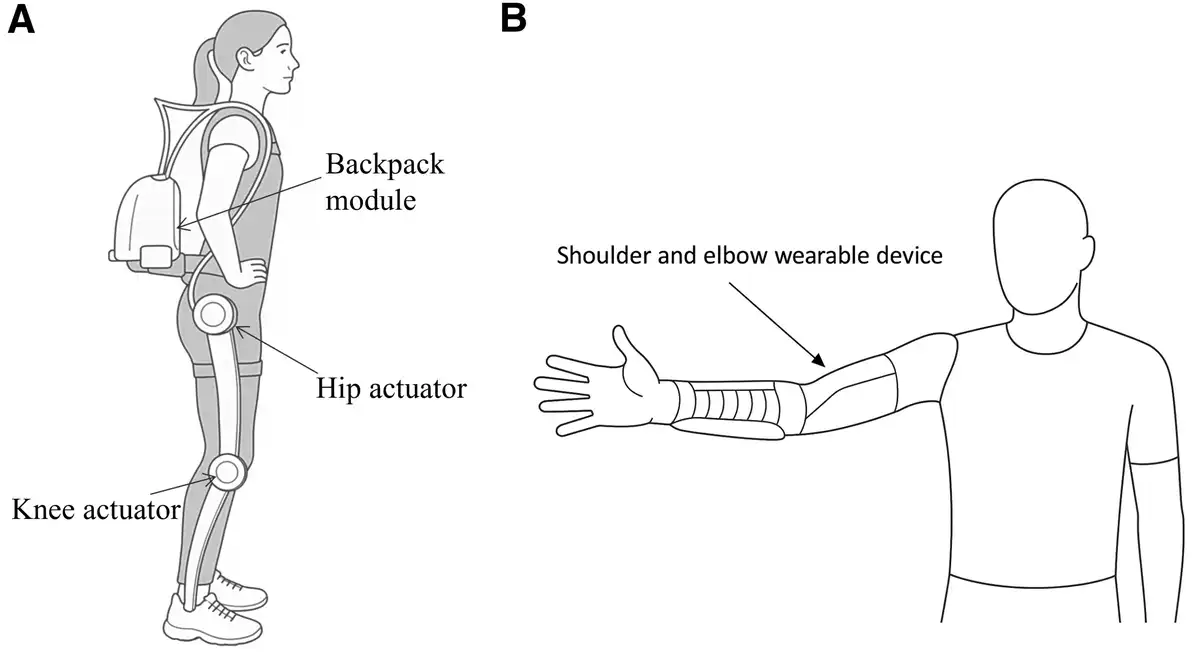
NASA’s Johnson Space Center has been at the forefront of developing wearable robotic exoskeletons, primarily to prevent muscle atrophy and bone loss in astronauts during prolonged space missions. As illustrated in Figure 6, these exoskeletons function as alternatives to traditional, bulky exercise equipment on space stations, thus optimizing space utilization and astronaut health[126]. To enhance astronauts’ ability to manipulate objects in microgravity, NASA has also engineered space gloves that improve grip strength. Furthermore, the center has designed wearable assistive devices with independently controlled shoulder and elbow joints, which enhance upper-limb dexterity in confined environments[127]. NASA’s long-term goal is to adapt these technologies for civilian applications, such as reducing fatigue and repetitive stress injuries, assisting individuals with mobility impairments, and augmenting human performance[128].
5.1.2 DARPA’s Warrior Web project
DARPA launched the Warrior Web project, which focuses on developing a lightweight, soldier-worn robotic system that functions similarly to a diving suit[129]. This system aims to mitigate musculoskeletal injuries in battlefield environments while enhancing combat performance. The project is divided into:
Task A, which explores 5 core technological aspects: injury mitigation, integrated system characterization, renewable actuation, adaptive sensing and control, and human–machine interaction.
Task B, which integrates these technological advancements into a fully functional, wearable robotic system for soldiers.
5.1.3 The BioRobotics Institute’s Wearable Robotics Laboratory
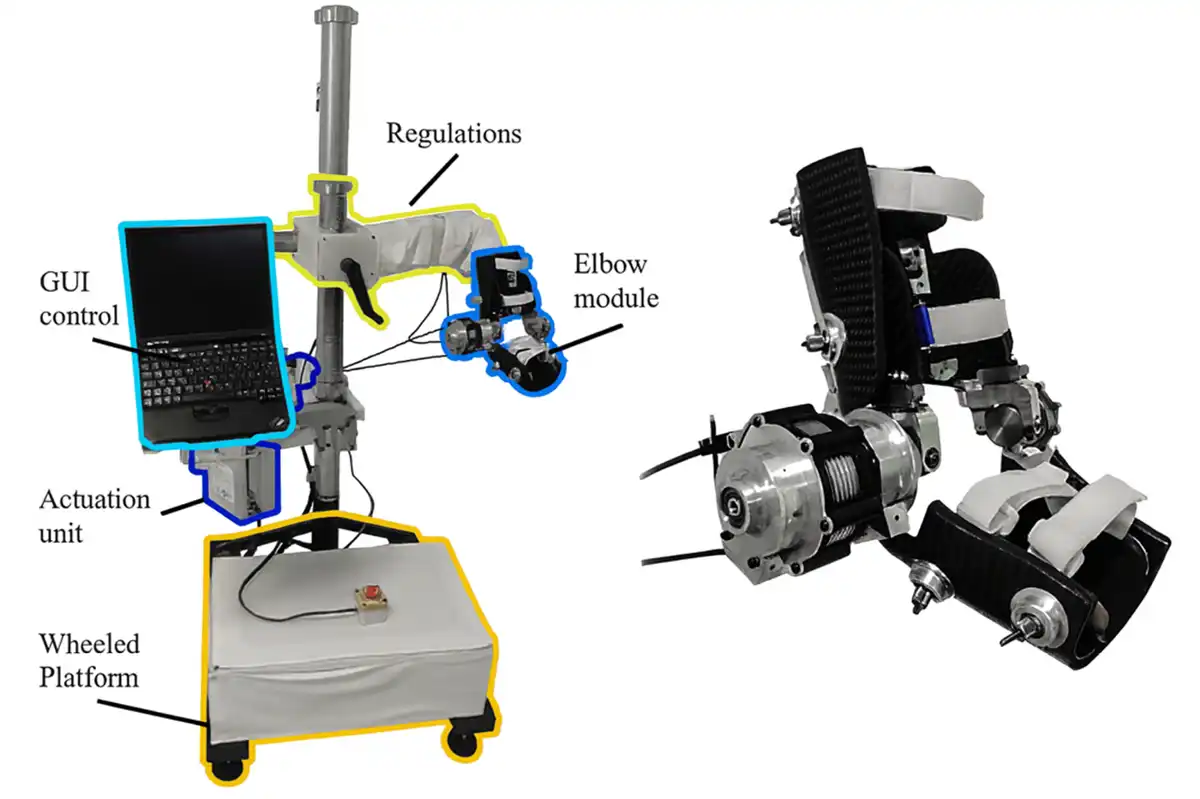
The BioRobotics Institute at the Sant’Anna School of Advanced Studies in Pisa, Italy, is one of the pioneering research centers in wearable robotics[130–131–132]. The institute houses 10 specialized laboratories and 8 primary research domains. It has developed numerous wearable robotic prototypes, including human–machine-integrated prosthetic hands, exoskeletons for upper and lower limb assistance, and wearable robotic footwear[133–134–135], as illustrated in Figure 7.
5.1.4 Harvard University’s Biodesign Laboratory
Harvard University’s Biodesign Laboratory specializes in the development of flexible wearable robots using functional textiles[14,16]. Since 2008, the lab has contributed significantly to wearable robotics research, publishing seminal studies on the metabolic cost reduction through soft exosuits[136–137–138–139] and wearable robots for gait rehabilitation in stroke patients[140].
This lab has designed and developed flexible wearable robots targeting different populations using functional textiles as the main material, and has published dozens of classic articles since 2008[137,138]. The flexible wearable robots that reduce metabolism during walking or running and the flexible wearable robots used for gait recovery in stroke patients have been published in the journals Science, Science Robotics, and Science Translational Medicine. As shown in Figure 8, the wearable robot designed by the team is characterized by using Bowden cable drive. Its main advantage is that the wearer’s joints are not constrained by external rigid structures, and it is lightweight, just like ordinary clothing, which can interact with the human body more naturally. The main research directions of the laboratory are functional textiles, lightweight and effective drivers, wearable sensors, intuitive and robust control methods, etc. Recent representative advances from this lab and collaborators include a study showing soft robotic apparel averting freezing of gait in Parkinson disease[141], a field evaluation where an active back exosuit reduced back muscle activation during an hour-long order-picking task[142], and an inpatient feasibility study that updated the Lab’s hip flexion exosuit for therapist-driven stroke rehabilitation[143].
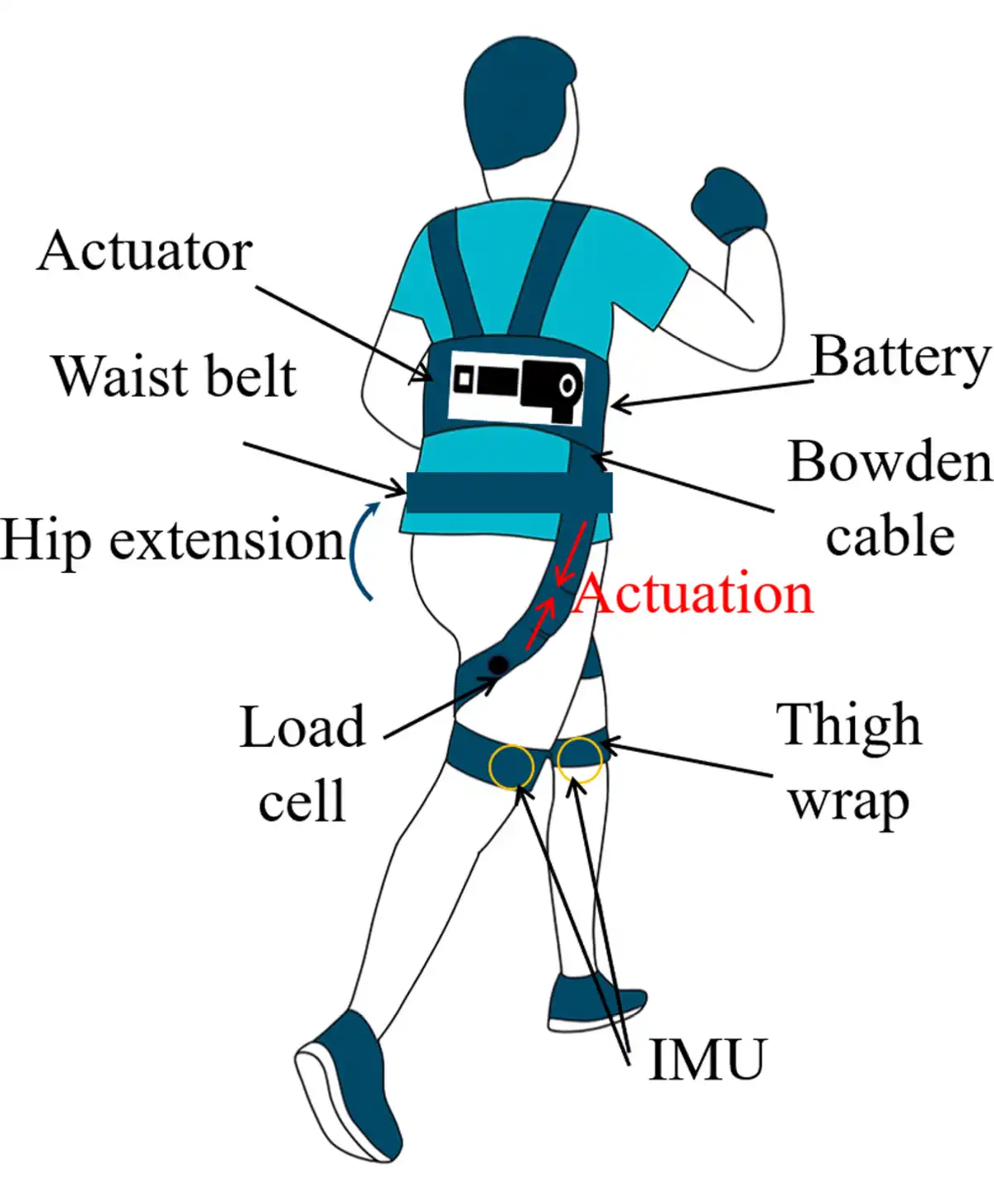
Figure 8.
Author-created schematic representation of wearable robots developed by the Harvard Biodesign Laboratory based on studies by Kim et al.[137] and Quinlivan et al.[139] The devices employ Bowden cable–driven actuation to assist movements such as hip flexion/extension and plantar flexion, featuring functional textiles, lightweight actuators, wearable sensors, and intuitive control strategies.
5.1.5 The SPEXO project
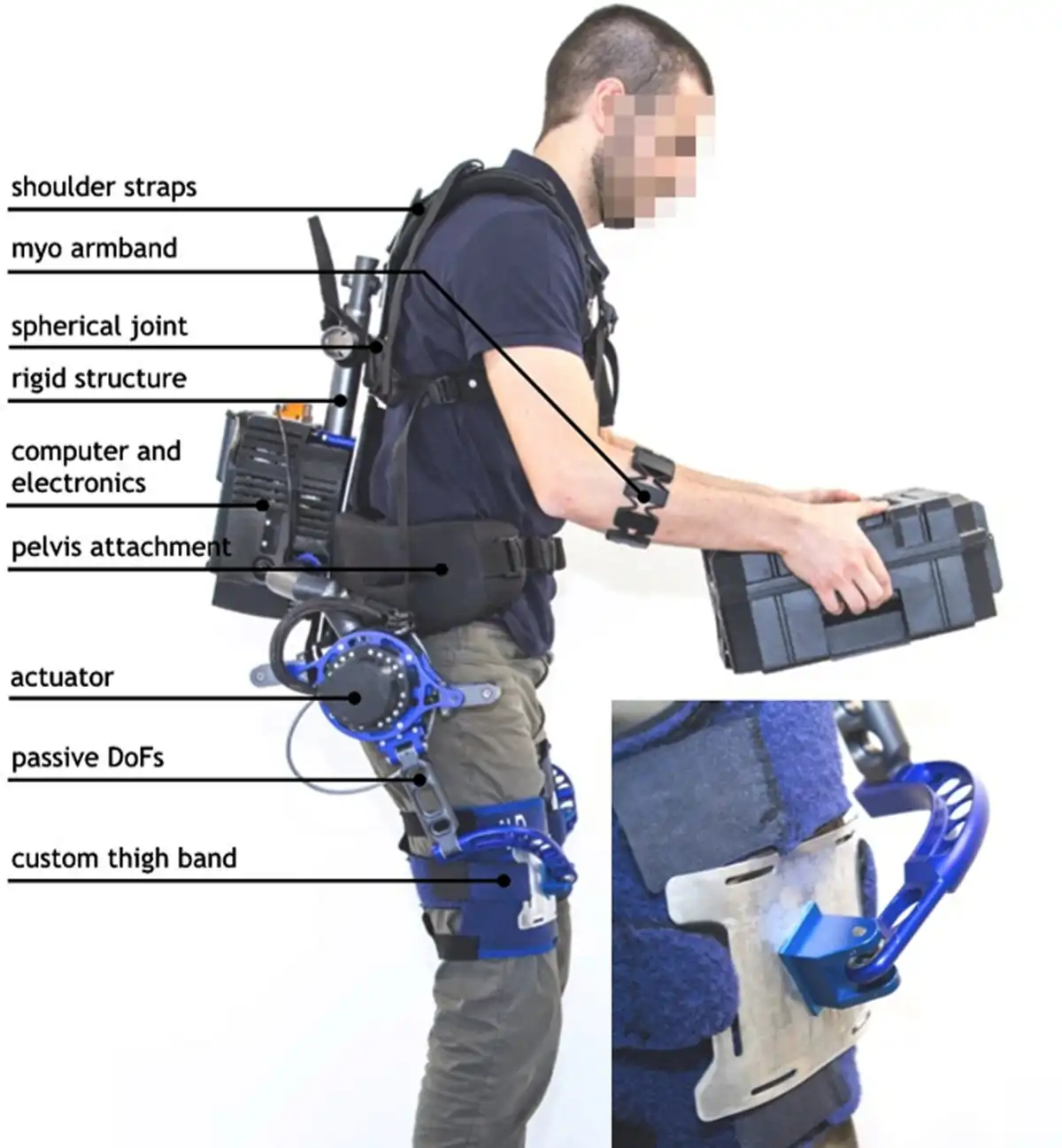
The SPEXO project is an EU Horizon 2020-funded initiative dedicated to developing wearable robotic solutions for individuals suffering from back pain. This multidisciplinary team consists of medical professionals and engineers from multiple European countries. They have successfully developed a hybrid wearable system that integrates both passive and active components[144–145–146] as shown in Figure 9.
5.1.6 The Aspire Create Team
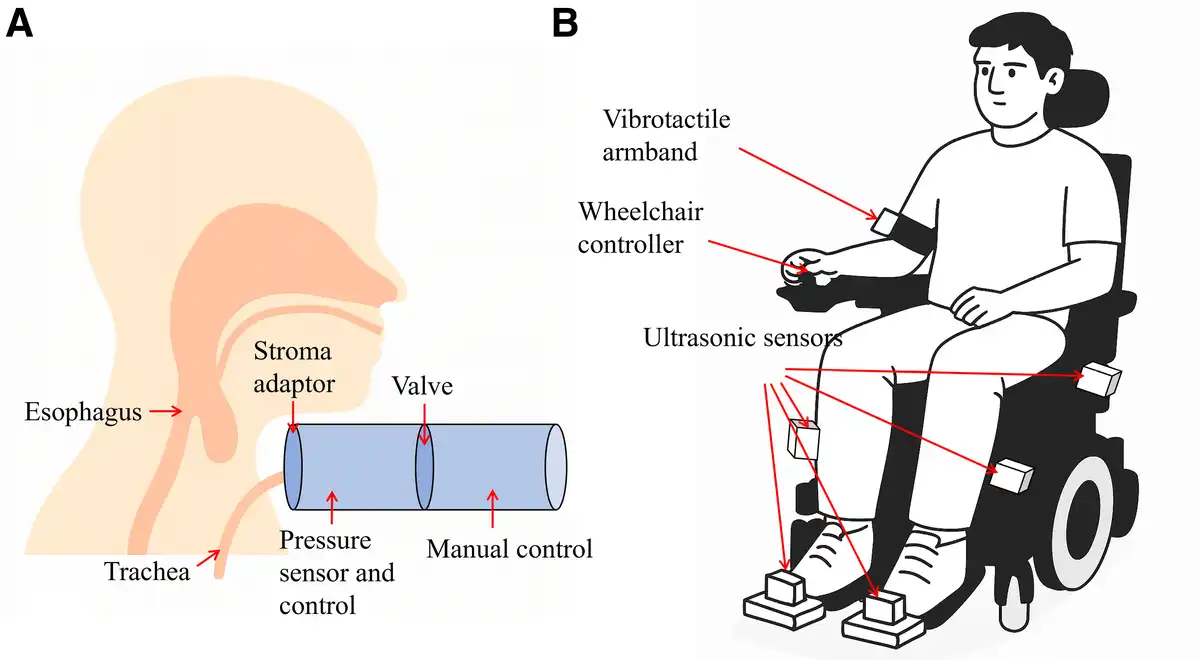
The Aspire Create Team, formed in collaboration between Aspire Charity, University College London, and the National Orthopaedic Hospital, was established in 2014 with the aim of improving the quality of life for individuals with spinal cord injuries. As depicted in Figure 10, the team has developed assistive technologies, including cough assist machines and smart wheelchairs for rehabilitation[147,148], with a focus on human–machine interaction and shared-control systems; recent outputs extend this line of work by presenting a modular smart-wheelchair architecture with built-in assistive features[149], demonstrating a time-of-flight-based shared-control “table-docking” method on a prototype power wheelchair[150], and outlining an equitable shared-control framework that personalizes assistance policies for assistive robotics[151].
5.1.7 Stanford’s Neuromuscular Biomechanics Laboratory
Stanford’s Neuromuscular Biomechanics Laboratory investigates human muscle function and movement mechanics, developing medical technologies to enhance human performance[152,153]. One of its most impactful contributions is OpenSim, a software tool used for human musculoskeletal modeling, kinematic and dynamic analysis, mechanical design, and control optimization[154–155–156]. Many wearable robot research projects utilize OpenSim for preliminary simulations[157]. Additionally, the Open Knee software is specifically designed for finite element modeling and simulation of knee joint biomechanics[158]. More recently, the lab introduced OpenCap[159], an open-source platform that computes 3D kinematics and dynamics from synchronized smartphone videos, expanding access to movement analysis, and leveraged simulation to identify touchdown kinematics that influence top sprinting speed, highlighting translational links to performance coaching[160].
5.1.8 Other research institutions
Beyond these major research institutions, several other organizations have made notable contributions to wearable robotics. The British Association of Spinal Surgeons (BASK) focuses on knee joint biomechanics and surgical interventions, with its journal, The Knee, serving as a key platform for publishing research on knee mechanics, rehabilitation strategies, and wearable robotic technologies; it is the official publication of BASK and has recently published joint BASK–EKS consensus statements relevant to current clinical practice[161,162]. Similarly, the General Hospital of the Guangzhou Military Region in China has conducted extensive research on knee joint rehabilitation, particularly in the development of personalized 3D-printed wearable titanium plates for postsurgical recovery in knee tumor patients[163–164–165]. These contributions, along with research from leading institutions worldwide, underscore the wide-ranging applications of wearable robots. These technologies are increasingly employed to reduce physical strain in industrial workers, facilitate stroke rehabilitation, and optimize human metabolic efficiency during movement, while also being leveraged for sports performance enhancement, military applications, aerospace missions, and everyday assistive technologies[166–167–168–169–170]. As wearable robotics continues to evolve, ongoing advancements in material innovation, actuation strategies, and control optimization are crucial to expanding its impact across multiple disciplines and unlocking its full potential.
5.2 Advancements in wearable robot actuators: from rigid exoskeletons to flexible TPU-based systems
The research efforts of the aforementioned institutions demonstrate the broad and diverse applications of wearable robots. These systems are employed not only to reduce physical strain in workers, facilitate rehabilitation for stroke patients, improve the athletic ability of athletes, and enhance movement efficiency by lowering metabolic energy consumption, but also in areas such as sports performance enhancement, military operations, aerospace exploration, and assistive technologies. Given this wide scope, further research into the technical challenges and optimization strategies of wearable robots is crucial for expanding their capabilities and applicability across multiple fields.
Early wearable robotic systems were predominantly rigid exoskeletons[171,172], incorporating motor-driven actuators, linkage mechanisms, transmission mechanisms, and clutch spring systems[173–174–175]. Although rigid exoskeletons can provide effective movement assistance, their large weight and limited mechanical degrees of freedom constraints often interfere with the user’s natural biomechanics movement behavior[176,177]. Additionally, these systems increase user’s metabolic energy expenditure[178,179], making prolonged use physically demanding. A notable limitation of the rigid exoskeletons is seen in knee joint devices, where the fixed rotational axis of the exoskeleton fails to align with the dynamic, shifting axis of the human knee during various movement[179]. This misalignment can lead to skin irritation, increased joint loading, and long-term joint degradation, elevating the risk of arthritis for wearers[180,181]. Additionally, the high cost, complex structural design, and difficulty in control further hinder the widespread adoption of rigid exoskeletons[171,178]. Consequently, there is a strong demand for lightweight, cost-effective, and easily controllable flexible wearable robots.
Flexible actuators have become a key focus in wearable robotics research[182–183–184], with scientists increasingly exploring functional materials for actuator development. Some promising materials include shape-memory alloys (SMAs), which can alter their shape in response to temperature or magnetic field changes[185], and electroactive polymers, which generate torque through high-voltage stimulation[186]. However, both material types require specialized operating conditions, such as high temperatures or high voltages, which raise safety concerns for wearable applications. Another widely used flexible actuator is the Bowden cable system, which has been successfully integrated into wearable robots. However, due to the linear motion mechanism of cables, this type of wearable robot requires additional rigid components, such as metal frames and gear conversion mechanisms to convert linear forces into rotational motion, thereby achieving rotational motion assistance for joints[46,139,187].
Pneumatic actuators have attracted a lot of interest in the field of wearable robots due to their characteristics, such as small mass, low cost, skin friendliness, and deformability[188–189–190]. Among them, the McKibben-type artificial muscles have been widely studied for their ability to generate high force outputs. However, their application in wearable robotics remains limited, as they still require linear-to-rotational motion conversion mechanisms[191,192]. To address this limitation, researchers have modified the McKibben-type actuators to develop the fiber-reinforced pneumatic actuators, which can directly produce bending motion without the need for rigid motion conversion mechanisms[8]. Despite their advantages, both the McKibben-type and the fiber-reinforced actuators depend on high gas pressure drive systems, introducing potential safety concerns in wearable applications. Additionally, other researchers have proposed rigid-flexible hybrid bending actuators[193,194], but their complex manufacturing process limits their practicality for widespread adoption.
TPU has emerged as a promising material for flexible actuators, widely used in airbags and food packaging due to its lightweight, cost-effective, and low-pressure operation. TPU actuators present significant potential in wearable robotics, as they are easily shaped and can provide assistance safely at low pressure. Recent studies have explored TPU-based actuators for wearable applications.
5.2.1 Mathematical modeling of TPU-based soft actuators
To quantitatively capture the performance of pressurized bending TPU actuators, a quasistatic model can be formulated from virtual work principles:
where is the chamber pressure, the internal chamber volume as a function of bend angle , a viscous damping coefficient, and a lumped friction/hysteresis term. This pressure–geometry leverage concept is foundational in soft pneumatic actuator literature and is summarized in the comprehensive review by Xavier et al.[195] For actuators using linear end-effector motion (eg, strap or tendon interfaces), an analogous force model,, where is displacement.
Embedding this actuator model into a dynamic joint-level framework gives:
with joint inertia , passive damping , and application-specific load torque . This dynamic structure aligns well with modeling approaches for fiber-reinforced elastomer actuators as described by Polygerinos et al.[8].
Crucially, geometric factors—such as chamber layout, wall thickness, and fiber orientation—determine and thus influence actuator torque generation, which supports design optimization to balance motion and force—insights supported in Polygerinos et al.[8] and related modeling studies[196].
5.2.2 Applications of TPU-based actuators in wearable robotics
As shown in Figure 11A, Natividad et al. developed a reconfigurable pneumatic bending actuator with replaceable inflation modules that can achieve bending motion assistance at various angles by adjusting the number of modules. However, its output force is insufficient to provide sufficient motion assistance for wearable robots[197]. Meanwhile, Nesler et al.[198] introduced a self-intersecting pneumatic actuator capable of generating joint torque to assist human movement, but its airflow efficiency during inflation and exhaust processes is low at large bending angles (Figure 11B).
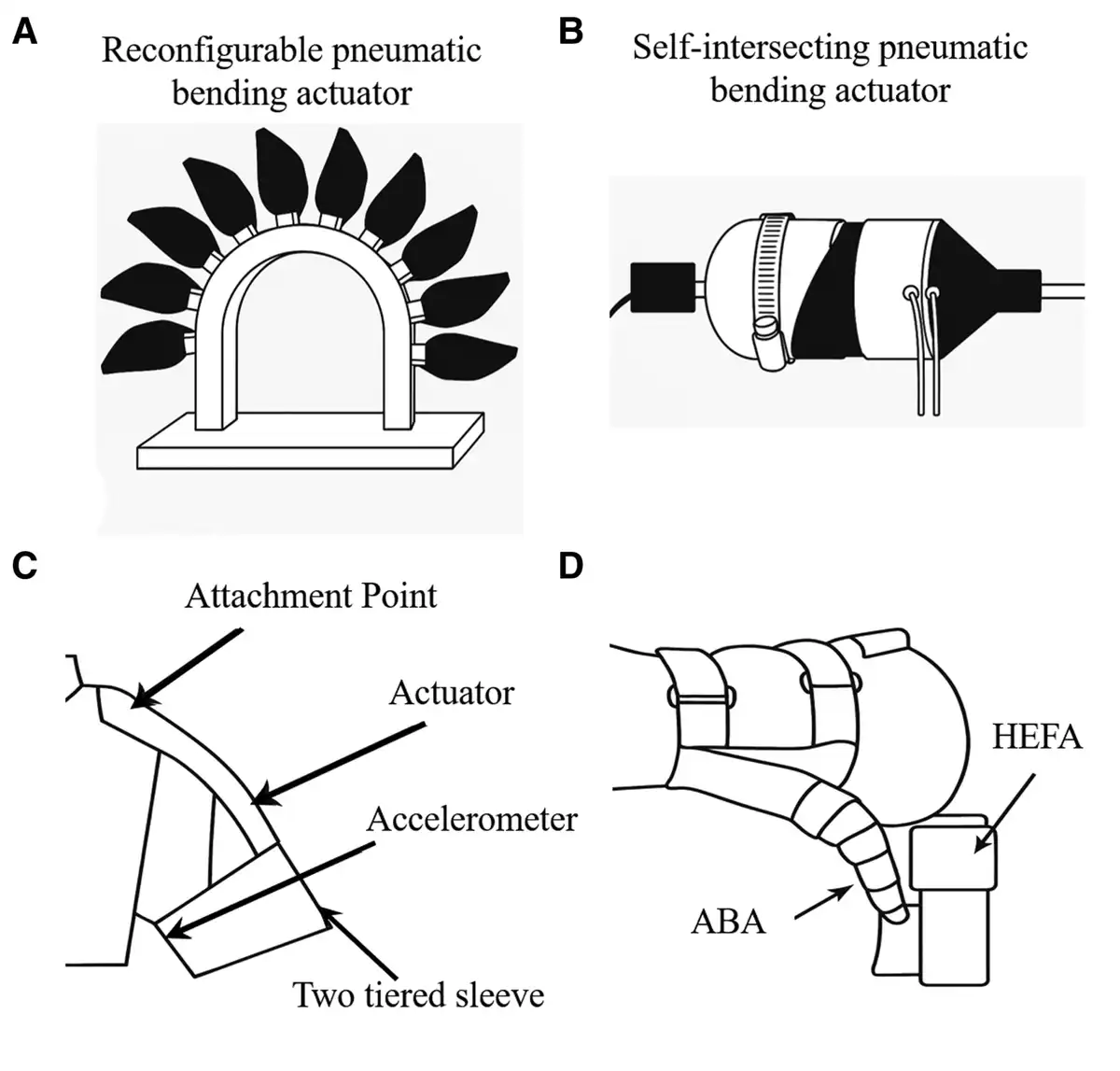
Figure 11.
(A, B) Author-created schematic of TPU flexible actuators based on the studies by Natividad et al.[197] and Nesler et al.[198]. (C, D) Author-created simplified illustrations of TPU-based wearable robots positioned at the shoulder, based on the studies by Natividad and Yeow[199] and O’Neill et al.[200].
Some researchers have applied TPU-based actuators to wearable robots. As illustrated in Figure 11C, Natividad and Yeow[199] designed a TPU fiber beam-driven shoulder wearable robot for the rehabilitation of patients with cerebral palsy. Similarly, as shown in Figure 11D, O’Neill et al.[200] developed a TPU-actuated soft shoulder wearable robot, but the 2 air chambers at the far end of the soft wearable robot provided minimal torque assistance
Besides that, the TPU-based actuators have been investigated for lower-limb wearable applications[201]. As depicted in Figure 12, Sridar et al.[202,203] designed a knee exosuit driven by the TPU actuator, which could provide knee joint assistance torque to the wearer during walking as needed. However, the assistance torque (4.4 Nm with 2 actuators) generated by this TPU actuator is limited, which restricts its ability to support other joint movements effectively. Fang et al.[201] proposed a novel design of foldable pneumatic bending actuators (FPBAs), which could produce torque by the inflation or interactive compression of their interconnect air chambers with no airflow restriction occurring at any bending angle. A knee exosuit equipped with the FPBAs was also designed and has been used in the area of knee rehabilitation training.
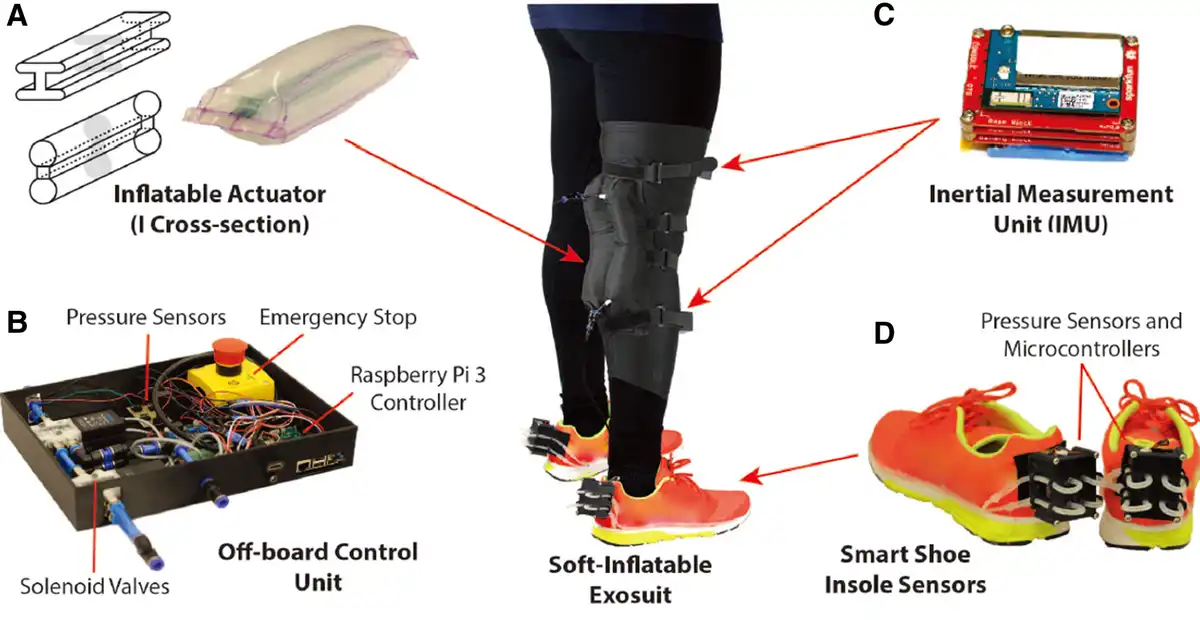
Figure 12.
TPU wearable robot at the knee joint[202] . Copyright 2018, The Authors.
To fully leverage TPU-based pneumatic actuators in wearable robotics, further refinements in structure and mechanical properties are required. Future research should focus on enhancing actuation efficiency, increasing output torque, and improving airflow control, ensuring that TPU actuators can meet the functional demands of wearable robotic applications.
Beyond actuator performance, sustained operation without tethered power remains a major challenge for wearable robots. Energy autonomy is increasingly addressed through advanced harvesting technologies. Fully autonomous exoskeleton prototypes integrate multisource energy capture and storage[204]. At the joint level, self-powered and self-sensing knee negative-energy harvesters recover energy from gait without impeding motion[205]. Recent reviews[206] and hybrid electromagnetic–triboelectric harvesters[207] highlight the potential of combining modalities to extend untethered operation.
Despite significant progress in this area, many challenges remain in achieving widespread adoption and optimized functionality. One key avenue for future research is the integration of TPU actuators with advanced sensor networks to improve real-time adaptability. By incorporating force, pressure, and motion sensors, TPU-based actuators could respond dynamically to user movements, enhancing their ability to provide personalized assistance. Additionally, developing closed-loop control strategies that incorporate real-time biofeedback data could significantly improve the effectiveness of wearable robots for rehabilitation and assistive applications.
Another promising area for research is the optimization of TPU actuator designs to improve force output and efficiency. Current TPU actuators still struggle with limited torque generation, preventing them from replacing bulkier actuation mechanisms in wearable robots. Future work should explore new structural designs, such as multichamber inflation systems and variable stiffness configurations, to increase torque while maintaining flexibility. Enhancing material formulations to improve TPU durability and elasticity would also contribute to more reliable long-term performance.
Energy efficiency is another critical factor influencing the feasibility of TPU-based wearable robots for real-world applications. Future research should focus on developing energy-efficient drive systems, including low-power pneumatic pumps and optimized air compression mechanisms. Additionally, exploring hybrid power solutions, such as integrating TPU actuators with energy-harvesting technologies like piezoelectric or triboelectric generators, could extend operational time without requiring frequent recharging.
Expanding the range of applications for TPU-based wearable robots is also a crucial consideration for future studies. While TPU actuators have primarily been explored for rehabilitation and assistive devices, they could also be applied to sports performance enhancement, industrial exoskeletons, and space exploration. The development of TPU-based wearables for enhancing athletic performance, preventing workplace injuries, and supporting astronauts in microgravity environments could further push the boundaries of this technology.
In conclusion, TPU-based actuators present a highly promising alternative to traditional rigid and hybrid actuation mechanisms in wearable robotics. However, further advancements in material properties, structural optimization, real-time sensing, and energy efficiency are necessary to unlock their full potential. By addressing these challenges, researchers can develop next-generation wearable robots that are lightweight, comfortable, and highly adaptable, ultimately enhancing human mobility, rehabilitation, and overall quality of life.
To place these developments in a broader context, the following section compares TPU-based actuators with other common actuation methods used in wearable robots. This quantitative overview highlights the trade-offs in force output, weight, power requirements, and controllability, providing a framework for understanding where TPU actuators excel and where further improvement is needed.
5.2.3 Quantitative comparison of actuation methods in wearable robotics
Wearable robots employ a variety of actuation technologies, each offering distinct advantages and limitations depending on the target application. Table 1 summarizes key performance metrics—such as specific torque, response time, control complexity, power source requirements, and mechanical compliance—for several widely used actuation types, including rigid electromechanical systems, Bowden cable–driven actuators, SMAs, pneumatic McKibben-type artificial muscles, fiber-reinforced pneumatic actuators, and TPU-based pneumatic actuators.
Table 1
Comparison of common actuation methods in wearable robotics.
| Device/actuation | Joint/task | Peak assist or torque | Drive/pressure | Metabolic change vs no-assist | Other quantified outcomes | Control method | Actuator type | Source |
|---|---|---|---|---|---|---|---|---|
| Portable soft exosuit (Bowden cables, autonomous) | Hip and ankle; walk 1.5 m s-1; run 2.5 m s-1 | – | Electromech (remote via Bowden cables) | −9.3% (walk), −4.0% (run) | Automatic walk↔run mode switching | Phase-synchronous force control (auto mode detection) | Cable-driven textile | [137,208] |
| HIL optimized soft exosuit | Hip; level walking ≈1.25 m s-1 | ≈216 N hip cable force (≈2.84 N/kg) | Electromech cables | −17.4 ± 3.2% | Bayesian optimization converged ≈21 min | HITL Bayesian optimization (timing and magnitude) | Cable-driven textile | [46,209,210] |
| Inflatable soft shoulder exosuit | Shoulder abduction during industrial tasks | Up to 6.6 Nm | Low-pressure portable inflatable | – | Deltoid EMG decreased up to ~40%; torque–pressure curves | PID/pressure regulation | Fabric inflatable | [14,130,211] |
| TPU soft-inflatable knee exosuit | Knee extension assist (swing) | ≈4.4 Nm (2 actuators) | Low-pressure TPU pneumatic | – | Quadriceps sEMG reductions; actuator and controller models | Feedforward + PID | Soft TPU pneumatic | [202,203] |
| Rigid knee exoskeleton (clutch spring/quasi-passive) | Knee; descent/running assistance prototypes | – | Mechanical clutch spring/motorized tuning | – | Rise time/bandwidth and descent assistance characterized | Torque/impedance style control | Rigid (quasi-passive/motor-tunable) | [173,174] |
| Ankle exosuit (loaded walking) | Ankle; loaded walking | – | Electromech (tethered/portable depending on study) | ≈ 7%–10% reduction reported in loaded walking | Net assist power reported; assistance at push-off | Phase/finite-state timing control | Cable-driven/electric | [49,139] |
| Accordion-fold pneumatic knee exosuit (FPBA) | Knee flexion/extension (static posture assist/rehab) | Up to ~25.7 Nm @ ~40 kPa (bench) | Low-pressure pneumatic (≈≤40 kPa); pressure sensor feedback | – | Quadriceps sEMG decreased up to ~64%; increased persistence time (static holds) | On/off control | Foldable fabric pneumatic (TPU) | [201,212,213] |
HIL, human-in-the-loop; sEMG, surface electromyography.
Rigid electromechanical actuators typically provide high torque and precise control but are heavy, rigid, and energetically costly, limiting long-duration wear. Bowden cable systems reduce weight at the joint but require bulky off-board actuation units and complex force transmission mechanisms. SMAs offer compact form factors but suffer from slow response times, high power consumption, and thermal safety concerns. McKibben-type and fiber-reinforced pneumatic actuators provide lightweight, compliant motion assistance but require high-pressure pneumatic sources, which add bulk and reduce portability. TPU-based pneumatic actuators, in contrast, can operate effectively at lower pressures, are lightweight, and are easy to fabricate; however, they currently produce lower peak torques and require further optimization in mechanical efficiency and durability.
By comparing these actuation technologies side-by-side, it becomes evident that TPU actuators strike a favorable balance between compliance, safety, and manufacturing simplicity, making them especially suitable for applications where comfort, low cost, and user safety are prioritized over maximum torque. However, for high-load applications such as heavy-lifting industrial exoskeletons or military-grade assistive devices, higher-torque actuation systems may still be preferable until TPU actuator performance is further enhanced.
5.3 Summary of advances in materials and actuation
Advances in wearable medical robotics are strongly driven by innovations in both material systems and actuation strategies. Material choice affects comfort, safety, and durability, while actuator selection determines achievable force, control precision, and efficiency. Optimal designs often require coordinated selection of materials and actuators to meet specific clinical and assistive needs.
Figure 13 provides a schematic overview of commonly used material classes and actuation methods, illustrating their relationships, performance ranges, and example applications. Table 2 summarizes key material categories, and Table 3 compares actuation strategies, outlining their advantages, limitations, and representative devices, with multiple literature sources for each. Together, these resources offer a consolidated reference to guide design decisions and highlight trends toward hybrid, sensor-integrated, and portable systems.
Table 2
Materials used in wearable medical robotics.
| Material class | Typical form/examples in wearables | Advantages | Disadvantages | Representative wearable uses | Example references |
|---|---|---|---|---|---|
| Functional textiles and fabric laminates | Woven/knit textiles with integrated tendon paths; fabric bladders | Breathable, conformal, lightweight, washable; user comfort | Limited peak force transmission; wear-and-tear from repeated washing | Soft exosuits for hip/ankle assistance; shoulder inflatable garments | [14,136,137,139] |
| TPU | 3D-printed/laminated pneumatic chambers; straps | Low-pressure actuation; easy shaping; low cost; good toughness | Lower torque than high-pressure elastomers; air leakage risk at folds/seams | Soft shoulder and knee exosuits; foldable pneumatic bending actuators | [10,11,199–200–201–202–203] |
| Elastomers for soft pneumatics (eg, silicones) | Cast fiber-reinforced elastomer actuators (FREAs), vacuum muscles | High compliance; large strain; biocompatible grades available | Higher actuation pressure; heavier than textiles; sealing complexity | Bending/contracting soft joints, grippers; rehab devices | [8,188–189–190,195] |
| Fiber-reinforced composites (in soft actuators) | Helical/axial fibers embedded in elastomer walls | Reinforcement directs deformation; boosts force output | Requires precise fabrication; less stretchable than unreinforced elastomers | Programmed bending/extension; joint assistance | [8,196] |
| SMAs | Wires/springs embedded in textiles or linkages | High specific work; compact form factor | Heating/cooling latency; thermal safety concerns; limited stroke | Lightweight assist modules; small-stroke devices | [185] |
| Electroactive polymers (EAPs) | Dielectric elastomer or ionic polymer actuators | Muscle-like compliance; silent operation | High voltage (dielectric) or hydration control (ionic); limited force | Emerging soft actuation modules | [186] |
| Origami/composite laminates | Paper-elastomer or polymer origami shells | Programmable kinematics; lightweight; compact storage | Durability/fatigue issues at folds; sealing challenges | Fold-based bending/contracting elements | [9,184,194] |
| Integrated sensing materials | Flexible, multifunctional sensor laminates | Enables strain/pressure/EMG integration; robust to wear | Adds fabrication complexity; potential signal drift over time | On-body intent sensing, HIL optimization inputs | [5] |
| Biohybrid and living-tissue composites (emerging) | Muscle-on-scaffold actuators; embedded electrodes | High efficiency; biological compliance | Still lab-stage; requires cell culture and maintenance | Long-term: biohybrid assist modules | [214–215–216–217–218] |
| Energy-harvesting and storage materials (supporting wear) | Triboelectric/electromagnetic harvesters; thin-film storage | Extends autonomy; can power sensors | Output depends on motion; may not meet high-power actuator demands | Joint/hip harvesters; portable systems | [204–205–206–207] |
Table 3
Actuation strategies in wearable medical robotics.
| Actuation type | Typical implementations and examples | Advantages | Limitations | Power source | Representative devices/contexts | Example references |
|---|---|---|---|---|---|---|
| Rigid electromechanical at joint | Motors/gearboxes, linkage transmission; clutch spring and variable stiffness | High torque and precision; mature control | Heavy, rigid; joint misalignment; higher metabolic cost | Batteries | Rigid knee assist (clutch spring, quasi-passive) | [171–172–173–174–175–176–177–178–179–180–181] |
| Remote electromechanical via Bowden cables (soft exosuits) | Hip/ankle exosuits with textile interfaces and off-board motors | Light at joints; good comfort; strong clinical and metabolic evidence | Transmission losses; sheath friction; still needs powered pack | Batteries | Portable hip/ankle exosuits; walk/run economy | [45,46,49,136,137,139,210] |
| McKibben pneumatic artificial muscles (PAMs) | Contractile braided muscles; antagonistic joints | High force-to-weight; compliant and safe | Hysteresis; pressure supply; linear→rotational conversion often needed | Compressed air/pumps | Rehab devices; PAM antagonistic joints; controllers | [72,87–88–89–90–91–92–93–94,191] |
| Fiber-reinforced pneumatic bending actuators (FREAs) | Elastomer chambers withfiber wraps for bending | Direct bending torques; compliant | Typically higher pressure; nonlinear dynamics | Compressed air/pumps | Joint assistance without rigid converters | [8,195] |
| TPU low-pressure pneumatic (soft-inflatable) | Laminated/printed TPU chambers; foldable designs | Low pressure; light; low cost; wearable-friendly | Lower peak torque; airflow limits at large bends (design-dependent) | Compact pumps | Shoulder/knee exosuits; foldable actuators | [198–199–200–201–202–203] |
| Inflatable fabric exosuits (industrial shoulder) | Fabric bladders around shoulder | Portable, low-pressure, large user trials potential | Torque-limited vs rigid; pressure regulation needed | Compact pumps | Industrial shoulder assistance, EMG reduction | [14,130] |
| SMA | SMA wire/spring drives | Compact, high specific work | Heating/cooling latency; thermal safety | Electrical heating | Lightweight assist modules | [185] |
| EAP (electroactive polymer) | Dielectric/ionic polymer actuators | Soft, silent, muscle-like | High-voltage (dielectric) or ionic constraints; limited force | High-voltage drivers or ionic | Emerging soft modules | [186] |
| Quasi-passive elastic/clutch systems | Springs + clutches to store/release energy | Very low power; lightweight | Limited net positive work; task-specific | Minimal | Knee descent/running assistance | [173,174] |
| Origami vacuum/pneumatic muscles | Fold-based contraction/extension | Simple fabrication; large stroke | Force density varies; sealing/fatigue | Vacuum/pneumatic | Lightweight assist elements | [184,190,194] |
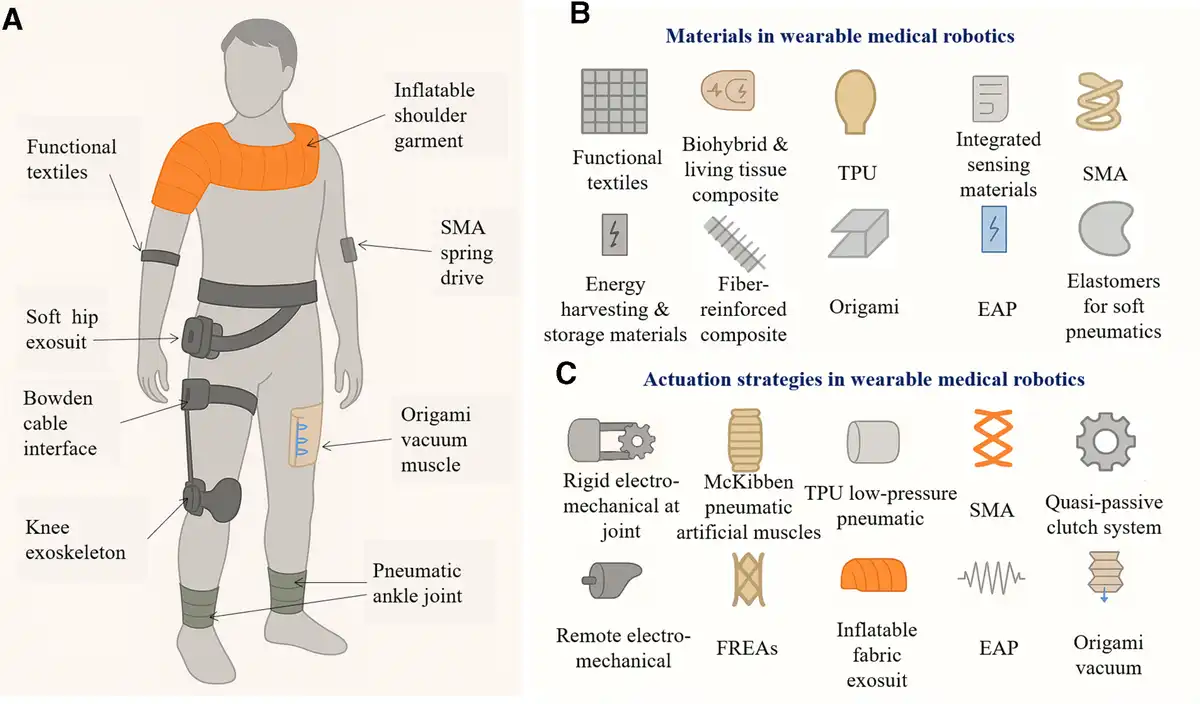
Figure 13.
Author-created schematic illustration of representative wearable medical robotic device placements on the human body (A), along with advances in materials (B) and actuation strategies (C).
6. Future work prospects
The future of wearable robotics holds immense potential, with several key areas requiring further exploration and advancement. As the field evolves, researchers must address challenges related to optimization, comfort, intelligence, and energy efficiency to fully unlock the capabilities of wearable robots in various applications, including healthcare, industry, and daily life.
One crucial research direction is the development of an integrated simulation platform that streamlines the optimization of wearable robots. By combining human biomechanical analysis, human–machine interaction modeling, and advanced optimization algorithms, such a platform would enable efficient testing and refinement of designs before physical prototyping. This approach could significantly reduce development costs and accelerate innovation by allowing researchers to conduct detailed simulations of movement dynamics, actuator performance, and control strategies within a virtual environment. The integration of AI-driven optimization techniques would further enhance the ability to design wearable robots that are personalized, adaptable, and highly efficient. Future research should explore the incorporation of real-time data from wearable sensors into simulation frameworks, allowing for adaptive virtual testing environments that can evolve based on user-specific biomechanics.
Another critical area of research is improving the comfort and biomechanical integration of wearable robots. The long-term success of these devices depends on their ability to assist movement without restricting natural biomechanics or causing discomfort. Current designs often introduce bulkiness, rigidity, or misalignment issues that interfere with the wearer’s movement. Future efforts should focus on refining the structural design of flexible actuators, making them lighter, more adaptable, and better integrated with the human body. The goal is to create wearable robots that feel as natural as clothing, offering movement assistance without imposing additional strain. Advancements in soft materials, lightweight actuator designs, and ergonomic attachment methods will be essential to improving both usability and user experience, ensuring that wearable robots can be comfortably worn for extended periods without disrupting daily activities. Additionally, the use of advanced computational modeling to predict pressure distribution and movement adaptation will enable the development of exosuits that minimize discomfort and maximize efficiency.
To further enhance functionality, the integration of intelligent sensing and human intention recognition technologies into wearable robotics will be pivotal. By leveraging high-resolution sensors, machine learning algorithms, and neural interfaces, wearable robots could interpret a user’s movement patterns, muscle activity, and environmental feedback to predict intent in real time. This would ensure a more natural and intuitive interaction between the device and the human body, allowing for seamless movement assistance that enhances mobility without unnecessary constraints. Intelligent control systems could also improve safety by detecting potential misalignments or fatigue in users, making wearable robots more responsive and adaptable to different conditions. Future studies should focus on multimodal sensor fusion, where different types of sensing—such as IMUs, EMG, and electroencephalography—are combined to improve intent detection accuracy and enable real-time adjustments.
Beyond these immediate research priorities, several emerging areas could shape the next generation of wearable robots. The development of energy-efficient and self-powered actuation mechanisms, such as piezoelectric or triboelectric generators, could extend battery life and reduce reliance on external power sources, making wearable robots more practical for daily use. Research into flexible and stretchable energy storage systems, such as bioinspired supercapacitors and lithium-based thin-film batteries, could lead to significant breakthroughs in power autonomy. Additionally, advancements in energy-harvesting technologies, including thermoelectric generators that utilize body heat, could enable self-sustaining wearable robotic systems that require minimal recharging.
Personalized and adaptive wearable robotics, equipped with machine learning algorithms, could dynamically adjust to an individual’s biomechanics, gait patterns, and rehabilitation needs, offering a level of customization previously unattainable. By integrating predictive modeling with real-time user data, future wearable robots could continuously learn from user-specific patterns and optimize assistance strategies accordingly. Additionally, the integration of multimodal human–machine interfaces, including BCI, EMG, and haptic feedback, could further enhance control precision and user experience, allowing for more seamless and intuitive interactions. Research into hybrid neural control mechanisms, where direct neural signals are combined with biomechanical sensing, could provide unprecedented levels of fluidity and responsiveness in robotic assistance.
Advances in biomimetic soft robotic materials that mimic human muscle function could also revolutionize actuator technology, enabling more fluid, natural movement assistance. Current actuator technologies often struggle to replicate the speed, force output, and compliance of biological muscles. Future work should explore new classes of materials, such as electroactive polymers and SMAs, to develop actuators that closely resemble the mechanical properties of human tissue. Additionally, biohybrid robotics—integrating living muscle cells with engineered robotic structures—could provide an alternative pathway for creating actuators that exhibit natural movement characteristics.
Pushing beyond purely synthetic biomimetic materials, researchers are now exploring biohybrid actuators that combine living muscle tissue with engineered robotic structures. Biohybrid actuators are progressing toward wearable integration. Bioinspired designs integrating muscle tissue with engineered scaffolds have been reviewed extensively[214], and neurotechnology-based biohybrid robots demonstrate closed-loop control capabilities[215]. Compact biohybrid actuators with embedded electrodes[216], portable electrical stimulators[217], and skeletal muscle–powered bipedal robots[218] exemplify the path from laboratory prototypes to functional wearable modules.
The future of wearable robotics also extends to applications beyond human movement assistance. In industrial settings, wearable robots could enhance worker endurance and reduce injury risks by providing ergonomic support during repetitive or physically demanding tasks. In sports science, exoskeletons and assistive suits could be designed to enhance athletic performance and optimize training regimens. Moreover, in space exploration, wearable robotics could play a crucial role in counteracting the effects of microgravity on muscle atrophy and bone density loss.
As research progresses in these directions, wearable robots will continue to evolve from assistive devices into intelligent, seamlessly integrated augmentation systems capable of enhancing mobility, rehabilitation, and overall human performance across diverse applications. By addressing the challenges of optimization, comfort, intelligence, and energy efficiency, wearable robotics will not only improve quality of life but also redefine the boundaries of human–machine interaction. To fully realize this vision, interdisciplinary collaboration between robotics, biomechanics, materials science, and AI will be essential, ensuring that wearable robots can seamlessly adapt to the needs of users across different environments and applications.
7. Conclusion
Wearable robotics has made remarkable progress, offering significant potential for movement assistance, rehabilitation, and performance enhancement. However, several key challenges remain. The lack of a unified theoretical framework limits the optimization and personalization of these systems, while the absence of standardized design methodologies increases development complexity and costs. Additionally, although flexible actuators provide greater compliance and user comfort, integration challenges and energy efficiency limitations must be addressed to maximize their effectiveness.
Advancements in biomechanical modeling, optimization algorithms, and flexible actuation technology will be critical in overcoming these barriers. By refining human–machine interaction models, improving simulation-driven design, and enhancing adaptive control mechanisms, wearable robots can become more intuitive, efficient, and accessible. Future efforts should focus on developing hybrid actuation systems that combine the strengths of both rigid and flexible actuators to achieve superior performance while maintaining lightweight and ergonomic designs. Additionally, integrating real-time physiological monitoring into wearable robotics will allow for intelligent adaptation to user-specific movement patterns, minimizing discomfort and maximizing functionality.
Another promising avenue for progress is the incorporation of machine learning algorithms and AI in control strategies. These technologies could enable wearable robots to predict and respond to user movements dynamically, enhancing real-time assistance while reducing cognitive load on the wearer. Additionally, ensuring long-term usability and comfort through improved materials, breathable and ergonomic designs, and user-friendly interfaces will be essential in expanding wearable robotics beyond clinical and industrial applications into everyday life.
As these innovations continue to evolve, wearable robotics is poised to transform healthcare, industrial applications, and daily activities, making seamless human augmentation a reality. By addressing the technical challenges that remain and fostering interdisciplinary collaboration, researchers and engineers can develop the next generation of wearable robots that are smarter, more efficient, and more accessible than ever before. In the coming years, the integration of advanced materials, intelligent control mechanisms, and energy-efficient actuators will play a decisive role in ensuring that wearable robotic systems reach their full potential, empowering individuals with enhanced mobility and improved quality of life.
Conflicts of interests
The authors declare that they have no conflicts of interest.
Data availability statement
Data sharing is not applicable to this article as no datasets were generated or analyzed during the current study.
Author contributions
Jing Fang and Lei Shi designed research. Jing Fang and Yue Li conducted research and analyzed data. Jing Fang, Yue Li, and Lei Shi wrote the paper. Lei Shi had primary responsibility for the final content. All authors read and approved the final manuscript.
References
- [1] Sharma B, Davies J, Nicotra E, et al. A soft robotic textile-actuated anthropomorphic artificial shoulder mechanism. Adv Intell Syst. 2025;7(4):2400807.
- [2] Gastaldi L, Digo E. Recent advance and application of wearable inertial sensors in motion analysis. Sensors (Basel, Switzerland). 2025;25:818.
- [3] Huo W, Mohammed S, Moreno JC, et al. Lower limb wearable robots for assistance and rehabilitation: a state of the art. IEEE Syst J. 2014;10:1068–1081.
- [4] Fick BR, Makinson JB. Hardiman I prototype for machine augmentation of human strength and endurance: final report. General Electric Company, Specialty Materials Handling Products Operation; 1971:29.
- [5] Xie M, Hisano K, Zhu M, et al. Flexible multifunctional sensors for wearable and robotic applications. Adv Mater Technol. 2019;4:1800626.
- [6] Pan M, Yuan C, Liang X, et al. Soft actuators and robotic devices for rehabilitation and assistance. Adv Intell Syst. 2022;4:2100140.
- [7] Yang L, Wang H. High-performance electrically responsive artificial muscle materials for soft robot actuation. Acta Biomater. 2024;185:24–40.
- [8] Polygerinos P, Wang Z, Overvelde JT, et al. Modeling of soft fiber-reinforced bending actuators. IEEE Trans Robot. 2015;31:778–789.
- [9] Feng Y, Yan W, Song J, et al. Origami-inspired reconfigurable soft actuators for soft robotic applications. Adv Mater Technol. 2024;9:2301924.
- [10] Kim K, Seo T. Fletbot, a flexible thermoplastic polyurethane applied tri-spiral spoke wheel robot. Int J Prec Eng Manuf . 2024;25:91–98.
- [11] Hu Y, Tang W, Qu Y, et al. Shape estimation for a TPU-based multi-material 3D printed soft pneumatic actuator using deep learning models. Sci China Technol Sci. 2024;67:1470–1481.
- [12] Diaz MA, Voß M, Dillen A, et al. Human-in-the-loop optimization of wearable robotic devices to improve human–robot interaction: a systematic review. IEEE Trans Cybern. 2022;53:7483–7496.
- [13] Ong CF, Hicks JL, Delp SL. Simulation-based design for wearable robotic systems: an optimization framework for enhancing a standing long jump. IEEE Trans Biomed Eng. 2015;63:894–903.
- [14] Zhou YM, Hohimer CJ, Young HT, et al. A portable inflatable soft wearable robot to assist the shoulder during industrial work. Sci Rob. 2024;9:2377.
- [15] Wang J, Mattamala M, Kassab C, et al. Exosense: a vision-based scene understanding system for exoskeletons. IEEE Rob Autom Lett. 2025;10(4):3510–3517.
- [16] Gionfrida L, Kim D, Scaramuzza D, et al. Wearable robots for the real world need vision. Sci Rob. 2024;9:8812.
- [17] Wang Y, Wang Y, Mushtaq RT, et al. Advancements in soft robotics: a comprehensive review on actuation methods, materials, and applications. Polymers. 2024;16(8):1087.
- [18] Yin S, Yao DR, Song Y, et al. Wearable and implantable soft robots. Chem Rev. 2024;124(20):11585–11636.
- [19] Ashby BM, Delp SL. Optimal control simulations reveal mechanisms by which arm movement improves standing long jump performance. J Biomech. 2006;39:1726–1734.
- [20] Blemker SS, Delp SL. Three-dimensional representation of complex muscle architectures and geometries. Ann Biomed Eng. 2005;33:661–673.
- [21] Maier B, Schulte M. Mesh generation and multi-scale simulation of a contracting muscle–tendon complex. J Comput Sci. 2022;59:101559.
- [22] Knaus KR, Handsfield GG, Blemker SS. A 3D model of the soleus reveals effects of aponeuroses morphology and material properties on complex muscle fascicle behavior. J Biomech. 2022;130:110877.
- [23] Lai AKM, Arnold AS, Wakeling JM. Why are antagonist muscles co-activated in my simulation? A musculoskeletal model for analysing human locomotor tasks. Ann Biomed Eng. 2017;45:2762–2774.
- [24] Catelli DS, Wesseling M, Jonkers I, et al. A musculoskeletal model customized for squatting task. Comput Methods Biomech Biomed Engin. 2019;22:21–24.
- [25] Carbone V, Fluit R, Pellikaan P, et al. Tlem 2.0–a comprehensive musculoskeletal geometry dataset for subject-specific modeling of lower extremity. J Biomech. 2015;48:734–741.
- [26] Rajagopal A, Dembia CL, DeMers MS, et al. Full-body musculoskeletal model for muscle-driven simulation of human gait. IEEE Trans Biomed Eng. 2016;63:2068–2079.
- [27] Xu W, Hu Z, Zhang Y, et al. On-orbit identifying the inertia parameters of space robotic systems using simple equivalent dynamics. Acta Astronaut. 2017;132:131–142.
- [28] Liu XF, Li HQ, Chen YJ, et al. Dynamics and control of space robot considering joint friction. Acta Astronaut. 2015;111:1–18.
- [29] Luo J, Zong L, Wang M, et al. Optimal capture occasion determination and trajectory generation for space robots grasping tumbling objects. Acta Astronaut. 2017;136:380–386.
- [30] Dasgupta B, Mruthyunjaya T. A Newton-Euler formulation for the inverse dynamics of the Stewart platform manipulator. Mech Mach Theory. 1998;33:1135–1152.
- [31] Featherstone R. The calculation of robot dynamics using articulated-body inertias. Int J Robot Res. 1983;2:13–30.
- [32] Winter DA. Biomechanics and Motor Control of Human Movement. John Wiley & Sons; 2009.
- [33] Umberger BR, Gerritsen KG, Martin PE. A model of human muscle energy expenditure. Comput Methods Biomech Biomed Engin. 2003;6(2):99–111.
- [34] Uchida TK, Hicks JL, Dembia CL, et al. Stretching your energetic budget: how tendon compliance affects the metabolic cost of running. PLoS One. 2016;11:e0150378.
- [35] Millard M, Uchida T, Seth A, et al. Flexing computational muscle: modeling and simulation of musculotendon dynamics. J Biomech Eng. 2013;135(2):021005.
- [36] Davy D, Audu M. A dynamic optimization technique for predicting muscle forces in the swing phase of gait. J Biomech. 1987;20:187–201.
- [37] Kaplan ML, Heegaard JH. Predictive algorithms for neuromuscular control of human locomotion. J Biomech. 2001;34:1077–1083.
- [38] Neptune RR, Hull ML. Evaluation of performance criteria for simulation of submaximal steady-state cycling using a forward dynamic model. J Biomech Eng. 1998;120(3):334–341.
- [39] Yamaguchi GT, Zajac FE. Restoring unassisted natural gait to paraplegics via functional neuromuscular stimulation: a computer simulation study. IEEE Trans Biomed Eng. 1990;37:886–902.
- [40] Thelen DG, Anderson FC, Delp SL. Generating dynamic simulations of movement using computed muscle control. J Biomech. 2003;36:321–328.
- [41] Thelen DG, Anderson FC. Using computed muscle control to generate forward dynamic simulations of human walking from experimental data. J Biomech. 2006;39:1107–1115.
- [42] Lee LF, Umberger BR. Generating optimal control simulations of musculoskeletal movement using opensim and matlab. PeerJ. 2016;4:e1638.
- [43] De Groote F, Kinney AL, Rao AV, Fregly BJ. Evaluation of direct collocation optimal control problem formulations for solving the muscle redundancy problem. Ann Biomed Eng. 2016;44:2922–2936.
- [44] Collins SH, Wiggin MB, Sawicki GS. Reducing the energy cost of human walking using an unpowered exoskeleton. Nature. 2015;522:212–215.
- [45] Ding Y, Panizzolo FA, Siviy C, et al. Effect of timing of hip extension assistance during loaded walking with a soft exosuit. J Neuroeng Rehabil. 2016;13:1–10.
- [46] Ding Y, Kim M, Kuindersma S, et al. Human-in-the-loop optimization of hip assistance with a soft exosuit during walking. Sci Rob. 2018;3:5438.
- [47] Seo K, Lee J, Lee Y, Ha T, Shim Y. Fully autonomous hip exoskeleton saves metabolic cost of walking. In: 2016 IEEE International Conference on Robotics and Automation (ICRA). IEEE; 2016:4628–4635.
- [48] Kim M. Ankle Controller Design for Robotic Ankle-Foot Prostheses to Reduce Balance-Related Effort during Walking Using a Dynamic Walking Approach. Carnegie Mellon University; 2015.
- [49] Panizzolo FA, Galiana I, Asbeck AT, et al. A biologically-inspired multi-joint soft exosuit that can reduce the energy cost of loaded walking. J Neuroeng Rehabil. 2016;13:1–14.
- [50] Lee S, Crea S, Malcolm P, Galiana I, Asbeck A, Walsh C. Controlling negative and positive power at the ankle with a soft exosuit. In: 2016 IEEE International Conference on Robotics and Automation (ICRA). IEEE; 2016:3509–3515.
- [51] Caputo JM, Adamczyk PG, Collins SH. Informing ankle-foot prosthesis prescription through haptic emulation of candidate devices. In: 2015 IEEE International Conference on Robotics and Automation (ICRA). IEEE; 2015:6445–6450.
- [52] Dembia CL, Silder A, Uchida TK, et al. Simulating ideal assistive devices to reduce the metabolic cost of walking with heavy loads. PLoS One. 2017;12:e0180320.
- [53] Uchida TK, Seth A, Pouya S, et al. Simulating ideal assistive devices to reduce the metabolic cost of running. PLoS One. 2016;11:e0163417.
- [54] Cseke B, Uchida TK, Doumit M. Simulating ideal assistive strategies to reduce the metabolic cost of walking in the elderly. IEEE Trans Biomed Eng. 2022;69:2797–2805.
- [55] Orlando MF, Akolkar H, Dutta A, Saxena A, Behera L. Optimal design and control of a hand exoskeleton. In: 2010 IEEE Conference on Robotics, Automation and Mechatronics. IEEE; 2010:72–77.
- [56] Copilusi C, Ceccarelli M, Dumitru N, Carbone G. Design and simulation of a leg exoskeleton linkage for a human rehabilitation system. In: The 11th IFToMM International Symposium on Science of Mechanisms and Machines. Springer; 2014:117–125.
- [57] Walsh C. Human-in-the-loop development of soft wearable robots. Nat Rev Mater. 2018;3:78–80.
- [58] Zhang J, Fiers P, Witte KA, et al. Human-in-the-loop optimization of exoskeleton assistance during walking. Science. 2017;356:1280–1284.
- [59] Koller JR, Gates DH, Ferris DP, Remy CD. Body-in-the-loop optimization of assistive robotic devices: a validation study. In: Proceedings of Robotics: Science and Systems (RSS). Ann Arbor, MI, USA: Robotics: Science and Systems Foundation; 2016. p. 1–10.
- [60] Haufe F, Wolf P, Riener R. Human-in-the-loop optimization of a multi-joint wearable robot for movement assistance. In: Rostalski P, Seel T, Lunze K, eds. Proceedings on Automation in Medical Engineering. Lübeck: Infinite Science Publishing; 2020:023.
- [61] Luo S, Jiang M, Zhang S, et al. Experiment-free exoskeleton assistance via learning in simulation. Nature. 2024;630(8016):353–359.
- [62] Xia H, Zhang Y, Rajabi N, et al. Shaping high-performance wearable robots for human motor and sensory reconstruction and enhancement. Nat Commun. 2024;15(1):1760.
- [63] Arnold J, Pathak P, Jin Y, et al. Personalized ML-based wearable robot control improves impaired arm function. Nat Commun. 2025;16(1):7091.
- [64] Nasiri R, Dinovitzer H, Manohara N, et al. Coordinated human-exoskeleton locomotion emerges from regulating virtual energy. PLoS One. 2025;20(1):e0292334.
- [65] Felt W, Selinger JC, Donelan JM, et al. “Body-in-the-loop”: optimizing device parameters using measures of instantaneous energetic cost. PLoS One. 2015;10:e0135342.
- [66] Schaffer C. Overfitting avoidance as bias. Mach Learn. 1993;10:153–178.
- [67] Pérez-Cruz F, Van Vaerenbergh S, Murillo-Fuentes JJ, et al. Gaussian processes for nonlinear signal processing: an overview of recent advances. IEEE Signal Process Mag. 2013;30(4):40–50.
- [68] Williams CK, Rasmussen CE. Gaussian Processes for Machine Learning. Vol 2. MIT press; 2006.
- [69] Gramacy RB, Lee HKH. Bayesian treed Gaussian process models with an application to computer modeling. J Am Stat Assoc. 2008;103:1119–1130.
- [70] Kim M, Ding Y, Malcolm P, et al. Human-in-the-loop Bayesian optimization of wearable device parameters. PLoS One. 2017;12:e0184054.
- [71] Merola A, Colacino D, Cosentino C, et al. Model-based tracking control design, implementation of embedded digital controller and testing of a biomechatronic device for robotic rehabilitation. Mechatronics. 2018;52:70–77.
- [72] Kurita Y, Thakur C, Das S. Assistive soft exoskeletons with pneumatic artificial muscles. In: Haptic Interfaces for Accessibility, Health, and Enhanced Quality of Life. Springer; 2020:217–242.
- [73] Peng Y, Liu Y, Yang Y, et al. Development of continuum manipulator actuated by thin McKibben pneumatic artificial muscle. Mechatronics. 2019;60:56–65.
- [74] Gong D, He R, Wang Y, Yu J. Bionic design of a 7-dof human-arm-like manipulator actuated by antagonized pneumatic artificial muscles. In: 2019 IEEE 9th Annual International Conference on CYBER Technology in Automation, Control, and Intelligent Systems (CYBER). IEEE; 2019:1503–1508.
- [75] Cacucciolo V, Nabae H, Suzumori K, et al. Electrically-driven soft fluidic actuators combining stretchable pumps with thin McKibben muscles. Front Robot AI. 2020;6:146.
- [76] Li Y, Jiang Y, Hosoda K. Controller design and experimental validation of walking for a musculoskeletal bipedal lower limb robot based on the spring-loaded inverted pendulum model. Front Robot AI. 2024;11:1449721.
- [77] Andrikopoulos G, Nikolakopoulos G, Manesis S. Development and control of a hybrid controlled vertical climbing robot based on pneumatic muscle actuators. J Control Eng Technol. 2011;1:53–58.
- [78] Balasubramanian K, Rattan KS. Fuzzy logic control of a pneumatic muscle system using a linearing control scheme. In: 22nd International Conference of the North American Fuzzy Information Processing Society, NAFIPS 2003. IEEE; 2003:432–436.
- [79] Chan SW, Lilly JH, Repperger DW, Berlin JE. Fuzzy PD+I learning control for a pneumatic muscle. In: Proceedings of the 2003 IEEE International Conference on Fuzzy Systems (FUZZ ’03). St. Louis, MO, 2003 Jul 9: 278–283.
- [80] Thanh TDC, Ahn KK. Nonlinear PID control to improve the control performance of 2 axes pneumatic artificial muscle manipulator using neural network. Mechatronics. 2006;16:577–587.
- [81] Ahn KK, Thanh TDC. Nonlinear PID control to improve the control performance of the pneumatic artificial muscle manipulator using neural network. J Mech Sci Technol. 2005;19:106–115.
- [82] Xing K, Huang J, Wang Y, et al. Tracking control of pneumatic artificial muscle actuators based on sliding mode and non-linear disturbance observer. IET Control Theory Appl. 2010;4:2058–2070.
- [83] Aschemann H, Schindele D. Sliding-mode control of a high-speed linear axis driven by pneumatic muscle actuators. IEEE Trans Ind Electron. 2008;55:3855–3864.
- [84] Huang X, Zhang X, Lu H. Forwarding-based dynamic surface control for antagonistic actuated robots. IET Control Theory Appl. 2016;10:1763–1770.
- [85] Carbonell P, Jiang Z, Repperger D. Nonlinear control of a pneumatic muscle actuator: backstepping vs. sliding-mode. In: Proceedings of the 2001 IEEE International Conference on Control Applications (CCA’01)(Cat. No. 01CH37204). IEEE; 2001:167–172.
- [86] Repperger D, Johnson K, Philips C. Nonlinear feedback controller design of a pneumatic muscle actuator system. In: Proceedings of the 1999 American Control Conference (Cat. No. 99CH36251). Vol 3. IEEE; 1999:1525–1529.
- [87] Klute GK, Hannaford B. Accounting for elastic energy storage in McKibben artificial muscle actuators. J Dyn Sys Meas Control. 2000;122:386–388.
- [88] Reynolds D, Repperger D, Phillips C, et al. Modeling the dynamic characteristics of pneumatic muscle. Ann Biomed Eng. 2003;31:310–317.
- [89] Takosoglu JE, Laski PA, Blasiak S, et al. Determining the static characteristics of pneumatic muscles. Meas Control. 2016;49:62–71.
- [90] Zhang D, Zhao X, Han J. Active modeling for pneumatic artificial muscle. In: 2016 IEEE 14th International Workshop on Advanced Motion Control (AMC). IEEE; 2016:44–50.
- [91] Minh TV, Tjahjowidodo T, Ramon H, et al. Cascade position control of a single pneumatic artificial muscle–mass system with hysteresis compensation. Mechatronics. 2010;20:402–414.
- [92] Schindele D, Aschemann H. Model-based compensation of hysteresis in the force characteristic of pneumatic muscles. In: 2012 12th IEEE International Workshop on Advanced Motion Control (AMC). IEEE; 2012:1–6.
- [93] Amato F, Colacino D, Cosentino C, Merola A. Guaranteed cost control for uncertain nonlinear quadratic systems. In: 2014 European Control Conference (ECC). IEEE; 2014:1229–1235.
- [94] Zhang D, Zhao X, Han J. Active model-based control for pneumatic artificial muscle. IEEE Trans Ind Electron. 2016;64:1686–1695.
- [95] Rawlings JB, Mayne DQ, Diehl M. Model Predictive Control: Theory, Computation, and Design. Vol 2. Nob Hill Publishing; 2020.
- [96] Manzano JM, Limon D, Muñoz de la Peña D, et al. Output feedback MPC based on smoothed projected kinky inference. IET Control Theory Appl. 2019;13(6):795–805.
- [97] Yan Y, Tang M, Wang W, et al. Trajectory tracking control of wearable upper limb rehabilitation robot based on Laguerre model predictive control. Robot Auton Syst. 2024;179:104745.
- [98] Jammeli I, Chemori A, Moon H, et al. An assistive explicit model predictive control framework for a knee rehabilitation exoskeleton. IEEE/ASME Trans Mechatron. 2021;27(5):3636–3647.
- [99] Cao Y, Huang J, Xiong C. Single-layer learning-based predictive control with echo state network for pneumatic-muscle-actuators-driven exoskeleton. IEEE Trans Cogn Dev Syst. 2020;13:80–90.
- [100] Mhd Yusoff MA, Mohd Faudzi AA, Hassan Basri MS, Rahmat MF, Shapiai MI, Mohamaddan S. Switching model predictive control for thin McKibben muscle servo actuator. Actuators. 2022;11:233.
- [101] Mashud G, Hasan S, Alam N. Advances in control techniques for rehabilitation exoskeleton robots: a systematic review. Actuators. 2025;14:108.
- [102] Ke F, Li Z, Yang C. Robust tube-based predictive control for visual servoing of constrained differential-drive mobile robots. IEEE Trans Ind Electron. 2017;65:3437–3446.
- [103] Xu J, van den Boom T, De Schutter B. Model predictive control for stochastic max-plus linear systems with chance constraints. IEEE Trans Autom Control. 2018;64:337–342.
- [104] Tseng CS. Model reference output feedback fuzzy tracking control design for nonlinear discrete time systems with time-delay. IEEE Trans Fuzzy Syst. 2006;14:58–70.
- [105] Cheng L, Liu W, Hou ZG, et al. Neural-network-based nonlinear model predictive control for piezoelectric actuators. IEEE Trans Ind Electron. 2015;62:7717–7727.
- [106] Thuruthel TG, Falotico E, Renda F, et al. Model-based reinforcement learning for closedloop dynamic control of soft robotic manipulators. IEEE Trans Robot. 2018;35:124–134.
- [107] Jin X, Guo J. Disturbance rejection model predictive control of lower limb rehabilitation exoskeleton. Sci Rep. 2023;13(1):19463.
- [108] Samal S, Barry O. Model predictive control for tremor suppressing exoskeleton. IFAC PapersOnLine. 2023;56(3):337–342.
- [109] Sun Z, Iyer A, Lambeth K, et al. Knee extension tracking and fatigue regulation results using a robust MPC approach in a hybrid exoskeleton. Control Eng Pract. 2023;141:105717.
- [110] Xue X, Iyer A, Sharma N. Koopman-based data-driven model predictive control of limb tremor dynamics with online model updating: a theoretical modeling and simulation approach. In: 2023 American Control Conference (ACC). IEEE; 2023:2873–2878.
- [111] El-Hussieny H. Real-time deep learning-based model predictive control of a 3-DOF biped robot leg. Sci Rep. 2024;14(1):16243.
- [112] Li K, Kim J, Xiong X, Hamed KA, Yue Y, Ames AD. Data-driven predictive control for robust exoskeleton locomotion. In: 2024 IEEE/RSJ International Conference on Intelligent Robots and Systems (IROS). IEEE; 2024:162–169.
- [113] Dashkovets A, Laschowski B. Reinforcement learning for control of human locomotion in simulation. In: 2024 10th IEEE RAS/EMBS International Conference for Biomedical Robotics and Biomechatronics (BioRob). IEEE; 2024:43–48.
- [114] Monteiro S, Figueiredo J, Fonseca P, et al. Human-in-the-loop optimization of knee exoskeleton assistance for minimizing user’s metabolic and muscular effort. Sensors (Basel, Switzerland). 2024;24(11):3305.
- [115] Lee UH, Shetty VS, Franks PW, et al. User preference optimization for control of ankle exoskeletons using sample efficient active learning. Sci Rob. 2023;8(83):eadg3705.
- [116] Xu L, Liu X, Chen Y, et al. Reducing the muscle activity of walking using a portable hip exoskeleton based on human-in-the-loop optimization. Front Bioeng Biotechnol. 2023;11:1006326.
- [117] Astudillo R, Li K, Tucker M, Cheng CX, Ames A, Yue Y. Preferential multi-attribute Bayesian optimization with application to exoskeleton personalization. In: ICML 2023 Workshop The Many Facets of Preference-Based Learning. 2023. Available at: https://icml.cc/virtual/2023/29084 ICML. Accessed October 17, 2025.
- [118] Shahrokhshahi A, Khadiv M, Mansouri S, et al. Learning user-specific control policies for lower-limb exoskeletons using Gaussian process regression. IEEE Access. 2024;12:36874–36881.
- [119] Maiworm M, Limon D, Findeisen R. Online learning-based model predictive control with Gaussian process models and stability guarantees. Int J Robust Nonlinear Control. 2021;31:8785–8812.
- [120] Awad M, Khan L. Support vector machines. In: Intelligent Information Technologies: Concepts, Methodologies, Tools, and Applications. IGI Global; 2008:1138–1146.
- [121] Hewing L, Kabzan J, Zeilinger MN. Cautious model predictive control using Gaussian process regression. IEEE Trans Control Syst Technol. 2019;28:2736–2743.
- [122] Kolewe B, Haghani A, Beckmann R, et al. Gaussian mixture regression and local linear network model for data-driven estimation of air mass. IET Control Theory Appl. 2015;9:1083–1092.
- [123] Kocijan J, Girard A, Banko B, et al. Dynamic systems identification with Gaussian processes. Math Comput Model Dyn Syst. 2005;11:411–424.
- [124] Kayacan E, Park S, Ratti C, Rus D. Learning-based nonlinear model predictive control of reconfigurable autonomous robotic boats: Roboats. In: 2019 IEEE/RSJ International Conference on Intelligent Robots and Systems (IROS). IEEE; 2019:8230–8237.
- [125] Ostafew CJ, Schoellig AP, Barfoot TD, et al. Learning-based nonlinear model predictive control to improve vision-based mobile robot path tracking. J Field Rob. 2016;33:133–152.
- [126] Rea R, Beck C, Rovekamp R, Neuhaus P, Diftler M. X1: A robotic exoskeleton for in-space countermeasures and dynamometry. In: AIAA Space 2013 Conference and Exposition. Reston, VA: American Institute of Aeronautics and Astronautics; 2013: 5510.
- [127] Kadivar Z, Beck CE, Rovekamp RN, O’Malley MK, Joyce CA. On the efficacy of isolating shoulder and elbow movements with a soft, portable, and wearable robotic device. In: Wearable Robotics: Challenges and Trends: Proceedings of the 2nd International Symposium on Wearable Robotics, WeRob2016. Springer; 2016:89–93.
- [128] Khan SUE, Varghese RJ, Kassanos P, et al. Space physiology and technology: musculoskeletal adaptations, countermeasures, and the opportunity for wearable robotics. arXiv e-prints. 2024. Available at: https://arxiv.org/abs/2404.03363. Accessed October 17, 2025.
- [129] McNally D. DARPA’s Warrior Web project may provide super-human enhancements. Available at: https://www.army.mil/article/125315/darpas_warrior_web_project_may_provide_super_human_enhancements. Accessed October 17, 2025.
- [130] Campioni L, Dimonte G, Sciarrone G, et al. Preliminary evaluation of a soft wearable robot for shoulder movement assistance. IEEE Trans Med Robot Bionics. 2025;7(1):315–324.
- [131] Proietti T, Bandini A. Wearable technologies for monitoring upper extremity functions during daily life in neurologically impaired individuals. IEEE Trans Neural Syst Rehabil Eng. 2024;32:2737–2748.
- [132] Camardella C, Lippi V, Porcini F, et al. User-centered evaluation of the wearable walker lower limb exoskeleton; preliminary assessment based on the experience protocol. Sensors (Basel, Switzerland). 2024;24(16):5358.
- [133] Fanciullacci C, McKinney Z, Monaco V, et al. Survey of transfemoral amputee experience and priorities for the user-centered design of powered robotic transfemoral prostheses. J Neuroeng Rehabil. 2021;18:1–25.
- [134] Grazi L, Trigili E, Proface G, et al. Design and experimental evaluation of a semi-passive upper-limb exoskeleton for workers with motorized tuning of assistance. IEEE Trans Neural Syst Rehabil Eng 2020;28:2276–2285.
- [135] Pilla A, Trigili E, McKinney Z, et al. Robotic rehabilitation and multimodal instrumented assessment of post-stroke elbow motor functions—a randomized controlled trial protocol. Front Neurol. 2020;11:587293.
- [136] Nuckols RW, Lee S, Swaminathan K, et al. Individualization of exosuit assistance based on measured muscle dynamics during versatile walking. Sci Rob. 2021;6:1362.
- [137] Kim J, Lee G, Heimgartner R, et al. Reducing the metabolic rate of walking and running with a versatile, portable exosuit. Science. 2019;365:668–672.
- [138] Lee G, Kim J, Panizzolo FA, et al. Reducing the metabolic cost of running with a tethered soft exosuit. Sci Robot. 2017;2:eaan6708.
- [139] Quinlivan BT, Lee S, Malcolm P, et al. Assistance magnitude versus metabolic cost reductions for a tethered multiarticular soft exosuit. Sci Rob. 2017;2:4416.
- [140] Baltrusch SJ, Van Dieen JH, Van Bennekom CA, et al. Testing an exoskeleton that helps workers with low-back pain: less discomfort with the passive SPEXOR trunk device. IEEE Robot Autom Mag. 2019;27:66–76.
- [141] Kim J, Porciuncula F, Yang HD, et al. Soft robotic apparel to avert freezing of gait in Parkinson’s disease. Nat Med. 2024;30(1):177–185.
- [142] Chung J, Quirk DA, Applegate M, et al. Lightweight active back exosuit reduces muscular effort during an hour-long order picking task. Comms Eng. 2024;3(1):35.
- [143] Chang CK, Lee C, Nuckols RW, et al. Implementation of a unilateral hip flexion exosuit to aid paretic limb advancement during inpatient gait retraining for individuals post-stroke: a feasibility study. J Neuroeng Rehabil. 2024;21(1):121.
- [144] Koopman AS, Toxiri S, Power V, et al. The effect of control strategies for an active back-support exoskeleton on spine loading and kinematics during lifting. J Biomech. 2019;91:14–22.
- [145] Babič J, Petrič T, Mombaur K, et al. SPEXOR: design and development of passive spinal exoskeletal robot for low back pain prevention and vocational reintegration. SN Appl Sci. 2019;1(3):262.
- [146] Toxiri S, Koopman AS, Lazzaroni M, et al. Rationale, implementation and evaluation of assistive strategies for an active back-support exoskeleton. Front Robot AI. 2018;5:53.
- [147] Yue K, Lancashire H, de Jager K, et al. An assistive coughing device for post-laryngectomy patients. IEEE Trans Med Robot Bionics. 2021;3:838–846.
- [148] Devigne L, Aggravi M, Bivaud M, et al. Power wheelchair navigation assistance using wearable vibrotactile haptics. IEEE Trans Haptic. 2020;13:52–58.
- [149] Morbidi F, Devigne L, Teodorescu CS, et al. Assistive robotic technologies for next-generation smart wheelchairs: codesign and modularity to improve users’ quality of life. IEEE Robot Autom Mag. 2022;30(1):24–35.
- [150] Arditti S, Habert F, Saracbasi OO, Walker G, Carlson T. Tackling the duality of obstacles and targets in shared control systems: a smart wheelchair table-docking example. In: 2023 IEEE International Conference on Systems, Man, and Cybernetics (SMC). IEEE; 2023:4393–4398.
- [151] Carlson T. Towards equitable shared control: shifting from static to dynamic policies that provide personalised support in assistive robotics. at - Automatisierungstechnik. 2024;72(12):1112–1120.
- [152] Slade P, Atkeson C, Donelan JM, et al. On human-in-the-loop optimization of human–robot interaction. Nature. 2024;633:779–788.
- [153] Krimsky E, Collins SH. Elastic energy-recycling actuators for efficient robots. Sci Rob. 2024;9:7246.
- [154] Seth A, Hicks JL, Uchida TK, et al. OpenSim: simulating musculoskeletal dynamics and neuromuscular control to study human and animal movement. PLoS Comput Biol. 2018;14:e1006223.
- [155] Reinbolt JA, Seth A, Delp SL. Simulation of human movement: applications using OpenSim. Procedia IUTAM. 2011;2:186–198.
- [156] Delp SL, Anderson FC, Arnold AS, et al. Opensim: open-source software to create and analyze dynamic simulations of movement. IEEE Trans Biomed Eng. 2007;54:1940–1950.
- [157] Price MA, Beckerle P, Sup FC. Design optimization in lower limb prostheses: a review. IEEE Trans Neural Syst Rehabil Eng. 2019;27(8):1574–1588.
- [158] Erdemir A. Open knee: open source modeling and simulation in knee biomechanics. J Knee Surg. 2016;29:107–116.
- [159] Uhlrich SD, Falisse A, Kidziński L, et al. OpenCap: human movement dynamics from smartphone videos. PLoS Comput Biol. 2023;19(10):e1011462.
- [160] Haralabidis N, Eaton AJ, Delp SL, et al. Simulations Reveal how Touchdown Kinematic Variables affect Top Sprinting Speed: Implications for Coaching. Med Sci Sports Exerc. 2025:10.1249/MSS.0000000000003797.
- [161] Price A, Thienpont E, Catani F, et al.; BASK and EKS Consensus Group. Consensus statement on unicompartmental knee replacement: a collaboration between BASK and EKS. Knee. 2023;41:391–396.
- [162] Porteous A, Wagenaar FC, Price A, et al.; BASK/EKS Consensus Group on Problematic Knees Replacement. Consensus statement on problematic knee replacement and revision knee replacement: a collaboration between EKS and BASK. Knee. 2025;53:86–92.
- [163] Zhang Y, Yao Z, Wang S, et al. Motion analysis of Chinese normal knees during gait based on a novel portable system. Gait Posture. 2015;41:763–768.
- [164] Ma L, Zhou Y, Zhu Y, et al. 3D printed personalized titanium plates improve clinical outcome in microwave ablation of bone tumors around the knee. Sci Rep. 2017;7:7626.
- [165] Zeng X, Lin F, Huang W, et al. Chronic ACLD knees with early developmental cartilage lesions exhibited increased posterior tibial translation during level walking. Orthop Surg. 2024;16(6):1364–1373.
- [166] Mohamed Refai MI, Moya-Esteban A, van Zijl L, et al. Benchmarking commercially available soft and rigid passive back exoskeletons for an industrial workplace. Wearable Technol. 2024;5:e6.
- [167] Govaerts R, De Bock S, Provyn S, et al. The impact of an active and passive industrial back exoskeleton on functional performance. Ergonomics. 2024;67(5):597–618.
- [168] Thevenot C, Pierre X, Mornieux G. Effects of an occupational soft-back exoskeleton during order picking: a field study in logistics. Ergonomics. 2025:1–14.
- [169] Liang C, Wan C, Yang J, et al. Effect of the Kickstart exoskeleton lower extremity walking system on improving lower extremity walking ability in subacute stroke patients: a randomized controlled trial. J Neuroeng Rehabil. 2025;22(1):155.
- [170] Divekar NV, Thomas GC, Yerva AR, et al. A versatile knee exoskeleton mitigates quadriceps fatigue in lifting, lowering, and carrying tasks. Sci Rob. 2024;9(94):eadr8282.
- [171] Aliman N, Ramli R, Haris SM. Design and development of lower limb exoskeletons: a survey. Robot Auton Syst. 2017;95:102–116.
- [172] Dollar AM, Herr H. Lower extremity exoskeletons and active orthoses: challenges and state-of the-art. IEEE Trans Robot. 2008;24:144–158.
- [173] Elliott G, Marecki A, Herr H. Design of a clutch–spring knee exoskeleton for running. J Med Dev. 2014;8:031002.
- [174] Rogers E, Polygerinos P, Allen S, Panizzolo FA, Walsh CJ, Holland DP. A quasi-passive knee exoskeleton to assist during descent. In: Wearable Robotics: Challenges and Trends: Proceedings of the 2nd International Symposium on Wearable Robotics, WeRob2016. Springer; 2016:63–67.
- [175] Karavas NC, Tsagarakis NG, Saglia J, Galdwell DG. A novel actuator with reconfigurable stiffness for a knee exoskeleton: design and modeling. In: Advances in Reconfigurable Mechanisms and Robots I. Springer; 2012:411–421.
- [176] Browning RC, Modica JR, Kram R, et al. The effects of adding mass to the legs on the energetics and biomechanics of walking. Med Sci Sports Exerc. 2007;39:515–525.
- [177] Gregorczyk KN, Obusek JP, Hasselquist L. The effects of a lower body exoskeleton load carriage assistive device on oxygen consumption and kinematics during walking with loads. In: 25th Army Science Conference. Orlando, FL: Tech Science Press (Army Science Conference: Transformational Army Science and Technology); 2006: 27–30.
- [178] Phillips B, Zhao H. Predictors of assistive technology abandonment. Assist Technol. 1993;5:36–45.
- [179] Singer JC, Lamontagne M. The effect of functional knee brace design and hinge misalignment on lower limb joint mechanics. Clin Biomech (Bristol, Avon). 2008;23:52–59.
- [180] Schiele A. Ergonomics of exoskeletons: objective performance metrics. In: World Haptics 2009Third Joint EuroHaptics Conference and Symposium on Haptic Interfaces for Virtual Environment and Teleoperator Systems. IEEE; 2009:103–108.
- [181] Li Y, Chang SH, Francisco G, Su H. Interaction force modeling for joint misalignment minimization toward bio-inspired knee exoskeleton design. In: Frontiers in Biomedical Devices. Vol 40789. American Society of Mechanical Engineers; 2018:V001T10A011.
- [182] Rus D, Tolley MT. Design, fabrication and control of soft robots. Nature. 2015;521:467–475.
- [183] Polygerinos P, Correll N, Morin SA, et al. Soft robotics: review of fluid-driven intrinsically soft devices; manufacturing, sensing, control, and applications in human-robot interaction. Adv Eng Mater. 2017;19:1700016.
- [184] Martinez RV, Fish CR, Chen X, et al. Elastomeric origami: programmable paper-elastomer composites as pneumatic actuators. Adv Funct Mater. 2012;22:1376–1384.
- [185] Jani JM, Leary M, Subic A, et al. A review of shape memory alloy research, applications and opportunities. Mater Des (1980-2015). 2014;56:1078–1113.
- [186] Bar-Cohen Y. Electroactive polymers as artificial muscles: a review. J Spacecr Rockets. 2002;39:822–827.
- [187] Awad LN, Bae J, O’donnell K, et al. A soft robotic exosuit improves walking in patients after stroke. Sci Transl Med. 2017;9:9084.
- [188] Marchese AD, Onal CD, Rus D. Autonomous soft robotic fish capable of escape maneuvers using fluidic elastomer actuators. Soft Rob. 2014;1:75–87.
- [189] Katzschmann RK, Marchese AD, Rus D. Autonomous object manipulation using a soft planar grasping manipulator. Soft Rob. 2015;2:155–164.
- [190] Lee JG, Rodrigue H. Origami-based vacuum pneumatic artificial muscles with large contraction ratios. Soft Rob. 2019;6:109–117.
- [191] Tondu B. Modelling of the McKibben artificial muscle: a review. J Intell Mater Syst Struct. 2012;23:225–253.
- [192] Yeh TJ, Wu MJ, Lu TJ, et al. Control of McKibben pneumatic muscles for a power-assist, lower-limb orthosis. Mechatronics. 2010;20:686–697.
- [193] Chen Y, Wan F, Wu T, et al. Soft-rigid interaction mechanism towards a lobster-inspired hybrid actuator. J Micromech Microeng. 2017;28:014007.
- [194] Paez L, Agarwal G, Paik J. Design and analysis of a soft pneumatic actuator with origami shell reinforcement. Soft Rob. 2016;3:109–119.
- [195] Xavier MS, Tawk CD, Zolfagharian A, et al. Soft pneumatic actuators: a review of design, fabrication, modeling, sensing, control and applications. IEEE Access. 2022;10:59442–59485.
- [196] Connolly F, Polygerinos P, Walsh CJ, et al. Mechanical programming of soft actuators by varying fiber angle. Soft Rob. 2015;2(1):26–32.
- [197] Natividad R, Del Rosario M Jr, Chen PC, Yeow CH. A reconfigurable pneumatic bending actuator with replaceable inflation modules. Soft Robot. 2018;5:304–317.
- [198] Nesler CR, Swift TA, Rouse EJ. Initial design and experimental evaluation of a pneumatic interference actuator. Soft Rob. 2018;5:138–148.
- [199] Natividad RF, Yeow CH. Development of a soft robotic shoulder assistive device for shoulder abduction. In: 2016 6th IEEE International Conference on Biomedical Robotics and Biomechatronics (BioRob). IEEE; 2016:989–993.
- [200] O’Neill CT, Phipps NS, Cappello L, Paganoni S, Walsh CJ. A soft wearable robot for the shoulder: design, characterization, and preliminary testing. In: 2017 International Conference on Rehabilitation Robotics (ICORR). IEEE; 2017:1672–1678.
- [201] Fang J, Yuan J, Wang M, et al. Novel accordion-inspired foldable pneumatic actuators for knee assistive devices. Soft Rob. 2020;7:95–108.
- [202] Sridar S, Qiao Z, Muthukrishnan N, et al. A soft-inflatable exosuit for knee rehabilitation: assisting swing phase during walking. Front Robot AI. 2018;5:44.
- [203] Sridar S, Nguyen PH, Zhu M, Lam QP, Polygerinos P. Development of a soft-inflatable exosuit for knee rehabilitation. In: 2017 IEEE/RSJ International Conference on Intelligent Robots and Systems (IROS). IEEE; 2017:3722–3727.
- [204] Knafo Y, Zhou Y, Manor A, et al. Toward an active exoskeleton with full energy autonomy. Front Robot AI. 2025;12:1597271.
- [205] Hao D, Li Y, Wu J, et al. A self-powered and self-sensing knee negative energy harvester. Iscience. 2024;27(3):109105.
- [206] Kang M, Yeo WH. Advances in energy harvesting technologies for wearable devices. Micromachines. 2024;15(7):884.
- [207] Hao D, Fan C, Xia X, et al. Hybrid electromagnetic-triboelectric hip energy harvester for wearables and AI-assisted motion monitoring. Small. 2025;21(21):2500643.
- [208] Sawicki GS, Beck ON, Kang I, et al. The exoskeleton expansion: improving walking and running economy. J Neuroeng Rehabil. 2020;17(1):25.
- [209] Yang C, Yu L, Xu L, et al. Current developments of robotic hip exoskeleton toward sensing, decision, and actuation: a review. Wearable Technol. 2022;3:e15.
- [210] Nam K, Sahoo S, Kim Y, et al. Reducing personalization time and energy cost while walking outdoors with a portable exosuit. Adv Robot Res. 2025:202400027.
- [211] Proietti T, O’Neill C, Gerez L, et al. Restoring arm function with a soft robotic wearable for individuals with amyotrophic lateral sclerosis. Sci Transl Med. 2023;15(681):eadd1504.
- [212] Shi Y, Dong W, Lin W, et al. Soft wearable robots: development status and technical challenges. Sensors (Basel, Switzerland). 2022;22(19):7584.
- [213] Huang X, Yu X. Overview of human-machine coupling mechanism design for knee exoskeletons. Acad J Eng Technol Sci. 2025;8(2):57–67.
- [214] Chen Z, Chen J, Jung S, et al. Bioinspired and biohybrid soft robots: principles and emerging technologies. Matter. 2025;8(4):102045.
- [215] Chen G, Dang D, Zhang C, et al. Recent advances in neurotechnology-based biohybrid robots. Soft Mat. 2024;20(40):7993–8011.
- [216] Li T, Nie M, Takeuchi S. Biohybrid actuators in compact arrangement with embedded X electrode. Adv Robot Res. 2025;0:202500063.
- [217] Collu R, Fuentes J, Lezcano F, et al. Development of an electrical current stimulator for controlling biohybrid machines. Sci Rep. 2025;15(1):22473.
- [218] Kinjo R, Morimoto Y, Jo B, et al. Biohybrid bipedal robot powered by skeletal muscle tissue. Matter. 2024;7(3):948–962.
This article is available under Open Access.
© 2025 The Authors