Organoids in motion: biohybrid robotics futures
Authors
Long Bai, Yan Wu, Jilong Li, Peiran Song*, Dongyang Zhou*, Jiacan Su*
- aMedEng-X Institute, Shanghai University, Shanghai, China
- bOrganoid Research Center, Institute of Translational Medicine, Shanghai University, Shanghai, China
- cDepartment of Orthopedics, Xinhua Hospital Affiliated to Shanghai Jiao Tong University School of Medicine, Shanghai, China
- dNational Center for Translational Medicine (Shanghai) SHU Branch, Shanghai University, Shanghai, China
- eWenzhou Institute of Shanghai University, Wenzhou, China.
* Correspondence: Address: Jiacan Su, MedEng-X Institutes, Shanghai University, Shanghai 200444, China. Email: drsujiacan@163.com (J. Su); Peiran Song, Organoid Research Center, Institute of Translational Medicine, Shanghai University, Shanghai 200444, China. Email: songpeiran@ shu.edu.cn (P. Song); Dongyang Zhou, Organoid Research Center, Institute of Translational Medicine, Shanghai University, Shanghai 200444, China. Email: zdychem@163.com (D. Zhou).
MedMat · 2025 · Vol. 2 · No. 2 · pp. 79-84
Translations
Long abstracts in additional languages. The English article is the version of record.
中文zh-Hans
将类器官与机器人技术融合的主要驱动力在于克服各自技术的局限性。类器官技术作为前沿工具,已能高度模拟人体器官的复杂性,用于研究与临床应用;然而,孤立的类器官缺乏体内环境中的血管灌注、机械刺激及系统级输入,这限制了其成熟度与长期功能。另一方面,软体机器人在模拟生理运动(如温和泵送或蠕动流)方面表现卓越,却缺失活组织的细胞代谢、感知能力及自适应响应。本文旨在探讨将两者整合为生物混合系统的潜力:赋予机器人以类器官的功能智能,同时利用机器人的动态环境与控制支持类器官的生存与功能发挥。这种融合有望解决医学领域的未满足需求,包括能实时响应药物和刺激的预测性疾病模型、适应患者生理的智能给药装置,以及通过活体界面促进组织再生的活性植入物。
本文系统综述了当前类器官科学与软机器人学的发展现状,并提出了实现两者集成的关键策略与框架。在材料与设计层面,重点探讨了机械耦合、电信号/化学信号整合以及光控或基因控制路径等接口模式。针对类器官成熟度不足的问题,文中介绍了微流控系统与生物反应器以提供灌注支持大尺寸类器官的长期存活;同时提及通过嵌入内皮细胞或使用生物材料支架进行血管化的生物工程策略。此外,文章还分析了“组装体”(assembloids)这一新兴方法,即结合多种类器官以模拟器官间相互作用(如脑区组装体或肠肝轴)。对于软机器人部分,则详细阐述了基于弹性体、水凝胶和纺织品的柔性材料设计,以及气动、液压、介电、磁驱动等温和致动机制的应用。
综述指出,当前技术进展已为类器官集成机器人奠定了基础:类器官提供了真实生物功能(如跳动的心肌组织、放电的神经回路及分泌型肠道上皮),而软体机器人则贡献了可控的致动能力、结构支撑及与物理世界交互的能力。文中特别引用了一项里程碑式成果:一种由人类心肌细胞驱动的仿生鱼,其通过两层拮抗排列的心肌细胞实现自主游动——每层收缩拉伸对侧触发反向收缩,形成自调节节律运动;嵌入式类似起搏器的节点维持了该循环。这一系统不仅展示了活体肌肉作为高效、自愈致动器与工程支架协同的潜力,还揭示了利用心脏生物学原理指导机器人设计的可行性。此类生物混合“生物机器人”为在动态环境中研究心脏生理及心律失常等疾病提供了新平台。
尽管前景广阔,类器官-软体机器人集成仍面临机械整合困难与长期维护挑战等关键技术障碍。本文强调,实现无缝协调需确保机器人与类器官间的双向通信:机器人需提供刺激并接收信号或动作反馈。未来的十年展望指出,该领域需在提升类器官成熟度、优化生物界面稳定性及开发更复杂的智能响应系统方面持续突破。虽然目前已有植入式软体呼吸机(如包裹猪膈肌的装置)成功增强吸气运动等成功案例,但将此类技术转化为广泛临床应用的活体接口仍需克服诸多科学难题。最终目标是构建超越部分之和的生物混合系统,使其在疾病建模、药物筛选及组织再生等领域发挥变革性作用,推动生物医学工程进入新纪元。
Françaisfr
La motivation principale de la fusion des organoïdes avec la robotique est de surmonter les limites inhérentes à chaque technologie prise isolément. La technologie des organoïdes a connu une progression rapide, devenant un outil de pointe pour recréer la complexité des organes dans le but de recherches et d'applications cliniques ; cependant, les organoïdes isolés manquent de perfusion vasculaire, de stimuli mécaniques et d'entrées systémiques propres à un corps vivant, ce qui limite leur maturation et leur fonctionnalité à long terme. D'un autre côté, les robots souples excellent dans la simulation des mouvements physiologiques et des environnements — du pompage doux aux flux péristaltiques — mais ils dépourvus de métabolisme cellulaire, de capacités sensorielles et de réponses adaptatives propres au tissu vivant. L'intégration d'organoïdes avec des robots souples pourrait créer des systèmes biohybrides supérieurs à la somme de leurs parties : des robots dotés de l'intelligence fonctionnelle des cellules vivantes soutenus par un environnement dynamique et le contrôle robotique, répondant ainsi aux besoins médicaux non satisfaits tels que des modèles de maladie plus prédictifs réagissant en temps réel.
Cet article examine les stratégies d'interfaçage entre organoïdes et robots, mettant l'accent sur la nécessité d'une communication bidirectionnelle soigneusement conçue. Les modes d'interface envisagés incluent le couplage mécanique, l'intégration de signaux électriques et chimiques, ainsi que des voies de contrôle optique ou génétique. Pour pallier les limitations actuelles en termes de maturité et d'évolutivité, la revue décrit l'utilisation de systèmes microfluidiques et de bioréacteurs pour assurer une perfusion soutenant la viabilité à long terme des organoïdes plus grands. Des stratégies d'ingénierie biologique sont également abordées, notamment l'enfouissement de cellules endothéliales ou de structures en biomatériaux visant à vasculariser les organoïdes. De plus, une approche émergente consiste à combiner plusieurs organoïdes pour former des « assembléoïdes », modélisant ainsi les interactions entre organes comme l'axe intestin-foie.
Les avancées récentes dans la biologie des organoïdes et la robotique souple posent les bases de cette intégration : les organoïdes apportent une fonction biologique authentique (tissu cardiaque battant, circuits neuronaux en activité), tandis que les robots souples offrent une action contrôlée et un support structurel. Un exemple marquant cité est le développement d'un poisson biohybride propulsé par des cellules musculaires cardiaques humaines ; ce système utilise deux couches de cardiomyocytes disposées de manière antagoniste, où chaque contraction étire la couche opposée pour déclencher une réponse rythmique autonome maintenue par un nœud similaire à un pacemaker. Cette réalisation illustre comment les muscles vivants peuvent servir d'actionneurs efficaces et auto-réparateurs au sein d'un échafaudage ingénieurisé, permettant l'étude de la physiologie cardiaque dans des conditions dynamiques tout en démontrant le potentiel synergique entre biologie et robotique.
Bien que prometteuse pour la modélisation des maladies, le dépistage médicamenteux et la régénération tissulaire, cette technologie fait face à des défis techniques majeurs concernant l'intégration mécanique et la maintenance à long terme. L'article souligne que les systèmes biohybrides doivent opérer en concert comme un système unique pour être véritablement fonctionnels dans des applications cliniques futures telles que les implants actifs ou les dispositifs d'administration de médicaments intelligents. Les obstacles restants incluent l'amélioration de la maturité et de l'évolutivité des organoïdes, ainsi que le développement de matériaux stimuli-réponsifs avancés comme les polymères à mémoire de forme et les élastomères en cristaux liquides pour une meilleure adaptation. La vision prospective pour la prochaine décennie appelle à surmonter ces barrières scientifiques afin de réaliser pleinement l'objectif d'une interface vivante dynamique capable de transformer le paysage biomédical moderne par des systèmes plus intelligents et adaptatifs que leurs composants séparés ne pourraient jamais être seuls capables de faire.
Españoles
La motivación principal para fusionar organoides con robótica es superar las limitaciones de cada tecnología por separado. La tecnología de organoides ha avanzado rápidamente como una herramienta de vanguardia para recapitular la complejidad orgánica en investigación y aplicaciones clínicas; sin embargo, los organoides aislados carecen de perfusión vascular, estímulos mecánicos e insumos a nivel sistémico propios de un cuerpo vivo, lo que limita su maduración y funcionalidad a largo plazo. Por otro lado, la robótica blanda sobresale en simular movimientos fisiológicos y entornos —desde bombeo suave hasta flujos peristálticos— pero carece del metabolismo celular, sensibilidad y respuestas adaptativas de los tejidos vivos. La integración de organoides con robots blandos podría crear sistemas biohíbridos que sean mayores que la suma de sus partes: robots dotados de inteligencia funcional de células vivas apoyadas por el entorno dinámico y control robótico. Tales sistemas podrían abordar necesidades médicas no satisfechas, como modelos de enfermedad más predictivos que respondan a fármacos en tiempo real o implantes activos que promuevan la regeneración tisular mediante interfaces vivientes.
Este artículo examina los avances actuales en ciencia de organoides y robótica blanda, examinando estrategias para interconectar ambos componentes. Se describen varios modos de interfaz concebibles, incluyendo acoplamiento mecánico, integración de señales eléctricas y químicas, e incluso vías de control óptico o genético. Para abordar limitaciones actuales en madurez y escalabilidad, se mencionan sistemas microfluídicos y biorreactores que proporcionan perfusión para soportar organoides más grandes con viabilidad sostenida. Además, estrategias de bioingeniería como incrustar células endoteliales o andamios biomateriales buscan vascularizar los organoides. También se destaca el enfoque emergente de combinar múltiples organoides para formar «assembloids», modelando interacciones entre órganos como ejes intestino-hígado. En cuanto a la robótica blanda, se detallan materiales compliant (elastómeros, hidrogeles, textiles) y mecanismos de actuación suaves (neumáticos, hidráulicos, dieléctricos, magnéticos), junto con avances en materiales responsivos como polímeros con memoria de forma.
Los avances conjuntos establecen las bases para la robótica integrada con organoides: los organoides aportan función biológica auténtica —tejido cardíaco latente, circuitos neuronales activos y epitelio intestinal secretor— mientras que los robots blandos contribuyen actuación controlada, soporte estructural e interacción con el mundo físico. Un ejemplo destacado es un pez biohíbrido impulsado por células musculares cardíacas humanas, donde dos capas de cardiomiocitos se disponen antagonísticamente; cada contracción estira la capa opuesta, desencadenando una respuesta rítmica autónoma mantenida por un nodo tipo marcapasos. Este sistema ilustra cómo las células vivas pueden actuar como actuadores eficientes y auto-reparables dentro de un andamio ingenierizado, permitiendo estudiar fisiología cardíaca en entornos dinámicos y demostrando la sinergia entre biología viva y robótica.
Aunque prometedora para modelado de enfermedades, cribado farmacológico y regeneración tisular, esta tecnología enfrenta desafíos técnicos clave como integración mecánica y mantenimiento a largo plazo. El artículo enfatiza que lograr una coordinación perfecta requiere interfaces diseñadas cuidadosamente donde robots entreguen estímulos y reciban señales o acciones de los organoides. Se destaca el potencial futuro para dispositivos inteligentes de administración de fármacos e implantes activos, pero se advierte sobre la necesidad de superar barreras científicas actuales en madurez y escalabilidad de organoides. La visión prospectiva para la próxima década aboga por continuar desarrollando interfaces biohíbridas que combinen inteligencia biológica con control robótico dinámico, superando limitaciones existentes mediante materiales avanzados como elastómeros de cristal líquido y técnicas de fabricación aditiva, con el objetivo final de crear sistemas biomédicos más predictivos y adaptativos que sus componentes por separado nunca podrían lograr.
日本語ja
類器官とロボティクスを融合させる主な動機は、それぞれの技術単独の限界を克服することにあります。類器官技術は急速に進展し、研究および臨床応用のために臓器の複雑さを再現する最先端ツールとなっていますが、孤立した類器官には生体における血管灌流や機械的刺激、システムレベルの入力が欠如しており、成熟度と長期機能性に制限が生じます。一方、ソフトロボティクスは温和なポンピングから蠕動流動に至るまで生理学的運動をシミュレートする点で優れていますが、生体組織特有の細胞代謝、感覚能力、適応反応を備えていません。本稿では、類器官とソフトロボットを統合することで、両者の部分之和を超えた生物ハイブリッドシステムが創出される可能性について論じます。具体的には、ロボットの動的環境と制御によって支えられた機能性知能を持つ細胞・類器官の導入により、リアルタイムで薬剤や刺激に応答する予測性の高い疾病モデルや、患者の生理に順応するスマートな薬物送達デバイスなどの未解決課題への対応が期待されます。
本稿では、現在の類器官科学とソフトロボティクスの進展を概観し、両者をインターフェースさせるための戦略を検討します。機能的な統合を実現するには、ロボットから类器官へ刺激を与え、逆に信号や動作を受け取る双方向通信の設計が不可欠です。提案されるインターフェースモードには機械的結合、電気・化学シグナルの統合、さらには光学的または遺伝子制御経路が含まれます。類器官の成熟度とスケーラビリティを向上させるため、マイクロ流体システムやバイオリアクターによる灌流供給、および内皮細胞の埋め込みや生体材料スケルトンを用いた血管化戦略が紹介されています。また、「アセンブロイド」と呼ばれる複数の類器官を組み合わせて臓器間相互作用(脳領域アセンブロイドや腸肝軸など)をモデル化する新興アプローチについても言及しています。ソフトロボット側では、弾性体、ハイドロゲル、繊維などの柔軟材料と、空気圧、油圧、誘電、磁気駆動による温和な作動機構の設計空間が拡大している現状が説明されています。
類器官生物学とソフトロボティクスの両分野におけるこれらの進展は、類器官統合型ロボティクスへの道を開く基盤となっています。类器官は拍動する心筋組織や発火する神経回路といった生体機能を提供し、ソフトロボットは制御可能な作動力と構造的サポートを付与します。特に注目すべきマイルストーンとして、ヒト心筋細胞によって駆動される生物ハイブリッド魚の例が挙げられています。このシステムでは2層の心筋細胞が拮抗的に配置され、一方の収縮が他方を伸長させて逆方向に作動させる自己調節リズム運動を実現し、埋め込まれたペースメーカー様ノードがこのサイクルを維持しています。これは生体筋肉が効率的で自己修復型のアクチュエータとして機能する可能性を示すだけでなく、心臓生理学や不整脈などの研究において動的なプラットフォームを提供することを示唆しており、生物学的知見がロボティクス設計にどう寄与するかを実証しています。
この技術は疾病モデル化、薬物スクリーニング、組織再生などにおけるダイナミックな生体医学応用を可能にする一方で、機械的統合と長期維持の課題にも直面しています。本稿では、類器官とロボットが単一のシステムとして協調して動作するよう、両者のシームレスな調整を実現することが重要であると強調しています。将来的には、刺激応答性材料(形状記憶ポリマーや液晶エラストマーなど)の進歩や添加製造技術の発展により、カスタム幾何学とプログラム可能な運動が可能になる見込みです。しかしながら、臨床応用に向けた活体インターフェースとしての実装には依然として多くの科学的障壁が残っており、特に類器官の成熟度向上とスケーラビリティの問題は解決が必要です。今後の10年間の展望では、これらの技術的課題を克服し、生体の動的環境とロボットの制御力を活用した次世代生物ハイブリッドシステムの実現を目指すことが示唆されています。
العربيةar
الدافع الرئيسي لدمج العضويات مع الروبوتات هو التغلب على قيود كل تقنية بمفردها. لقد تقدمت تكنولوجيا العضيات بسرعة كأداة متطورة لإعادة تجسيد تعقيد الأعضاء لأغراض البحث والتطبيقات السريرية؛ ومع ذلك، تفتقر العضيات المعزولة إلى التروية الوعائية والمحفزات الميكانيكية والمدخلات على مستوى النظام الموجودة في الجسم الحي، مما يحد من نضجها ووظيفتها طويلة الأمد. من ناحية أخرى، تتفوق الروبوتات الناعمة في محاكاة الحركات والبيئات الفسيولوجية —من الضخ اللطيف إلى التدفق الدودي— لكنها تفتقر إلى التمثيل الغذائي الخلوي والحساسية والاستجابات التكيفية الخاصة بالأنسجة الحية. يمكن أن يؤدي دمج العضيات مع الروبوتات الناعمة إلى إنشاء أنظمة هجينة بيولوجية تفوق مجموع أجزائها: روبوتات مجهزة بذكاء وظيفي من الخلايا الحية تدعمها البيئة الديناميكية والتحكم الآلي، مما قد يعالج الاحتياجات الطبية غير الملباة مثل نماذج الأمراض التنبؤية التي تستجيب للأدوية في الوقت الفعلي أو أجهزة توصيل الأدوية الذكية التي تتكيف مع فسيولوجيا المريض.
يستعرض هذا المقال التقدم الحالي في علم العضيات وروبوتات النانو اللينة، ويبحث استراتيجيات لربط العضيات بالروبوتات. تشمل أنماط الواجهة الممكنة الاقتران الميكانيكي، وتكامل الإشارات الكهربائية والكيميائية، وحتى مسارات التحكم البصري أو الجيني. لمعالجة قيود النضج والقابلية للتوسع الحالية، يُشار إلى استخدام أنظمة ميكروفلويديكية ومفاعلات حيوية لتوفير التروية لدعم العضيات الأكبر حجماً مع استمرارية بقائها. كما تُناقش استراتيجيات الهندسة الحيوية مثل دمج الخلايا البطانية أو سقالات المواد البيولوجية بهدف وعائية العضيات. علاوة على ذلك، يُبرز نهجاً ناشئاً يتمثل في الجمع بين عدة عضويات لتشكيل «أ Assembloids»، لنمذجة التفاعلات بين الأعضاء (مثل أ Assembloids لمنطقة الدماغ أو محور الأمعاء-الكبد). فيما يتعلق بالروبوتات الناعمة، تُفصّل المواد المرنة مثل المطاطيات والهيدروجيل والمنسوجات وآليات التشغيل اللطيفة الهوائية والهيدروليكية والكهربائية والمغناطيسية.
تُعد هذه التطورات في بيولوجيا العضيات وروبوتات النانو الأساس لدمج الروبوتات مع العضيات: توفر العضيات وظائف بيولوجية حقيقية (نسيج قلبي نابض، دوائر عصبية نشطة)، بينما تساهم الروبوتات اللينة في التشغيل القابل للتحكم والدعم الهيكلي. يُستشهد بمilestone بارز وهو تطوير سمكة هجينة حيوية مدفوعة بخلايا عضلية قلبية بشرية؛ حيث يتم ترتيب طبقتين من خلايا العضلات القلبية بشكل تآزري، بحيث يؤدي كل انقباض إلى شد الطبقة المقابلة مما يحفزها على الانقباض في تناوب منتجاً حركة إيقاعية ذاتية مستمرة بواسطة عقدة تشبه جهاز تنظيم ضربات القلب. يوضح هذا النظام كيف يمكن للعضلات الحية أن تعمل كمحركات فعالة وقادرة على الشفاء الذاتي ضمن سقالة هندسية، ويوفر منصة لدراسة الفسيولوجيا القلبية في بيئة ديناميكية.
على الرغم من إمكاناتها لتطبيقات بيوميديا ديناميكية بما في ذلك نمذجة الأمراض وفحص الأدوية وتجديد الأنسجة، فإن هذا المجال يواجه تحديات تقنية رئيسية تتعلق بالدمج الميكانيكي والصيانة طويلة الأمد. يؤكد المقال أن تحقيق تنسيق سلس يتطلب واجهات مصممة بعناية تسمح باتصال ثنائي الاتجاه: حيث يجب على الروبوتات تقديم محفزات للعضيات واستقبال إشارات أو أفعال منها. تُستعرض التحديات المتبقية مثل الحاجة إلى تحسين نضج العضيات وقابليتها للتوسع، بالإضافة إلى تطوير مواد متجاوبة مع المحفزات مثل بوليمرات الذاكرة الشكلية ومطاطيات البلورات السائلة. الرؤية المستقبلية لعقد من الزمان القادمة تدعو إلى التغلب على هذه العقبات العلمية لتحقيق أنظمة هجينة بيولوجية ديناميكية قادرة على إحداث تحول في الطب، حيث تعمل كواجهات حية نشطة تعزز تجديد الأنسجة وتوفر نماذج مرضية أكثر دقة واستجابة فورية للعلاجات المختلفة.
Full Text
1. Introduction
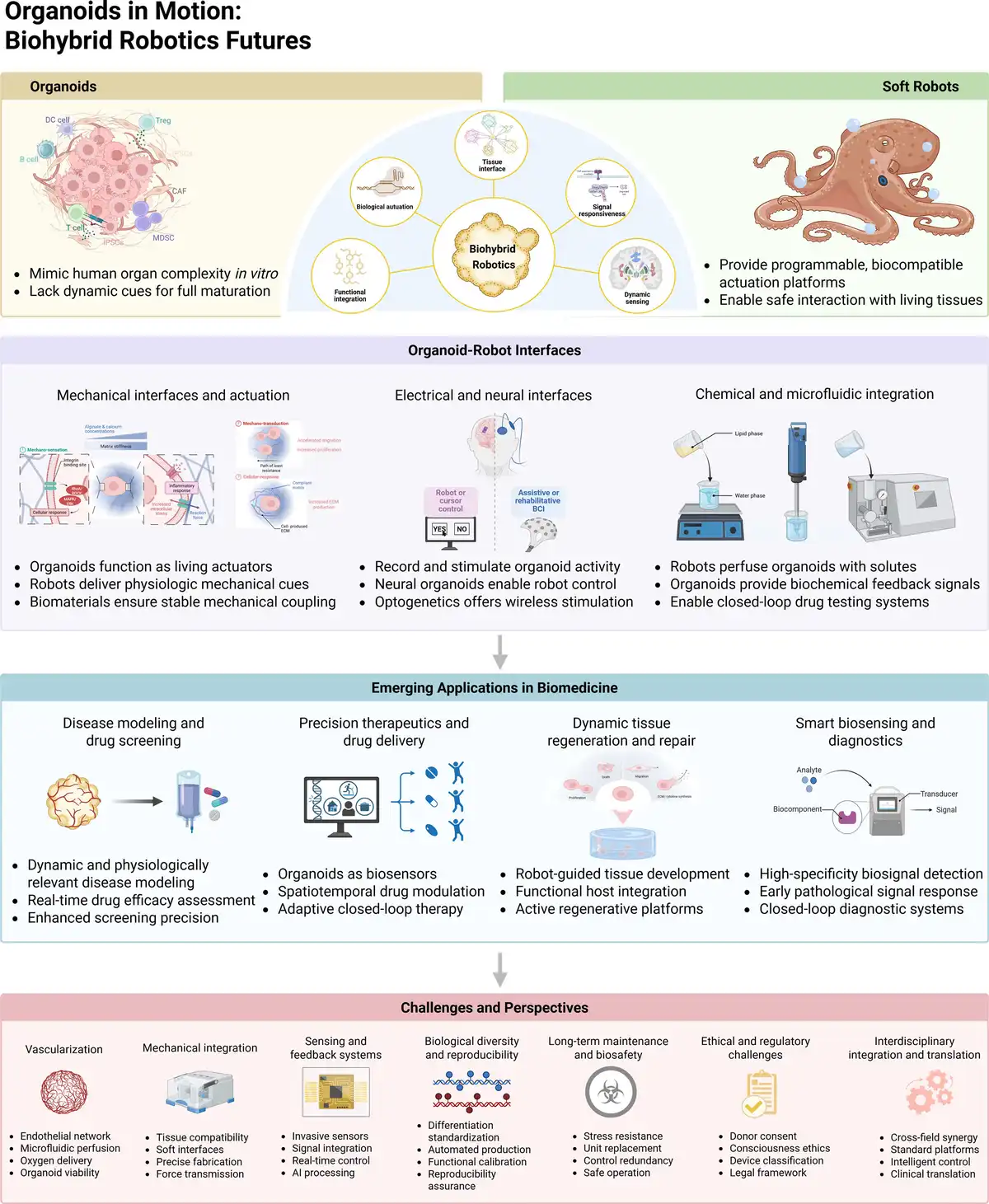
A driving motivation for merging organoids with robotics is to overcome the limitations of each technology alone. Organoid technology has rapidly progressed as a cutting-edge tool to recapitulate organ complexity for research and clinical applications. Yet, organoids in isolation lack the vascular perfusion, mechanical stimuli, and system-level inputs of a living body, which can limit their maturation and long-term functionality. Soft robots, on the other hand, excel at simulating physiological motions and environments—from gentle pumping to peristaltic flows—but lack the cellular metabolism, sensing, and adaptive responses of living tissue.[1] The integration of organoids with soft robots could create biohybrid systems that are greater than the sum of their parts: robots endowed with the functional intelligence of living cells and organoids supported by the dynamic environment and control of robotics.[2] Such biohybrid systems may address unmet needs in medicine—for example, more predictive disease models that respond to drugs and stimuli in real time, smarter drug delivery devices that adapt to patient physiology, and active implants that promote tissue regeneration through living interfaces. In the following sections, we discuss current progress in organoid science and soft robotics, examine strategies for interfacing organoids with robots, highlight application opportunities across biomedicine, outline key technical hurdles, and present a forward-looking vision for the next decade of organoid-integrated biohybrid robotics (Figure 1).
Figure 1.
Organoids integrated with soft robots enable dynamic biomedical applications, including disease modeling, drug screening, and tissue regeneration, while addressing challenges in mechanical integration and long-term maintenance (brain–computer interface [BCI]).
2. Advances in organoid technology and soft robotics
Organoid technology has seen tremendous advances over the past decade, yielding ever more complex and physiologically relevant mini-tissues. From tiny cerebral organoids that model aspects of human brain development, to cardiac organoids (cardioids) that beat spontaneously, to intestinal organoids that form crypt-villus structures, researchers can now generate a spectrum of mini-organs in vitro. This includes advanced techniques, such as realizing engineering large-scale self-mineralizing bone organoids and woven bone organoid formation.[3,4] These organoids capture key features of their in vivo counterparts—for instance, brain organoids exhibit diverse neuron types and network activity and gut organoids form polarized epithelial layers with nutrient absorption and secretion functions.[5,6] Indeed, brain organoids have provided unprecedented insights into neurodevelopment and disease, and they hold promise for drug screening in neurological disorders. Similarly, patient-derived tumor organoids are used to test cancer drugs ex vivo, and liver and kidney organoids model metabolic diseases and toxicity.[7] Efforts are underway to improve organoid maturity and scalability, addressing current limitations. For example, microfluidic and bioreactor systems provide perfusion to support larger organoids with sustained viability, and bioengineering strategies (such as embedding endothelial cells or biomaterial scaffolds) aim to vascularize organoids.[8] Additionally, combining multiple organoids to form “assembloids” is an emerging approach to model interactions between organs (eg, brain-region assembloids or gut–liver axis).[9] These developments reflect an increasing demand for organoids in disease modeling, drug testing, and even as building blocks for future organ replacements. In summary, organoids have evolved into sophisticated in vitro avatars of human organs, yet they typically remain static, lacking the dynamic mechanical and electrical cues of a living organism.
Concurrently, soft robotic systems have matured to become powerful platforms for biomedical interaction. Soft robots are constructed from compliant materials (elastomers, hydrogels, textiles) and employ gentle actuation mechanisms (pneumatic, hydraulic, dielectric, magnetic, etc) that are inherently suited for interfacing with delicate biological tissues.[10] Their flexibility and adaptability enable capabilities ranging from minimally invasive surgical tools to implantable assistive devices. For instance, soft robotic catheters and endoscopes can navigate the body’s tortuous pathways for targeted interventions, and implantable soft actuators have been developed to augment organ function (such as a robotic sleeve that assists heart pumping or a diaphragmatic actuator that aids breathing in respiratory failure). A recent example demonstrated an implantable soft robotic ventilator wrapped around a pig’s diaphragm to effectively increase inspiratory motion.[11] Advances in stimuli-responsive materials (eg, shape-memory polymers, liquid crystal elastomers) and additive manufacturing are expanding the design space of soft robots, allowing custom geometries and programmable motions. Importantly, soft robots can operate in close contact with living tissues without causing damage, due to their compliant nature and high biocompatibility. This makes them ideal platforms to integrate with organoids. Moreover, the field of biohybrid robotics has begun to incorporate living cells as actuators or sensors in robots—for example, skeletal muscle strips or cardiac tissues have been used to power small locomoting devices.[12] These early biohybrid “biobots” showcase the potential synergy: living muscle cells provide efficient, self-healing actuators, while the engineered scaffold provides structure and direction. Notably, one milestone was the development of a biohybrid fish powered by human cardiac muscle cells, which achieved self-propelled swimming by replicating the heart’s mechanoelectrical feedback loops.[12] In this system, 2 layers of cardiomyocytes were arranged antagonistically; each contraction stretched the opposite layer, triggering it to contract in turn, producing an autonomous rhythmic motion. An embedded pacemaker-like node maintained the cycle, enabling the fish to swim continuously. This remarkable example, published in Science 2022, illustrates how insights from cardiac biology can inform robotic design and result in a self-regulating biohybrid machine.[12] It also hints at broader applications—such a system provides a platform to study cardiac physiology and diseases (like arrhythmias) in a dynamic setting.
Together, these advances in organoid biology and soft robotics set the stage for organoid-integrated robotics. Organoids bring authentic biological function—beating heart tissue, firing neural circuits, and secreting gut epithelium—while soft robots contribute controllable actuation, structural support, and the ability to interact with the physical world. The following sections delve into how these components can be interfaced and harnessed, and what new capabilities emerge as a result.
3. Organoid–robot interfaces: signal integration and actuation strategies
Creating a functional union between organoids and robots requires carefully engineered interfaces that allow 2-way communication: robots must deliver stimuli to organoids and receive signals or actions from them. Several modes of interface are conceivable, including mechanical coupling, electrical and chemical signal integration, and even optical or genetic control pathways. The overarching goal is to achieve seamless coordination such that the organoid and robotic components operate in concert as a single system. Here, we outline key interface and actuation strategies that underpin organoid–robot integration.
3.1 Mechanical interfaces and actuation
One straightforward approach is to use the organoid as a living actuator or mechanical sensor within a soft robot. Contractile organoids, such as cardiac or muscle organoids, can produce forces or motion that a robot can harness. For example, a cardiac organoid attached to an elastic robotic scaffold could generate pumping or locomotion when it beats. Conversely, a soft robot can apply controlled mechanical stimuli to an organoid—such as stretch, compression, or fluid flow—to influence its development or function. A well-known example is the biohybrid fish, in which human cardiomyocytes powered rhythmic swimming by coupling with a compliant fin structure.[12] This system demonstrated a 2-way mechanical feedback loop: the contractions of cardiomyocytes drove the fins, while the elastic tension of the fins paced the cells in return.
In a similar vein, researchers have built biohybrid robots where engineered skeletal muscle strips are anchored to flexible skeletons; when the muscle cells contract (induced by electrical pulses or light in optogenetic cells), the robot bends or crawls forward. The mechanical integration of organoids may involve embedding them in soft matrices or coupling them via connectors to the robot’s movable parts. Critical to success is maintaining the organoid’s viability and adherence during actuation. The success of such systems depends heavily on preserving organoid viability and stable attachment during actuation. To this end, innovations in biomaterials—such as collagen or fibrin gels—have enabled effective coupling between soft tissues and synthetic frameworks by forming a responsive mechanotransduction interface. Moreover, mechanical interfacing must account for differences in stiffness and strain tolerance: organoids are fragile and typically require gentle forces in physiologic ranges. The use of compliant materials and strain-limiting mechanisms in the robot can ensure that the organoid experiences lifelike mechanical cues without damage. Mechanical loading can also serve as a developmental cue-constant fluid pulsation or cyclic stretch can promote maturation of organoids (for instance, applying anisotropic stretch was shown to induce formation of multichambered, vascularized cardiac organoids mimicking an embryonic heart structure).
However, despite the promising prospects, organ-based actuators also face fundamental challenges. Compared with synthetic motor systems, they usually generate lower force output, have reduced durability, and offer lower control accuracy. Furthermore, biological tissues require continuous support, such as perfusion or nutrient delivery, to maintain vitality, and their functional lifespan is essentially limited by biological aging. From this perspective, the mechanical interface is not merely a driving pipeline. They also play an active role in supporting organoid health and guiding maturation through physiologically related forces.
3.2 Electrical and neural interfaces
Many organoids (especially neural, cardiac, and muscle types) communicate via electrical signals. Integrating these organoids with robots often entails reading and delivering electrical impulses. High-density microelectrode arrays or flexible electronics can be incorporated to record an organoid’s electrophysiological activity (such as the spiking of neurons in a brain organoid or the field potential of a cardiac organoid) and to stimulate the organoid electrically to evoke activity. In an organoid–robot control loop, a neural organoid could serve as a biological processor: the organoid receives sensory input from the robot (translated into electrical pulses delivered via electrodes), processes this input in its neuronal circuits, and then outputs signals that are fed back to the robot’s actuators. Early demonstrations of this concept are already appearing. In the DishBrain system, a 2D neural culture (a precursor to organoids) was embodied in a simulated game environment, and it was able to learn to play Pong by responding to electrical feedback—essentially functioning as a primitive biological computer.[13] Extending this to 3D brain organoids, one can envision living “brains” controlling robots. Indeed, researchers have reported that brain organoid cultures interfaced with microchips can drive mobile robots, adapting their activity based on feedback from the robot’s sensors. A recent open-source platform called MetaBOC has been developed to connect brain organoids to external devices, showing that human neurons grown on chips can receive inputs from and send outputs to robotic systems. These findings highlight that organoid networks are capable of embodied learning and closed-loop control, given appropriate interface hardware and training feedback. Electrical coupling is equally powerful for actuation: for instance, a soft robotic gripper lined with muscle organoids could have embedded electrodes that trigger the organoids to contract on demand, causing the gripper to bend and hold an object. Alternatively, light-based stimulation can be used if the organoid cells are genetically modified with optogenetic channels—light can penetrate soft tissues and avoid direct electrode contact, offering a wireless mode of control. In sum, electrical interfaces enable organoids to act as controllers and actuators in biohybrid robots, effectively merging biological neural networks with robotic systems in real time.
3.3 Chemical and microfluidic integration
Another interface modality involves the exchange of chemical signals (eg, metabolites, hormones, and neurotransmitters) between organoid and robot. Organoids, by nature, secrete a variety of biochemical factors and respond to their culture milieu. A robot equipped with microfluidic channels can perfuse an organoid with specific solutes (drugs, nutrients, and signaling molecules) under precisely regulated timing and conversely sample the organoid’s secreted factors for analysis or feedback control. This type of interface is especially pertinent for metabolic organoids (liver, gut, pancreatic islets) and for drug testing applications. For example, a gastrointestinal organoid integrated in a robotic device could be exposed to varying concentrations of a drug via automated micropumps, while sensors measure the organoid’s secreted enzymes or electrical responses, creating a closed-loop drug screening system. There are already organs-on-chips that incorporate human organoids or tissue constructs with flowing media to emulate blood flow and nutrient delivery, some even linking multiple organoid types in sequence to represent a physiological system. Robotic automation has been used to assemble and cultivate organoids on-chip, ensuring reproducible placement and connection of tiny tissue spheroids. In advanced setups, one could imagine a “robotic symbiote” where the robot provides life support to the organoid—continuous perfusion, waste removal, and even immune isolation—similar to a heart–lung machine but on the microscale. The organoid, in return, provides real-time biochemical sensing or production. A concrete illustration is a “robot-on-a-chip” human motor unit developed in 2024, which integrated a brain organoid with a network of motor neuron spheroids and a muscle tissue strip, all on a microfluidic chip.[14] In this device, microfluidic channels supplied nutrients and drugs (like levodopa [L-DOPA] for a Parkinson disease model) to the organoids, while the neurons relayed signals from the brain organoid to activate the muscle, effectively coupling chemical neurotransmission with mechanical actuation in one platform. This exemplifies how fluidic and chemical interfaces can connect organoid and robotic elements into a functional circuit.
3.4 Multimodal signal integration
Ultimately, effective organoid–robot interfaces will likely be multimodal—combining mechanical, electrical, and chemical linkages. Consider the challenge of connecting a cerebral organoid to a soft exoskeleton for neuroprosthetics: one might embed the organoid with electrode arrays (neural interface), enmesh it in a supportive hydrogel scaffold that transmits forces (mechanical interface), and perfuse it with a blood-mimicking fluid (chemical support). The signals flowing across these interfaces can be integrated via onboard electronics and software. Advanced signal processing and artificial intelligence (AI) algorithms can decode complex organoid outputs (eg, deciphering neural spiking patterns or metabolic readouts) and translate them into actionable instructions for the robot’s actuators. Conversely, algorithms can determine the optimal stimulation patterns to elicit desired responses from the organoid (training it over time, akin to adaptive control). Achieving seamless integration also requires addressing the time-scale differences between biological responses and robotic control loops—for instance, neurons fire in milliseconds, hormonal changes occur over minutes, and tissue growth/remodeling happens over days. A robust interface will manage this by operating on multiple time scales, perhaps using faster electronic feedback for immediate control and slower chemical modulation for long-term adaptation.
A noteworthy aspect is that the organoid–robot interface need not be purely manmade; biological components can serve as connectors. For example, in the aforementioned human motor circuit chip, endothelial cells (human umbilical vein endothelial cells [HUVECs]) were introduced to promote neurite outgrowth between the brain organoid and muscle, essentially forming a vascularized neural bridge. The endothelial network not only helped sustain the neurons but also guided the integration of neural circuits, improving signal transmission from the organoid to the muscle. Such use of cellular components (vascular cells, glial cells, etc.) as living interfaces might greatly enhance the stability and integration of organoid and robot parts. This blurring of boundaries is intrinsic to biohybrid design—the interface is not a single point of contact but an engineered ecosystem where living and nonliving elements intermix.
In summary, organoid–robot interfaces require a convergence of bioengineering and robotics: flexible electronics, microfluidics, biofabrication, and computational control all come into play. With thoughtful design, it becomes possible to treat organoids as “brains,” “hearts,” or “guts” of a robotic system, enabling the robot to sense and act biologically. The following section explores concrete application areas where such organoid-integrated robots could be game changers, illustrating the concepts in practice.
4. Emerging applications in biomedicine
The fusion of organoids with soft robotics opens up a rich landscape of applications across biomedicine. In this section, we present in-depth examples spanning disease modeling, precision therapeutics, dynamic tissue regeneration, and smart biosensing. These examples highlight how organoid-integrated robots could function in each domain, leveraging the unique strengths of living organoids to solve pressing challenges.
4.1 Disease modeling and drug screening
Organoid–robot hybrids are reshaping disease modeling by introducing dynamic, physiologically relevant parameters absent in conventional static systems. A compelling example is the motor-system-on-a-chip platform, integrating cortical brain organoids, motor neurons, and contractile muscle tissue on a soft robotic substrate to replicate the neuromuscular axis in Parkinson disease.[14] The system quantifies therapeutic efficacy in real time, evidenced by enhanced muscle contraction following L-DOPA administration, providing patient-specific readouts with high translational value. Beyond neurology, soft robotic platforms enable mechanodynamic modeling of pulmonary or gastrointestinal diseases by mimicking breathing and peristalsis, revealing how physical forces shape pathophysiology and microbial interaction.[1] The addition of mechanical actuation to robotic screening systems augments throughput and precision, advancing phenotype-based drug discovery.
4.2 Precision therapeutics and drug delivery
Integrating organoids as intelligent biosensors within robotic systems enables a new class of therapeutic platforms that sense, decide, and actuate in real time. One envisioned application is a biohybrid artificial pancreas, where a pancreatic islet organoid embedded in a soft implant autonomously secretes insulin in response to glucose levels. In such a system, robotics through controllable actuation or programmable microfluidic channels can fine-tune the rate, timing, and localization of insulin release. This enhances delivery fidelity by reducing overshoot, synchronizing release with physiological demand, and minimizing off-target exposure. Similarly, tumor organoid-laden robotic catheters could preview chemotherapeutic responses intraoperatively. Screen out appropriate drugs using tumor organoids and adjust treatment decisions in real time based on immediate feedback. A soft robotic catheter embedded may be used intraoperatively to test microdoses of chemotherapeutics in real time, offering a personalized prediction of response before systemic administration. Advances in synthetic biology allow engineered organoids to secrete therapeutic agents on demand, while soft robotic components regulate spatial and temporal delivery. Such feedback-controlled systems—for instance, those in which neural organoids monitor electrophysiological activity to detect preseizure patterns, triggering soft robotic components to deliver targeted vagus nerve stimulation—demonstrate the feasibility of living devices for adaptive, closed-loop therapies.
4.3 Dynamic tissue regeneration and repair
Organoid-integrated soft robots offer an active paradigm in regenerative medicine, moving beyond inert scaffolds to devices that modulate the microenvironment during tissue repair. In muscle regeneration, robotic meshes embedded with stem cell–derived muscle organoids apply controlled stretch and stimulation, promoting alignment, fusion, and maturation into contractile tissue. In neuroregeneration, brain organoids coupled with microelectronic interfaces have been shown to integrate structurally and functionally with host circuits upon electrical stimulation, restoring impaired connectivity postinjury.[15] For cardiac repair, organoid-infused soft robotic patches synchronize with the heartbeat and deliver electrical pacing, enhancing functional integration and potentially enabling scarless myocardial regeneration.[16] These systems capitalize on developmental principles, where robotic-imposed geometry and force guide self-organizing organoids to form context-specific architectures.[17]
4.4 Smart biosensing and diagnostics
Organoid–robotic constructs offer unprecedented sensitivity and specificity in biosensing by combining the nuanced biological responsiveness of organoids with the precision of robotic transduction. In vitro, liver organoid robots linked to real-time metabolic sensors provide early toxicity alerts by tracking adenosine triphosphate (ATP) production or enzyme secretion. In vivo, soft wearable robots housing miniaturized immune or neural organoids could detect early cytokine surges or neurotransmitter imbalances, triggering automated therapeutic responses. For environmental surveillance, robotic platforms equipped with multiorganoid arrays (eg, lung, skin, and neural) serve as living detectors for chemical vapors, radiation, or neurotoxins, offering a sophisticated alternative to conventional sensors. These systems not only detect molecular presence but interpret physiological consequences, enabling closed-loop diagnostics and intervention—a foundational shift from static assays to embodied, intelligent monitoring.
From these examples, it is clear that organoid-integrated biosensors offer rich, human-relevant information. They bridge the gap between biochemical sensing and physiological interpretation: rather than just measuring a molecule’s presence, they measure the tissue’s response to that molecule. When combined with robotics, this becomes actionable information. For instance, detection of a certain stress response in a cardiac organoid sensor might trigger a wearable defibrillator to activate, or sensing a spike in glucose could command an insulin pump. This closes the loop for diagnostic and preventive action. In all application domains discussed—modeling, therapeutics, regeneration, and sensing—organoids act as central players, providing functions traditionally limited to living organisms (learning, metabolism, regeneration, and sensation). Integrated with soft robotics, they give rise to a new class of biohybrid machines that could transform medicine by being more lifelike in function and more personalized in operation.
5. Challenges and perspectives
Realizing organoid-integrated soft robotics demands overcoming a series of complex technical and biological challenges that span vascularization, mechanical integration, sensing-feedback systems, biological variability, and long-term maintenance. Ensuring sustained viability of organoids within robotic platforms necessitates vascularization strategies that integrate endothelial networks and microfluidic circuits to mimic in vivo perfusion and oxygenation. Simultaneously, mechanical compatibility between fragile organoids and actuating soft robotic elements requires compliant interfaces, viscoelastic hydrogels, and spatially precise biofabrication technologies such as RODEO to prevent structural damage and ensure functional transmission. For real-time control, the development of minimally invasive sensing architectures—ranging from optical and chemical sensors to flexible electrophysiology arrays—is vital for capturing organoid states and enabling adaptive robotic responses. These systems must navigate biological signal variability and latency, which differ significantly across organoid types (eg, fast-reacting neural vs. slow endocrine tissues), requiring robust AI-enhanced control frameworks. Variability in organoid morphology and function further complicates reproducibility, demanding standardized differentiation protocols, automated manufacturing, and in situ calibration routines. As organoids inevitably decline in function due to metabolic stress or senescence, strategies such as modular biocartridge replacement, redundancy, or fallback control logic must be implemented to ensure continuity and biosafety. Finally, as organoid-based systems edge toward cognitive or sensory functions, ethical and regulatory concerns surrounding sentience, donor consent, and device classification become increasingly urgent. For instance, the integration of neural organoids into responsive robotic systems raises unresolved questions about the emergence of sentience or moral status. While current models remain far from consciousness, any future scenario involving adaptive or learning behaviors will require careful ethical oversight. Similarly, the use of patient-derived tissues in biohybrid devices calls for robust frameworks ensuring informed consent, privacy protection, and long-term data stewardship. These challenges, while formidable, are active frontiers in interdisciplinary research and will define the roadmap toward clinically viable and ethically responsible biohybrid robotics.
The integration of organoids with biohybrid robotics is poised to revolutionize biomedicine over the next 5 to 10 years, progressing from in vitro demonstrations to clinically relevant platforms. Sophisticated prototypes—such as closed-loop systems where neural organoids control muscle actuation under metabolic input from liver organoids—are expected to validate the functional integration of multiple organoid types within robotic frameworks. Concurrently, standardization and high-precision biofabrication methods, including RODEO droplet platforms and laser-guided assembly, will support scalable production of organoids with defined actuation or sensing properties. The first in vivo applications, such as implantable insulin-secreting pancreatic organoid robots or vascularized neural interfaces, are likely to emerge through advances in perfusable architectures, immune protection strategies, and biodegradable robotic scaffolds. At the control level, AI will increasingly assist in decoding biosignals and optimizing robot–organoid interactions, while organoid intelligence—exemplified by neural tissues capable of learning tasks like Pong—may offer a novel biological computing substrate. These systems will catalyze new theoretical models of embodied intelligence, raising questions about developmental plasticity, computation, and sentience in engineered biological substrates. Ethical and regulatory frameworks will evolve in parallel, particularly for neural organoids approaching cognitive thresholds. Ultimately, interdisciplinary convergence—encompassing tissue engineering, robotics, neuroscience, synthetic biology, and ethics—will define the future of this field, supported by emerging institutional infrastructures and dedicated translational consortia.
In conclusion, the integration of organoids with soft robotics represents a bold and visionary frontier—one that could yield fundamentally new technologies for medicine and beyond. By combining the adaptive, self-organizing capabilities of living tissues with the precision and programmability of machines, we edge closer to creating devices that are not just bioinspired but truly biointegrated. Such devices might one day behave as an extension of the human body, capable of sensing, healing, and interacting in ways that restore or enhance natural function. However, along with this vision come biological and practical problems. Organoids require metabolism, have a limited lifespan, and are affected by functional variability. Ensuring long-term stability requires a powerful support system, such as vascularized stents, real-time monitoring, and modular replacement strategies, to maintain long-term viability and performance. Unlike synthetic components, living tissues can degrade, adapt to unpredictable conditions, or respond slowly to stimuli. All of these must be taken into account in design and control.
Over the next decade, we expect organoid-integrated biohybrid robots to transition from imaginative laboratory demonstrations to early translational applications, setting the stage for a new era of living therapeutic machines. The journey will require overcoming significant challenges and careful ethical navigation, but the potential benefits—finely-tuned disease models, smart implants that respond to the body, regenerating tissues, and intelligent biosensors—herald a transformative impact on biomedical engineering and human health. The convergence of organoids and robotics is more than an integration of 2 technologies; it is the inception of a new class of entities that straddle the boundary of living and synthetic, opening up possibilities as vast as they are exciting.
Funding
This work was financially supported by the National Natural Science Foundation of China (No. 32471396, 82427809, 82230071, 82172098, and 32471395), Shanghai Committee of Science and Technology (No. 23141900600, Laboratory Animal Research Project), and the Young Elite Scientist Sponsorship Program by China Association for Science and Technology (No. YESS20230049).
Conflicts of interests
The authors declare that they have no conflicts of interest.
Author contributions
L.B.: conceived, organized, and wrote the manuscript. Y.W. and J.L.: organized and wrote the manuscript. P.S. and D.Z.: conceptualization. J.S.: conceptualization, funding acquisition, investigation, project administration, resources, supervision. All authors discussed and approved the final manuscript.
References
- [1] Cianchetti M, Laschi C, Menciassi A, et al. Biomedical applications of soft robotics. Nat Rev Mater. 2018;3:143–153.
- [2] Leng Y, Li X, Zheng F, et al. Advances in in vitro models of neuromuscular junction: focusing on organ-on-a-chip, organoids, and biohybrid robotics. Adv Mater. 2023;35:e2211059.
- [3] Zhu M, Zhang H, Zhou Q, et al. Dynamic GelMA/DNA dual-network hydrogels promote woven bone organoid formation and enhance bone regeneration. Adv Mater. 2025:e2501254.
- [4] Wang J, Wu Y, Li G, et al. Engineering large-scale self-mineralizing bone organoids with bone matrix-inspired hydroxyapatite hybrid bioinks. Adv Mater. 2024;36:e2309875.
- [5] Mansour AA, Gonçalves JT, Bloyd CW, et al. An in vivo model of functional and vascularized human brain organoids. Nat Biotechnol. 2018;36:432–441.
- [6] Li VSW. Modelling intestinal inflammation and infection using ‘mini-gut’ organoids. Nat Rev Gastroenterol Hepatol. 2021;18:89–90.
- [7] Veninga V, Voest EE. Tumor organoids: opportunities and challenges to guide precision medicine. Cancer cell. 2021;39:1190–1201.
- [8] Quintard C, Tubbs E, Jonsson G, et al. A microfluidic platform integrating functional vascularized organoids-on-chip. Nat Commun. 2024;15:1452.
- [9] Reiner O, Sapir T, Parichha A. Using multi-organ culture systems to study Parkinson’s disease. Mol Psychiatry. 2021;26:725–735.
- [10] Rus D, Tolley MT. Design, fabrication and control of soft robots. Nature. 2015;521:467–475.
- [11] Hu L, Bonnemain J, Saeed MY, et al. An implantable soft robotic ventilator augments inspiration in a pig model of respiratory insufficiency. Nat Biomed Eng. 2023;7:110–123.
- [12] Lee KY, Park S-J, Matthews DG, et al. An autonomously swimming biohybrid fish designed with human cardiac biophysics. Science. 2022;375:639–647.
- [13] Ledford H. Neurons in a dish learn to play pong–what’s next. Nature. 2022;610:433–433.
- [14] Shin M, Ha T, Lim J, et al. Human motor system-based biohybrid robot-on-a-chip for drug evaluation of neurodegenerative disease. Adv Sci. 2024;11:e2305371.
- [15] Hu N, Shi J-X, Chen C, et al. Constructing organoid-brain-computer interfaces for neurofunctional repair after brain injury. Nat Commun. 2024;15:9580.
- [16] Morita T, Nie M, Takeuchi S. Human induced pluripotent stem cell-derived cardiac muscle rings for biohybrid self-beating actuator. Lab Chip. 2024;24:3377–3387.
- [17] Gjorevski N, Nikolaev M, Brown TE, et al. Tissue geometry drives deterministic organoid patterning. Science. 2022;375:eaaw9021.
This article is available under Open Access.
© 2025 The Authors