Advancement of AI-assisted self-powered healthcare sensing systems
Authors
Liwei Dong, Chaoyang Zhao, Chengjia Han, Yaowen Yang, Fan Yang*
- aSchool of Civil and Environmental Engineering, Nanyang Technological University, Singapore
- bCollege of Transportation, Tongji University, Shanghai, China
- cDepartment of Orthopaedics, Shanghai Key Laboratory for Prevention and Treatment of Bone and Joint Diseases, Shanghai Institute of Traumatology and Orthopaedics, Ruijin Hospital, Shanghai Jiao Tong University School of Medicine, Shanghai, China.
* Correspondence: Address: Fan Yang, Department of Orthopaedics, Shanghai Key Laboratory for Prevention and Treatment of Bone and Joint Diseases, Shanghai Institute of Traumatology and Orthopaedics, Ruijin Hospital, Shanghai Jiao Tong University School of Medicine, Shanghai, 200025, China. Email: yf12498@sjtu.edu.cn (F. Yang). Liwei Dong, Chaoyang Zhao, and Chengjia Han contributed equally to this work.
MedMat · 2025 · Vol. 2 · No. 1 · pp. 55-77
Abstract
Self-powered sensors, which derive energy from environmental or physiological sources, provide a sustainable approach to eliminating the reliance on external power supplies. They enable the autonomous operation of sensing systems, paving the way for the increasingly expanding Internet of things (IoTs). The integration of artificial intelligence (AI) into these systems for healthcare has significantly advanced their capabilities in processing complex signals, extracting meaningful features, and delivering high-precision health insights. This review explores the latest advancement in self-powered sensors, involving the various applications of piezoelectricity, triboelectricity, electromagnetism, thermoelectricity, photovoltaics, and biofuel cells in healthcare. The applications of AI methodologies in self-powered sensing systems are covered and reviewed, addressing challenges like noise reduction, data analysis, and multisignal fusion. Future directions emphasize leveraging material innovation, manufacturing technology, structural optimization, and further integration of AI technology, to achieve multifunctional, high-performance, and intelligentized healthcare sensing systems. These developments underscore the potential of AI-assisted self-powered sensors to revolutionize healthcare with sustainable, precise, and intelligent solutions.
Translations
Long abstracts in additional languages. The English article is the version of record.
中文zh-Hans
随着物联网(IoT)的迅速扩张,传统依赖外部电源的健康监测系统面临着能源供应受限和更换电池不便等严峻挑战。自供电传感器通过从环境或生理活动中获取能量,提供了一种可持续的解决方案,能够消除对外部电源的依赖并实现系统的自主运行。然而,如何有效处理复杂的生物信号、提取关键特征并确保高精度健康洞察仍是当前亟待解决的核心问题。本综述旨在系统梳理人工智能(AI)辅助自供电传感系统在医疗健康领域的最新进展,重点探讨其如何通过融合多种能量收集机制与智能算法,推动下一代智能化健康监测技术的发展。
本文深入分析了基于压电性、摩擦电效应、电磁感应、热电转换、光伏效应及生物燃料电池等多种物理化学机制的自供能传感器设计原理与应用现状。综述详细阐述了这些新兴压电生物材料在将机械运动、体温变化或生化反应转化为可用电能过程中的关键作用,并系统介绍了AI算法如何嵌入传感系统中以优化信号采集与处理流程。研究框架涵盖了从基础材料创新到制造工艺改进,再到结构优化的全方位技术路径,特别强调了多模态信号融合技术在提升数据质量方面的核心地位,为构建高性能智能感知平台奠定了理论基础。
分析表明,将人工智能深度集成至自供电传感系统中显著提升了复杂信号的解析能力与特征提取的准确性。AI算法在噪声抑制、海量数据分析以及多源信号融合方面展现出卓越性能,有效解决了传统传感器在动态生理环境下数据失真和误报率高的问题。通过智能处理机制,系统能够从微弱的压电或摩擦电信号中精准识别健康指标,实现从原始能量收集到高价值医疗洞察的完整闭环。这种技术路径不仅验证了多物理场耦合与人工智能协同工作的可行性,更揭示了其在提升监测精度、响应速度及长期稳定性方面的巨大潜力,为复杂生理信号的实时解析提供了科学依据。
尽管AI辅助自供电传感系统展现出革命性前景,但当前仍面临材料耐久性不足、制造工艺标准化缺失以及算法泛化能力有限等挑战。未来的发展方向将聚焦于新型功能材料的持续创新、先进制造技术的突破以及结构设计的进一步优化,旨在实现多功能集成与高性能表现的统一。同时,深化人工智能技术与能量收集机制的深度融合将是关键突破口,以推动系统向更加智能化、微型化和自适应化的方向演进。这些进展共同彰显了AI辅助自供电传感器在构建可持续、精准且智能的健康医疗解决方案中的核心地位,有望彻底革新未来的医疗健康监测模式。
Françaisfr
L'expansion rapide de l'internet des objets (IoT) a mis en lumière les limitations critiques des systèmes de surveillance médicale traditionnels, qui dépendent fortement de sources d'alimentation externes et nécessitent un remplacement fréquent de batteries. Les capteurs auto-alimentés offrent une approche durable en récupérant l'énergie directement à partir de sources environnementales ou physiologiques, permettant ainsi le fonctionnement autonome de ces systèmes sans fil. Cependant, la capacité à traiter des signaux complexes, extraire des caractéristiques significatives et fournir des informations précises sur la santé reste un défi majeur dans ce domaine émergent. Cette revue a pour objectif d'examiner les avancées récentes dans l'intégration de l'intelligence artificielle (IA) avec ces capteurs auto-alimentés, en se concentrant sur leur potentiel à transformer le paysage du diagnostic et du suivi médical continu.
L'analyse couvre une large gamme de mécanismes de conversion d'énergie, notamment la piézoélectricité, l'effet triboélectrique, l'électromagnétisme, les effets thermoélectriques, photovoltaïques et les piles à combustible biologiques. Le texte détaille comment ces technologies sont appliquées dans le contexte des biomatériaux piezoelectric émergents pour la médecine avancée, en soulignant leur rôle dans la transformation de mouvements mécaniques ou de variations thermiques en signaux électriques exploitables. L'approche méthodologique examine l'intégration d'algoritmes d'IA conçus spécifiquement pour réduire le bruit, analyser des données massives et fusionner plusieurs types de signaux simultanément. Cette synthèse met en lumière les stratégies de conception qui combinent innovation matérielle, optimisation structurelle et technologies de fabrication avancées pour créer une plateforme de capteurs robuste.
Les résultats principaux démontrent que l'intégration de l'IA améliore considérablement la capacité des systèmes à traiter des signaux complexes et à extraire des caractéristiques pertinentes avec une haute précision. Les méthodologies d'IA se sont avérées essentielles pour surmonter les défis liés au bruit environnemental, à l'analyse de données hétérogènes et à la fusion multisignale, permettant ainsi des insights santé fiables même dans des conditions dynamiques. L'examen révèle que ces systèmes hybrides peuvent non seulement collecter efficacement l'énergie mais aussi interpréter instantanément les signaux physiologiques pour fournir un diagnostic précoce. Cette synergie entre la collecte d'énergie passive et le traitement intelligent actif valide une nouvelle ère de capteurs médicaux autonomes, capables de fonctionner indéfiniment tout en offrant des performances supérieures à celles des systèmes conventionnels.
Bien que prometteurs, ces systèmes font face à des défis persistants concernant la durabilité des matériaux sur le long terme et l'optimisation continue des algorithmes pour diverses populations cliniques. Les directions futures soulignent la nécessité de poursuivre les innovations dans les matériaux fonctionnels, d'améliorer les technologies de fabrication et de raffiner l'intégration de l'IA pour atteindre une multifonctionnalité accrue et une intelligence supérieure. Il est crucial de noter que le passage à des systèmes véritablement intelligents nécessite encore des percées technologiques majeures en matière de miniaturisation et d'adaptabilité contextuelle. Néanmoins, ces développements soulignent le potentiel révolutionnaire des capteurs auto-alimentés assistés par l'IA pour offrir des solutions médicales durables, précises et intelligentes, redéfinissant ainsi les standards futurs du monitoring santé autonome.
Españoles
La expansión acelerada del Internet de las cosas (IoT) ha puesto de manifiesto los desafíos críticos que enfrentan los sistemas tradicionales de monitoreo médico, los cuales dependen en gran medida de fuentes de alimentación externas y requieren un reemplazo frecuente de baterías. Los sensores autoalimentados ofrecen una solución sostenible al derivar energía directamente de fuentes ambientales o fisiológicas, permitiendo así el funcionamiento autónomo sin necesidad de conexiones eléctricas continuas. Sin embargo, la capacidad para procesar señales complejas, extraer características significativas y proporcionar información precisa sobre la salud sigue siendo un obstáculo técnico importante en este campo emergente. Esta revisión tiene como objetivo examinar los avances recientes en la integración de la inteligencia artificial (IA) con estos sensores autoalimentados, centrándose específicamente en su potencial para transformar el panorama del diagnóstico y el seguimiento médico continuo.
El análisis cubre una amplia gama de mecanismos de conversión de energía, incluyendo la piezoelectricidad, el efecto triboeléctrico, el electromagnetismo, los efectos termoeléctricos, fotovoltaicos y las celdas de combustible biológicas. El texto detalla cómo estas tecnologías se aplican en el contexto de biomateriales piezoeléctricos emergentes para aplicaciones médicas avanzadas, destacando su papel en la transformación de movimientos mecánicos o variaciones térmicas en señales eléctricas aprovechables. La metodología examina la integración de algoritmos de IA diseñados específicamente para reducir el ruido, analizar grandes volúmenes de datos y fusionar múltiples tipos de señales simultáneamente. Esta síntesis resalta las estrategias de diseño que combinan innovación material, optimización estructural y tecnologías de fabricación avanzadas para crear una plataforma de sensores robusta.
Los resultados principales demuestran que la integración profunda de IA mejora significativamente la capacidad del sistema para procesar señales complejas y extraer características relevantes con alta precisión. Las metodologías de IA se han revelado esenciales para superar los desafíos relacionados con el ruido ambiental, el análisis de datos heterogéneos y la fusión multisensorial, permitiendo así información confiable sobre la salud incluso en condiciones dinámicas. El examen revela que estos sistemas híbridos no solo pueden recolectar energía eficientemente sino también interpretar instantáneamente las señales fisiológicas para ofrecer un diagnóstico temprano. Esta sinergia entre la recolección pasiva de energía y el procesamiento activo inteligente valida una nueva era de sensores médicos autónomos, capaces de funcionar indefinidamente mientras ofrecen un rendimiento superior al de los sistemas convencionales.
Aunque prometedores, estos sistemas enfrentan desafíos persistentes en cuanto a la durabilidad de los materiales a largo plazo y la optimización continua de algoritmos para diversas poblaciones clínicas. Las direcciones futuras subrayan la necesidad de continuar con innovaciones en materiales funcionales, mejorar las tecnologías de fabricación y refinar la integración de IA para alcanzar una multifuncionalidad aumentada e inteligencia superior. Es crucial notar que el paso a sistemas verdaderamente inteligentes requiere aún avances tecnológicos mayores en miniaturización y adaptabilidad contextual. No obstante, estos desarrollos subrayan el potencial revolucionario de los sensores autoalimentados asistidos por IA para ofrecer soluciones médicas sostenibles, precisas e inteligentes, redefiniendo así los estándares futuros del monitoreo de salud autónomo.
日本語ja
インターネット・オブ・シングス(IoT)の急速な拡大に伴い、従来の外部電源に依存する健康モニタリングシステムは、エネルギー供給の制約やバッテリー交換の手間という深刻な課題に直面しています。環境または生理学的ソースからエネルギーを生成する自給型センサーは、これらの問題を解決し、システムの自律的な動作を可能にする持続可能なアプローチを提供します。しかし、複雑な信号処理、意味のある特徴量の抽出、および高精度の健康洞察の提供における技術的障壁はまだ残っています。本レビューでは、人工知能(AI)がヘルスケア分野において自給型センサーとどのように統合され、その能力を飛躍的に向上させているかを体系的に概説し、次世代のインテリジェントな医療監視システムの発展への道筋を示すことを目的としています。
本稿は、圧電性、摩擦電気効果、電磁気学、熱電変換、光発電および生物燃料電池など、多様なエネルギー収集メカニズムを有する自給型センサーの最新動向と応用について詳述しています。特に、先進的な医療用途のための新興圧電生体材料の文脈において、これらの技術がどのように機械的運動や体温変化などの生理学的信号を利用可能な電力に変換するかという設計原理に焦点を当てています。AI手法の適用範囲は、ノイズ低減、データ分析およびマルチシグナル融合といった課題に対処するものとして包括的にレビューされており、材料革新から製造技術、構造最適化に至るまでの広範な枠組みが提示されています。
主要な知見として、ヘルスケア分野におけるAIの統合は、複雑な信号処理能力を大幅に向上させ、特徴抽出と高精度な健康洞察の実現に寄与していることが示されました。AI手法は、ノイズ低減やデータ分析、マルチシグナル融合において重要な役割を果たし、従来のセンサーが抱えていた課題を克服しています。このレビューでは、これらのシステムがどのようにして微弱なエネルギー収集信号から高価値の医療情報を抽出するかという科学的解釈を提供しており、自律的な動作と高度な知能化を実現するメカニズムを解明しています。これにより、複雑な生理学的環境下でも安定したデータ取得が可能となり、従来の限界を超えた性能が発揮されることが確認されています。
これらの開発はヘルスケアの革新に大きな可能性を示していますが、材料の耐久性や製造技術の標準化など、依然として克服すべき課題が存在します。今後の方向性としては、機能性の高い新材料の開発、製造プロセスの高度化、構造設計の最適化に加え、AI技術とのさらなる統合が強調されています。これにより、多機能で高性能かつインテリジェントなヘルスケアセンサーシステムの実現が目指されます。本レビューは、これらの進展が持続可能で精密かつ知的なソリューションを提供し、将来的に医療監視のパラダイムを根本から変革する可能性を強く示唆しており、技術的限界を超えた未来への展望を描いています。
العربيةar
مع التوسع السريع في إنترنت الأشياء (IoT)، تواجه أنظمة المراقبة الصحية التقليدية تحديات جسيمة تتعلق بتوفر الطاقة الخارجية والحاجة المتكررة لاستبدال البطاريات. توفر أجهزة الاستشعار ذاتية التغذية نهجًا مستدامًا من خلال استخلاص الطاقة من المصادر البيئية أو الفسيولوجية، مما يمكّن التشغيل المستقل لهذه الأنظمة دون الاعتماد على إمدادات طاقة خارجية. ومع ذلك، لا تزال القدرة على معالجة الإشارات المعقدة واستخراج الميزات الهامة وتقديم رؤى صحية عالية الدقة تمثل تحدياً رئيسياً في هذا المجال الناشئ. يهدف هذا الاستعراض إلى استكشاف أحدث التطورات في دمج الذكاء الاصطناعي (AI) مع أجهزة استشعار ذاتية التغذية، مع التركيز بشكل خاص على إمكاناتها الثورية لتحويل مشهد التشخيص والمراقبة الصحية المستمرة.
يغطي التحليل مجموعة واسعة من آليات تحويل الطاقة، بما في ذلك الكهربية الانضغاطية، وتأثير الكهرباء الاحتكاكية، والكهرومغناطيسية، والتأثيرات الحرارية الكهربائية، والخلايا الشمسية، وخلايا الوقود البيولوجية. يوضح النص بالتفصيل كيف تُطبق هذه التقنيات في سياق المواد الحيوية piezoelectric الناشئة للتطبيقات الطبية المتقدمة، مع تسليط الضوء على دورها في تحويل الحركات الميكانيكية أو التغيرات الحرارية إلى إشارات كهربائية قابلة للاستخدام. تغطي منهجية الدراسة تكامل خوارزميات الذكاء الاصطناعي المصممة خصيصاً لتقليل الضوضاء وتحليل البيانات ودمج الإشارات المتعددة، مما يوفر إطار عمل شاملاً يجمع بين الابتكار في المواد والتصنيع المتقدم لتحقيق أداء مستقر.
تُظهر النتائج الرئيسية أن دمج الذكاء الاصطناعي بشكل عميق يعزز قدرة الأنظمة على معالجة الإشارات المعقدة واستخراج الميزات ذات الصلة بدقة عالية. أثبتت منهجيات الذكاء الاصطناعي دورها الحيوي في التغلب على التحديات المتعلقة بالضوضاء البيئية وتحليل البيانات غير المتجانسة ودمج الإشارات، مما يتيح رؤى صحية موثوقة حتى في الظروف الديناميكية. يكشف الاستعراض أن هذه الأنظمة الهجينة لا يمكنها فقط جمع الطاقة بكفاءة ولكن أيضاً تفسير الفسيولوجيا فورياً لتقديم تشخيص مبكر. تؤكد هذه التناغم بين الجمع السلبي للطاقة والمعالجة الذكية النشطة حقبة جديدة من أجهزة الاستشعار الطبية المستقلة، القادرة على العمل إلى ما لا نهاية مع تقديم أداء يتفوق على الأنظمة التقليدية.
على الرغم من وعودها الكبيرة، تواجه هذه الأنظمة تحديات مستمرة تتعلق بمتانة المواد على المدى الطويل وتحسين الخوارزميات باستمرار لمختلف الفئات السريرية. تركز الاتجاهات المستقبلية على ضرورة مواصلة الابتكار في المواد الوظيفية، وتحسين تقنيات التصنيع، وصقل دمج الذكاء الاصطناعي لتحقيق وظائف متعددة وأداء ذكي متفوق. من المهم ملاحظة أن الانتقال إلى أنظمة ذكية حقاً يتطلب قفزات تقنية كبرى في التناقص والتكيف السياقي. ومع ذلك، تؤكد هذه التطورات الإمكانية الثورية لأجهزة الاستشعار ذاتية التغذية المدعومة بالذكاء الاصطناعي لتقديم حلول طبية مستدامة ودقيقة وذكية، مما يعيد تعريف معايير مستقبل المراقبة الصحية المستقلة.
Keywords
Full Text
1. Introduction
In recent years, the rapid development of Internet of things (IoTs) and big data has significantly increased the need for sensors. Wearable sensors have emerged as a transformative technology, addressing the growing demand for personalized healthcare and human–machine interaction (HMI) through real-time monitoring of physiological states and motion.[1] These devices, which operate autonomously with integrated features of point-of-care systems and mobile connectivity, collect data noninvasively or minimally invasively to detect subtle physiological changes over time. Comprising key components such as substrate and electrode materials, sensing units for signal interfacing and transduction, decision-making units for data processing, and power units, wearable sensors provide precise and personalized health insights.[2] Their applications span health monitoring,[3] sports performance optimization,[4] and human–machine interaction[5] by measuring parameters like heart rate, blood pressure, and physical activity levels, enabling early detection and intervention to improve health outcomes and promote wellness. With the ability to deliver real-time feedback, these devices empower individuals to make informed decisions about their health and lifestyle, driving innovation and addressing modern challenges in healthcare and technology.
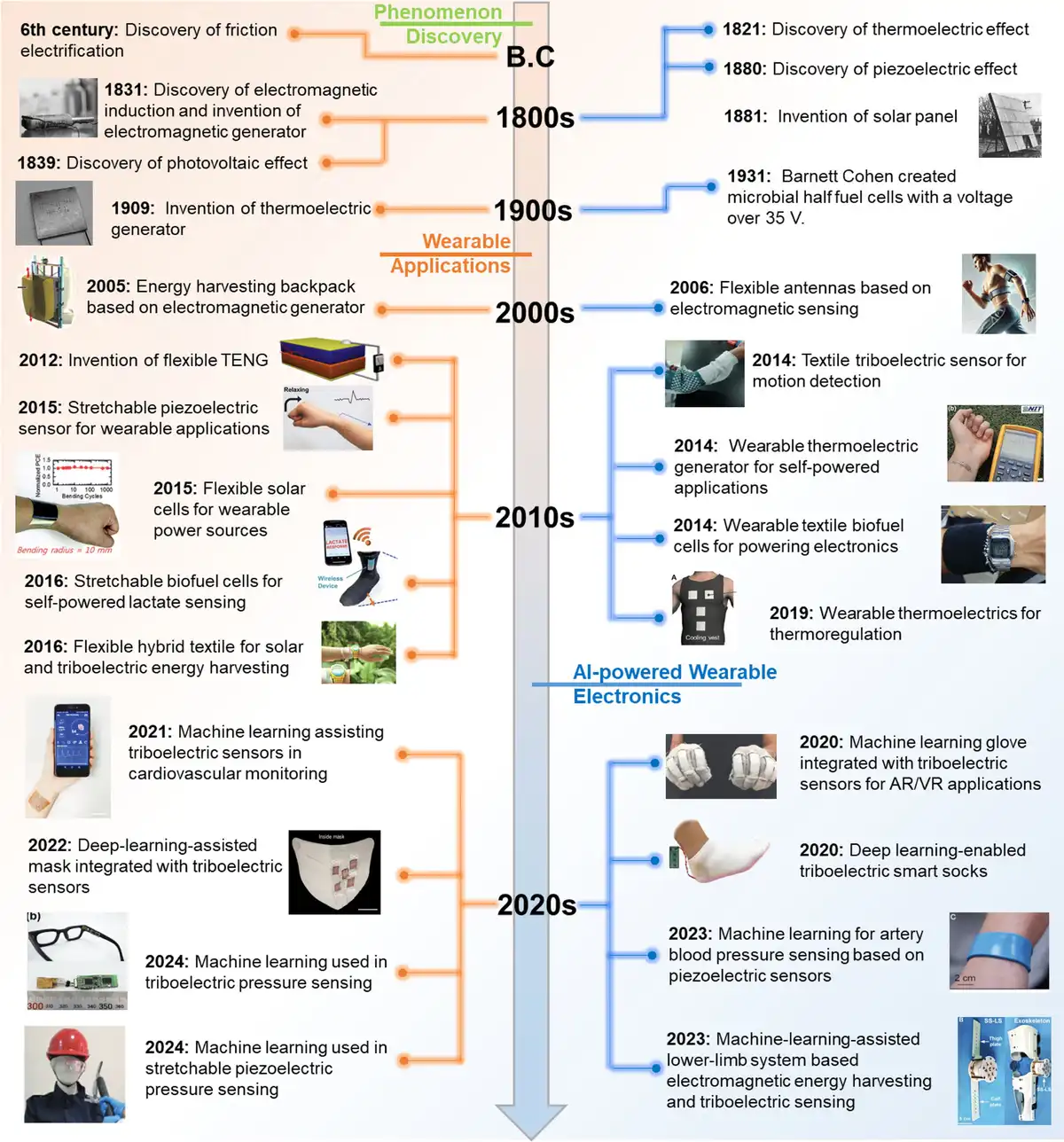
Self-powered sensing, which converts physiological signals into electrical signals through various energy conversion effects, significantly reduces the complexity of sensor implementation and enhances sensing system integration. The development of this technology can be divided into 3 stages. Before the 21st century, scientists discovered key energy conversion effects, such as piezoelectric,[6] triboelectrification, electromagnetic induction,[7,30–31–32] thermoelectric,[8] photovoltaic,[9,10] and electrochemical[11] effects, which formed the basis for self-powered sensing but lacked large-scale applications. From 2000 to 2020, advancements in flexible materials and fabrication processes greatly improved the flexibility, scalability, and biocompatibility of wearable sensors, leading to the emergence of numerous wearable applications.[12–13–14–15–16–17–18–19–20–21] Since 2020, breakthroughs in machine learning (ML) and deep learning (DL) have propelled the field into an era of artificial intelligence (AI)-driven self-powered sensing,[22–23–24–25–26–27–28–29] where customized sensor designs enhance electrical signal outputs under weak physiological conditions and advanced data processing enables the extraction of valuable features from complex and noisy signals. This has expanded applications in disease prevention, prediction, and rehabilitation. As a result, AI-integrated wearable sensing systems are becoming a key trend for intelligent healthcare applications (Figure 1).
Figure 1.
Advancement of self-powered sensing technology. Before the 21st century, scientists discovered key energy conversion effects, such as piezoelectric,[6] triboelectrification, electromagnetic induction,[7] thermoelectric,[8] photovoltaic,[9,10] and electrochemical[11] effects. From 2000 to 2020, advancements in flexible materials and fabrication processes greatly improved the flexibility, scalability, and biocompatibility of wearable sensors. In 2005, an energy-harvesting backpack based on an electromagnetic generator was invented. Adapted with permission from Rome et al,[12] Copyright © 2005, The American Association for the Advancement of Science. In 2006, flexible antennas based on electromagnetic sensing were designed.[13] In 2012, the first flexible triboelectric nanogenerator (TENG) was proposed. Adapted with permission from Fan et al,[14] Copyright © 2012 Elsevier Ltd. In 2014, a textile triboelectric sensor was developed for motion detection (adapted with permission from Zhou et al,[15] Copyright © 2014 American Chemical Society); a wearable thermoelectric generator was proposed for self-powered applications (adapted with permission from Kim et al,[16] Copyright © 2014 Royal Society of Chemistry); and wearable textile biofuel cells were developed for powering electronics (adapted with permission from Jia et al,[17] Copyright © 2014 Royal Society of Chemistry). In 2015, flexible solar cells were invented for wearable power sources. Adapted with permission from Kim et al,[18] Copyright © 2015 Royal Society of Chemistry. In 2016, stretchable biofuel cells were invented for self-powered lactate sensing (adapted with permission from Jeerapan et al,[19] Copyright © 2016 Royal Society of Chemistry); and a flexible hybrid textile was conceived for solar and triboelectric energy harvesting (adapted with permission from Chen et al,[20] Copyright © 2016, Springer Nature Limited). In 2019, wearable thermoelectrics were proposed for thermoregulation. Adapted with permission from Hong et al,[21] Copyright © 2019, The American Association for the Advancement of Science. Since 2020, breakthroughs in ML and DL have propelled the field into an era of AI-driven self-powered sensing. In 2020, an ML glove integrated with triboelectric sensors for augmented reality (AR)/ virtual reality (VR) applications was proposed (adapted with permission from Wen et al,[22] Copyright © 2020 Wiley-VCH GmbH); and DL-enabled triboelectric smart socks were invented (adapted with permission from Zhang et al,[23] Copyright © 2020 Springer Nature Limited). In 2021, ML-assisted triboelectric sensors were designed for cardiovascular monitoring. Adapted with permission from Fang et al,[24] Copyright © 2020 Wiley-VCH GmbH. In 2022, a DL-assisted mask was designed and integrated with triboelectric sensors. Adapted with permission from Fang et al,[25] Copyright © 2022 Wiley-VCH GmbH. In 2023, ML was proposed for artery blood pressure sensing based on piezoelectric sensors (adapted with permission from Li et al,[26] Copyright © 2023 Springer Nature Limited); and an ML-assisted lower-limb system-based electromagnetic energy-harvesting and triboelectric sensing was designed (adapted with permission from Kong et al,[27] Copyright © 2023 Wiley-VCH GmbH). In 2024, ML was used in triboelectric pressure sensing (adapted with permission from Xie et al,[28] Copyright © 2024 Wiley-VCH GmbH); and ML was employed in stretchable piezoelectric pressure sensing (adapted with permission from Garg et al,[29] Copyright © 2024 Wiley-VCH GmbH).
Given the rapid advancements in AI technology and self-powered sensing systems, coupled with the growing demand for smart healthcare applications, we present a comprehensive review of AI-assisted healthcare self-powered sensing systems. Different from existing literature, this review emphasizes the materials, manufacturing processes, structural designs, and integrated approaches specific to healthcare systems based on various self-powered sensing principles. Additionally, we explore in depth the role of AI technology in enhancing these systems, driving automation and intelligence in healthcare applications. First, we introduce the principles and foundational development of self-powered sensing technology. Next, we review its applications in the healthcare field, emphasizing materials, manufacturing processes, and structural designs. Furthermore, we summarize and examine the role of AI in sensing systems, as well as its combination with signal recognition, classification, and disease rehabilitation. Finally, we discuss the challenges faced by self-powered sensing systems and explore potential future directions for their development.
2. Principle of self-powered sensing
Energy harvesting technologies have emerged as a key solution for self-powered sensors by utilizing ambient or body-derived energy. Energy harvesting mechanisms (Figure 2), including piezoelectricity, triboelectricity, electromagnetic radiation, thermoelectricity, photovoltaics, and electrocatalytic reaction, are widely explored for self-powered applications.
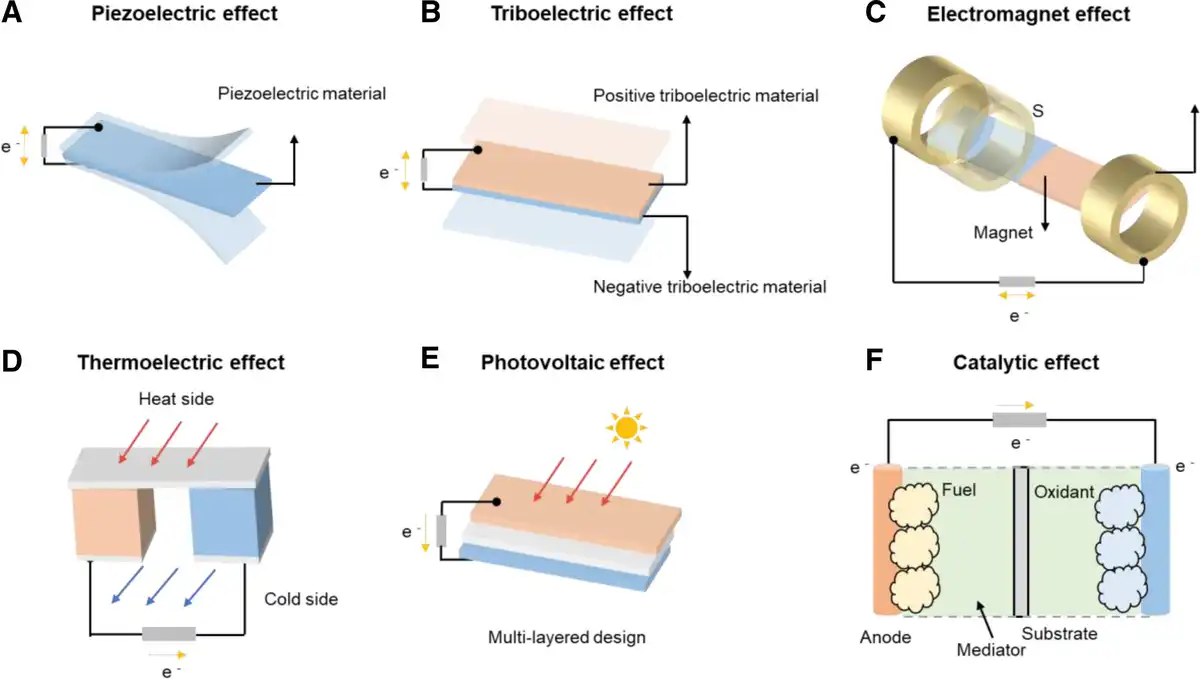
Figure 2.
Principles of self-powered sensing. (A) Piezoelectric effect. (B) Triboelectric effect. (C) Electromagnet effect. (D) Thermoelectric effect. (E) Photovoltaic effect. (F) Catalytic effect.
Piezoelectric sensors utilize mechanical stress or strain to create an internal electric field within piezoelectric materials (Figure 2A).[33–34–35–36] Common materials include zinc oxide nanorods, lead zirconate titanate (PZT), barium titanate (BaTiO3), and polyvinylidene fluoride (PVDF), which are structured to maximize energy conversion efficiency.[37–38–39] With power densities reaching up to 810 mW/m²,[40] these systems are effective for capturing energy from low-frequency movements. Piezoelectric sensors have better stability and are less susceptible to external environmental interference. They can be classified into compression type and bending type, utilizing the d33 and d31 piezoelectric modes, respectively. The d33 mode is typically employed to measure small-displacement press or pulse signals, while the d31 mode is more suited for monitoring large-displacement joint motion.
Triboelectric sensors operate based on the triboelectric effect and electrostatic induction (Figure 2B). When two materials with different electron affinities come into contact, electrical charges are generated on their surfaces. Upon separation, charges are induced at the electrodes, allowing charge flow between them due to electrostatic induction.[14,41,42] A key advantage of triboelectric sensors is the wide availability of triboelectric materials. The selection of suitable materials can be guided by the triboelectric series.[43] In general, materials containing fluorine exhibit a strong ability to attract negative charges, such as polytetrafluoroethylene (PTFE), polydimethylsiloxane (PDMS), and fluorinated ethylene propylene (FEP). Conversely, materials such as aluminum (Al), copper (Cu), nylon, and glass, tend to lose electrons easily, becoming positively charged. The design of triboelectric sensors should ensure that the selected materials have significantly different charge-attracting capabilities to optimize performance.[44] Triboelectric sensors operate in four fundamental modes: contact-separation mode, single-electrode mode, lateral-sliding mode, and freestanding triboelectric-layer mode.[43] The contact-separation and single-electrode modes promote full contact between surfaces, maximizing charge transfer, making them particularly suitable for mechanical vibration energy harvesting.[45] In contrast, the lateral-sliding and freestanding triboelectric-layer modes minimize surface contact to reduce friction and wear, making them ideal for applications involving rotary motion, such as harnessing wind[46] and water flow[47] energy with high efficiency. Furthermore, triboelectric generators (TENGs) offer power densities of up to 10 W/m2[48] and are flexible enough for integration into textiles or on-skin applications. As sensing devices, TENGs are highly sensitive and can generate significant voltages under weak physical inputs. However, durability remains a concern, as many TENGs rely on metallic-organic polymers prone to degradation over time.[49]
Electromagnetic induction offers a promising way for healthcare sensing, as flexible antennas can capture ambient electromagnetic waves for both power and data transfer without batteries (Figure 2C).[50,51] These antennas are made from materials like polymers, textiles, graphene, neoprene, wool, cellulose, and silk and composites such as ceramics or MXenes.[52] A key challenge is ensuring the substrates are printable, with conductive materials like Cu or special inks used.[53] Research is ongoing to investigate on new materials and physical effects to improve the performance.[54,55] Wearable antennas are compact and operate at frequencies of GHz.[56] They are useful for tracking body movement and position, such as walking, falling, or bending, making them ideal for health and activity monitoring.[57,58] However, challenges include how the antenna interacts with the human body, which can affect performance, especially with high electromagnetic exposure.[59] Antennas also need to withstand deformation from movements like walking or bending and maintain stable performance over time, despite environmental factors like temperature, humidity, and frequent washing.
Thermoelectric generators (TEGs) harness small amounts of heat and convert them into electricity (Figure 2D), making them ideal for powering wearable devices by utilizing heat generated through human metabolic activities. These generators offer the potential for near-perpetual energy production.[60] While traditional TEGs are typically rigid and bulky, recent advancements have introduced flexible versions made from composite materials, including conductive polymers, hybrid organic–inorganic materials, continuous inorganic films, and liquid metals, which are better suited for wearable applications.[61,62] However, these devices often resemble heatsinks, making them difficult to clean and less aesthetically appealing. In comparison to piezoelectric nanogenerators (PENGs) and TENGs, TEGs tend to be larger in size, typically measuring tens of square centimeters, and have lower power densities of up to 400 mW/m².[63] Despite their potential, several challenges remain in the development of stable and efficient wearable TEGs. These include low energy conversion efficiency, issues with biocompatibility, maintaining consistent contact with the heat source, and ensuring adaptability to changes in body temperature across different environments.[64]
Photovoltaic materials represent a sustained energy source for wearable sensors, offering the advantage of solar power harvesting (Figure 2E). Traditionally, solar cells are rigid; however, recent innovations have led to the development of stretchable, twistable, and bendable photovoltaic devices based on transparent electrodes or smart textiles made from deformable hybrid thin films and soft composite materials.[65] These smart textiles enable photorechargeable power sources, some of which are even washable.[66,67] However, miniaturization remains a significant challenge for solar cells, as they tend to be bulky and heavy, particularly for applications requiring higher energy densities. Additionally, much of the space in wearable devices is occupied by energy storage components, which limits the potential for compact, lightweight designs. Solar cells convert sunlight into electricity using multilayered photovoltaic materials. Stretchable, bendable, and washable designs have been achieved through advanced materials like transparent electrodes and deformable hybrid films. While solar energy is a promising renewable source, these systems often remain bulky and require further miniaturization to meet the size and energy density demands of wearable devices.[68]
Biofuel cells offer a promising power source for wearable sensors by using enzymes to convert chemical energy into electricity (Figure 2F). For example, lactate, which is abundant in sweat, can be used as a fuel. Enzymes such as lactate oxidase can oxidize lactate to generate electricity.[69] Biofuel cells can also use other substances in sweat, such as glucose, urea, and ammonium, allowing for multianalyte detection.[70,71] This makes them ideal for self-powered wearables that monitor health. However, challenges include improving energy density, catalyst stability, fuel availability, and miniaturization.[72] Enzyme degradation under nonideal conditions can reduce performance, but nanozymes, as catalytically active nanoparticles with enzyme-like kinetics, have shown potential as replacements.[73] Incorporating nanomaterials like carbon nanotubes (CNTs) and high-surface-area electrodes can boost efficiency.[74] Current wearable biofuel cells are advantageous in size and can deliver power densities of mW/cm2.[75]
3. Self-powered sensing for healthcare
3.1 Piezoelectric sensors
The evolution of wearable piezoelectric sensors has been significantly influenced by the continuous innovation in piezoelectric materials. These materials play a pivotal role in translating mechanical stimuli into electrical signals, enabling diverse applications in health monitoring, energy harvesting, and HMI.
Inorganic piezoelectric materials, such as PZT and BaTiO3,[76,77] have long been favored for their high piezoelectric coefficients and robustness in energy conversion. However, they are inherently rigid, brittle, and difficult to process, limiting their applications in wearable devices. Piezoelectric polymers, such as PVDF and its copolymers, have gained prominence due to their intrinsic flexibility, lightweight nature, and processability.[78] Among these, PVDF exhibits a piezoelectric coefficient d33 of approximately ~23 pC/N when well-electrically poled. Copolymers of PVDF, such as polyvinylidene fluoride-trifluoroethylene (PVDF-TrFE), offer an enhanced d33 of ~40 pC/N.[79,80]
One significant direction involves optimizing PVDF-based composites to enhance the β-phase content, a critical factor in improving piezoelectric performance. Zhang et al[81] incorporated BiCl3 and ZnO into electrospun PVDF nanofibers, achieving a longitudinal piezoelectric coefficient of 3.8 pC/N. The resulting hybrid nanofiber-based PENGs demonstrated sensitivity in detecting human joint movements, such as elbow and knee bending. Similarly, Li et al[82] developed BaTiO3-doped PVDF nanofibers, as shown in Figure 3A, which exhibited enhanced β-phase content and durability over 12,000 loading cycles. Their self-powered tactile sensor showed high sensitivity and repeatability for detecting human motion, making it suitable for healthcare and activity-tracking applications.
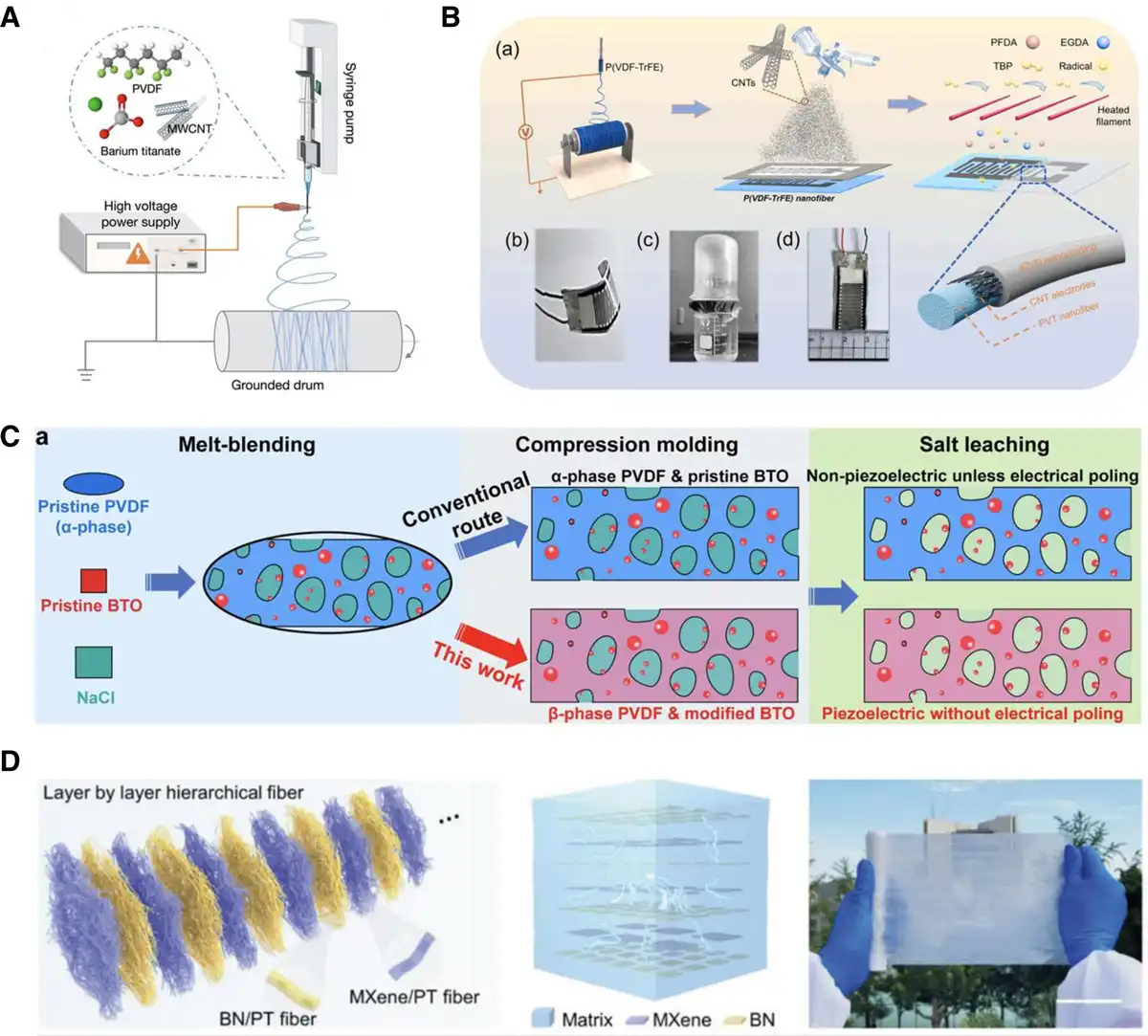
Figure 3.
Progress in piezoelectric sensors from a material perspective. (A) Electrospinning process of BaTiO3-doped PVDF nanofibers. Adapted with permission from Li et al,[82] Copyright © 2023, Donghua University. (B) Preparation process of piezoelectric sensor with a superhydrophobic coating. Adapted with permission from Su et al,[83] Copyright © 2022, Elsevier Ltd. (C) Fabrication process of PVDF/BaTiO3 composites. Adapted with permission from Huang et al,[84] Copyright © 2024 Springer Nature Limited. (D) Illustration of the hierarchical piezoelectric composite film. Adapted with permission from Tian et al,[85] Copyright © 2024 Wiley-VCH GmbH.
Efforts to improve piezoelectric polymers also extend to self-poling methods, which eliminate the need for energy-intensive electrical poling. As illustrated in Figure 3C, Huang et al[84] introduced a melt-state energy implantation technique to fabricate PVDF/BaTiO3 composites, achieving a high d33 value of 51.20 pC/N. This method simplifies the production process while enabling sustainable self-powered sensing and energy harvesting.
To overcome the inherent limitations of polymer-based piezoelectric materials, hybrid composites integrating ceramic fillers have been widely studied. Du et al[86] developed multilayered PZT/PVDF composites with a porous structure, which enhanced overall polarization and surface charge density. The resulting PENG achieved an output voltage of 62 V, a significant improvement compared with traditional composites, and demonstrated excellent flexibility and mechanical robustness. In a complementary approach, Tian et al[85] utilized MXene and boron nitride nanosheets within PVDF-TrFE composites, as depicted in Figure 3D, achieving a piezoelectric charge coefficient of 41.67 pC/N. These hierarchical composites were optimized for continuous blood pressure monitoring, offering both accuracy and user comfort in wearable applications.
Inorganic materials have also been explored for their superior piezoelectric properties and stability. Lv et al[87] developed an all-inorganic Sm-doped PMN-PT thin film on a flexible mica substrate, achieving an ultrahigh d33 value of 380 pm/V. This material enabled devices with exceptional energy-harvesting performance and motion-sensing capabilities, further demonstrating the potential of flexible inorganic piezoelectric films in advanced wearable technologies.
To address environmental durability and long-term usability, researchers have investigated surface treatments and encapsulation methods. Venkatesan et al[88] combined perovskite quantum dots with PVDF nanofibers, achieving a high open-circuit voltage of 20.3 V while incorporating photocatalytic functionalities for environmental applications. Moreover, the durability and environmental resistance of wearable devices have been significantly improved by surface modifications. As shown in Figure 3B, Su et al[83] introduced a superhydrophobic coating via initiated chemical vapor deposition on piezoelectric sensors, enhancing their resistance to humidity, liquid exposure, and bacterial fouling. This innovation ensures stable and reliable performance in harsh environments, demonstrating the practical viability of wearable piezoelectric sensors in real-world applications.
Advancements in the structural design of piezoelectric wearable sensors have played a critical role in enhancing their functionality, sensitivity, and durability from another perspective. These innovations focus on bioinspired structures, novel geometries, and multifunctional integration to address challenges such as adaptability, mechanical stability, and multienvironment operability.
Bioinspired designs have emerged as a powerful approach to enhancing the sensitivity and adaptability of piezoelectric sensors. As shown in Figure 4A, Yuan et al[89] introduced a bionic lateral-line–inspired sensor, mimicking the stress-concentration mechanism of fish. The curved PVDF-based structure demonstrated an exceptionally low detection limit of 0.0005 N, enabling highly sensitive respiratory monitoring. He et al[90] drew inspiration from the cuttlebone structure, designing a 3D-printed composite reinforced with Rochelle salt crystals, as illustrated in Figure 4B. This structure achieved a balance between mechanical protection and piezoelectric sensitivity, making it ideal for high-impact applications such as sports monitoring and fall detection systems. Both studies highlight how nature-inspired structural features can be translated into advanced sensor designs with enhanced performance.
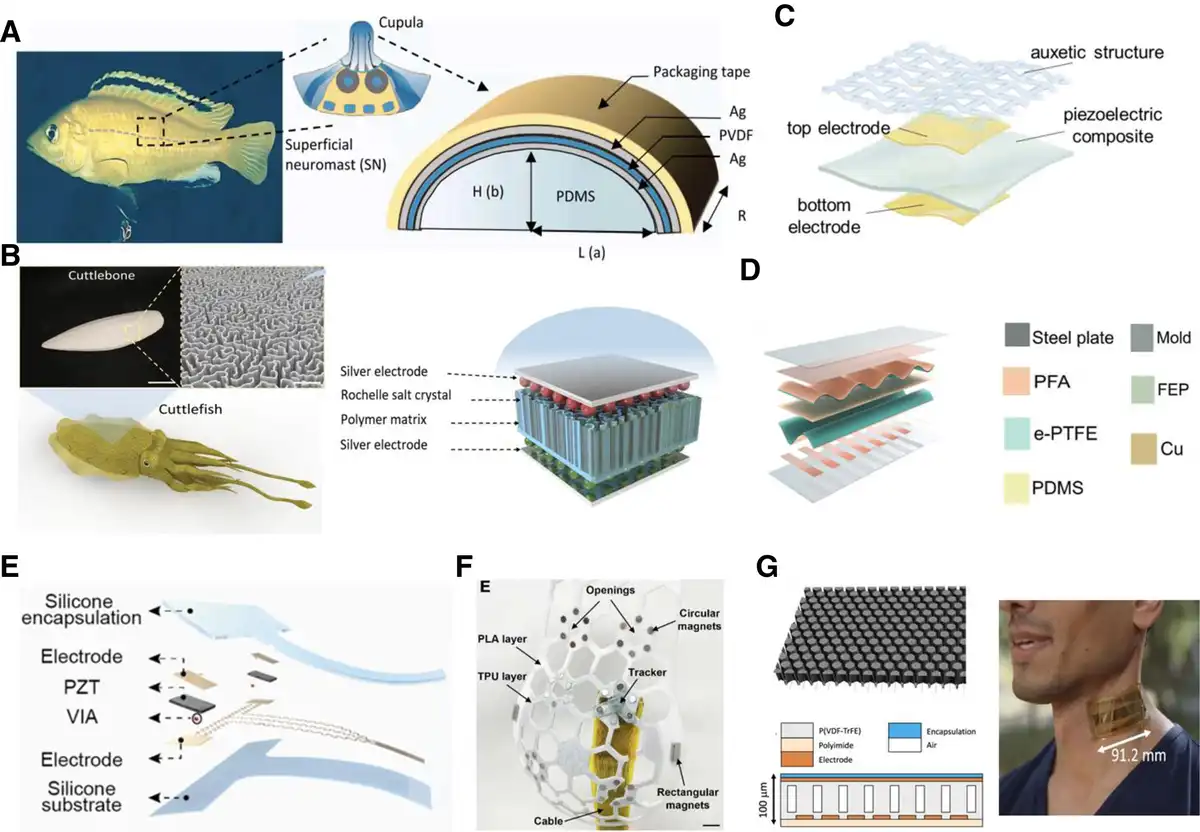
Figure 4.
Progress in piezoelectric sensors from a structural perspective. (A) Bionic lateral-line-inspired piezoelectric sensor. Adapted with permission from Yuan et al,[89] Copyright © 2022, Elsevier Ltd. (B) Cuttlebone-inspired piezoelectric sensor. Adapted with permission from He et al,[90] Copyright © 2023 Springer Nature Limited. (C) Piezoelectric sensor with 3D-printed auxetic structure. Adapted with permission from Zhou et al,[91] Copyright © 2023 Wiley-VCH GmbH. (D) Piezoelectric sensor with microcavities enhancing sensitivity. Adapted with permission from Wu et al,[92] Copyright © 2024 Wiley-VCH GmbH. (E) Thin, soft piezoelectric sensor array for blood pressure monitoring. Adapted with permission from Li et al,[26] Copyright © 2023 Springer Nature Limited. (F) Honeycomb-structured patch for breast cancer diagnostics. Adapted with permission from Du et al,[96] Copyright © 2023, The American Association for the Advancement of Science. (G) Ultrasound transducer foil-based embossed polymer. Adapted with permission from van Neer et al,[95] Copyright © 2024 Springer Nature Limited.
The optimization of mechanical deformations has also been a significant direction in structural design. As illustrated in Figure 4C, Zhou et al[91] employed a 3D-printed auxetic structure to transform bending deformations into in-plane stretching, amplifying piezoelectric output by 8.3 times. This structure enables efficient energy-harvesting and precise motion sensing, demonstrating the potential of structural design to expand the mechanical adaptability of piezoelectric devices. Similarly, Wu et al[92] incorporated microcavities into the piezoelectric layer to improve sensitivity and durability, as illustrated in Figure 4D. This design allowed for real-time dynamic pressure monitoring, including applications in robotics and prosthetics.
Integrating multifunctionality into structural designs has been another key focus. Zhang et al[93] developed a flexible lamb wave-based piezoelectric device capable of sensing, communication, and positioning. This multifunctional system combines high-frequency acoustic sensing for respiratory monitoring with low-frequency vibration for wireless communication. The integration of diverse functionalities into a single device underscores the versatility of structural innovations in piezoelectric sensors.
In healthcare, structural innovations have been pivotal in achieving accurate and continuous monitoring. Yi et al[94] optimized piezoelectric dynamics for arterial pulse monitoring, addressing challenges in fidelity and motion artifacts. Their single-sensor system achieved precise continuous blood pressure monitoring, providing a simpler and more portable alternative to conventional multisensor setups. As depicted in Figure 4E, Li et al[95] expanded on this by integrating a thin, soft piezoelectric sensor array into an ML-assisted system for continuous arterial blood pressure monitoring. This conformal design improves skin interaction and enhances measurement accuracy, marking a significant step forward in wearable medical technologies.
For imaging applications, ultrasound-based piezoelectric devices have seen remarkable advancements. Du et al[96] introduced a honeycomb-structured patch for breast cancer diagnostics (Figure 4F), achieving precise imaging over large, curved surfaces. Van Neer et al[26] developed an embossed polymer ultrasound array for flexible medical imaging (Figure 4G). By eliminating rigid transducer assemblies, their design enables scalable, high-performance patches for real-time monitoring of organs and blood flow. These studies demonstrate the transformative potential of structural innovations in wearable imaging technologies.
Overall, the continuous innovations in piezoelectric materials and structural designs have significantly advanced the capabilities of sensors. By addressing challenges related to flexibility, biocompatibility, and sustainability, they have paved the way for multifunctional, self-powered, and user-friendly wearable technologies.
3.2 Triboelectric sensors
Triboelectric sensors offer real-time, noninvasive monitoring of physiological and biomechanical parameters. By utilizing the triboelectric effect, these sensors convert mechanical stimuli, such as motion, pressure, or strain, into electrical signals, enabling precise measurements of athletic performance, injury risk, and rehabilitation progress.[97–98–99] A key advantage of triboelectric sensors is their ability to generate electrical signals autonomously, eliminating the need for external power sources. Many researchers have focused on designing sensors using textiles and fabrics due to their comfort and practicality in real-world applications. For instance, Fang et al[24] introduced a textile-based triboelectric sensor composed of a PDMS substrate, FEP film, Al, CNTs conductive layers, and packaging textile. This sensor demonstrates high sensitivity with a signal-to-noise ratio of 23.3 dB and a response time of 0.21 µA/kPa, enabling accurate blood pressure measurement and monitoring the progression of atherosclerosis in blood vessels, as illustrated in Figure 5A. Additionally, the sensor operates effectively under various environmental conditions, including stationary, dynamic, and humid settings. Wen et al[100] reported a self-powered textile by integrating fiber-shaped triboelectric nanogenerators, solar cells, and supercapacitors as shown in Figure 5B. This innovative design combines energy generation and storage capabilities, resulting in a compact and efficient system. Similarly, other fiber-based textile sensors have been developed, as reported by Yu et al[101] and Kim et al.[102] Most of these fibers are either composed of polymers or coated with elastomers such as PDMS to enhance flexibility.[103] However, while PDMS provides good flexibility and stretchability, its poor breathability can lead to skin-related issues. To address this limitation, fabric-based designs have been explored. Choi et al[104] developed a corrugated textile-based TENG using a knitted conductive textile, a layer of silicone rubber, and woven silk coated with conductive textile, as shown in Figure 5C. This generator effectively produces energy through pressing and stretching motions. Chu et al[105] fabricated a conformal TENG using PEF fabric as a substrate, with graphene as the electrode for enhanced performance (Figure 5D). Xiong et al[106] designed an all-fabric-based triboelectric sensor utilizing hydrophobic cellulose oleoyl ester nanoparticles (HCOENPs), as illustrated in Figure 5E. This sensor not only exhibits excellent waterproofing properties but also generates electricity from water droplets, achieving a power density of 0.14 W/m2.
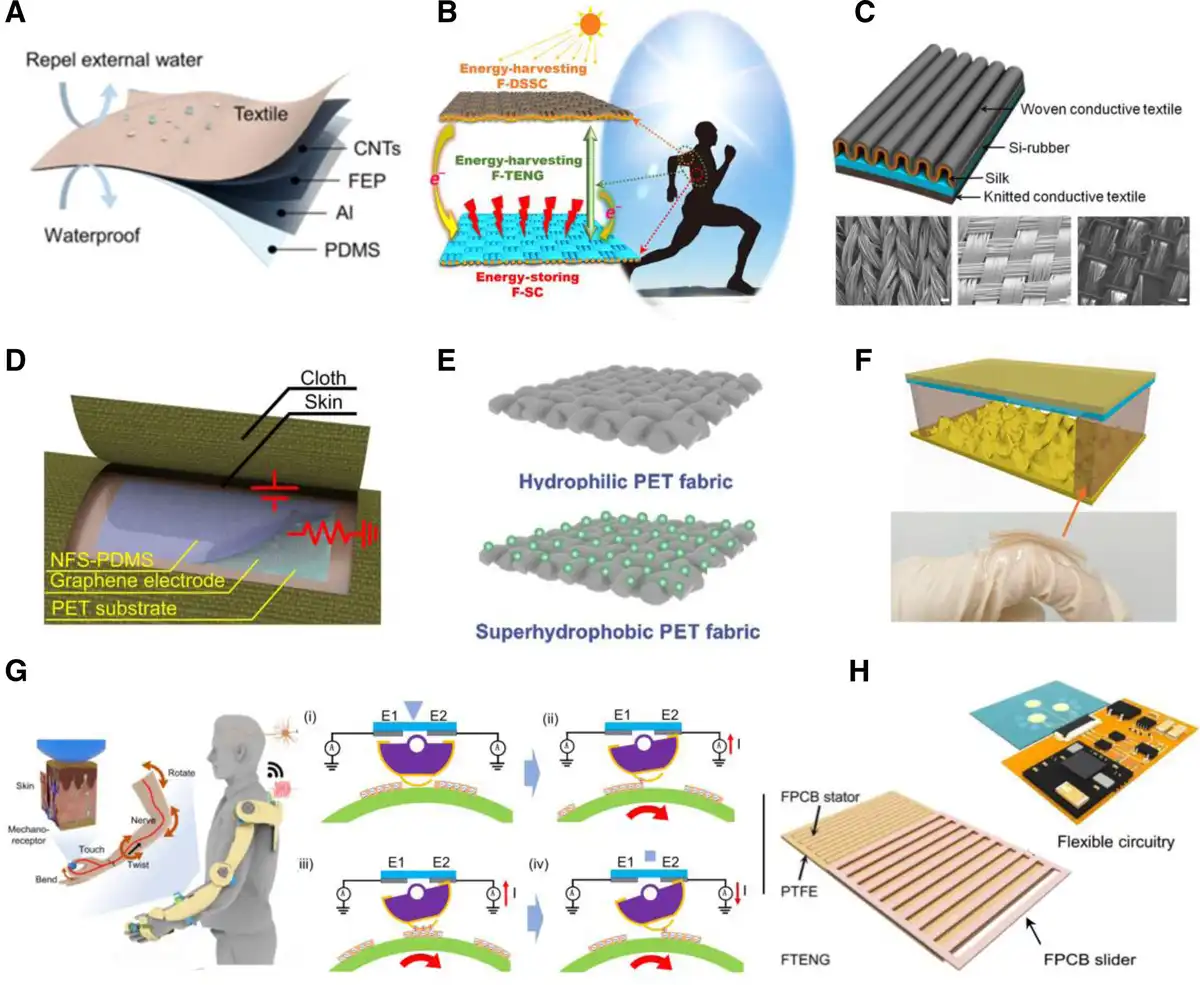
Figure 5.
Progress in triboelectric sensors. (A) Photograph of the single-layered ultra-soft smart textile. Adapted with permission from Fang et al,[24] Copyright © 2020 Wiley-VCH GmbH. (B) Schematic illustration of fiber-based self-powered system. Adapted with permission from Wen et al,[100] Copyright © 2016, The American Association for the Advancement of Science. (C) Corrugated textile-based TENG and its microscale morphology. Adapted with permission from Choi et al,[104] Copyright © 2017, Springer Nature Limited. (D) Conformal triboelectric sensor attached to the human skin. Adapted with permission from Chu et al,[105] Copyright © 2016, Elsevier Ltd. (E) Diagram of hydrophobic PET fabric with HCOENPs coating. Adapted with permission from Xiong et al,[106] Copyright © 2017 Wiley-VCH GmbH. (F) Crumpled Au-based triboelectric sensor to monitor finger motion. Adapted with permission from Chen et al,[107] Copyright © 2018, Elsevier Ltd. (G) Schematics of exoskeleton sensory system and working principle of triboelectric sensor. Adapted with permission from Zhu et al,[112] Copyright © 2021, Springer Nature Limited. (H) Schematic diagram of the FPCB-based FTENG with a grating slider and stator, which is integrated into microfluidic-based sweat sensor patch interfacing with the flexible circuitry. Adapted with permission from Song et al,[113] Copyright © 2020, The American Association for the Advancement of Science.
Triboelectric sensors are highly effective for monitoring human motion, with the most typical structure consisting of two contact layers. For example, Chen et al[107] introduced a sensor based on crumpled gold films. In this design, gold is deposited onto a prestretched elastomer. When the applied force is released, the surface buckles, forming a crumpled structure. This phenomenon enhances the effective contact area between the triboelectric layers, improving the sensor’s performance. The sensor is capable of monitoring finger bending angles and gestures with precision, as depicted in Figure 5F. Significant attention has been directed toward designing sensors for monitoring the motion of body joints, such as fingers,[108] wrists,[109] elbows,[110] and knees.[111] These designs aim to capture the full-body motion status through advanced signal processing and analytical methods. To ensure accurate monitoring of joint movements, researchers are innovating sensor structures to improve functionality. For instance, Zhu et al[112] reported a bidirectional triboelectric sensor integrated into a sensory system capable of detecting multiple degrees of freedom. This sensor is suitable for incorporation into exoskeleton systems to facilitate robotic manipulation. Figure 5G shows the working mechanism of the triboelectric sensing unit, featuring a circular grating pattern made from PTFE film and a cam-shaped switch with electrodes. The rotation angle is determined by counting the generated pulses, while the rotation direction is also detectable.
TENGs can also serve as power sources and integrate seamlessly with other sensors. For example, Song et al[113] developed a self-powered wearable sensor for human motion monitoring. This sensor incorporates a microfluidic sweat sensor powered by a flexible printed circuit board (FPCB)-based freestanding triboelectric nanogenerator (FTENG). The FTENG incorporates a grating structure composed of an FPCB stator and sliders, with the stator surface laminated with PTFE, as shown in Figure 5H. The system’s circuitry is integrated into the FPCB, providing both flexibility and comfort when attached to human skin. Additionally, the monitored signals are designed for seamless wireless transmission to mobile devices. For comprehensive medical applications, a systematic design is essential when integrating triboelectric harvesters with other sensors. This requires both the harvesters and sensors to be flexible, lightweight, and compact. Such demands have further driven advancements in soft electronics, offering innovative solutions for wearable technologies.[114] In summary, the wearable design of triboelectric sensors makes them ideal for integration into sports gear, enabling continuous data acquisition without hindering movement. Furthermore, their high sensitivity and self-powered operation minimize the need for external power sources, enhancing their practicality for long-term use.
3.3 Thermoelectric generators
TEGs convert temperature gradients into electrical signals, providing valuable insights into an athlete’s health, performance, and recovery. Their lightweight, flexible, and noninvasive design allows seamless integration into wearable devices or sports gear, ensuring comfort and minimal interference with movement.[122–123–124] A typical TEG functions like a band-aid, providing adaptability to human skin. For example, Sattar et al[115] reported an all-in-one flexible thermoelectric device capable of measuring multiple physiological signals, such as electrocardiograms (ECGs), heart rate variability, and electromyograms (EMGs), in real-time. The TEG, shown in Figure 6A, is constructed from highly thermal-conductive CNT film with the surface-constructed thermal p/n junction components. A Cu heat sink layer enhances heat rejection, maintaining a high thermal gradient. The thermoelectric unit can be integrated with bioelectrical sensors. Yang et al[116] reported a similar type of TEG with integrated electronics capable of generating electricity from body heat, as illustrated in Figure 6B. However, such TEGs typically require the assembly of rigid p/n junctions, which compromises their flexibility and comfort. To address the challenges, Karthikeyan et al[117] developed a film-type thermoelectric energy generator by depositing N-PbTe and P-SnTe arrays onto a polyimide substrate, as displayed in Figure 6C. This generator achieved a maximum output voltage and power density of 250 mV and 8.4 mW/cm², respectively, at a temperature gradient of 120°C.
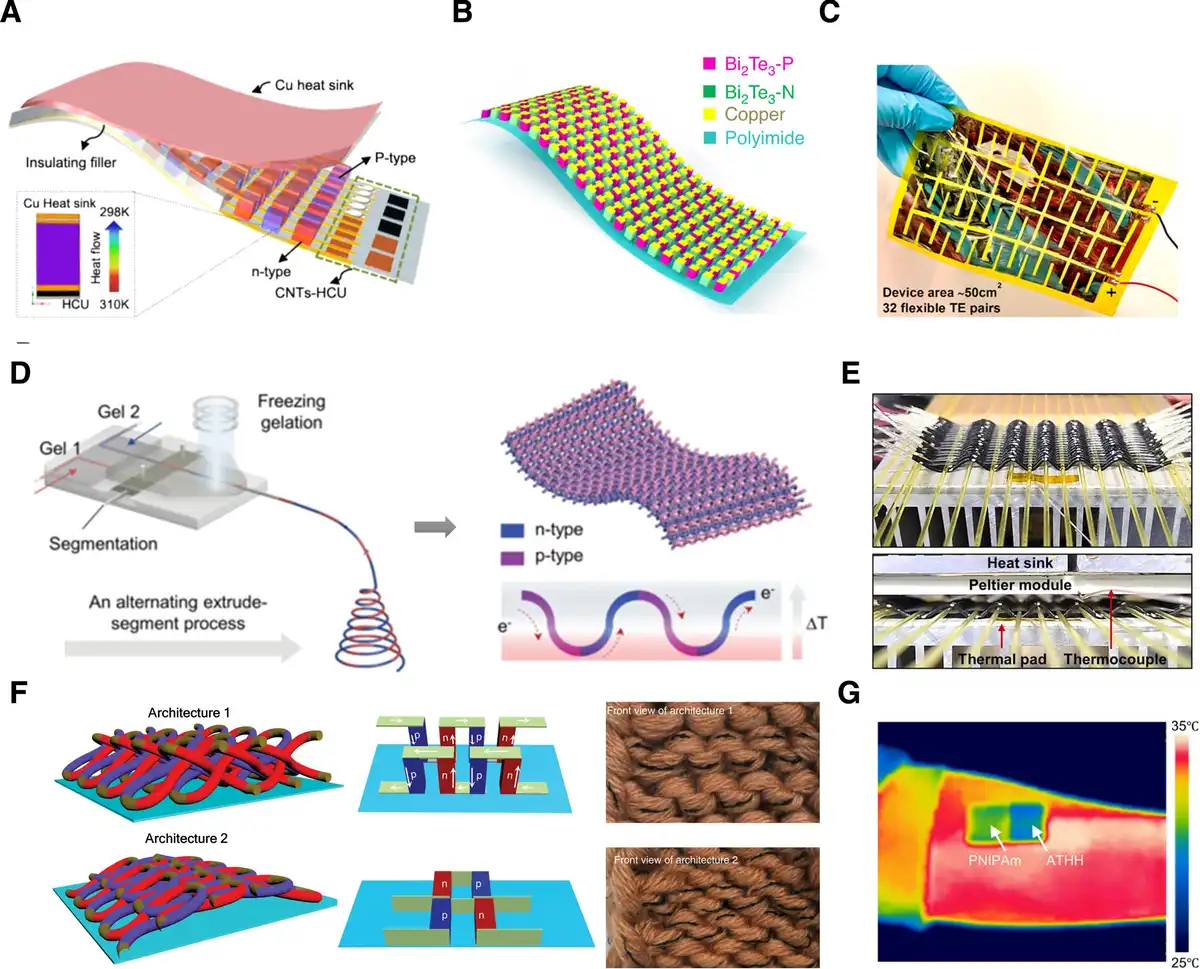
Figure 6.
Progress in TEGs. (A) A typical flexible thermoelectric unit. Adapted with permission from Sattar et al,[115] Copyright © 2024 American Chemical Society. (B) Diagram of TEG with P/N Bi2Te3 on the polyimide substrate. Adapted with permission from Yang et al,[116] Copyright © 2023, Springer Nature Limited. (C) Actual photo of TEG with 32 pairs. Adapted with permission from Karthikeyan et al,[117] Copyright © 2020, Elsevier Ltd. (D) Diagram of alternating extrusion process for thermoelectric fiber fabrication and detailed textile with the pitch waves showing successive p-n junctions alternate between hot and cold surfaces. Adapted with permission from Ding et al,[118] Copyright © 2020, Springer Nature Limited. (E) Weaved fabric and the test setup for evaluating its thermoelectric performance. Adapted with permission from Jang et al,[119] Copyright © 2022, Elsevier Ltd. (F) Illustration of two different fiber assembly architectures on the actual fabric. Adapted with permission from Sun et al,[120] Copyright © 2020, Springer Nature Limited. (G) Infrared radiation camera image of autonomous thermal homeostatic hydrogel on a human skin. Adapted with permission from Park et al,[121] Copyright © 2023, Springer Nature Limited.
To further enhance flexibility, fiber-type thermoelectric components have been investigated. For example, Ding et al[118] developed scalable thermoelectric fibers for multifunctional textile electronics. As shown in Figure 6D, the p-n gel segments are fabricated using an alternating extrusion process, enabling continuous meter-scale thermoelectric fiber production with clear p-n gel interfaces. These fibers can be woven into flexible thermoelectric textiles for conformable heat energy harvesting and to power biomedical sensors. Similarly, Jang et al[119] introduced a 3D thermoelectric fiber with exceptional mechanical reliability and an elongation ratio of up to 100% (Figure 6E). Furthermore, to improve the comfort and breathability of thermoelectric sensors, Sun et al[120] developed active thermoelectric materials using carbon nanotube fibers, which were strategically woven into stretchable fabrics, as indicated in Figure 6F. This design demonstrated a peak power density of 70 mW/m², providing enhanced wearability and performance.
Beyond fibers and fabrics, hydrogels have emerged as promising materials for thermoelectric applications due to their high-water content, biocompatibility, and ability to interface seamlessly with biological tissues. Thermal homeostasis, a critical physiological function maintaining the body’s optimal temperature of 36 to 37°C, can also be effectively addressed using hydrogel-based materials. Park et al[121] introduced an autonomous thermal homeostatic hydrogel (ATHH) capable of reversible and bidirectional thermal control. Fully attachable to the skin, the ATHH effectively blocks infrared radiation from the body, as depicted in Figure 6G. Further studies confirmed that the ATHH generates electrical signals corresponding to temperature changes, demonstrating its potential for energy-harvesting and biosensing applications. Overall, thermoelectric sensors harness body heat to generate continuous power, offering a distinct advantage over piezoelectric and triboelectric sensors, which rely on mechanical motion.
3.4 Solar cells
Solar cells convert light energy into electrical signals to power wearable electronics or monitor environmental factors. They are widely employed in applications such as tracking heart rate, oxygen saturation, and skin temperature, often through wearable devices.[125–126–127] Min et al[128] introduced a highly integrated wearable biosensor powered by a flexible perovskite solar cell (FPSC) as depicted in Figure 7A. This compact FPSC functions as a power source and integrates with biosensor arrays to monitor various physicochemical markers, including glucose, pH, Na+, sweat rate, and skin temperature. For optimal performance, solar cells must exhibit high energy conversion efficiency while maintaining flexibility and comfort to adapt seamlessly to human skin. Kaltenbrunner et al[129] reported ultrathin and lightweight organic solar cells with remarkable flexibility. Figure 7B shows the cell’s multilayer structure, with a total thickness of just 1.9 μm. These cells deform along with a bonded elastomeric substrate, demonstrating exceptional conformability. Similarly, Hailegnaw et al[130] developed flexible quasi-2D perovskite solar cells characterized by high specific power and improved stability. Figure 7C shows a multilayer structure and a thickness of less than 2.5 μm. These cells are flexible yet resistant to buckling, which can adversely affect power conversion efficiency. These advanced cells achieved an outstanding specific power of 44 W/g (average: 41 W/g), an open-circuit voltage of 1.15 V, and a champion efficiency of 20.1% (average: 18.1%). The majority of solar cells are designed in a film shape, allowing them to bend but limiting their stretchability.
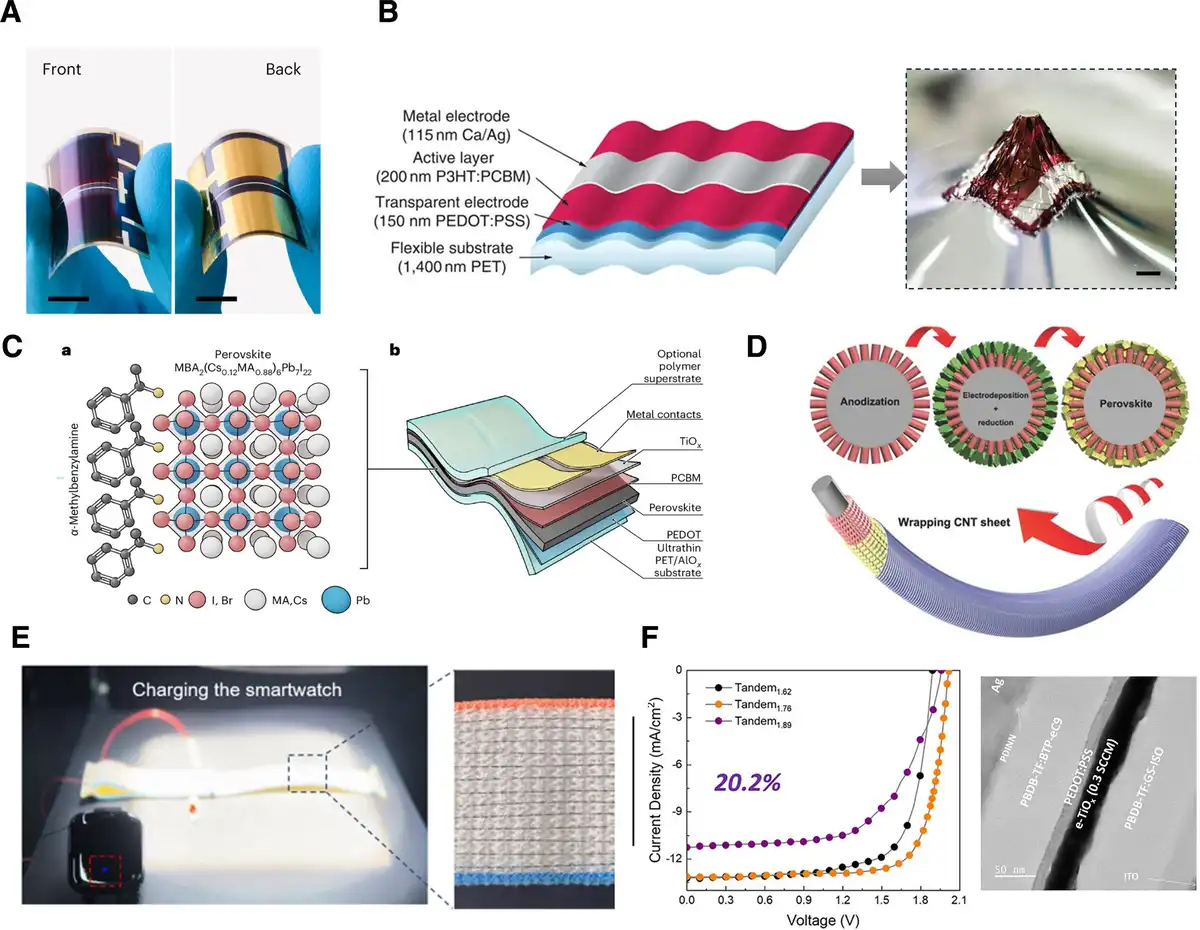
Figure 7.
Progress in solar cells. (A) Photo of an FPSC. Adapted with permission from Min et al,[128] Copyright © 2023, Springer Nature Limited. (B) Diagram of the ultra-light and flexible organic solar cell and the deformed device attached to the elastomeric support. Adapted with permission from Kaltenbrunner et al,[129] Copyright © 2012, Springer Nature Limited. (C) Schematic illustration of the perovskite device architecture and the photo of an actual flexible solar cell. Adapted with permission from Hailegnaw et al,[130] Copyright © 2024, Springer Nature Limited. (D) Diagram of solar cell in fiber shape. Adapted with permission from Qiu et al,[132] Copyright © 2016, Wiley-VCH GmbH. (E) Actual photos of the organic solar cell integrated into the fabric. Adapted with permission from Lv et al,[133] Copyright © 2022, Springer Nature Limited. (F) Graph showing the efficiency of organic solar cell and its corresponding cross-sectional scanning electron microscope (SEM) image. Adapted with permission from Zheng et al,[135] Copyright © 2022, Cell Press.
Recently, fiber-based solar cells have garnered attention due to their potential for enhanced flexibility and adaptability. For example, Chen et al[131] developed a dye-sensitized solar wire by using aligned CNT fiber and TiO2 nanotubes, achieving an energy conversion efficiency of 4.6%. Similarly, Qiu et al[132] introduced fiber-shaped perovskite solar cells via an electromechanical deposition process, which delivered a higher efficiency of 7.1%, as shown in Figure 7D. However, despite their fiber-based design, the stretchability of these solar cells remains suboptimal due to the reliance on inorganic materials. To address this limitation, Lv et al[133] designed a highly efficient organic solar cell in a fiber shape, offering excellent 1D conformability and weave-ability. Figure 7E displays the fiber being integrated into the fabric and the power of the smartwatch under light. Organic solar cells present significant potential for future wearable applications due to their superior elasticity compared with inorganic materials. Substantial efforts have been made to enhance the energy conversion efficiency of such solar cells. For instance, Zeng et al[134] developed an all-polymer organic solar cell with a large light-receiving angle, achieving an impressive efficiency of 19.06% and demonstrating superior illumination stability for up to 1200 hours. Furthermore, Zheng et al[135] reported a tandem organic solar cell with a groundbreaking efficiency of 20.2% as indicated in Figure 7F, marking the first instance of surpassing the 20% efficiency threshold. Continuous advancements in this field have consistently pushed efficiency records higher. In summary, solar cells contribute to sustainable, self-powered systems, reducing reliance on external batteries and improving convenience for athletes.
3.5 Biofuel cells
Recent developments in biofuel cells have emphasized material innovations, structural designs, and wearable applications to address challenges in efficiency, scalability, and integration with real-world systems.[136] Flexibility and wearability are achieved by integrating fiber-based electrochemical sensors into smart textiles through techniques like weaving, embroidery, and knitting, enabling real-time health monitoring.[137] The application of nanomaterials, such as CNTs[136] and graphene,[138] enhances conductivity, surface area, and enzyme-electrode electron transfer efficiency. Lee et al[139] developed stretchable enzymatic biofuel cells based on microfluidic-structured elastomeric PDMS. The wrinkled gold electrodes significantly increased the surface area, enabling high catalyst loading and efficient enzymatic reactions, even under mechanical deformation. This design demonstrated high stretchability and robust power output, making it suitable for energy-harvesting applications in wearable health-monitoring systems. Yin et al[140] combined sweat-lactate-based biofuel cells with rechargeable Zn–AgCl batteries in a wearable e-skin microgrid (Figure 8D). This system efficiently harvested biochemical energy and provided stable power storage, ensuring autonomous operation for extended periods. The integration of biofuel cells with energy storage modules eliminated the need for complex power management systems, enabling continuous operation in wearable devices for sweat sensing and health monitoring. Innovative materials derived from renewable sources are also being explored for biofuel cells. Lou et al[141] synthesized biomass-derived carbon heterostructures through the pyrolysis of lignocellulose, creating nonporous, graphitized carbon materials with enhanced conductivity and environmental adaptability. These materials, designed to support wideband electromagnetic wave absorption, can be adapted to biofuel cell electrodes, providing stable performance under various environmental conditions and expanding their applicability to real-world wearable devices.
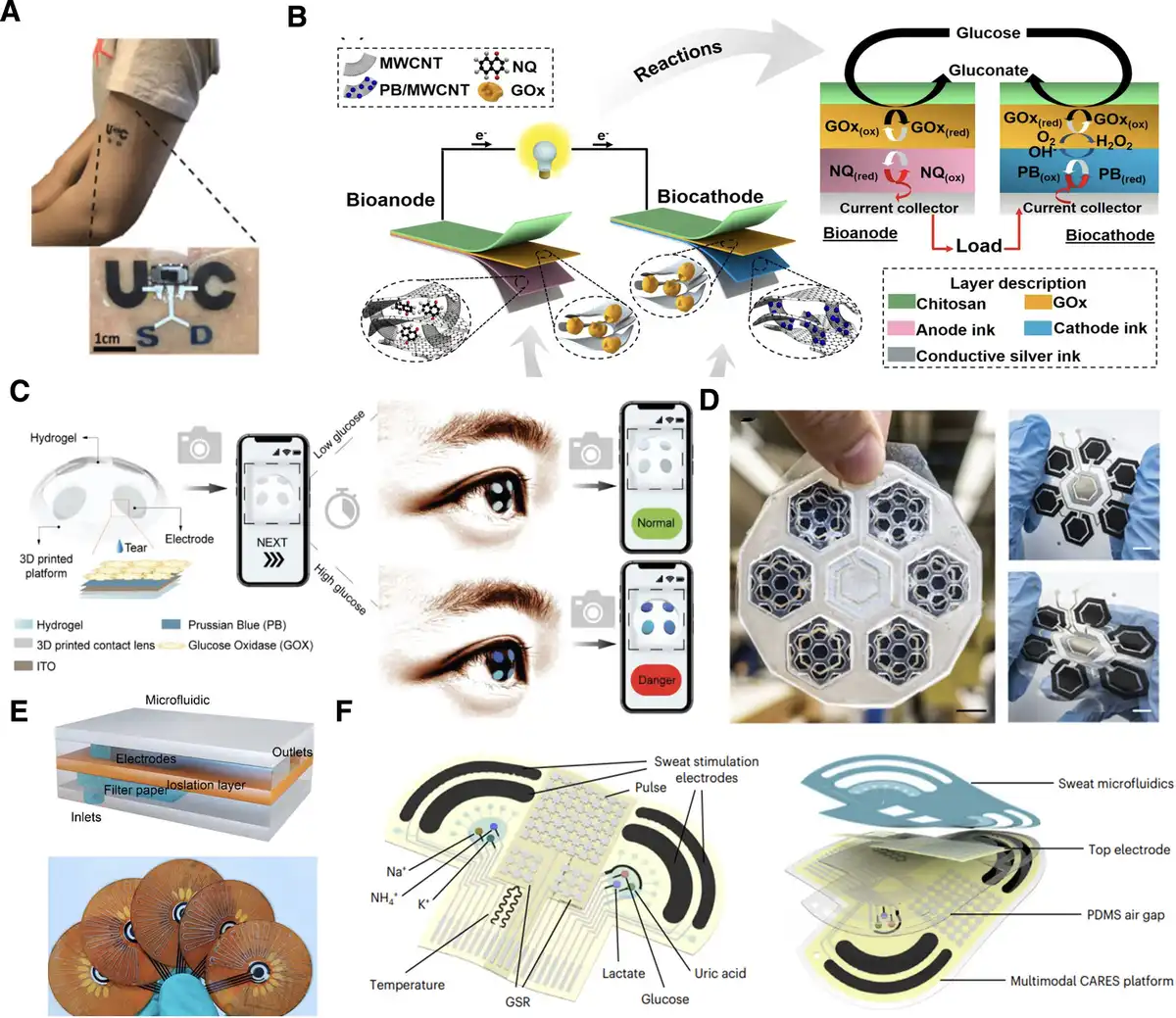
Figure 8.
Progress in biofuel cells. (A) Resettable electrochromic biosensor powered by lactate biofuel cells. Adapted with permission from Hartel et al,[142] Copyright © 2022, Elsevier Ltd. (B) Single-enzyme-based biofuel cells based on screen-printable nanocomposite inks. Adapted with permission from Veenuttranon et al,[143] Copyright © 2023, Springer Nature Limited. (C) A smart contact lens based on a biofuel cell system for glucose sensing. Adapted with permission from Li et al,[144] Copyright © 2023, Wiley-VCH GmbH. (D) Sweat-lactate-based biofuel cells with rechargeable Zn–AgCl batteries. Adapted with permission from Yin et al,[140] Copyright © 2022, Wiley-VCH GmbH. (E) Multimodal wearable biochip for monitoring sweat phenylalanine. Adapted with permission from Zhong et al,[145] Copyright © 2024, Springer Nature Limited. (F) Physicochemical-sensing electronic skin for stress monitoring. Adapted with permission from Xu et al,[146] Copyright © 2024, Springer Nature Limited.
For wearable sensing applications, Li et al[144] introduced a smart contact lens that utilized a biofuel cell system for glucose sensing (Figure 8C). The device employed electrochromic Prussian blue electrodes to provide a direct, color-based glucose readout, eliminating the need for external power or wireless communication. This innovative approach demonstrated the feasibility of biofuel cells for autonomous, noninvasive health monitoring. Veenuttranon et al[143] developed screen-printable nanocomposite inks for single-enzyme-based biofuel cells (Figure 8B). By combining glucose oxidase with CNTs and Prussian blue, they achieved a high power density and stable performance under mechanical stress. This system, integrated into wearable biosensors, enabled glucose detection in artificial sweat, highlighting its potential for scalable and flexible health-monitoring applications.
In addition to glucose monitoring, biofuel cells are being adapted for tracking broader metabolic indicators. Hartel et al[142] designed a resettable electrochromic biosensor powered by lactate biofuel cells for continuous sweat-lactate monitoring (Figure 8A). The integration of electrochromic displays with biofuel cells enabled visual feedback without external instruments, improving the usability and practicality of wearable sensors for continuous health monitoring. Zhong et al[145] developed a multimodal wearable biochip for monitoring sweat phenylalanine, which integrated advanced electrochemical electrodes and microfluidic channels (Figure 8E). This biochip correlated sweat biomarkers with blood levels, providing insights into metabolic states during exercise. The system’s ability to operate autonomously using biofuel cells underscores the potential of biofuel cells in multisensor wearable platforms for personalized health tracking. Xu et al[146] extended the application of biofuel cells to stress monitoring by creating a physicochemical-sensing electronic skin capable of continuous operation (Figure 8F). This system monitored multiple sweat biomarkers, including glucose and lactate, alongside vital signs such as pulse waveform and skin temperature. The electronic skin demonstrated robust stability over extended periods, leveraging biofuel cells to enable real-time, autonomous health monitoring for stress and metabolic conditions.
3.6 Wearable antennas
Advancements in fabrication techniques for wearable antennas are crucial to address the demands for flexibility, stretchability, miniaturization, and lightweight design. These antennas must conform to the human body, endure mechanical deformations, and maintain stable electrical performance.[50,150] Precise fabrication methods, such as 3D printing and inkjet printing, enable the creation of complex structures with high precision, while layered assembly improves performance in compact designs.[151] Techniques like photolithography and etching ensure fine features for high-frequency applications, and the integration of conductive threads or fabrics into textiles creates stretchable and wearable designs.[152,153] Embedding antennas in elastomers like PDMS enhances durability and stretchability, while liquid metals offer self-healing properties and excellent conductivity.[154,155] These methods collectively ensure that wearable antennas achieve high electromagnetic performance, environmental resistance, and seamless integration with various substrates, enabling applications in healthcare, communication, and beyond. Shao et al[147] introduced a room-temperature direct printing approach using additive-free MXene-based inks (Figure 9A). This method allows high-precision fabrication of wireless electronic components, including antennas, on flexible substrates without the need for postprocessing, achieving superior electrical conductivity and compatibility with diverse surfaces. Li et al[148] leveraged 3D weaving technology to fabricate textile-based antennas embedded with electromagnetic metamaterials (Figure 9B). By embedding conductive yarns into spacer fabrics, this method not only improved mechanical strength but also suppressed surface wave radiation, resulting in a significant gain increase from 5.1 to 9.6 dB. Mirzajani et al[149] employed femtosecond laser ablation to produce compact and flexible NFC antennas, demonstrating precise control over antenna geometry. This process integrates the antennas seamlessly into health-monitoring systems, eliminating the bulk and rigidity of traditional electronic components (Figure 9C). Arulmurugan et al[156] utilized screen-printing techniques to develop a dual-band wearable textile antenna integrated with an electromagnetic bandgap structure. This fabrication approach achieved gains of 6.59 dB and 7.03 dB in the 2.48 GHz and 5.2 GHz bands, respectively, while reducing the specific absorption rate (SAR), ensuring safety and compatibility for wearable applications
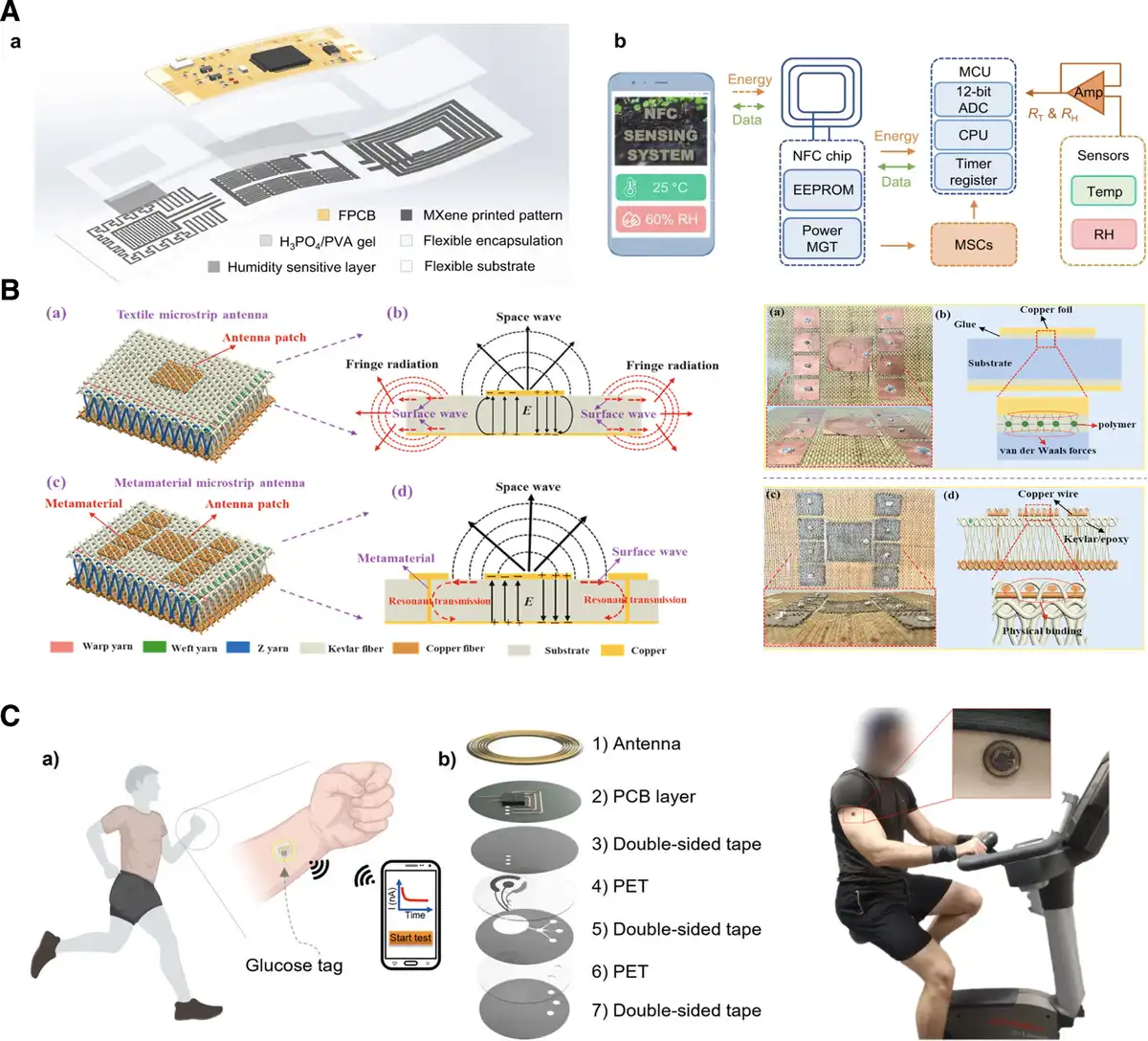
Figure 9.
Progress in wearable antenna. (A) Scheme of the all-MXene-printed wearable antenna. Adapted with permission from Shao et al,[147] Copyright © 2022, Springer Nature Limited. (B) Diagram of metamaterial antenna using 3D weaving technology. Adapted with permission from Li et al,[148] Copyright © 2024, Elsevier Ltd. (C) Configuration of a glucose tag for health monitoring. Adapted with permission from Mirzajani et al,[149] Copyright © 2022, Elsevier Ltd.
Structural design plays a critical role in the development of wearable antennas to ensure optimal performance, durability, and user comfort. The necessity for advanced structural designs stems from the unique requirements of wearable applications. Wearable antennas must conform to the human body’s curvature while maintaining efficient electromagnetic performance, even under mechanical deformation such as bending, stretching, or twisting.[157] Miniaturization and lightweight structures are essential for user comfort, while durability is required to withstand environmental conditions like moisture, sweat, and mechanical wear.[152] Additionally, antennas must integrate seamlessly with textiles or flexible substrates without compromising functionality. For instance, Yang et al[158] designed a broadband circularly polarized all-textile antenna, leveraging characteristic mode analysis and flexible felt substrates to achieve high gain and omnidirectional radiation patterns. This antenna was particularly effective for both on- and off-body communication, addressing challenges posed by the dynamic nature of wearable devices. Yu et al[159] presented a dual-band, dual-circularly polarized antenna equipped with an artificial magnetic conductor reflector. This innovative design achieved high gains (11.9 dBic at 3.5 GHz and 10.5 dBic at 5.8 GHz) and minimized SAR, making it highly suitable for 5G and IoT applications. Zhang et al[160] developed a wearable localized surface plasmon antenna that combined compact size and multiband functionality. The design used polyimide as a substrate to ensure flexibility and comfort, while the antenna maintained stable performance even under mechanical deformation. The antenna also demonstrated capabilities in both communication and sweat-sensing applications, showcasing its multifunctionality. Moreover, Zhang et al[161] proposed a wideband circularly polarized antenna with a metasurface plane for biomedical telemetry. This design employed a crossed dipole structure with a metasurface reflector to improve gain and axial ratio bandwidth, ensuring reliable communication with implanted devices while conforming to the human body.
While wearable antennas do not inherently possess self-powered characteristics, the autonomous operation of the system can be achieved through the effective integration of a rectenna for radio-frequency (RF) energy harvesting. Rectennas combine an antenna with a rectifier for converting electromagnetic energy, typically from RF sources, into direct current power.[162] The main components of a rectenna include the antenna for capturing RF energy, the rectifier for conversion, and often a filter to smooth the resulting DC output. Key challenges in rectenna design involve enhancing efficiency, particularly at low power levels, optimizing the matching between the antenna and rectifier, and ensuring a broad frequency response while minimizing energy losses.[163]
4. AI in sensing systems
4.1 AI model selection in healthcare sensing systems
AI is becoming an essential technology for processing signals collected by sensors. By utilizing AI techniques to extract features and patterns, it identifies valuable information within the signals, transforming them into interpretable semantics or classifications that meet our needs.[164] Compared with traditional signal analysis methods, AI has a lower dependency on the macroscopic interpretability of signals. This allows it to uncover deeper feature correlations, significantly reducing the high standards required for sensor signal patterns.[165] Consequently, this alleviates the design burden on sensors and enhances the accuracy of signal recognition on the data processing side. AI is generally divided into two categories: traditional ML and DL.
4.1.1 Traditional ML algorithm
Traditional ML, known for its high computational efficiency and relatively simple models, has been widely applied in wearable sensor data analysis. Common traditional ML models include support vector machines (SVM),[166] decision trees,[167] random forests,[168] and k-nearest neighbors,[169] which are used for tasks such as classification, regression, and clustering. For example, as shown in Figure 10A, Luo et al reported a bioinspired soft sensor array (BOSSA) and further analyzed it using a data-driven algorithm (multilayer perceptron) to extract higher-level features. SVM was employed for user identification tasks with BOSSA, demonstrating an accuracy of 98.9% in identifying 10 users.[170] Many researchers use t-distributed Stochastic Neighbor Embedding, a typical dimensionality reduction algorithm, to process data. It preserves the local and global structures of high-dimensional data (eg, gestures, surface materials, objects, and textures) in a low-dimensional space.[171,172] However, traditional ML is well-suited for signal recognition tasks involving small datasets with clear data features. It is simple, fast, and has low computational costs for training and inference, making it widely applied to feature recognition of signals from wearable sensors. However, traditional ML struggles with scenarios involving large datasets and complex tasks. For example, in Luo et al’s BOSSA system,[170] SVM was used for user classification due to the distinct signal feature differences between users in small sample datasets, achieving excellent performance. However, for identifying the placement or extraction of 10 different objects, a DL model, such as an artificial neural network (ANN), was employed for feature extraction. This is because the differences in signals collected for object recognition lack clear macroscopic semantic meaning. DL models are better suited to this scenario due to their ability to extract richer information and achieve higher-level feature representation directly from raw signals.
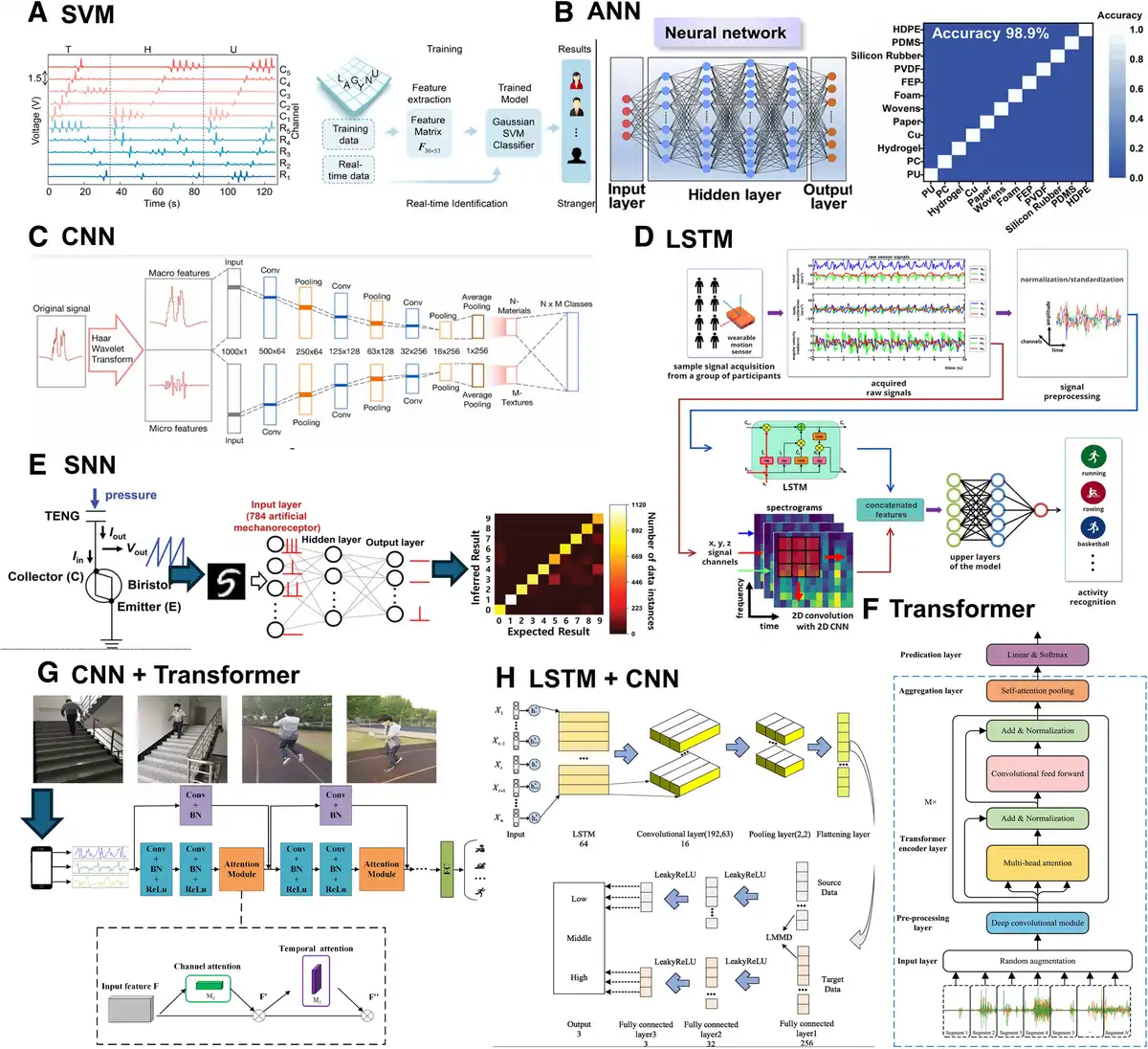
Figure 10.
AI techniques in sensing systems. (A) Traditional ML model SVM for user identification. Adapted with permission from Luo et al,[170] Copyright © 2022, American Chemical Society. (B) DL model ANN for material type recognition. Adapted with permission from Wei et al,[173] Copyright © 2022, Cell Press. (C) DL model CNN for object shape recognition. Adapted with permission from Zhang et al,[175] Copyright © 2023, Elsevier Ltd. (D) DL model LSTM for activity type and intensity recognition. Adapted with permission from Koşar et al,[177]; © 2023, Elsevier Ltd. (E) DL model SNN for handwritten digit recognition. Adapted with permission from Han et al,[174] Copyright © 2022, Wiley-VCH GmbH. (F) DL model Transformer for activity recognition. Adapted with permission from Sun et al,[178] Copyright © 2024, Elsevier Ltd. (G) Hybrid DL model CNN + Transformer for multimodal human activity recognition. Adapted with permission from Gao et al,[179] Copyright © 2021, Elsevier Ltd. (H) Hybrid DL model LSTM + CNN for motion part recognition. Adapted with permission from Qiu et al,[180] Copyright © 2024, Elsevier Ltd.
4.1.2 DL algorithm
Compared with traditional ML, DL models have stronger nonlinear mapping capabilities, more robust performance, and higher accuracy. The most commonly used DL model is the ANN, also known as the multilayer perceptron (MLP), which consists solely of stacked fully connected layers and features a simple structure. As shown in Figure 10B, Wei et al[173] reported a hybrid electronic skin composed of a piezoresistive pressure sensor and a TENG. Enhanced by an improved ANN, the system achieved high-precision sensing with an accuracy of 98.9% for 12 different materials. Moreover, ANNs are also often combined with physical components to form spiking neural network (SNN) models specifically designed for processing spiking signals. As shown in Figure 10E, Han et al designed an SNN model based on a triboelectric nanogenerator. The nanogenerator mimics biological mechanoreceptors to detect pressure and encode spiking signals, serving as input neurons for the SNN. The SNN model was trained using backpropagation to analyze the signals, achieving an accuracy of 85.8% on handwritten digit classification tasks.[174]
ANNs are generally used to handle multi-feature inputs but are not well-suited for processing signal sequences or time series. In contrast, 1D convolutional neural networks (CNNs), with their weight-sharing convolutional units and sliding window operations, are better equipped to extract features from sequential signals. As a result, they are widely applied in recognizing voltage signals captured by wearable sensors. Zhang et al[175] designed a highly sensitive single-electrode TENG and compared the performance of three signal recognition models: SVM, Transformer, and ResNet. The CNN-based ResNet model achieved a recognition accuracy of 98.1% in object shape identification tasks. As shown in Figure 10C, Song et al[176] designed a wireless and fully integrated tactile sensing system, MTSensing, and designed a dual-channel data fusion 1D convolutional model. This model processes decoupled signals from the sensor into macro and micro features to predict the material and texture of contacted objects, achieving accuracies of 99.07% and 99.32%, respectively.
When the signal features from sensors are too long, recurrent neural networks (RNNs) are employed to address the issue of early feature forgetting in long-term sequence processing. The most commonly used units in this context are long short-term memory (LSTM) and gated recurrent unit. As shown in Figure 10D, Koşar and Barshan[177] proposed an LSTM-based hybrid network model to process signals collected by wearable sensors, simultaneously recognizing human activities. The proposed hybrid model exhibits superior performance metrics and acceptable complexity. Additionally, the Transformer model, a mainstream framework in natural language processing, is also widely applied in signal processing, similar to RNNs. As shown in Figure 10F, Sun et al[178] proposed a contrastive self-supervised model based on a deep convolutional transformer to enhance wearable sensors for efficient human activity recognition. The proposed model achieved mean F1 scores of 95.64%, 88.39%, and 98.40% on the UCI-HAR, Skoda, and Mhealth datasets, respectively.
In addition to using a single type of general-purpose neural network model, combining multiple network architectures and designing task-specific hybrid models tailored to the characteristics and working scenarios of wearable sensors can undoubtedly better adapt to tasks and achieve superior recognition performance. As shown in Figure 10G, Gao et al[179] proposed a dual attention method called DanHAR that combines CNNs with transformers, which fuses temporal attention on channel and residual networks to improve the feature representation ability for sensor-based human activity recognition tasks. As shown in Figure 10H, Qiu et al[180] proposed a hybrid network combining LSTM and CNN to optimize wearable sensors. After feature extraction using the hybrid network, a classification model was constructed through a deep subdomain adaptation network algorithm, achieving an average classification accuracy of 91.62% for movements across 8 body parts.
Overall, in the field of AI-assisted self-powered healthcare, traditional ML and DL each have their own characteristics and advantages. Their differences in data processing, model design, and application scenarios mean that a rational selection and integration of these two approaches can not only leverage their respective strengths but also compensate for each other’s weaknesses, thereby advancing the intelligent and personalized progress of healthcare management.
Traditional ML has distinct advantages in feature engineering, model interpretability, and low-resource environments. It is well-suited for healthcare monitoring and early-warning scenarios where the data volume is small and real-time performance is required. Traditional ML typically relies on experts to design and extract representative features in advance. For example, when processing medical sensor data, key indicators such as heart rate and blood oxygen saturation might need to be extracted based on experience. Because it depends on pre-extracted features, its model complexity is relatively low, the training speed is faster, and computational resource consumption is minimal, making it easier to debug and interpret. Its excellent interpretability enables researchers and clinical experts to more easily understand the basis for the model’s decisions, which helps build trust in medical settings. Therefore, when the data is limited and the structure is clear, the use of carefully designed features can often enhance the model’s interpretability and stability.
In contrast, DL excels in precise diagnosis and prediction on large-scale, multimodal data due to its powerful automatic feature learning capability and its ability to capture complex data patterns, although it also faces challenges such as higher computational demands and lower interpretability. Represented by deep neural network models, DL can automatically extract and learn complex features from raw data without requiring extensive manual intervention, making it suitable for processing complex, multimodal data such as medical images, time-series signals, and genomic data. In a big data environment, DL models can efficiently integrate multiple sources of information—such as data from wearable devices, electronic health records, and genomic datasets—through complex network structures. For complex physiological signals (eg, ECG and electroencephalogram [EEG]), DL can capture subtle changes to provide more accurate predictive models for disease warning.
In future practical research, traditional ML and DL are not mutually exclusive but can complement each other:
(1) Hybrid models: Traditional methods can be used for initial feature extraction and selection, followed by DL for refined analysis, thereby improving overall efficiency and accuracy.
(2) Enhanced interpretability: To address the “black box” issue of DL models, current research is attempting to introduce interpretability-enhancing algorithms (such as visualization and attention mechanisms) to improve the transparency of medical decision-making.
(3) Resource allocation: Lightweight traditional models can be deployed on edge devices, while DL is used in the cloud to handle big data, with both working in tandem to construct a comprehensive healthcare management system.
4.2 AI for physiological signal recognition and detection
AI for physiological signal recognition and detection is revolutionizing healthcare by providing high-precision, real-time, and personalized solutions for health monitoring and disease diagnosis.[181] These methods, combined with diverse wearable sensing devices, analyze complex signal patterns from raw signals such as ECGs,[182] EEGs,[183] blood oxygen levels,[182] and EMGs[184] using advanced ML and DL algorithms, enabling rapid and accurate estimation of the test subject’s task demand state. In these studies, AI is responsible for identifying the subjects’ actions or states based on the signals collected by sensors, thereby providing supplementary information for further healthcare.
AI-assisted sensor-based HMI technology holds tremendous potential in the medical field. Its goal is to enhance diagnostics, treatment, and patient experience through intuitive and efficient interaction, combining human perception with computational and device capabilities. Zhu et al[185] reported an AI-enhanced, wearable, self-powered, and sustainable HMI sensor applied to human finger movements and their virtual activities as shown in Figure 11A. In this study, AI was utilized to classify fast and slow finger movements, demonstrating remarkable visualization capabilities and excelling in clustering, visualization, and handling motion speed disturbances. Zhang et al[186] developed a triboelectric sensor and its array (TSA) that mimics the synaptic structure of neural cells, as shown in Figure 11B. Enhanced by a deep CNN, the system extracts higher-level motion features from electrical signals, enabling a single sensor to identify which body part is producing motion with an accuracy of 98.89%. By combining TSAs with varying numbers of sensors, the system achieves high-precision recognition of motion language, offering significant potential for assisting in the rehabilitation of patients with limb injuries. Li et al[187] proposed a wearable device composed of EMG and strain sensors to address the clinical assessment of muscle strength (MS), as shown in Figure 11C. The device collects surface EMG and mechanical signals from the same location during various muscle activities. They designed a DL model based on temporal convolutional networks and Transformers, which leverages deep feature extraction from temporal signals to achieve accurate grading and prediction of 25 levels of MS. Fang et al[188] proposed a gesture recognition system using a triboelectric intelligent wristband, enhanced by an adaptive accelerated learning (AAL) model, as shown in Figure 11E. The AAL model features a significantly smaller size compared with traditional neural networks while offering superior and faster classification performance. It achieved a recognition accuracy of 97.56% in training tasks with 21 categories and enabled low-latency (<1 second) real-time proprioceptive remote control. Deng et al[189] developed a novel wearable electromechanical coupling sensor using zinc oxide and enhanced it with a 1D CNN for recognizing and classifying different human motions, as shown in Figure 11F. The system achieved 100% recognition accuracy during testing. Additionally, some studies design HMI systems based on bodily fluids. Zhou et al[190] developed a highly selective nonenzymatic sweat sensor as shown in Figure 11D. A designed ANN was applied in these sensors to reliably sense and physiologically monitor sweat biomarkers during the test subject’s physical activity. The system enabled the device to generate four interpretable features, which were used to accurately predict the concentrations of tyrosine and tryptophan as well as the pH value of the sweat. Wang et al[191] reported a bioinspired data fusion architecture for wearable e-skin. The sensing component consists of skin-like stretchable strain sensors made from single-walled CNTs. By combining visual data with proprioceptive data from the sensors through a deep ANN, the system achieves human gesture recognition with 100% accuracy. Kim et al[192] reported a novel electronic skin based on substrate-less nanomesh receptors, with the nanomesh made of biocompatible materials that can be directly printed onto human hands. The study integrated an unsupervised meta-learning framework with the sensors and developed a time-correlated contrastive learning algorithm, enabling user-independent, data-efficient recognition of various hand tasks. Moin et al[193] reported a wearable surface electromyography biosensing system based on a conformal electrode array fabricated through screen printing. The system implemented a neuro-inspired hyperdimensional computing algorithm for enhanced real-time gesture classification, as well as model training and updating under variable conditions such as different arm positions and sensor replacements. Experimental results demonstrated a classification accuracy of up to 97.12% for 13 gestures, which remained high at 92.87% when the number of gestures was expanded to 21.
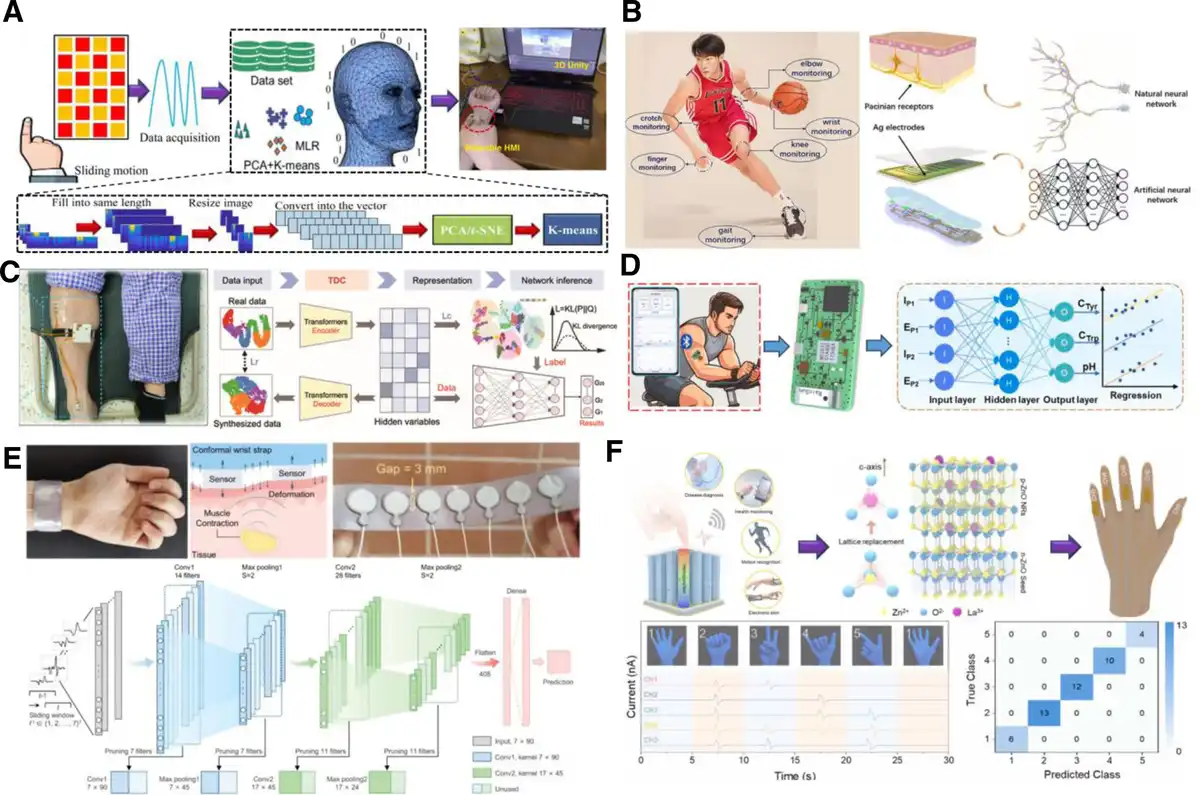
Figure 11.
AI-assisted sensing systems for physiological signal recognition and detection. (A) AI-enhanced HMI for human finger movements detection. Adapted with permission from Zhu et al,[185] Copyright © 2022, Elsevier Ltd. (B) AI-enhanced TSA for body part movement recognition. Adapted with permission from Zhang et al,[186] Copyright © 2023, Elsevier Ltd. (C) AI-enhanced EMG sensor for MS assessment. Adapted with permission from Li et al,[187] Copyright © 2024, The American Association for the Advancement of Science. (D) AI-enhanced nonenzymatic sweat sensor for sweat biomarkers monitoring. Adapted with permission from Zhou et al,[190] Copyright © 2024, Elsevier Ltd. (E) AI-enhanced triboelectric intelligent wristband for gesture recognition. Adapted with permission from Fang et al,[188] Copyright © 2023, Wiley-VCH GmbH. (F) AI-enhanced electromechanical coupling sensor using zinc oxide for human motion recognition. Adapted with permission from Deng et al,[189] Copyright © 2024, Elsevier Ltd.
Based on the above review, the advantages of AI-assisted signal recognition can be revealed:
(1) Sensitivity to weak signals: AI, particularly DL models, can automatically extract deep features from complex physiological signals and detect subtle or inconspicuous changes that traditional methods often miss, achieving higher sensitivity.
(2) Suitability for dynamic monitoring: AI methods exhibit high generalization and inference speed, surpassing traditional analytical techniques. They can be deployed on mobile devices to analyze real-time streaming data and provide immediate feedback, making them particularly suitable for applications requiring continuous data collection and analysis.
(3) Multimodal integration capability: AI can integrate signals from various sensors, enabling end-to-end multimodal data analysis and reducing potential errors inherent in single-signal data.
4.3 AI for rehabilitation
AI is playing an increasingly important role in the fields of healthcare and rehabilitation. With its powerful data processing and learning capabilities, it offers revolutionary solutions for disease diagnosis, treatment decision-making, rehabilitation training, and personalized health management, particularly when integrated into health devices.[184] In the development of AI-assisted medical sensing devices, wearable sensors that are remote, lightweight, sensitive, accurate, and real-time provide intelligent diagnostic and therapeutic support to a wide range of populations.[182] In these studies, AI is responsible for directly conducting medical-related evaluations based on the physical signals collected by sensors. Compared with Section 4.2, where the AI technology is more general-purpose, the research in Section 4.3 directly handles end-to-end healthcare tasks.
Fang et al[24] developed a low-cost, lightweight, and mechanically durable textile triboelectric sensor for high-fidelity and continuous pulse waveform monitoring in scenarios involving movement and sweating, as shown in Figure 12A. Enhanced by ANNs, the textile triboelectric sensor can continuously and accurately measure systolic and diastolic blood pressure, while also enabling predictions and cardiovascular health diagnostics. Gao et al[194] developed a wearable sensor integrated with pneumatic actuators and piezoelectric components for in vivo measurement of muscle elasticity, as shown in Figure 12B. A CNN was designed to process the voltage signals collected by the sensor, enabling the assessment of the severity of neuromuscular diseases. Li et al[195] designed a portable sensor combining triboelectric and electromagnetic principles for highly sensitive detection and rapid recognition of human motion, as shown in Figure 12C. An ANN was developed for gesture recognition and limb disability detection, addressing the need for generalization across multiple scenarios. Bao et al[196] reported a sparse sensor network equipped with a soft wireless IMU device for the early clinical assessment of infant brain development, as shown in Figure 12D. A miniature ML algorithm was integrated into the sensing system to automatically identify at-risk infants based on general movements, achieving an accuracy of up to 99.9%. Shin et al[197] reported an AI-enhanced wireless multimodal wearable system capable of automatically and accurately conducting clinical assessments of swallowing behavior and diagnosing silent aspiration in patients with dysphagia as shown in Figure 12E. In this study, a deep neural network combining 1D convolution layers and LSTM units was developed, achieving an 89.47% classification accuracy for swallowing patterns. Guo et al[198] presented a flexible self-powered piezoelectric sensor patch (SPP) using a PVDF fibrous membrane as the functional layer as shown in Figure 12F. The sensor employed an LSTM-based network model as AI assistance to process data collected from the SPP for wrist joint motion recognition, aiding in flexibility assessment. The motion recognition tests achieved an accuracy of 92.6%. Yang et al[199] proposed a dual-response piezoelectric pressure sensor for monitoring athletes’ rehabilitation training, as shown in Figure 12G. Assisted by an ML algorithm guiding rehabilitation actions, the system, based on ANNs and random forests, achieved 100% recognition of rehabilitation maneuvers. Zeng et al[200] developed wearable sensors based on epidermal electronic systems for monitoring mental fatigue in scenarios such as driving and healthcare. The study employed AI algorithms to determine mental fatigue levels, achieving up to 89% prediction accuracy using a decision tree algorithm based on 6 different physiological features. Researchers have also designed AI-based high-sensitivity biosensors for early detection of diseases such as cancer and diabetes. Kim et al[201] addressed the challenge of high false-positive rates in early prostate cancer screening by designing a learning-capable urinary multibiomarker biosensor. The sensor utilized two common ML algorithms to analyze the correlation between clinical conditions and urinary multibiomarker sensor signals, identifying the optimal combination of biomarkers. In screening 76 urine samples, the sensor achieved an accuracy exceeding 99%. Li et al[202] addressed the challenges of large-scale screening and early identification of COVID-19 infections during the pandemic by developing a rapid, ultrasensitive, multifunctional plasmonic biosensor based on surface-enhanced infrared absorption for on-site COVID-19 diagnosis. In this study, a genetic algorithm-based intelligent program was employed to automate the design and rapidly optimize the sensing device, thereby enhancing sensing performance. As a result, the sensor achieved ultrahigh sensitivity (1.66%/nm), a wide detection range, and adaptability to diverse measurement environments (gas/liquid) for quantitative COVID-19 detection.
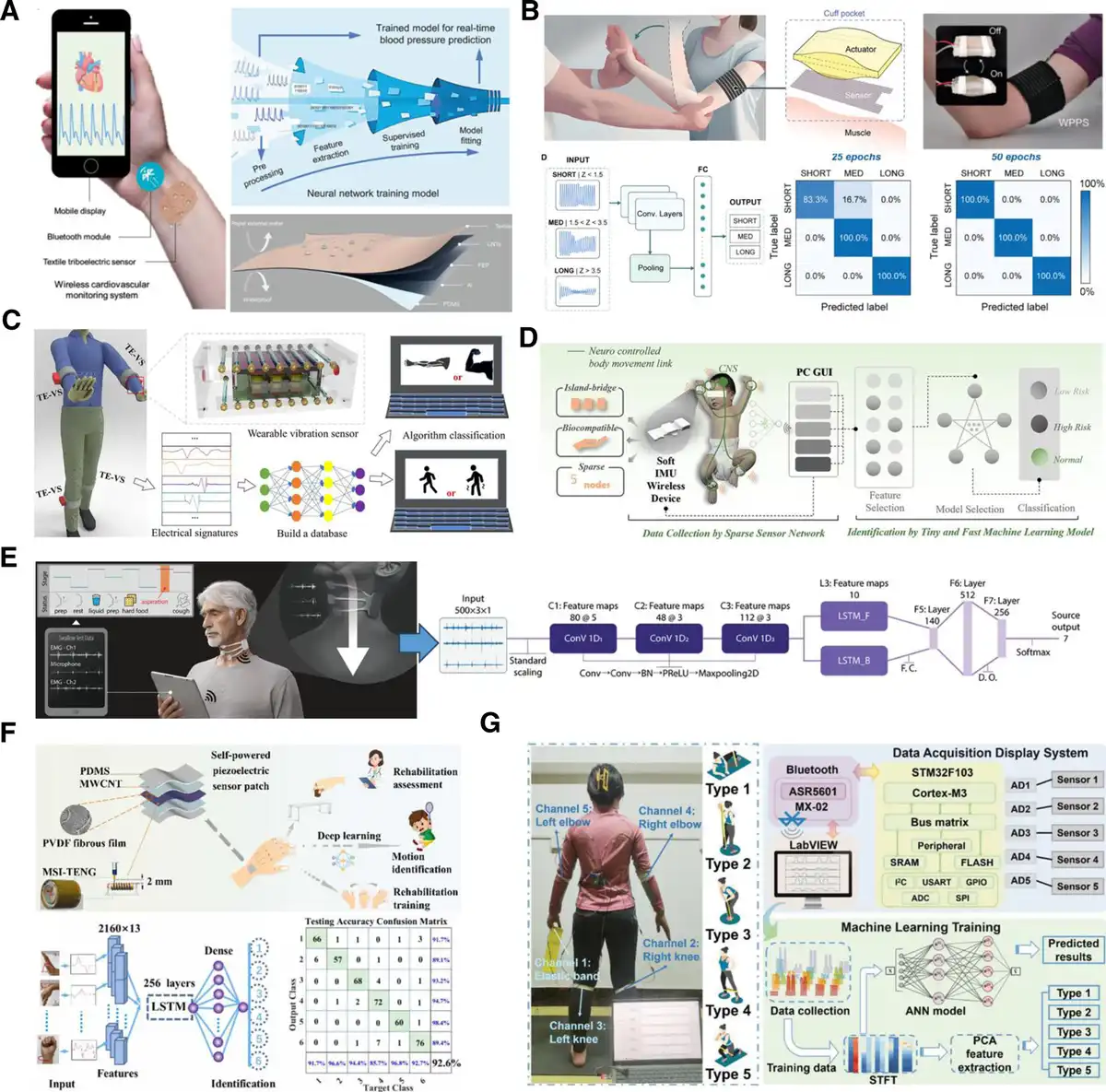
Figure 12.
AI-assisted sensing systems for rehabilitation. (A) AI-assisted textile triboelectric sensor for continuous pulse waveform monitoring. Adapted with permission from Fang et al,[24] Copyright © 2021, Wiley-VCH GmbH. (B) AI-assisted wearable sensor for in vivo measurement of muscle elasticity. Adapted with permission from Gao et al,[194] Copyright © 2024, Cell Press. (C) AI-assisted portable sensor for recognition of human motion. Adapted with permission from Li et al,[195] Copyright © 2023, Elsevier Ltd. (D) AI-assisted sparse sensor network for the early clinical assessment of infant brain development. Adapted with permission from Bao et al,[196] Copyright © 2024, Wiley-VCH GmbH. (E) AI-enhanced wireless multimodal wearable system for conducting clinical assessments of swallowing behavior. Adapted with permission from Shin et al,[197] Copyright © 2024, Wiley-VCH GmbH. (F) AI-assisted self-powered piezoelectric sensor for wrist joint motion recognition. Adapted with permission from Guo et al,[198] Copyright © 2024, Elsevier Ltd. (G) AI-assisted piezoelectric pressure sensor for monitoring athletes’ rehabilitation training. Adapted with permission from Yang et al,[199] Copyright © 2024, Wiley-VCH GmbH.
The review highlights the advantages of AI-assisted rehabilitation:
(1) Precise rehabilitation assessment and prediction: AI, combined with sensor technology, can monitor patients’ motion states, physiological signals, and rehabilitation progress in real time. Through deep data mining of collected signals, AI can capture subtle motion changes, significantly improving assessment accuracy.
(2) Applicability and generalization: AI excels at learning pattern characteristics across different patients, enabling sensors to generalize effectively for various patient types. Similarly, this feature can be utilized in reverse to achieve patient-specific customization, tailoring sensor designs to meet the needs of individual patients.
5. Conclusion and outlook
In summary, the advancement of AI-assisted self-powered sensors represents a pivotal development in the healthcare sector, offering groundbreaking capabilities for continuous, real-time monitoring and personalized health management. This review highlighted the significant progress made in materials, structural designs, manufacturing methods, and AI integration for wearable self-powered sensors. However, several universal challenges remain, including biocompatibility, durability, stability, perceptual sensitivity, and system autonomy. Improvements in the following areas, as illustrated in Figure 13, could help address these issues.
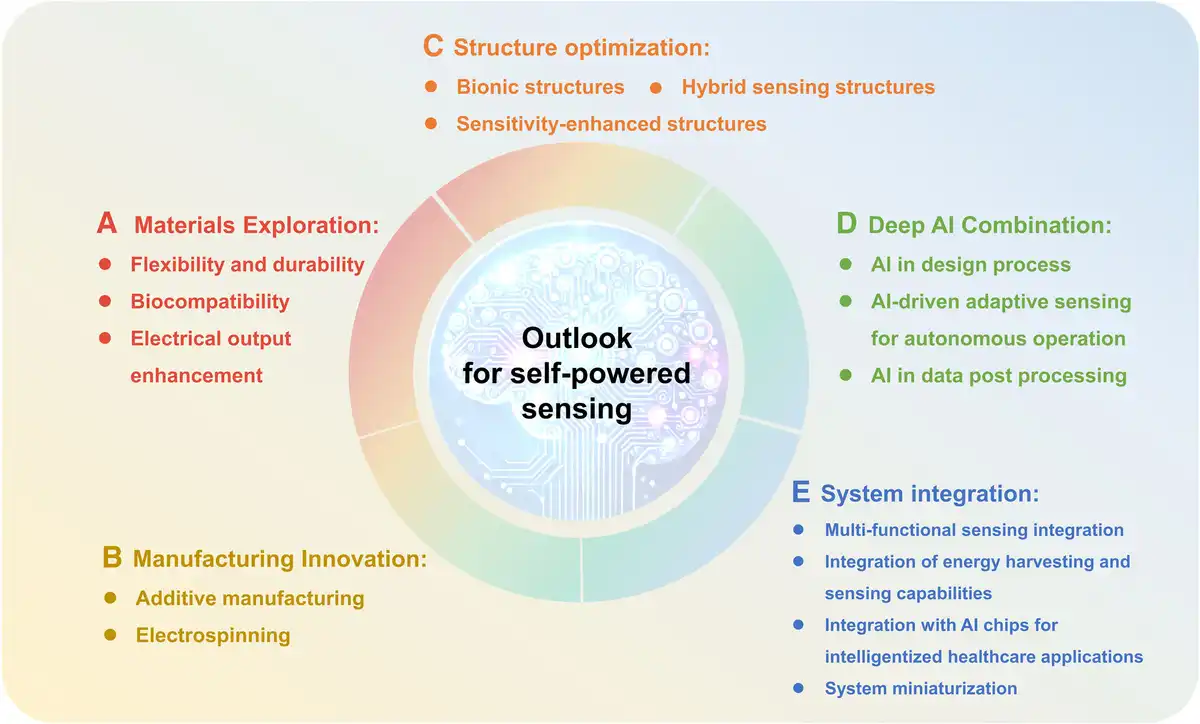
Figure 13.
Outlook of self-powered sensing for healthcare applications.
5.1 Materials exploration
While significant advancements have been made, there remains a need for new materials that offer improved flexibility, durability, and biocompatibility. Achieving high electrical performance in wearable applications while ensuring environmental sustainability is a critical challenge.
5.2 Manufacturing innovation
Scalable and efficient fabrication methods, such as additive manufacturing and electrospinning, require further refinement to support the production of complex and miniaturized sensor designs. Integrating these methods into large-scale production processes without compromising performance remains a key issue.
5.3 Structure optimization
Designing and optimizing bionic structures, hybrid sensing configurations, and advanced architectures to enhance sensitivity and adaptability is an ongoing challenge. Developing structures that can reliably capture weak physiological signals under dynamic conditions is particularly critical.
5.4 Deep AI combination
Although AI has been successfully applied to sensing system operation and data postprocessing, its integration into the design process of self-powered sensors is still in its early stages. Realizing AI-driven optimization for customized sensor designs for healthcare applications are areas of potential growth. In addition, AI-driven adaptive sensing systems are pursued to enhance system autonomy.
5.5 System integration
System integration has the potential to significantly enhance the versatility and practicality of sensing systems. For instance, multifunctional sensor systems represent a pivotal development direction for the future, enabling the simultaneous monitoring of multiple physical signals. Furthermore, the integration of energy-harvesting and sensing functionalities can effectively improve system autonomy, paving the way for fully battery-free designs. Additionally, incorporating AI chips into these systems is a promising avenue for enabling more intelligent and advanced healthcare applications. Moreover, the miniaturization of the integrated system is essential to reduce interference with normal physiological activities.
Future efforts should focus on addressing these challenges through interdisciplinary collaborations across materials science, engineering, and AI. By tackling these obstacles, self-powered sensors can fully realize their potential to transform healthcare, providing intelligent, real-time solutions for medical diagnostics, disease prevention, and rehabilitation.
Funding
This research is sponsored by the National Natural Science Foundation of China (No. 12202276), the Science Foundation of Sichuan Province for Young Scholars (No. 2023NSFSC1381), Fundamental Research Funds for the Central Universities (No. YG2025ZD18), Shanghai Municipal Health Commission (No. 2024ZZ2002), and the Innovative Research Team of High-Level Local Universities in Shanghai.
Conflicts of interests
The authors declare that they have no conflicts of interest.
References
- [1] Ates HC, Nguyen PQ, Gonzalez-Macia L, et al. End-to-end design of wearable sensors. Nat Rev Mater. 2022;7:887–907.
- [2] Hassan Chowdhury MK, Anik HR, Akter M, et al. Sensing the future with graphene-based wearable sensors: a review. Results Mater. 2025;25:100646.
- [3] Majumder S, Mondal T, Deen MJ. Wearable sensors for remote health monitoring. Sensors (Basel). 2017;17:130.
- [4] Sun F, Zhu Y, Jia C, et al. Advances in self-powered sports monitoring sensors based on triboelectric nanogenerators. J Energy Chem. 2023;79:477–488.
- [5] Yin R, Wang D, Zhao S, et al. Wearable sensors-enabled human–machine interaction systems: from design to application. Adv Funct Mater. 2021;31:2008936.
- [6] Afilal M, Soufyane A, de Lima Santos M. Piezoelectric beams with magnetic effect and localized damping. Math Control Relat Fields. 2023;13:250–264.
- [7] Allerhand A. Electrostatic telegraphy—1753–1816 [scanning our past]. Proc IEEE. 2020;108:465–473.
- [8] Beretta D, Neophytou N, Hodges JM, et al. Thermoelectrics: from history, a window to the future. Mater Sci Eng R Rep. 2019;138:100501.
- [9] Lincot D. The new paradigm of photovoltaics: from powering satellites to powering humanity. CR Phys. 2017;18:381–390.
- [10] Ragheb M. Solar thermal power and energy storage historical perspective. Nucl Power Eng. 2014:52.
- [11] Gajda I, Greenman J, Ieropoulos IA. Recent advancements in real-world microbial fuel cell applications. Curr Opin Electrochem. 2018;11:78–83.
- [12] Rome LC, Flynn L, Goldman EM, et al. Generating electricity while walking with loads. Science. 2005;309:1725–1728.
- [13] Locher I, Klemm M, Kirstein T, et al. Design and characterization of purely textile patch antennas. IEEE Trans Adv Packag. 2006;29:777–788.
- [14] Fan F-R, Tian Z-Q, Lin Wang Z. Flexible triboelectric generator. Nano Energy. 2012;1:328–334.
- [15] Zhou T, Zhang C, Han CB, et al. Woven structured triboelectric nanogenerator for wearable devices. ACS Appl Mater Interfaces. 2014;6:14695–14701.
- [16] Kim SJ, We JH, Cho BJ. A wearable thermoelectric generator fabricated on a glass fabric. Energy Environ Sci. 2014;7:1959–1965.
- [17] Jia W, Wang X, Imani S, et al. Wearable textile biofuel cells for powering electronics. J Mater Chem A. 2014;2:18184–18189.
- [18] Kim BJ, Kim DH, Lee Y-Y, et al. Highly efficient and bending durable perovskite solar cells: toward a wearable power source. Energy Environ Sci. 2015;8:916–921.
- [19] Jeerapan I, Sempionatto JR, Pavinatto A, et al. Stretchable biofuel cells as wearable textile-based self-powered sensors. J Mater Chem A. 2016;4:18342–18353.
- [20] Chen J, Huang Y, Zhang N, et al. Micro-cable structured textile for simultaneously harvesting solar and mechanical energy. Nat Energy. 2016;1:16138.
- [21] Hong S, Gu Y, Seo JK, et al. Wearable thermoelectrics for personalized thermoregulation. Sci Adv. 2019;5:eaaw0536.
- [22] Wen F, Sun Z, He T, et al. Machine learning glove using self-powered conductive superhydrophobic triboelectric textile for gesture recognition in VR/AR applications. Adv Sci (Weinh). 2020;7:2000261.
- [23] Zhang Z, He T, Zhu M, et al. Deep learning-enabled triboelectric smart socks for IoT-based gait analysis and VR applications. npj Flexible Electron. 2020;4:29.
- [24] Fang Y, Zou Y, Xu J, et al. Ambulatory cardiovascular monitoring via a machine-learning-assisted textile triboelectric sensor. Adv Mater. 2021;33:2104178.
- [25] Fang Y, Xu J, Xiao X, et al. A deep-learning-assisted on-mask sensor network for adaptive respiratory monitoring. Adv Mater. 2022;34:2200252.
- [26] Li J, Jia H, Zhou J, et al. Thin, soft, wearable system for continuous wireless monitoring of artery blood pressure. Nat Commun. 2023;14:5009.
- [27] Kong L, Fang Z, Zhang T, et al. A self-powered and self-sensing lower-limb system for smart healthcare. Adv Energy Mater. 2023;13:2301254.
- [28] Xie L, Lei H, Liu Y, et al. Ultrasensitive wearable pressure sensors with stress-concentrated tip-array design for long-term bimodal identification. Adv Mater. 2024;36:2406235.
- [29] Garg R, Majhi A, P N, et al. Polarization-induced mechanically socketed ultra-stretchable and breathable textile-based nanogenerator and pressure sensor. Adv Funct Mater. 2024;34:2401593.
- [30] Dong L, Zuo J. Vibration-adaptive energy management technology for self-sufficient wireless ECP braking systems on heavy-haul trains. Mech Syst Signal Process. 2025;223:111940.
- [31] Dong L, Hu G, Yu J, et al. Maximizing onboard power generation of large-scale railway vibration energy harvesters with intricate vehicle-harvester-circuit coupling relationships. Appl Energy. 2023;347:121388.
- [32] Dong L, Li J, Zhang H, et al. Adaptive energy harvesting approach for smart wearables towards human-induced stochastic oscillations. J Clean Prod. 2023;418:138094.
- [33] Bai Y, Meng H, Li Z, et al. Degradable piezoelectric biomaterials for medical applications. Med Mat. 2024;1:40–49.
- [34] Dong L, Hu G, Tang Q, et al. Advanced aerodynamics-driven energy harvesting leveraging galloping-flutter synergy. Adv Funct Mater. 2024;35:2414324.
- [35] Zhang J, Li R, Dong L, et al. Ultrasensitive biodegradable piezoelectric sensors with localized stress concentration strategy for real-time physiological monitoring. Chem Eng J. 2025;507:160521.
- [36] Zhao E, Wang T, Wang Y, et al. Active learning assisted piezoelectric materials synthesis on the basis of composite decision-making. Med Mat. 2024;1:95–103.
- [37] Dong L, Ke Y, Liao Y, et al. Rational modeling and design of piezoelectric biomolecular thin films toward enhanced energy harvesting and sensing. Adv Funct Mater. 2024;34:2410566.
- [38] Yang F, Li J, Long Y, et al. Wafer-scale heterostructured piezoelectric bio-organic thin films. Science. 2021;373:337–342.
- [39] Dong L, Zuo J, Wang T, et al. Enhanced piezoelectric harvester for track vibration based on tunable broadband resonant methodology. Energy. 2022;254:124274.
- [40] Song S, Yun K-S. Design and characterization of scalable woven piezoelectric energy harvester for wearable applications. Smart Mater Struct. 2015;24:045008.
- [41] Dong L, Tang Q, Zhao C, et al. Flag-type hybrid nanogenerator utilizing flapping wakes for consistent high performance over an ultra-broad wind speed range. Nano Energy. 2024;119:109057.
- [42] Dong L, Hu G, Zhang Y, et al. Metasurface-enhanced multifunctional flag nanogenerator for efficient wind energy harvesting and environmental sensing. Nano Energy. 2024;124:109508.
- [43] Kim W-G, Kim D-W, Tcho I-W, et al. Triboelectric nanogenerator: structure, mechanism, and applications. ACS Nano. 2021;15:258–287.
- [44] Zhao Z, Zhou L, Li S, et al. Selection rules of triboelectric materials for direct-current triboelectric nanogenerator. Nat Commun. 2021;12:4686.
- [45] Wang X, Yin G, Sun T, et al. Mechanical vibration energy harvesting and vibration monitoring based on triboelectric nanogenerators. Energy Technol. 2024;12:2300931.
- [46] Ren Z, Wu L, Pang Y, et al. Strategies for effectively harvesting wind energy based on triboelectric nanogenerators. Nano Energy. 2022;100:107522.
- [47] Munirathinam K, Kim D-S, Shanmugasundaram A, et al. Flowing water-based tubular triboelectric nanogenerators for sustainable green energy harvesting. Nano Energy. 2022;102:107675.
- [48] Li K, Shan C, Fu S, et al. High efficiency triboelectric charge capture for high output direct current electricity. Energy Environ Sci. 2024;17:580–590.
- [49] Zhao J, Shi Y. Boosting the durability of triboelectric nanogenerators: a critical review and prospect. Adv Funct Mater. 2023;33:2213407.
- [50] Xie Z, Avila R, Huang Y, et al. Flexible and stretchable antennas for biointegrated electronics. Adv Mater. 2020;32:1902767.
- [51] Olenik S, Lee HS, Güder F. The future of near-field communication-based wireless sensing. Nat Rev Mater. 2021;6:286–288.
- [52] Soni GK, Yadav D, Kumar A. Design consideration and recent developments in flexible, transparent and wearable antenna technology: a review. Trans Emerging Telecommun Technol. 2024;35:e4894.
- [53] Yang W, Cheng X, Guo Z, et al. Design, fabrication and applications of flexible RFID antennas based on printed electronic materials and technologies. J Mater Chem C. 2023;11:406–425.
- [54] Marterer V, Radouchová M, Soukup R, et al. Wearable textile antennas: investigation on material variants, fabrication methods, design and application. Fashion Text. 2024;11:9.
- [55] Saleh S, Saeidi T, Timmons N, et al. A comprehensive review of recent methods for compactness and performance enhancement in 5G and 6G wearable antennas. Alex Eng J. 2024;95:132–163.
- [56] Karthikeyan TA, Nesasudha M, Saranya S, et al. A review on fabrication and simulation methods of flexible wearable antenna for industrial tumor detection systems. J Ind Inf Integr. 2024;41:100673.
- [57] Sabban A. Novel meta-fractal wearable sensors and antennas for medical, communication, 5G, and IoT applications. Fractal Fract. 2024;8:100.
- [58] Ghosh S, Basu B, Nandi A, et al. Hand activity classification based on perturbed nearfield radiation and augmented impedance of a wearable textile antenna. Expert Syst Appl. 2024;238:121830.
- [59] Alam MM, Ben Hamida E. Strategies for optimal MAC parameters tuning in IEEE 802.15.6 wearable wireless sensor networks. J Med Syst. 2015;39:106.
- [60] Zuo J, Dong L, Yang F, et al. Energy harvesting solutions for railway transportation: a comprehensive review. Renew Energy. 2023;202:56–87.
- [61] Wang Y, Yang L, Shi X-L, et al. Flexible thermoelectric materials and generators: challenges and innovations. Adv Mater. 2019;31:1807916.
- [62] Zhang L, Shi X-L, Yang Y-L, et al. Flexible thermoelectric materials and devices: from materials to applications. Mater Today. 2021;46:62–108.
- [63] Fan W, Shen Z, Zhang Q, et al. High-power-density wearable thermoelectric generators for human body heat harvesting. ACS Appl Mater Interfaces. 2022;14:21224–21231.
- [64] Hasan MN, Nafea M, Nayan N, et al. Thermoelectric generator: materials and applications in wearable health monitoring sensors and internet of things devices. Adv Mater Technol. 2022;7:2101203.
- [65] Li X, Li P, Wu Z, et al. Review and perspective of materials for flexible solar cells. Mater Rep Energy. 2021;1:100001.
- [66] Ali I, Islam MR, Yin J, et al. Advances in smart photovoltaic textiles. ACS Nano. 2024;18:3871–3915.
- [67] Ke H, Gao M, Li S, et al. Advances and future prospects of wearable textile-andfiber-based solar cells. Solar RRL. 2023;7:2300109.
- [68] Zhao R, Gu Z, Li P, et al. Flexible and wearable optoelectronic devices based on perovskites. Adv Mater Technol. 2022;7:2101124.
- [69] Shitanda I, Morigayama Y, Iwashita R, et al. Paper-based lactate biofuel cell array with high power output. J Power Sources. 2021;489:229533.
- [70] Khumngern S, Jeerapan I. Synergistic convergence of materials and enzymes for biosensing and self-sustaining energy devices towards on-body health monitoring. Commun Mater. 2024;5:135.
- [71] Gao F, Liu C, Zhang L, et al. Wearable and flexible electrochemical sensors for sweat analysis: a review. Microsyst Nanoeng. 2023;9:1.
- [72] Cai J, Shen F, Zhao J, et al. Enzymatic biofuel cell: a potential power source for self-sustained smart textiles. iScience. 2024;27:108998.
- [73] Zheng J-J, Zhu F, Song N, et al. Optimizing the standardized assays for determining the catalytic activity and kinetics of peroxidase-like nanozymes. Nat Protocols. 2024;19:3470–3488.
- [74] Yang C, Denno ME, Pyakurel P, et al. Recent trends in carbon nanomaterial-based electrochemical sensors for biomolecules: a review. Anal Chim Acta. 2015;887:17–37.
- [75] Suzuki R, Shitanda I, Aikawa T, et al. Wearable glucose/oxygen biofuel cell fabricated using modified aminoferrocene and flavin adenine dinucleotide-dependent glucose dehydrogenase on poly(glycidyl methacrylate)-grafted MgO-templated carbon. J Power Sources. 2020;479:228807.
- [76] Smith GL, Pulskamp JS, Sanchez LM, et al. PZT-based piezoelectric MEMS technology. J Am Ceram Soc. 2012;95:1777–1792.
- [77] Acosta M, Novak N, Rojas V, et al. BaTiO3-based piezoelectrics: fundamentals, current status, and perspectives. Appl Phys Rev. 2017;4:041305.
- [78] Mokhtari F, Samadi A, Rashed AO, et al. Recent progress in electrospun polyvinylidene fluoride (PVDF)-based nanofibers for sustainable energy and environmental applications. Prog Mater Sci. 2025;148:101376.
- [79] Qian X, Chen X, Zhu L, et al. Fluoropolymer ferroelectrics: multifunctional platform for polar-structured energy conversion. Science. 2023;380:eadg0902.
- [80] Zhang L, Li S, Zhu Z, et al. Recent progress on structure manipulation of poly(vinylidene fluoride)-based ferroelectric polymers for enhanced piezoelectricity and applications. Adv Funct Mater. 2023;33:2301302.
- [81] Zhang D, Zhang X, Li X, et al. Enhanced piezoelectric performance of PVDF/BiCl3/ZnO nanofiber-based piezoelectric nanogenerator. Eur Polym J. 2022;166:110956.
- [82] Li J, Yin J, Wee MG, et al. A self-powered piezoelectric nanofibrous membrane as wearable tactile sensor for human body motion monitoring and recognition. Adv Fiber Mater. 2023;5:1417–1430.
- [83] Su C, Huang X, Zhang L, et al. Robust superhydrophobic wearable piezoelectric nanogenerators for self-powered body motion sensors. Nano Energy. 2023;107:108095.
- [84] Huang Z-X, Li L-W, Huang Y-Z, et al. Self-poled piezoelectric polymer composites via melt-state energy implantation. Nat Commun. 2024;15:819.
- [85] Tian G, Deng W, Yang T, et al. Hierarchical piezoelectric composites for noninvasive continuous cardiovascular monitoring. Adv Mater. 2024;36:2313612.
- [86] Du X, Zhou Z, Zhang Z, et al. Porous, multi-layered piezoelectric composites based on highly oriented PZT/PVDF electrospinning fibers for high-performance piezoelectric nanogenerators. J Adv Ceram. 2022;11:331–344.
- [87] Lv P, Qian J, Yang C, et al. Flexible all-inorganic Sm-doped PMN-PT film with ultrahigh piezoelectric coefficient for mechanical energy harvesting, motion sensing, and human-machine interaction. Nano Energy. 2022;97:107182.
- [88] Venkatesan M, Chen W-C, Cho C-J, et al. Enhanced piezoelectric and photocatalytic performance of flexible energy harvester based on CsZn0.75Pb0.25I3/CNC–PVDF composite nanofibers. Chem Eng J. 2022;433:133620.
- [89] Yuan Y, Chen H, Xu H, et al. Highly sensitive and wearable bionic piezoelectric sensor for human respiratory monitoring. Sens Actuators A. 2022;345:113818.
- [90] He Q, Zeng Y, Jiang L, et al. Growing recyclable and healable piezoelectric composites in 3D printed bioinspired structure for protective wearable sensor. Nat Commun. 2023;14:6477.
- [91] Zhou X, Parida K, Chen J, et al. 3D printed auxetic structure-assisted piezoelectric energy harvesting and sensing. Adv Energy Mater. 2023;13:2301159.
- [92] Wu L, Xue J, Meng J, et al. Self-powered flexible sensor array for dynamic pressure monitoring. Adv Funct Mater. 2024;34:2316712.
- [93] Zhang Q, Wang Y, Li D, et al. Multifunctional and wearable patches based on flexible piezoelectric acoustics for integrated sensing, localization, and underwater communication. Adv Funct Mater. 2023;33:2209667.
- [94] Yi Z, Liu Z, Li W, et al. Piezoelectric dynamics of arterial pulse for wearable continuous blood pressure monitoring. Adv Mater. 2022;34:2110291.
- [95] van Neer PLMJ, Peters LCJM, Verbeek RGFA, et al. Flexible large-area ultrasound arrays for medical applications made using embossed polymer structures. Nat Commun. 2024;15:2802.
- [96] Du W, Zhang L, Suh E, et al. Conformable ultrasound breast patch for deep tissue scanning and imaging. Sci Adv. 2023;9:eadh5325.
- [97] Xiong J, Cui P, Chen X, et al. Skin-touch-actuated textile-based triboelectric nanogenerator with black phosphorus for durable biomechanical energy harvesting. Nat Commun. 2018;9:4280.
- [98] Tao K, Yi H, Yang Y, et al. Origami-inspired electret-based triboelectric generator for biomechanical and ocean wave energy harvesting. Nano Energy. 2020;67:104197.
- [99] Dong K, Wu Z, Deng J, et al. A stretchable yarn embedded triboelectric nanogenerator as electronic skin for biomechanical energy harvesting and multifunctional pressure sensing. Adv Mater. 2018;30:e1804944.
- [100] Wen Z, Yeh MH, Guo H, et al. Self-powered textile for wearable electronics by hybridizing fiber-shaped nanogenerators, solar cells, and supercapacitors. Sci Adv. 2016;2:e1600097.
- [101] Yu A, Pu X, Wen R, et al. Core–shell-yarn-based triboelectric nanogenerator textiles as power cloths. ACS Nano. 2017;11:12764–12771.
- [102] Kim K, Song G, Park C, et al. Multifunctional woven structure operating as triboelectric energy harvester, capacitive tactile sensor array, and piezoresistive strain sensor array. Sensors (Basel). 2017;17:2582.
- [103] Li X, Lin Z-H, Cheng G, et al. 3D fiber-based hybrid nanogenerator for energy harvesting and as a self-powered pressure sensor. ACS Nano. 2014;8:10674–10681.
- [104] Choi AY, Lee CJ, Park J, et al. Corrugated textile based triboelectric generator for wearable energy harvesting. Sci Rep. 2017;7:45583.
- [105] Chu H, Jang H, Lee Y, et al. Conformal, graphene-based triboelectric nanogenerator for self-powered wearable electronics. Nano Energy. 2016;27:298–305.
- [106] Xiong J, Lin M-F, Wang J, et al. Wearable all-fabric-based triboelectric generator for water energy harvesting. Adv Energy Mater. 2017;7:1701243.
- [107] Chen H, Bai L, Li T, et al. Wearable and robust triboelectric nanogenerator based on crumpled gold films. Nano Energy. 2018;46:73–80.
- [108] Shi Q, Wang H, Wang T, et al. Self-powered liquid triboelectric microfluidic sensor for pressure sensing and finger motion monitoring applications. Nano Energy. 2016;30:450–459.
- [109] Dudem B, Dharmasena RDIG, Riaz R, et al. Wearable triboelectric nanogenerator from waste materials for autonomous information transmission via Morse code. ACS Appl Mater Interfaces. 2022;14:5328–5337.
- [110] Yang Y, Zhao Y. A triboelectric nanogenerator based on flexible zwitterionic ionic conductive hydrogel for running training monitoring. Mater Des. 2024;242:112991.
- [111] Zhang H, Wang H, Zhang Z, et al. A negative-work knee energy harvester based on homo-phase transfer for wearable monitoring devices. iScience. 2023;26:107011.
- [112] Zhu M, Sun Z, Chen T, et al. Low cost exoskeleton manipulator using bidirectional triboelectric sensors enhanced multiple degree of freedom sensory system. Nat Commun. 2021;12:2692.
- [113] Song Y, Min J, Yu Y, et al. Wireless battery-free wearable sweat sensor powered by human motion. Sci Adv. 2020;6:eaay9842.
- [114] Wang C, Wang C, Huang Z, et al. Materials and structures toward soft electronics. Adv Mater. 2018;30:1801368.
- [115] Sattar M, Lee YJ, Kim H, et al. Flexible thermoelectric wearable architecture for wireless continuous physiological monitoring. ACS Appl Mater Interfaces. 2024;16:37401–37417.
- [116] Yang S, Li Y, Deng L, et al. Flexible thermoelectric generator and energy management electronics powered by body heat. Microsyst Nanoeng. 2023;9:1–9.
- [117] Karthikeyan V, Surjadi JU, Wong JCK, et al. Wearable and flexible thin film thermoelectric module for multi-scale energy harvesting. J Power Sources. 2020;455:227983.
- [118] Ding T, Chan KH, Zhou Y, et al. Scalable thermoelectric fibers for multifunctional textile-electronics. Nat Commun. 2020;11:6006.
- [119] Jang D, Park KT, Lee S-S, et al. Highly stretchable three-dimensional thermoelectric fabrics exploiting woven structure deformability and passivation-induced fiber elasticity. Nano Energy. 2022;97:107143.
- [120] Sun T, Zhou B, Zheng Q, et al. Stretchable fabric generates electric power from woven thermoelectric fibers. Nat Commun. 2020;11:572.
- [121] Park G, Park H, Seo J, et al. Bidirectional thermo-regulating hydrogel composite for autonomic thermal homeostasis. Nat Commun. 2023;14:3049.
- [122] Suarez F, Nozariasbmarz A, Vashaee D, et al. Designing thermoelectric generators for self-powered wearable electronics. Energy Environ Sci. 2016;9:2099–2113.
- [123] Jia Y, Jiang Q, Sun H, et al. Wearable thermoelectric materials and devices for self-powered electronic systems. Adv Mater. 2021;33:2102990.
- [124] Suarez F, Parekh DP, Ladd C, et al. Flexible thermoelectric generator using bulk legs and liquid metal interconnects for wearable electronics. Appl Energy. 2017;202:736–745.
- [125] Hashemi SA, Ramakrishna S, Aberle AG. Recent progress in flexible–wearable solar cells for self-powered electronic devices. Energy Environ Sci. 2020;13:685–743.
- [126] Zhao J, Xu Z, Law M-K, et al. Simulation of crystalline silicon photovoltaic cells for wearable applications. IEEE Access. 2021;9:20868–20877.
- [127] Peng M, Dong B, Zou D. Three dimensional photovoltaic fibers for wearable energy harvesting and conversion. J Energy Chem. 2018;27:611–621.
- [128] Min J, Demchyshyn S, Sempionatto JR, et al. An autonomous wearable biosensor powered by a perovskite solar cell. Nat Electron. 2023;6:630–641.
- [129] Kaltenbrunner M, White MS, Głowacki ED, et al. Ultrathin and lightweight organic solar cells with high flexibility. Nat Commun. 2012;3:1–7.
- [130] Hailegnaw B, Demchyshyn S, Putz C, et al. Flexible quasi-2D perovskite solar cells with high specific power and improved stability for energy-autonomous drones. Nat Energy. 2024;9:677–690.
- [131] Chen T, Qiu L, Kia HG, et al. Designing aligned inorganic nanotubes at the electrode interface: towards highly efficient photovoltaic wires. Adv Mater. 2012;24:4623–4628.
- [132] Qiu L, He S, Yang J, et al. Fiber-shaped perovskite solar cells with high power conversion efficiency. Small. 2016;12:2419–2424.
- [133] Lv D, Jiang Q, Shang Y, et al. Highly efficient fiber-shaped organic solar cells toward wearable flexible electronics. npj Flexible Electron. 2022;6:1–9.
- [134] Zeng R, Zhu L, Zhang M, et al. All-polymer organic solar cells with nano-to-micron hierarchical morphology and large light receiving angle. Nat Commun. 2023;14:4148.
- [135] Zheng Z, Wang J, Bi P, et al. Tandem organic solar cell with 20.2% efficiency. Joule. 2022;6:171–184.
- [136] Garland NT, Kaveti R, Bandodkar AJ. Biofluid-activated biofuel cells, batteries, and supercapacitors: a comprehensive review. Adv Mater. 2023;35:2303197.
- [137] Tian H, Ma J, Li Y, et al. Electrochemical sensing fibers for wearable health monitoring devices. Biosens Bioelectron. 2024;246:115890.
- [138] Huang X, Li H, Li J, et al. Transient, implantable, ultrathin biofuel cells enabled by laser-induced graphene and gold nanoparticles composite. Nano Lett. 2022;22:3447–3456.
- [139] Lee J, Kim K-Y, Kwon Y, et al. Stretchable enzymatic biofuel cells based on microfluidic structured elastomeric polydimethylsiloxane with wrinkled gold electrodes. Adv Funct Mater. 2024;34:2309386.
- [140] Yin L, Sandhu SS, Liu R, et al. Wearable E-skin microgrid with battery-based, self-regulated bioenergy module for epidermal sweat sensing. Adv Energy Mater. 2023;13:2203418.
- [141] Lou Z, Wang Q, Kara UI, et al. Biomass-derived carbon heterostructures enable environmentally adaptive wideband electromagnetic wave absorbers. Nanomicro Lett. 2021;14:11.
- [142] Hartel MC, Lee D, Weiss PS, et al. Resettable sweat-powered wearable electrochromic biosensor. Biosens Bioelectron. 2022;215:114565.
- [143] Veenuttranon K, Kaewpradub K, Jeerapan I. Screen-printable functional nanomaterials for flexible and wearable single-enzyme-based energy-harvesting and self-powered biosensing devices. Nanomicro Lett. 2023;15:85.
- [144] Li Z, Yun J, Li X, et al. Power-free contact lens for glucose sensing. Adv Funct Mater. 2023;33:2304647.
- [145] Zhong B, Qin X, Xu H, et al. Interindividual- and blood-correlated sweat phenylalanine multimodal analytical biochips for tracking exercise metabolism. Nat Commun. 2024;15:624.
- [146] Xu C, Song Y, Sempionatto JR, et al. A physicochemical-sensing electronic skin for stress response monitoring. Nat Electron. 2024;7:168–179.
- [147] Shao Y, Wei L, Wu X, et al. Room-temperature high-precision printing of flexible wireless electronics based on MXene inks. Nat Commun. 2022;13:3223.
- [148] Li W, Zhang, Pei R, et al. Composite metamaterial antenna with super mechanical and electromagnetic performances integrated by three-dimensional weaving technique. Composites Part B. 2024;273:111265.
- [149] Mirzajani H, Abbasiasl T, Mirlou F, et al. An ultra-compact and wireless tag for battery-free sweat glucose monitoring. Biosens Bioelectron. 2022;213:114450.
- [150] Singh A, Mitra D, Mandal B, et al. A review of electromagnetic sensing for healthcare applications. AEU Int J Electron Commun. 2023;171:154873.
- [151] Wang Y, Zhang X, Su R, et al. 3D printed antennas for 5G communication: current progress and future challenges. Chin J Mech Eng. 2023;2:100065.
- [152] Shi J, Liu S, Zhang L, et al. Smart textile-integrated microelectronic systems for wearable applications. Adv Mater. 2020;32:1901958.
- [153] Wang P, Ma X, Lin Z, et al. Well-defined in-textile photolithography towards permeable textile electronics. Nat Commun. 2024;15:887.
- [154] Zhu J, Cheng H. Recent development of flexible and stretchable antennas for bio-integrated electronics. Sensors. 2018;18:4364.
- [155] Dickey MD. Stretchable and soft electronics using liquid metals. Adv Mater. 2017;29:1606425.
- [156] Arulmurugan S, Suresh Kumar TR, Alex ZC. Screen-printed dual-band wearable textile antenna incorporated with EBG structure for WBAN communications. Int J Commun Syst. 2024;37:e5716.
- [157] Ashyap AYI, Dahlan SHB, Abidin ZZ, et al. An overview of electromagnetic band-gap integrated wearable antennas. IEEE Access. 2020;8:7641–7658.
- [158] Yang H, Liu X, Fan Y. Design of broadband circularly polarized all-textile antenna and its conformal array for wearable devices. IEEE Trans Antennas Propag. 2022;70:209–220.
- [159] Yu C, Yang S, Han Y, et al. A DBDCP antenna with a helmet-conformal AMC for industrial IoT applications featuring LHCP and RHCP in the low and high bands, respectively. IEEE Internet Things J. 2024;11:22310–22320.
- [160] Zhang C, Xiao P, Zhao ZT, et al. A wearable localized surface plasmons antenna sensor for communication and sweat sensing. IEEE Sens J. 2023;23:11591–11599.
- [161] Zhang K, Särestöniemi M, Myllymäki S, et al. A wideband circularly polarized antenna with metasurface plane for biomedical telemetry. IEEE Antennas Wirel Propag Lett. 2024;23:1879–1883.
- [162] Okba A, Takacs A, Aubert H, et al. Multiband rectenna for microwave applications. CR Phys. 2017;18:107–117.
- [163] Wagih M, Weddell AS, Beeby S. Rectennas for radio-frequency energy harvesting and wireless power transfer: a review of antenna design [Antenna Applications Corner]. IEEE Antennas and Propagation Magazine. 2020;62:95–107.
- [164] Zhang Y, Hu Y, Jiang N, et al. Wearable artificial intelligence biosensor networks. Biosens Bioelectron. 2023;219:114825.
- [165] Xiao X, Yin J, Xu J, et al. Advances in machine learning for wearable sensors. ACS Nano. 2024;18:22734–22751.
- [166] Lopez-Meyer P, Tiffany S, Patil Y, et al. Monitoring of cigarette smoking using wearable sensors and support vector machines. IEEE Trans Biomed Eng. 2013;60:1867–1872.
- [167] Yin H, Jha NK. A health decision support system for disease diagnosis based on wearable medical sensors and machine learning ensembles. IEEE Trans Multi-Scale Comput Syst. 2017;3:228–241.
- [168] Dunn J, Kidzinski L, Runge R, et al. Wearable sensors enable personalized predictions of clinical laboratory measurements. Nat Med. 2021;27:1105–1112.
- [169] Vidya B, Sasikumar P. Wearable multi-sensor data fusion approach for human activity recognition using machine learning algorithms. Sens Actuators A. 2022;341:113557.
- [170] Luo Y, Xiao X, Chen J, et al. Machine-learning-assisted recognition on bioinspired soft sensor arrays. ACS Nano. 2022;16:6734–6743.
- [171] Xing P, An S, Wu Y, et al. A triboelectric tactile sensor with flower-shaped holes for texture recognition. Nano Energy. 2023;116:108758.
- [172] Ji X, Zhao T, Zhao X, et al. Triboelectric nanogenerator based smart electronics via machine learning. Adv Mater Technol. 2020;5:1900921.
- [173] Wei X, Li H, Yue W, et al. A high-accuracy, real-time, intelligent material perception system with a machine-learning-motivated pressure-sensitive electronic skin. Matter. 2022;5:1481–1501.
- [174] Han JK, Tcho IW, Jeon SB, et al. Self-powered artificial mechanoreceptor based on triboelectrification for a neuromorphic tactile system. Adv Sci. 2022;9:2105076.
- [175] Zhang S, Meng S, Zhang K, et al. A high-performance S-TENG based on the synergistic effect of keratin and calcium chloride for finger activity tracking. Nano Energy. 2023;112:108443.
- [176] Song Z, Yin J, Wang Z, et al. A flexible triboelectric tactile sensor for simultaneous material and texture recognition. Nano Energy. 2022;93:106798.
- [177] Koşar E, Barshan B. A new CNN-LSTM architecture for activity recognition employing wearable motion sensor data: enabling diverse feature extraction. Eng Appl Artif Intell. 2023;124:106529.
- [178] Sun Y, Xu X, Tian X, et al. Efficient human activity recognition: a deep convolutional transformer-based contrastive self-supervised approach using wearable sensors. Eng Appl Artif Intell. 2024;135:108705.
- [179] Gao W, Zhang L, Teng Q, et al. DanHAR: dual attention network for multimodal human activity recognition using wearable sensors. Appl Soft Comput. 2021;111:107728.
- [180] Qiu J-G, Li Y, Li H, et al. Wearable sensor-based physical activity intensity recognition using deep learning feature engineering fusion. Measurement. 2025;241:115663.
- [181] Cho S, Nam HJ, Shi C, et al. Wireless, AI-enabled wearable thermal comfort sensor for energy-efficient, human-in-the-loop control of indoor temperature. Biosens Bioelectron. 2023;223:115018.
- [182] Nahavandi D, Alizadehsani R, Khosravi A, et al. Application of artificial intelligence in wearable devices: opportunities and challenges. Comput Methods Programs Biomed. 2022;213:106541.
- [183] Shin JH, Kwon J, Kim JU, et al. Wearable EEG electronics for a brain–AI closed-loop system to enhance autonomous machine decision-making. npj Flexible Electron. 2022;6:32.
- [184] Lee H, Lee S, Kim J, et al. Stretchable array electromyography sensor with graph neural network for static and dynamic gestures recognition system. npj Flexible Electron. 2023;7:20.
- [185] Zhu J, Ji S, Yu J, et al. Machine learning-augmented wearable triboelectric human-machine interface in motion identification and virtual reality. Nano Energy. 2022;103:107766.
- [186] Zhang D, Xu Z, Wang Z, et al. Machine-learning-assisted wearable PVA/acrylic fluorescent layer-based triboelectric sensor for motion, gait and individual recognition. Chem Eng J. 2023;478:147075.
- [187] Li C, Wang T, Zhou S, et al. Deep learning model coupling wearable bioelectric and mechanical sensors for refined muscle strength assessment. Research (Wash D C). 2024;7:0366.
- [188] Fang H, Wang L, Fu Z, et al. Anatomically designed triboelectric wristbands with adaptive accelerated learning for human–machine interfaces. Adv Sci. 2023;10:2205960.
- [189] Deng W, Huang L, Zhang H, et al. Discrete ZnO pn homojunction piezoelectric arrays for self-powered human motion monitoring. Nano Energy. 2024;124:109462.
- [190] Zhou Z, He X, Xiao J, et al. Machine learning-powered wearable interface for distinguishable and predictable sweat sensing. Biosens Bioelectron. 2024;265:116712.
- [191] Wang M, Yan Z, Wang T, et al. Gesture recognition using a bioinspired learning architecture that integrates visual data with somatosensory data from stretchable sensors. Nat Electron. 2020;3:563–570.
- [192] Kim KK, Kim M, Pyun K, et al. A substrate-less nanomesh receptor with meta-learning for rapid hand task recognition. Nat Electron. 2023;6:64–75.
- [193] Moin A, Zhou A, Rahimi A, et al. A wearable biosensing system with in-sensor adaptive machine learning for hand gesture recognition. Nat Electron. 2021;4:54–63.
- [194] Gao D, Lee JP, Chen J, et al. A wearable pneumatic-piezoelectric system for quantitative assessment of skeletomuscular biomechanics. Device. 2024;2:100288.
- [195] Li S, Qian J, Liu J, et al. Machine learning-assisted wearable triboelectric-electromagnetic vibration sensor for monitoring human rehabilitation training. Mech Syst Signal Process. 2023;201:110679.
- [196] Bao B, Zhang S, Li H, et al. Intelligence sparse sensor network for automatic early evaluation of general movements in infants. Adv Sci. 2024;11:e2306025.
- [197] Shin B, Lee SH, Kwon K, et al. Automatic clinical assessment of swallowing behavior and diagnosis of silent aspiration using wireless multimodal wearable electronics. Adv Sci. 2024;11:e2404211.
- [198] Guo Y, Zhang H, Fang L, et al. A self-powered flexible piezoelectric sensor patch for deep learning-assisted motion identification and rehabilitation training system. Nano Energy. 2024;123:109427.
- [199] Yang Z, Wang Q, Yu H, et al. Self-powered biomimetic pressure sensor based on Mn–Ag electrochemical reaction for monitoring rehabilitation training of athletes. Adv Sci. 2024;11:2401515.
- [200] Zeng Z, Huang Z, Leng K, et al. Nonintrusive monitoring of mental fatigue status using epidermal electronic systems and machine-learning algorithms. ACS Sensors. 2020;5:1305–1313.
- [201] Kim H, Park S, Jeong IG, et al. Noninvasive precision screening of prostate cancer by urinary multimarker sensor and artificial intelligence analysis. ACS Nano. 2020;15:4054–4065.
- [202] Li D, Zhou H, Hui X, et al. Plasmonic biosensor augmented by a genetic algorithm for ultra-rapid, label-free, and multi-functional detection of COVID-19. Anal Chem. 2021;93:9437–9444.
This article is available under Open Access.
© 2025 The Authors