Reactive oxygen species and neurodegenerative diseases: insights into nanozyme therapeutics
Authors
Luo Wang, Feixiang Chen, Cuiling Zhang, Yuen Yee Cheng*, Wenbo Bu, Yanyan Liu*
- aDepartment of Materials Science and State Key Laboratory of Molecular Engineering of Polymers, Academy for Engineering and Technology, Fudan University, Shanghai, China
- bShanghai Engineering Research Center of Molecular Therapeutics and New Drug Development, Department of Chemistry, School of Chemistry and Molecular Engineering, East China Normal University, Shanghai, China
- cInstitute for Biomedical Materials & Devices (IBMD), Faculty of Science, University of Technology Sydney, Sydney, Australia.
* Correspondence: Address: Yuen Yee Cheng, Institute for Biomedical Materials & Devices (IBMD), Faculty of Science, University of Technology Sydney, Ultimo NSW 2007, Australia. Email: YuenYee.Cheng@uts.edu.au (Y. Y. Cheng); Yanyan Liu, Department of Materials Science and State Key Laboratory of Molecular Engineering of Polymers, Fudan University, Shanghai 200433, China. Email: liuyyan@fudan.edu.cn (Y. Liu).
MedMat · 2024 · Vol. 1 · No. 2 · pp. 55-73
Abstract
Oxidative stress plays a critical role in the onset and progression of neurodegenerative diseases. Traditional methods for regulating oxidative stress using drugs or enzyme molecules often face limitations in efficacy, potential side effects, and the ability to fully meet clinical needs. The emergence of nanozymes offers a novel approach to overcome these challenges and explore therapeutic mechanisms. Focusing on the interaction between reactive oxygen species (ROS) and the nervous system, this article reviews the latest advancements in the use of nanozymes for treating neurodegenerative diseases. First, the mechanism of ROS interaction with neurons and glial cells in the complex nervous network is summarized by analyzing the characteristics of ROS. Second, the application examples and mechanism exploration of different types of ROS-related nanozymes in many neurodegenerative diseases are introduced and summarized. Additionally, the current situation and future prospects of nanozymes combined with advanced technologies such as in vitro detection and artificial intelligence for disease treatment are further discussed. This approach is poised to significantly advance the development of therapies for neurodegenerative diseases.
Translations
Long abstracts in additional languages. The English article is the version of record.
中文zh-Hans
氧化应激在神经退行性疾病的发病和进展中起着至关重要的作用,然而传统利用药物或酶分子调节氧化应激的方法往往面临疗效有限、潜在副作用以及难以完全满足临床需求等严峻挑战。本文旨在综述纳米酶的兴起如何为克服这些障碍提供新途径,并深入探索其治疗机制。文章聚焦于活性氧(ROS)与神经系统之间的相互作用,系统性地梳理了利用纳米酶治疗神经退行性疾病的最新进展,以期为解决当前疗法瓶颈提供理论依据和新的思路。
本文首先通过详细分析活性氧的特性,总结了其在复杂神经网络中与神经元及胶质细胞相互作用的机制,构建了理解氧化应激病理生理的基础框架。随后,文章广泛介绍并归纳了不同类型ROS相关纳米酶在多种神经退行性疾病中的应用实例及其作用机理的深入探索。此外,还进一步讨论了将纳米酶与体外检测技术及人工智能等先进技术相结合的治疗现状,旨在通过多模态策略提升疾病治疗的精准度与效率。
综述指出,纳米酶作为一种新型治疗手段,能够有效模拟天然酶的活性并克服传统方法的局限性,为调节神经系统中的氧化应激提供了创新方案。文章详细阐述了不同类别的ROS相关纳米酶在应对特定病理环境时的具体应用案例,揭示了其在清除过量自由基、保护细胞免受损伤方面的潜在机制。同时,结合体外检测与人工智能技术的融合趋势,展示了未来治疗策略向智能化、个性化方向发展的科学前景和理论可能性。
尽管纳米酶疗法展现出显著的应用潜力,但当前研究仍面临诸多挑战,包括长期生物安全性评估不足及临床转化路径尚不清晰等局限性。本文强调,未来的工作需重点关注纳米酶与先进技术的深度整合,特别是利用人工智能优化设计以及体外检测手段的实时监测能力,以推动该领域从理论探索向实际临床应用迈进。这一综合方法有望显著加速神经退行性疾病治疗方案的开发进程,为最终实现精准医疗提供强有力的科学支撑和广阔的发展空间。
Françaisfr
Le stress oxydatif joue un rôle critique dans l'apparition et la progression des maladies neurodégénératives, mais les méthodes traditionnelles de régulation utilisant des médicaments ou des molécules enzymatiques font souvent face à des limites en termes d'efficacité, aux effets secondaires potentiels et à leur incapacité à répondre pleinement aux besoins cliniques. Cet article vise à examiner comment l'émergence des nanozymes offre une approche novatrice pour surmonter ces défis et explorer les mécanismes thérapeutiques sous-jacents. En se concentrant sur l'interaction entre les espèces réactives de l'oxygène (ROS) et le système nerveux, cette revue synthétise les avancées récentes dans l'utilisation des nanozymes pour traiter les maladies neurodégénératives.
L'article commence par résumer le mécanisme d'interaction des ROS avec les neurones et les cellules gliales au sein du réseau nerveux complexe en analysant les caractéristiques spécifiques de ces espèces. Ensuite, il introduit et synthétise les exemples d'application ainsi que l'exploration approfondie des mécanismes de différents types de nanozymes liés aux ROS dans diverses maladies neurodégénératives. De plus, la revue discute également de la situation actuelle et des perspectives futures concernant le couplage des nanozymes avec des technologies avancées telles que les détections in vitro et l'intelligence artificielle pour le traitement des maladies.
La synthèse met en évidence comment les nanozymes constituent une approche nouvelle capable de contourner les obstacles liés aux thérapies conventionnelles, offrant ainsi un potentiel significatif dans la modulation du stress oxydatif au sein du système nerveux. L'article détaille divers cas d'application et mécanismes où différents types de nanozymes agissent sur des pathologies spécifiques, illustrant leur capacité à interagir avec les ROS pour atténuer les dommages cellulaires. Parallèlement, l'intégration potentielle avec l'in vitro détection et l'intelligence artificielle est présentée comme une voie prometteuse vers des stratégies thérapeutiques plus précises et personnalisées.
Bien que cette approche soit appelée à faire avancer considérablement le développement de thérapies pour les maladies neurodégénératives, la revue reconnaît également les limites actuelles et l'importance d'une évaluation rigoureuse avant toute application clinique. Les travaux futurs devront se concentrer sur l'amélioration des synergies entre les nanozymes et les technologies émergentes comme l'intelligence artificielle pour optimiser le diagnostic et le traitement in vitro. En conclusion, cette approche intégrée promet de transformer la prise en charge de ces pathologies complexes, ouvrant ainsi une nouvelle ère dans la recherche biomédicale sur les neurodégénératives avec des perspectives d'innovation thérapeutique substantielles.
Españoles
El estrés oxidativo desempeña un papel crítico en el inicio y la progresión de las enfermedades neurodegenerativas, sin embargo, los métodos tradicionales para regular este proceso mediante fármacos o moléculas enzimáticas a menudo enfrentan limitaciones en su eficacia, efectos secundarios potenciales y una capacidad insuficiente para satisfacer plenamente las necesidades clínicas. Este artículo examina cómo la aparición de nanozimas ofrece un enfoque novedoso para superar estos desafíos y explorar los mecanismos terapéuticos subyacentes. Centrándose en la interacción entre las especies reactivas de oxígeno (ROS) y el sistema nervioso, esta revisión sintetiza los avances más recientes en el uso de nanozimas para tratar enfermedades neurodegenerativas.
En primer lugar, se resume el mecanismo de interacción de las ROS con neuronas y células gliales dentro de la compleja red neuronal mediante un análisis detallado de las características de estas especies. Posteriormente, se introducen y resumen los ejemplos de aplicación y la exploración de mecanismos de diferentes tipos de nanozimas relacionadas con ROS en diversas enfermedades neurodegenerativas. Además, el artículo discute adicionalmente la situación actual y las perspectivas futuras sobre la combinación de nanozimas con tecnologías avanzadas como la detección in vitro e inteligencia artificial para el tratamiento de estas patologías.
La revisión destaca que las nanozimas representan una nueva vía capaz de abordar las limitaciones de los tratamientos convencionales, ofreciendo un potencial significativo en la modulación del estrés oxidativo dentro del sistema nervioso. Se detallan diversos casos de aplicación y mecanismos donde diferentes tipos de nanozimas actúan sobre patologías específicas, ilustrando su capacidad para interactuar con ROS y mitigar el daño celular. Asimismo, se presenta la integración potencial con detección in vitro e inteligencia artificial como una vía prometedora hacia estrategias terapéuticas más precisas y personalizadas.
Aunque este enfoque tiene el potencial de avanzar significativamente en el desarrollo de terapias para enfermedades neurodegenerativas, la revisión reconoce también las limitaciones actuales y la importancia de una evaluación rigurosa antes de su aplicación clínica. Los trabajos futuros deberán centrarse en mejorar las sinergias entre nanozimas y tecnologías emergentes como la inteligencia artificial para optimizar el diagnóstico y tratamiento in vitro. En conclusión, este enfoque integrado promete transformar el manejo de estas patologías complejas, abriendo así una nueva era en la investigación biomédica con perspectivas de innovación terapéutica sustanciales.
日本語ja
酸化ストレスは神経変性疾患の発症と進行において決定的な役割を果たしていますが、薬物や酵素分子を用いた従来の調節方法は、有効性の限界、潜在的な副作用、および臨床ニーズを完全に満たす能力の欠如という課題に直面しています。本稿では、これらの課題を克服し治療メカニズムを探求するための新たなアプローチとしてナノザイムの登場を取り上げます。活性酸素種(ROS)と神経系との相互作用に焦点を当て、このレビュー記事は神経変性疾患の治療におけるナノザイム利用の最新動向を体系的に概説することを目的としています。
本稿ではまず、ROSの特徴を分析することにより、複雑な神経ネットワーク内でのニューロンおよびグリア細胞とROSとの相互作用メカニズムを要約します。次に、さまざまな種類のROS関連ナノザイムが多数の神経変性疾患においてどのように応用され、その作用機序が探索・整理されているかについて紹介し、総括しています。さらに、疾病治療におけるナノザイムと体外検出や人工知能などの先端技術を組み合わせた現状および将来展望についても議論を深め、多角的な視点から治療戦略の枠組みを示しています。
レビューの結果として、ナノザイムが従来の方法の有効性や安全性に関する課題を克服し、神経系における酸化ストレス調節に対する革新的な解決策を提供できることが示唆されています。本稿は、異なるタイプのROS関連ナノザイムの具体的な応用例とそのメカニズムの探求について詳細に記述しており、これらが疾患環境下でどのように機能するかを科学的に解釈しています。また、体外検出技術や人工知能との融合による治療アプローチの可能性についても言及し、これらの要素が将来の治療戦略においてどのような役割を果たすかについての洞察を提供しています。
このアプローチは神経変性疾患の治療法の開発を大幅に進める可能性がありますが、現在の研究には依然として課題が残されており、今後の展望も示されています。特に、ナノザイムと人工知能や体外検出などの先端技術の組み合わせにおける現状分析と将来の可能性について言及しており、これらの要素が治療効果を高める上で重要であることが強調されています。最終的に、この統合的なアプローチは神経変性疾患に対する新たな治療法の開発を加速させ、臨床応用に向けた重要な一歩となることを期待しています。
العربيةar
يلعب الإجهاد التأكسدي دوراً حاسماً في بداية وتطور الأمراض التنكسية العصبية، ومع ذلك فإن الطرق التقليدية لتنظيم هذا الإجهاد باستخدام الأدوية أو الجزيئات الإنزيمية تواجه غالباً قيوداً تتعلق بفعالية محدودة وآثار جانبية محتملة وعدم القدرة على تلبية الاحتياجات السريرية بشكل كامل. يهدف هذا المقال إلى استعراض كيف يقدم ظهور المحفزات النانوية نهجاً مبتكراً للتغلب على هذه التحديات واستكشاف الآليات العلاجية الكامنة وراءها، مع التركيز على التفاعل بين أنواع الأكسجين التفاعلية والجهاز العصبي.
يستعرض البحث أولاً آلية تفاعل أنواع الأكسجين التفاعلية مع الخلايا العصبية والخلايا الدبقية ضمن الشبكة العصبية المعقدة من خلال تحليل خصائص هذه الأنواع. ثانياً، يقدم المقال ويستخلص أمثلة تطبيقية واستكشاف الآليات لأنواع مختلفة من المحفزات النانوية المرتبطة بأنواع الأكسجين في العديد من الأمراض التنكسية العصبية. بالإضافة إلى ذلك، يناقش البحث الوضع الحالي والآفاق المستقبلية لدمج المحفزات النانوية مع تقنيات متقدمة مثل الكشف体外 والذكاء الاصطناعي لعلاج هذه الأمراض.
تشير المراجعة إلى أن المحفزات النانوية كوسيلة علاجية جديدة يمكنها محاكاة نشاط الإنزيمات الطبيعية والتغلب على قيود الطرق التقليدية، مما يوفر حلاً مبتكراً لتنظيم الإجهاد التأكسدي داخل الجهاز العصبي. يوضح المقال بالتفصيل حالات تطبيق مختلفة وآليات عمل أنواع محددة من المحفزات النانوية في بيئات مرضية معينة، مبرزاً قدرتها المحتملة على إزالة الجذور الحرة الزائدة وحماية الخلايا من التلف.
على الرغم من أن نهج العلاج بالمحفزات النانوية يظهر إمكانات كبيرة للتطبيقات المستقبلية، إلا أن البحث الحالي لا يزال يواجه تحديات تتعلق بتقييم السلامة الحيوية طويلة الأمد ومسارات التحويل السريري غير الواضحة. يؤكد المقال على ضرورة تركيز الأعمال المستقبلية على التكامل العميق بين المحفزات النانوية والتقنيات المتقدمة مثل الذكاء الاصطناعي لتحسين التصميم والمراقبة في المختبر، مما قد يسرع بشكل كبير من تطوير علاجات للأمراض التنكسية العصبية ويوفر دعماً علمياً قوياً للطب الدقيق.
Keywords
Full Text
1. Introduction
Neurodegenerative diseases, such as Parkinson disease (PD) and Alzheimer disease (AD), present serious challenges to human health.[1–2–3–4] These diseases affect the structural and functional integrity of the brain and are often accompanied by severe consciousness and behavioral disorders, greatly affecting the quality of life of patients. Recently, oxidative stress caused by elevated reactive oxygen species (ROS) levels has been considered a key factor in inducing neurodegenerative disease.[5–6–7] Normally, ROS plays an important role in cell signaling and immune response. However, an imbalance between ROS production and clearance can produce oxidative stress, causing damage to cellular components such as DNA, lipids, proteins, and membranes.[8] This is particularly significant in the nervous system because it directly affects the survival of neurons, leading to a range of neurodegenerative diseases. Although researchers have recognized the importance of oxidative stress in neurodegenerative diseases, many challenges remain unsolved. Traditional antioxidants, such as astaxanthin, anthocyanins, and other small molecules, can clear ROS to a certain extent, but the limited clearance efficiency, poor stability, potential toxicity, and insufficient blood–brain barrier (BBB) penetration limit their clinical application.[9] Therefore, there is an urgent need to develop strategies to effectively treat neurodegenerative diseases.
Nanozyme, a new concept that combines nano effects and biocatalytic functions, has attracted wide attention from researchers since its inception.[8] As nanomaterials with enzyme-like catalytic activity, nanozymes possess special size, surface, and quantum effects. These properties give nanozymes unprecedented application potential in many fields such as biomedicine, environmental governance, and the food industry.[10] Recently, research on nanozymes has expanded from single materials to multicomponent composite materials and from simple structures to complex morphologies.[11–12–13–14] Different nanozymes have unique enzymatic catalytic properties, which can be customized and optimized for complex biochemical reactions and environmental conditions.[15] Additionally, by adjusting the properties of the nanozymes (such as structure, size, and morphology), their catalytic performance can be continuously optimized and biocompatibility in vivo can be improved. The multifunctional integration and intelligent design of nanozyme have also become a focus of current research, providing strong support for achieving more accurate disease diagnosis and treatment.[16]
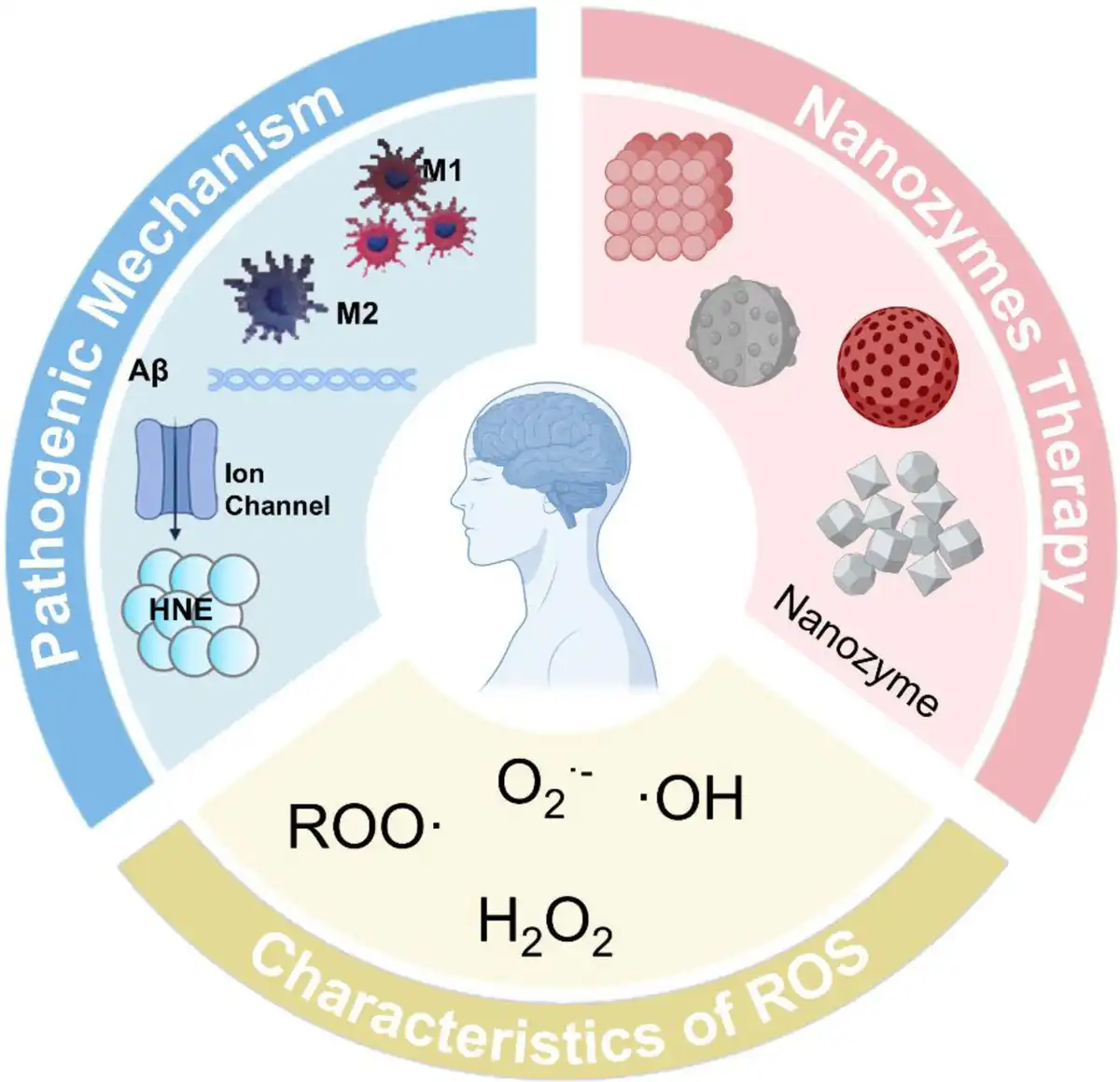
With interdisciplinary integration, nanozyme research has progressed a stage from preliminary discovery to in-depth exploration, and then to widespread application, providing a new way for the treatment of neurodegenerative diseases. This review comprehensively discusses the mechanism of ROS in neurodegenerative diseases and the latest research progress of nanozyme in disease treatment (Figure 1). By analyzing the types and characteristics of ROS, we summarize the transformation process of ROS in the complex network of cells. In addition, by analyzing the interaction between ROS and the nervous system, the pathogenesis mechanism includes lipid peroxidation, protein misfolding, ion channel dysfunction, and regulation of glial cells (astrocytes and microglia). Based on this, the review provides an overview of recent nanozyme research with different catalytic properties in treating neurodegenerative diseases, and it enumerates the potential of nanozymes to improve catalytic performance and applications through custom design. Finally, considering the broad prospects of nanozyme, we discuss the challenges faced by nanozyme to facilitate the rapid development of this field.
Figure 1.
Nanozymes and neurodegenerative diseases.
2. ROS and neurodegenerative diseases
ROS, as an inevitable product of physiological metabolism, is of great importance in signal transduction, cell survival, and immune response, regulating complex physiological networks.
ROS mainly includes superoxide anion (O2·⁻), hydrogen peroxide (H₂O₂), and hydroxyl radical (·OH). In organisms, ROS has various sources, primarily produced by mitochondria, niacinamide adenine dinucleotide phosphate (NADPH) oxidase, and external stimuli. While the production of ROS exceeds the body’s ability to maintain homeostasis, it is transformed into a destructive force closely related to the occurrence and development of neurodegenerative diseases. Therefore, ROS has different pathogenic mechanisms for neurons and glial cells. Through the combination of these mechanisms, ROS leads to neural damage and exacerbates inflammatory responses in the nervous system.
2.1 ROS properties: types and source
ROS is a diverse family of oxidizing chemical substances with different properties and reactivity (Figure 2A). Based on their composition, ROS can be roughly divided into 2 categories: free ROS and incorporated ROS.[17] It is worth noting that there is a certain transformation relationship between free ROS and incorporated ROS. Free ROS can generate incorporated ROS by initiating free radical reactions (Figure 2B).
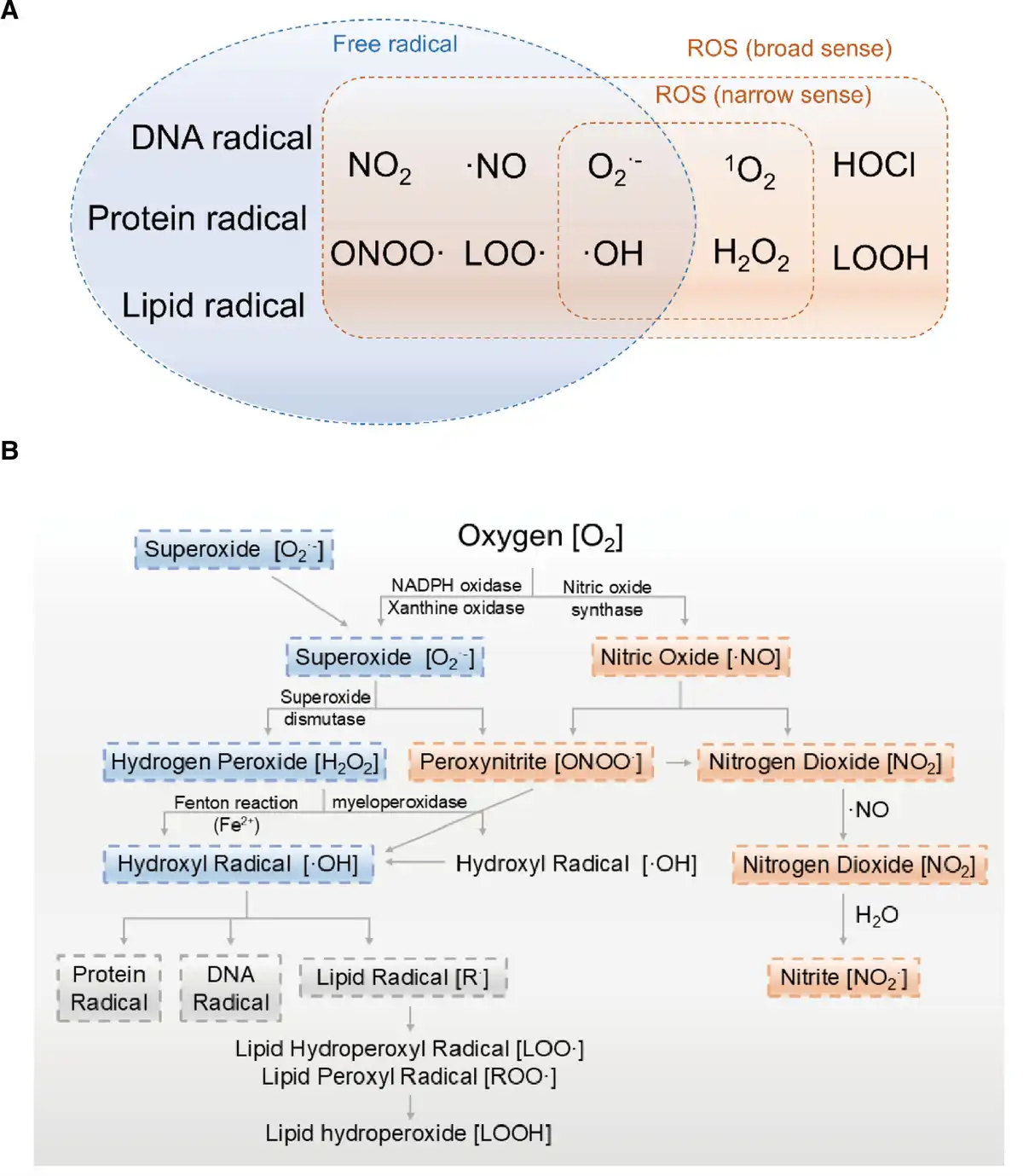
Figure 2.
ROS properties. (A) Different kinds of ROS. (B) The process of transforming the free ROS into the incorporated ROS.
(1) Free ROS: only consisting of the hydrogen (H) and oxygen (O) elements, typical free ROS includes hydrogen peroxide (H2O2), superoxide anion radical (O2·⁻), and hydroxyl radical (·OH).
(2) Incorporated ROS: Compared with the free state, the incorporated ROS is formed by the combination of oxygen atoms with other elements or molecules. Its structure is more complex, such as peroxy free radical (ROO·), peroxy hydroxyl free radical (HOO·), and its derivative peroxy nitroso anion (ONOO−).
Additionally, the redox potential and half-life of different ROS are important parameters for the properties of free radicals determining their activity and stability in chemical reactions.[18,19] In general, most free ROS have a high oxidation capacity but a short half-life. Among ROS, ·OH has an extremely high oxidation capacity due to its redox potential of 2.8 V and a half-life of ~ns. It is one of the strongest oxidants and can react indiscriminately with almost all biological molecules. O2·⁻ has a lifetime of about 1 to 10 ms inside the cell. Its low redox capacity makes it somewhat selective. For example, it can react with another free radical nitric oxide (•NO) to form peroxynitrite or with Fe–S clusters external proteins instead of attacking most biomolecules. H2O2 is a stable chemical molecule and inactive to most biomolecules. Its main feature is that it can diffuse through cell membranes and play an important role as redox signaling molecules. As the main intermediate product of lipid peroxidation, the ROO• free radical is relatively stable and has a long half-life (~7 s) in the lipid membrane, allowing it to spread to distant cell sites and cause greater damage to cells.
Intracellular ROS are generated in various ways.[20] Among them, O2·− has the dual properties of weak oxidation and reduction and is a key starter that triggers a series of free radical chain reactions. In the normal physiological metabolic cycle of cells, mitochondria and various enzymatic reactions promote the production of O2·−. This mainly includes the catalytic action of NADPH oxidase, xanthine oxidase, and uncoupled endothelial nitric oxide synthase. The most significant generation pathways can be attributed to the following 2: NADPH oxidase catalysis[21] and direct electron leakage.[22]
2.2 Pathogenesis of ROS
Neurodegenerative diseases are characterized by the progressive loss of specific populations of neurons at both functional and structural levels.[23] These diseases have complex causes, often involving mitochondrial dysfunction, neuroinflammation, and brain injury while the pathogenesis has not been fully elucidated. Among these causes, oxidative stress damage caused by excessive accumulation of ROS is one of the key underlying factors, leading to an imbalance of the redox state in the organism. This imbalance determines the occurrence and progression of neurodegenerative diseases. ROS are generally produced through both combined action of cell metabolic activities and a variety of external environmental stimuli. Due to their strong reactivity, ROS can destroy nucleic acids, proteins, lipids, and other large molecules, altering their functions and thus affecting the fate of neurons and glial cells.[24] Here, starting from neurons and glial cells, the pathogenic mechanism of ROS leading to neurodegenerative diseases will be summarized and explored.
The core of oxidative stress is the excessive production of ROS, which affects different types of cells differently. For neurons, ROS leads to similar cellular damage mechanisms across different types of neurons, such as mitochondrial dysfunction,[17] protein damage,[18] and lipid peroxidation.[19] In contrast, different types of glial cells exhibit varied responses to oxidative stress due to their physiological differences. For example, under oxidative stress, astrocytes proliferate and release inflammatory cytokines, forming glial scars that hinder axon regeneration and neurite outgrowth. Microglia, on the other hand, primarily show increased secretion of proinflammatory factors and a shift from the M2 to M1 cell type. Therefore, the pathogenesis of ROS in neurons and glial cells will be discussed in terms of response targets and cell types, respectively.
2.2.1 ROS and neurons
Neurons are vulnerable to oxidative damage due to their high content of polyunsaturated fatty acids (PUFA) in cell membrane, high oxygen consumption, and weak antioxidant defense mechanisms.[25] Relevant studies have shown that ROS can cause cell membrane damage, protein aggregation, and functional abnormalities through interaction with neuronal lipids and proteins. It also can induce oxidative stress in the brain environment and accelerate the development of neurodegenerative diseases.
Lipid molecules are major components of cell membranes and organelles (such as mitochondria and nuclei), performing roles in nerve signaling and membrane potential maintenance. However, due to its unsaturated double bonds, it is extremely vulnerable to ROS attacks.
Unsaturated C–H bonds in PUFA in lipids can react with ROS, leaving behind an unpaired electron and converted into a peroxy radical[26] (Figure 3). Once formed, peroxy radicals will eventually produce malondialdehyde, 4-hydroxynonenal, and other toxic products. Reactions with other PUFA further produce lipid peroxidation, and the plasma membrane is eventually destroyed. Lipid peroxidation induced by ROS through the above pathways can cause neuronal damage and promote the progression of neurodegenerative diseases.[27]
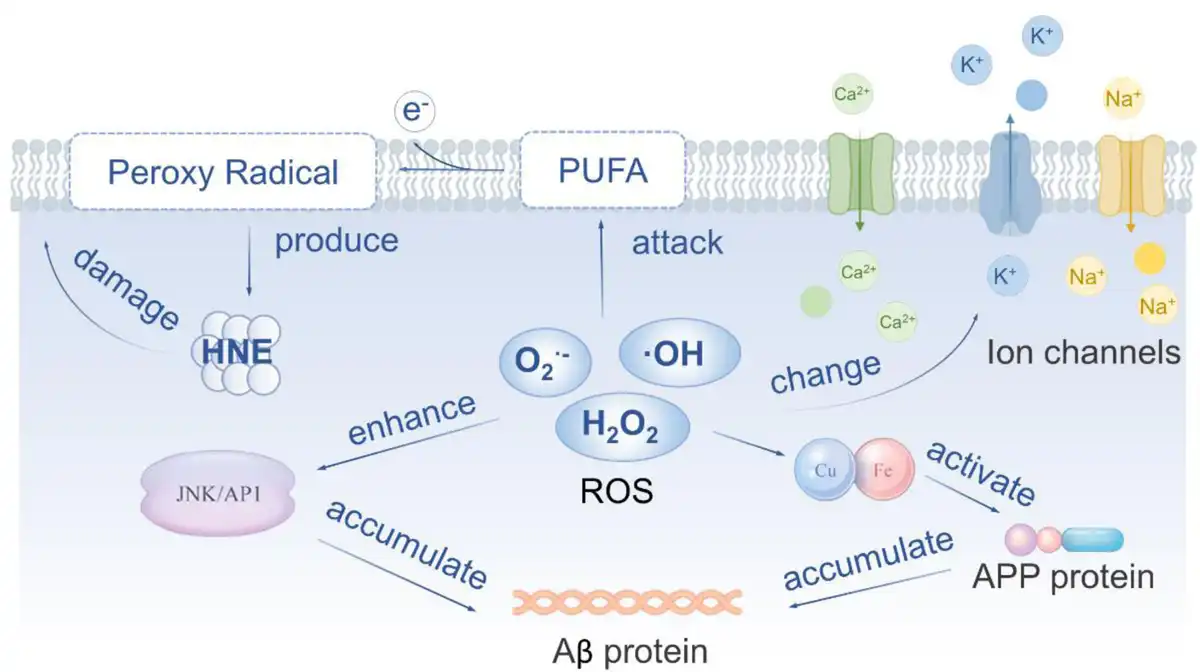
Pathogenesis of ROS. Lipids, disease-associated protein (Aβ protein), ion channels, and ROS.
ROS can oxidize proteins, leading to protein cross-linking and misfolding. This oxidative damage will further cause mitochondrial dysfunction and produce more ROS. This vicious cycle exacerbates the development of neurodegenerative diseases. In this context, ROS exhibits unique protein interactions with different types of neurodegenerative diseases (Figure 3).
In Huntington disease (HD), both oxidation-damaged Huntington protein and mitochondria direct interaction reduce the energy supply, increase the generation of ROS, and eventually lead to neuronal death.[28] In AD, ROS can activate amyloid precursor protein through oxidative stress, promoting the production and aggregation of amyloid protein (Aβ protein).[24] And it can further oxidize Aβ protein, making it easier to aggregate to form amyloid plaques. After oxidation, Aβ protein has a higher aggregation ability, and the protein accumulation will enhance the production of ROS, which further promotes protein accumulation. The combined action causes neuronal cell apoptosis, damages synapses, and affects synaptic transmission. This cycle not only directly exacerbates neuronal damage but also affects lipid transfer between neurons and glial cells by increasing lipid peroxidation.[29]
In neurons, ion channels can selectively conduct ions to regulate neural function. The action mechanism of ROS on neuronal ion channels is very complex, including oxidation modification of ion channel proteins, regulation of channel activity, and change of ion permeability. These effects can lead to changes in neuronal excitability, abnormal signaling, and cell damage, playing an important role in neurodegenerative diseases (Figure 3).
Through nitroso, nitration, and oxidation of specific amino-acid residues, ROS directly changes the conformation and function of ion channels potential, causing the channel activities to enhance or inhibit. For example, cysteine residues are most easily oxidized due to their highly reactive sulfhydryl groups, and they can oxidize thiols to sulfonic acid or sulfonic acid, depending on the amount of oxidant present, redox potential, charge, and temperature. This ultimately alters the signaling pathways for channel function and affects neural activity.[30]
2.2.2 ROS and glial cells
Glial cells, mainly astrocytes and microglia, perform important functions in the brain. However, under oxidative stress conditions, glial cells may not be able to effectively maintain their supporting functions, leading to neurotransmitter imbalances and neuroinflammation. Understanding the interaction between ROS and glial cells is of great significance for the research and treatment of neurodegenerative diseases.
Astrocytes are a type of glial cell found in the brain and spinal cord, providing nutrients to nerve tissue, maintaining extracellular ion balance, and repairing brain damage. In addition, astrocytes regulate the absorption and release of neurotransmitters. However, excessive production of ROS can disrupt these functions, leading to an imbalance of neurotransmitters, which in turn affects the transmission of nerve signals.
Cytosine–cytosine–adenosine–adenosine–thymidine (CCAAT)/enhancer binding protein delta (CEBPD) belongs to the CCAAT/enhancer binding protein family. It is a transcription factor, expressed in astrocytes, and plays an important role in the formation of ROS (Figure 4). Wang et al[31] work research shows that lack of mice CEBPD astrocytes causes low levels of ROS. It suggests that CEBPD is very important to the production of ROS in the cells. Under the stimulation, astrocytes ROS produced by CEBPD promotes oxidative stress. Destruction of cellular components leads to neuronal degeneration and disease progression.[32] Specifically, CEBPD regulates the transcription of genes, such as p47phox and p67phox of the NADPH oxidase complex, which are key components of ROS production.[31] At the same time, CEBPD can also aggravate neuronal apoptosis and oxidative stress through the nuclear factor erythroid-2-related factor 2/heme oxygenase 1 (Nrf2/HO-1) pathway.[33] Therefore, in neurodegenerative diseases, reactive astrocytes increase ROS production and reduce antioxidant protection mechanisms, further exacerbating nerve damage.
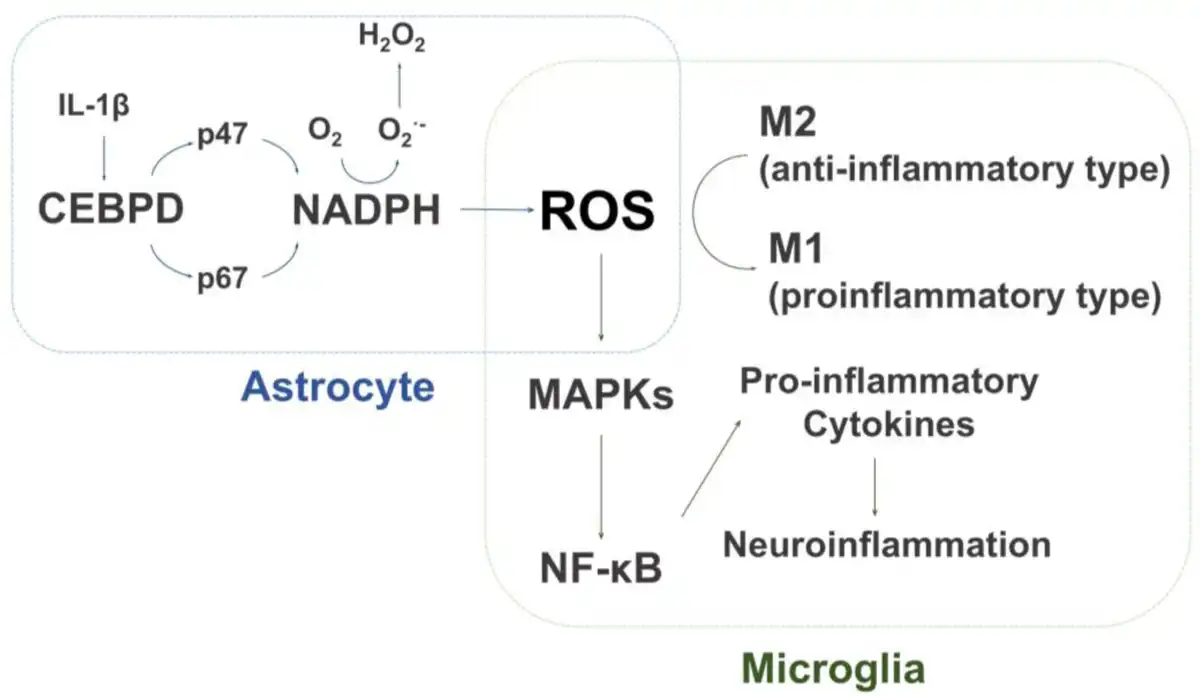
ROS formation by astrocytes through CEBPD leads to oxidative stress in astrocytes. ROS signaling pathway activation in microglia and transformation from anti-inflammatory M2 to proinflammatory M1.
Microglia are resident immune cells in brains.[34] ROS can contribute to neurodegenerative diseases by influencing microglia in 2 ways: altering microglial signaling pathways and modifying the phenotype of microglial cells (Figure 4).
In signaling pathways, ROS works synergistically with regulated microglia signaling pathways to jointly promote the occurrence and development of neurodegenerative diseases. For example, HMGB1 acts as an inflammatory mediator. ROS can promote its release from the nucleus to the outside of the cell, activate immune cells, and promote inflammation. Upregulation of HMGB1 can increase the expression of proinflammatory cytokine IL-17A, promoting microglia apoptosis through p53 and phosphoinositide 3-kinases/protein kinase B (PI3K/Akt) signaling pathway and aggravating brain injury.[35]
Additionally, ROS can also activate mitogen-activated protein kinase (MAPK) and nuclear factor-κB (NF-κB) signaling pathways.[36] MAPK pathway includes extracellular regulated protein kinases (ERK1/2), c-Jun N-terminal kinase (JNK), and p38 MAPK. These kinases regulate the expression of downstream genes through phosphorylation and promote the production of inflammatory mediators. The MAPK signaling pathway also activates NF-κB. The transfer of NF-κB from the cytoplasm to the nucleus initiates the transcription of genes associated with inflammation, such as inducible nitric oxide synthase (iNOS) and cyclooxygenase-2 (COX-2), further inducing an inflammatory response. These findings suggest that ROS plays a critical role in influencing microglial cell signaling pathways and damaging neurons.
When stimulated by pathogens, injury, or pathological stress, small colloidal cells exhibit functional reprogramming, known as polarization. The phenotypes of microglia can be divided into M1 (proinflammatory type) and M2 (anti-inflammatory type).
ROS acts as secondary messengers to regulate the expression of proinflammatory genes in microglia-mediated pathogenesis by altering the kinase cascade and activating transcription factors, including MAPK and NF-κB. It also promotes the transition from anti-inflammatory M2 phenotype to proinflammatory M1 phenotype.[37] For example, rotenone (an inhibitor of the mitochondrial electron transport chain) enhances M1 activation by upregulating ROS production, while blocking NADPH oxidase responsible for ROS production, which can mitigate the proinflammatory response of the M1 phenotype.[38]
This section focuses on both a brief introduction of ROS and mechanisms by which ROS contribute to pathogenesis. While summarizing the types and sources of ROS, the destructive effects of ROS on nerve cell membrane lipids, specific proteins, and ion channels are also discussed. Meanwhile, the neuroinflammatory response induced by ROS in astrocytes and microglia through transcription factors, signaling pathways, and phenotypic regulation is explored.
After diving into the definition and mechanisms of ROS, we turn to a special tool with high therapeutic value—nanozymes. Due to its many special properties, nanozyme exhibits broad clinical application prospects, particularly in the treatment of neurodegenerative diseases.
3. Nanozyme and neurodegenerative diseases
Nanozyme is a kind of nanomaterial with natural enzyme activity. Due to nano size, high stability, and adjustability, it can be customized and optimized. There are many kinds of nanozymes, which also show great potential in clinical therapeutic applications.
3.1 Classification of nanozymes
According to the catalytic mechanism and reaction, nanozyme can be divided into many types, mainly including superoxide dismutase (SOD), catalase (CAT), peroxidase (POD), glutathione peroxidase (GPx), etc. In this section, we will focus on SOD, CAT, and POD nanozymes, which have shown a wide range of application prospects in treating neurodegenerative diseases by simulating the catalytic mechanism of natural enzymes.
3.1.1 SOD nanozyme
SOD catalyzes the dismutation of O2·− into O2 and H2O2, which plays an antioxidant role and usually includes nanomaterials with metal cores, such as Mn3O4, Au, MnO2, and CeO2. The reaction is as follows:
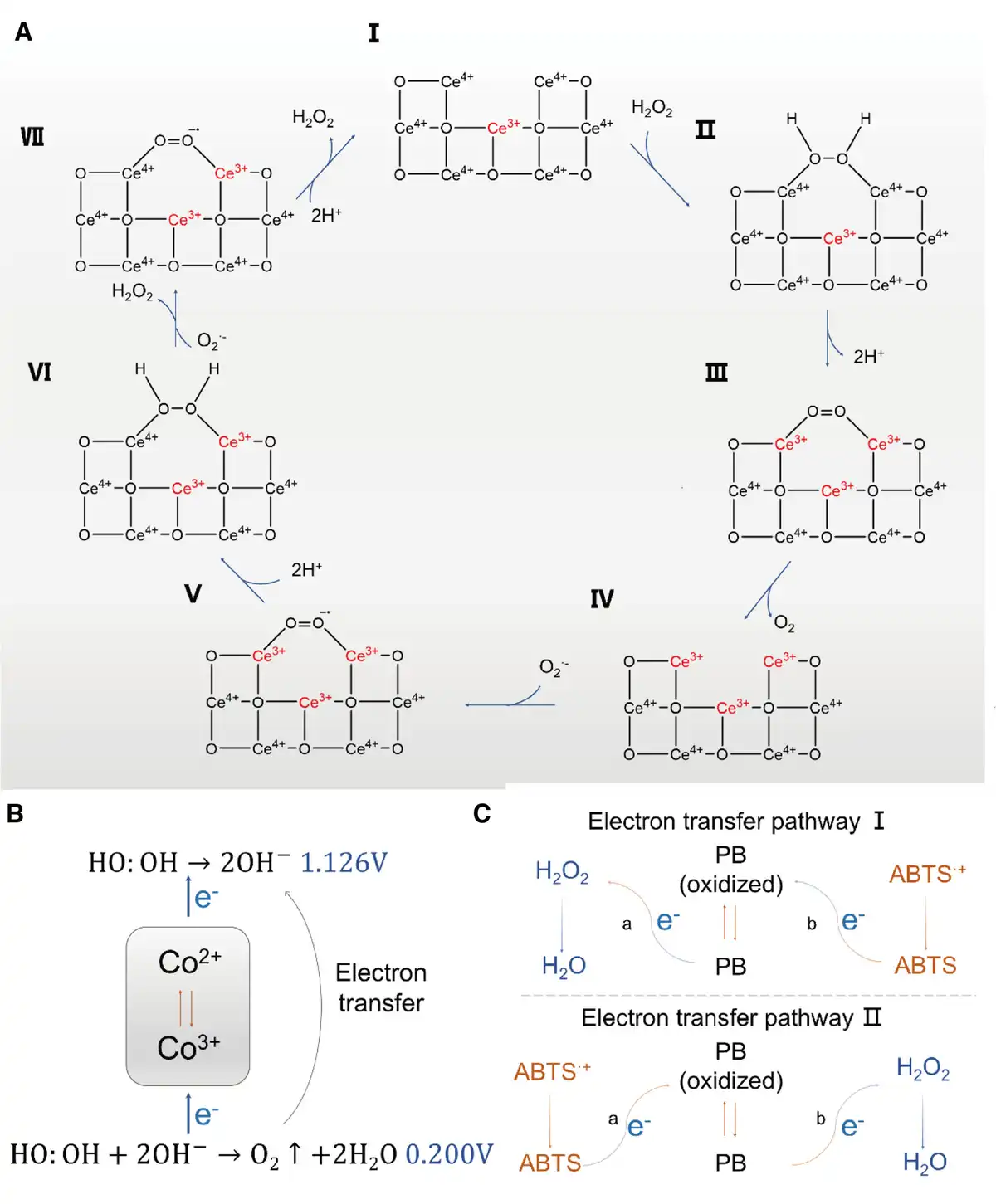
In the case of CeO2 nanoparticles, their catalytic activity derives from the rapid and convenient transition between Ce4+ and Ce3+ compounds. Celardo et al[39] studied the SOD catalytic mechanism of Ce metal ions in more detail. CeO2 first reacts with an H2O2 to form H+ and O2, and some Ce ions change from +4 valence to +3 valence. Then, they react with O2·− and hydrogen atoms to change back to +4 valence to form H2O2 (Figure 5A). In addition to the SOD-like activity of CeO2 nanoparticles, the performance of MnO2-based nanozymes was also explored. Unlike the valence state transitions of CeO2 nanoparticles, MnO2 nanozymes show how structural design can enhance SOD-like catalytic efficiency. Zhang et al[42] designed a BSA-coated MnO2 nanoparticle showing great SOD simulation activity. They also demonstrated that the structural design can enhance SOD nanozyme catalysis efficiency. Yu et al[43] synthesized nanozyme with multiscale layered structure and honeycomb morphology by using graphene oxide (GO) as a framework and loading δ-MnO2 nanosheets. This design provides a large specific surface area, which is conducive to the adsorption of O2·− and catalytic reaction. Both examples demonstrate the great efficiency of nanozymes in mimicking SOD activity. They lay a solid foundation for the application of nanozymes in the treatment of neurodegenerative diseases.
3.1.2 CAT nanozyme
CAT decomposes H2O2 to produce H2O and O2. It has the effect of eliminating oxidative stress and is important in protecting cells from oxidative damage. In living organisms, CAT first forms a high-valent iron intermediate with H2O2, which then reacts with another molecule of H2O2.
Taking Co3O4 nanozyme as an example, it can be used as an electron transport medium due to the variable valence state of Co. As shown in Figure 5B, the order of redox potential from high to low is H2O2/OH−, Co3+/Co2+, and O2/H2O. Therefore, Co3+ can easily take electrons from H2O2 and convert them into Co2+, which converts H2O2 into O2 and H2O. Co2+ can also return electrons to H2O2 and convert H2O2 back to trivalent, which converts H2O2 into OH−. Cong et al[40] utilized this characteristic of Co3O4 nanoparticles, they reported the effects of Co3O4 on antiaging, antioxidation, and mitochondrial regulation, suggesting its potential therapeutic application in the field of neurodegenerative diseases.
3.1.3 POD nanozyme
POD is a class of enzymes that can catalyze biological reactions. Peroxides such as H2O2 and lipid hydrogen peroxide are reduced in catalytic reactions, and at the same time, redox substrates can be oxidized as electron donors. Most natural PODs are hemoglobin, which can activate H2O2 to produce an intermediate with a hypervalent state, allowing electrons to be extracted from different substrates.
Feng et al[41] found that Prussian blue (PB) nanoparticles follow a 2-path electron transport mechanism during POD catalysis and have the advantage of long service life. In Figure 5C, the POD nanozyme mechanism has 2 different electron transfer pathways. (1) As a semiconductor, PB can undergo a valence band-mediated pathway (VBP), where PB first provides one electron to H2O2 (process 1) and then receives another electron from 2,2’-Azinobis-(3-ethylbenzthiazoline-6-sulphonate) (ABTS) (process 2). (2) The catalytic reaction can be carried out via a conduction band-mediated pathway. PB or its preoxidation state first receives electrons from ABTS (process 1) and then electrons are transferred to H2O2 (process 2).
Furthermore, the substrate affinity can be enhanced by modifying other metal particles on the surface of the POD nanozyme to improve the POD catalytic ability. Ma et al[44] reported a Fe3O4@Pt nanozyme. Pt nanoparticles have a strong substrate adsorption capacity, especially for POD substrates such as 3,3’,5,5’-tetramethylbenzidine (TMB). Through the modification of Pt nanoparticles, Fe3O4@Pt adsorbs and concentrates substrate molecules more effectively. It also improves the initial reaction speed and reaction efficiency.
3.2 Nanozyme and neurodegenerative diseases
In view of the key role of ROS in the pathogenesis of nervous system diseases, nanozyme with high ROS scavenging efficiency has become a promising new method for the treatment of such diseases. With their diverse functional properties and composition advantages, these nanozymes have demonstrated the ability to significantly reduce oxidative stress and alleviate neurodegenerative diseases.
3.2.1 Alzheimer disease (AD)
AD is a neurodegenerative disease that progresses slowly over time. The course of the disease is related to the pathological aggregation of fibrous amyloid proteins in the brain.[45,46] Under oxidative stress, stress-activated protein kinase (SAPK) signaling pathways (such as JNK/SAPK and p38/SAPK2) are activated, mediating cellular stress responses and possibly leading to neuronal apoptosis.[47] At the same time, ROS can oxidize beta-Aβ in neurons, which enhances the toxicity of Aβ and accelerates its accumulation to form amyloid plaques, further exacerbating neuroinflammation and apoptosis.[48]
Nanozymes show potential applications in the treatment of AD. Due to their enzyme-like activity, nanozymes play a critical role in removing excess ROS. As shown in Figure 6A, B, Jia et al[49] designed and prepared an octahedral palladium (Pd) nanozyme, and combined borneol (Bor), a traditional Chinese medicine, on the surface of the Pd@PEG nanomaterial to improve the efficiency of crossing the BBB and targeting neurons. This composite material (Pd@PEG@Bor) can eliminate excessive ROS in cells and maintain mitochondrial membrane potential and calcium ion levels. By inhibiting the production and aggregation of Aβ, it protects neurons and effectively alleviates AD symptoms. In Figure 6C–E, Kwon et al[50] designed and synthesized cerium oxide nanoparticles (TPP-Ceria NPs) targeting mitochondria. As a lipophilic cation, triphenylphosphine (TPP) is able to target mitochondria through negative mitochondrion membrane potential. The Ceria component in the material exhibits excellent SOD and CAT activities. It can scavenge ROS through the reversible binding of oxygen atoms and shuttling between the Ce³⁺ (reduced) and Ce4⁺ (oxidized) states on the surface, which is a recyclable process. Furthermore, the oxidative stress level and damage of mitochondria are reduced, and the AD process is alleviated.
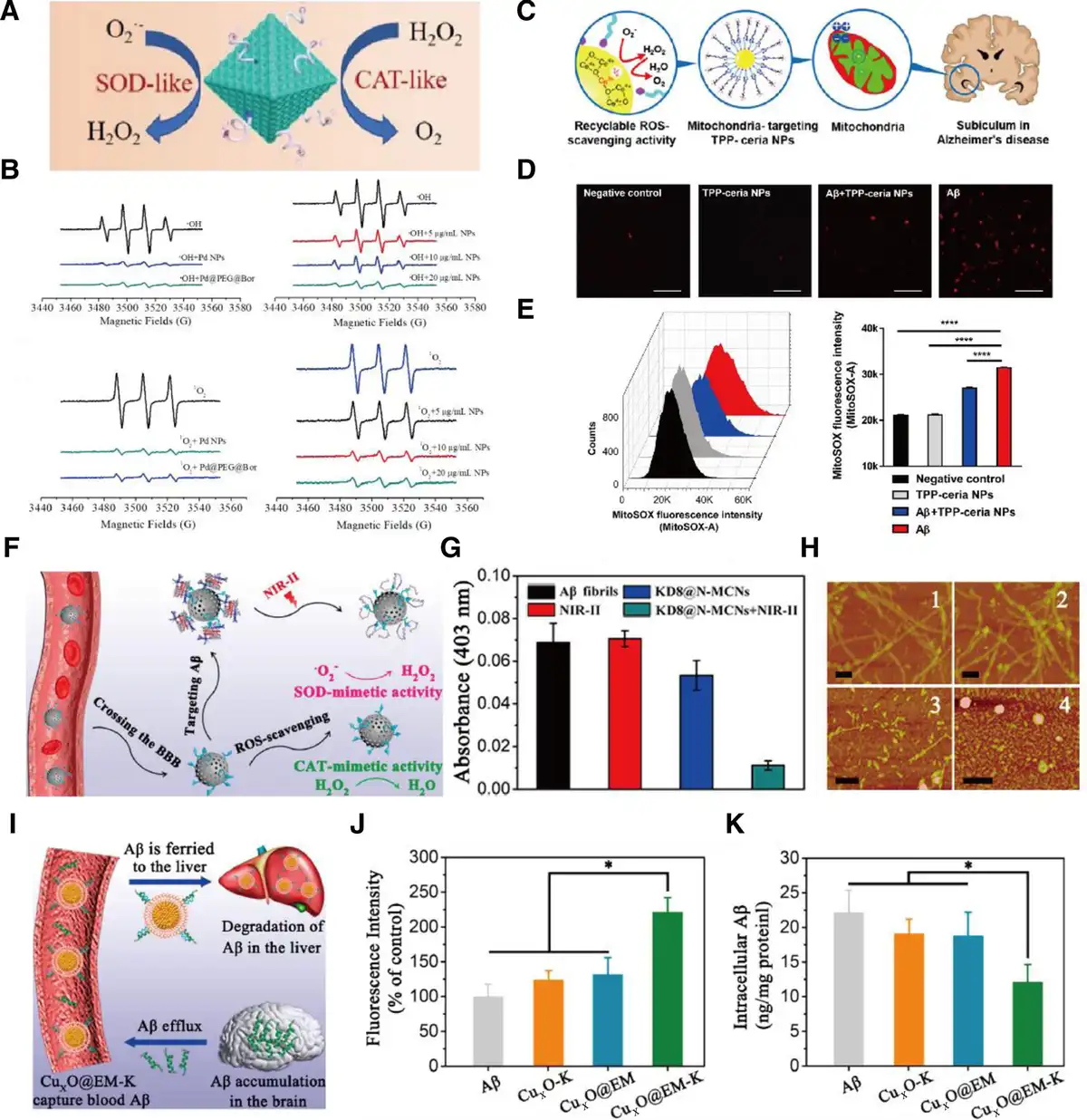
Figure 6.
The nanozyme material for AD. (A) Function diagram of Pd@PEG@Bor nanozyme. (B) Detection of ROS clearance effect of Pd NPs and Pd@PEG@Bor.[49] Copyright 2021, American Chemical Society. (C) Active oxygen scavenging activity of TPP-ceria NPs. (D, E) Cell experiments confirmed that TPP-ceria NPs significantly inhibited Aβ-induced mitochondrial ROS levels.[50] Copyright 2016, American Chemical Society. (F) Schematic diagram of KD8@N-MCNs scavenging ROS mechanism. (G) Turbidity of Aβ fibrils. (H) AFM images of Aβ.[51] Copyright 2020, American Chemical Society. (I) Schematic diagram of Aβ scavenging by CuxO@EM-K. (J, K) Remaining Aβ level.[52] Copyright 2020, American Chemical Society.
Additionally, some functionalized nanozymes have the potential to inhibit the aggregation of pathological proteins and thus reduce their toxicity, providing an innovative dual strategy for the treatment of AD. Ma et al[51] designed the KD8@N-MCNs nanozyme, which interacts with Aβ proteins through multiple mechanisms to inhibit its aggregation. Figure 6F–H clearly shows that it effectively inhibits Aβ aggregation due to its ability to bind Aβ specifically via noncovalent interactions. Second, KD8@N-MCNs can disaggregate preformed Aβ fibrils through a photothermal effect under near-infrared II (NIR-II) light. At the same time, its SOD and CAT activities effectively eliminate intracellular ROS. Furthermore, it can cross the BBB effectively due to the covalently grafted amino-acid peptide (KLVFFAED) target peptides on its surface.
Currently, most research focuses more on the direct interaction between nanozymes and Aβ proteins in brains, and less on clearing peripheral Aβ. Notably, existing work has provided a unique, noninvasive nanozyme-based approach for treating AD. In Figure 6I–K, Ma et al[52] designed the nanozyme (CuxO@EM-K) with a surface coated by an Aβ-targeting pentapeptide (KLVFF), allowing it to specifically recognize and bind to Aβ in the bloodstream, enhancing Aβ enrichment on the nanozyme. Among them, the CuxO core with multiple antioxidant enzyme-like activities stabilized the outer erythrocyte membrane (EM) and alleviated Aβ-induced oxidative damage. The EM component in the material prevents the formation of a protein corona, avoiding the side effects of multilayer proteins attaching to the surface. After captured by CuxO@EM-K in the blood, Aβ will be degraded by the liver and cleared, reducing Aβ deposition in brains.
3.2.2 Parkinson disease (PD)
PD is a chronic neurodegenerative disease of the central nervous system affecting the motor nervous system.[53] Its symptoms gradually appear over time. The imbalance of oxidative stress in PD leads to the accumulation of α-synuclein subsequently causing the accumulation of ROS, which forms a vicious cycle. Such oxidative stress ends in the loss of upconversion nanoparticles (UCNPs) minergic neurons in the nigra.[54–55–56]
Nanozymes can inhibit oxidative stress and inflammation through antioxidant activity to protect dopaminergic neurons and slow the progression of the disease. For example, Hao et al[57] designed CuxO nanoparticle clusters (NCs), as shown in Figure 7A. Phenylalanine binds to CuO through its carboxyl and amino groups, forming strong coordination bonds with Cu²⁺. Its aromatic group provides strong hydrophobic interactions, balancing repulsive electrostatic interactions and promoting the formation of super-particle assembly. It mimics the activity of POD, SOD, CAT, and GPx, effectively reducing ROS-induced oxidative stress and improving PD symptoms in Figure 7B–E. Ma et al[58] used PB nanozymes for treating PD, as shown in Figure 7F, G. PB nanozymes take Fe²⁺/Fe³⁺ as an electron transfer platform, mimicking enzyme-like activity to scavenge various ROS (eg., •OH, O2·−, H₂O₂). Figure 7H indicates that PB is first oxidized by H₂O₂ into Berlin green (BG) or Prussian yellow in an acidic environment, and then reacts with O2·− to revert to its original form. It also inhibits the assembly and activation of the NLRP3 inflammasome, thereby reducing the activation of pyroptosis-related proteins such as caspase-1 and gasdermin D (GSDMD). The release of proinflammatory factors such as IL-1β and IL-18 is also reduced, slowing the neurodegenerative process in PD. Liu et al used a biocompatible antioxidant nanozyme (PtCu nanoalloy) to counter the diffusion of α-synuclein. Noble metal (alloy) nanostructures have a stable zero-valent metal surface and adjustable catalytic activity. Therefore, they exhibit high efficiency in ROS scavenging. By changing the ratio of Pt and Cu in the alloy, they can control the material’s SOD, CAT, and POD activities. As the Pt content increases, the enzyme activity is enhanced. And they reported for the first time that nanozyme could block the diffusion of α-synuclein.[59] By decreasing the level of ROS in primary cortical neurons induced by α-synuclein preformed fibrils, PtCu stopped the α-synuclein pathology in primary cortical neurons. Jiang et al[60] developed chiral nanozymes as an antineuroinflammatory agent to treat PD by embedding ultra-small platinum nanozymes (Ptzyme) in the L-type and D-type chiral ZIF framework. Ptzyme@D-ZIF has cascade SOD/CAT-like activities. And they discovered that chiral ZIFs have significantly enhanced ROS scavenging ability compared with nonchiral ZIFs. With longer plasma retention times, they can cross more BBB pathways through clathrin-mediated as well as fossa-mediated endocytosis. It has been shown to accumulate higher in the brains of PD mouse models. Ptzyme@D-ZIF alleviates the death of damaged neurons by inhibiting apoptosis and iron death induced by neuroinflammation, demonstrating the potential of nanozymes in the treatment of PD.
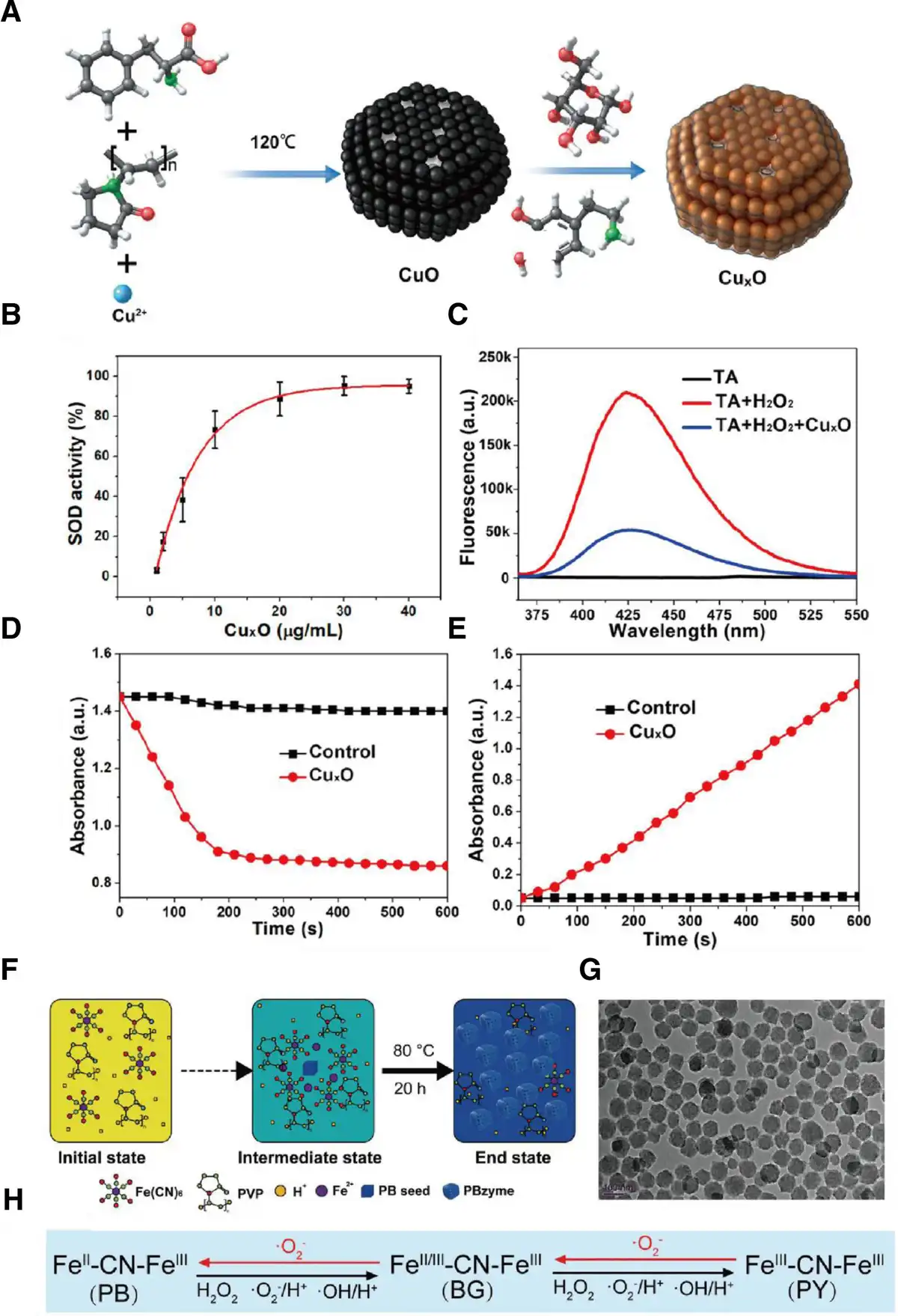
Figure 7.
The nanozyme material for PD. (A) Schematic illustration of CuxO NCs synthesis. (B–E) Different multienzyme-like activities in CuxO NCs.[57] Copyright 2018, American Chemical Society. (F, G) Schematic synthesis diagram and transmission electron microscope (TEM) image of PBzyme. (H) Schematic diagram of transformation of PBzyme in the interaction.[58] Copyright 2022, Wiley-VCH GmbH.
3.2.3 Huntington disease (HD)
HD is a common progressive neurodegenerative disorder caused by the misfolding of the huntingtin gene (Htt).[61–62–63] To date, there is no effective drug treatment. Mutant huntingtin protein (mHTT) aggregates inside cells, forming inclusions.[63] These mHTT aggregates are not only passive markers of cellular damage but actively promote oxidative stress. This is achieved through the following mechanisms.
(1) Haber–Weiss reaction: mHTT proteins can bind to transition metals like copper ions (Cu²⁺), which catalyze the Haber–Weiss reaction inside cells, producing large amounts of ROS. These reactions accelerate the production of O2·−, H₂O₂, and ·OH, leading to increased oxidative stress.[64,65] (2) Mitochondrial dysfunction: mHTT aggregates also impair mitochondrial function, further increasing ROS production.[66] Therefore, HD treatment often focuses on scavenging ROS or breaking down mHTT protein aggregates.
Adhikari et al[67] showed that citrate-functionalized manganese-based biocompatible nanomaterials (C-Mn3O4 NPs) effectively mimic GPx in physiological environments in Figure 8A. These nanomaterials participate in cellular antioxidant enzyme cascades, reducing H₂O₂ accumulation. In a 3-nitro propionic acid-induced mouse model, C-Mn3O4 nanozymes show significant therapeutic effects. The core mechanism involves mimicking the GPx reaction, using glutathione (GSH) as a cofactor to reduce H₂O₂ while oxidizing NADPH. Figure 8B clearly shows that the specific process is as follows. (1) H₂O₂ reduction: C-Mn3O4 NPs react with H₂O₂ (I), forming a peroxide intermediate (II). One of the intermediate’s hydroxyl groups reacts with a proton from GSH (III) and produces water (IV). (2) After losing a proton, GS− attacks another hydroxyl group linked to the metal center easily, forming a GSOH intermediate. Then GSOH dissociates by regenerating the Mn²⁺ catalytic center. (3) Water is replaced by H₂O₂, initiating the next cycle.
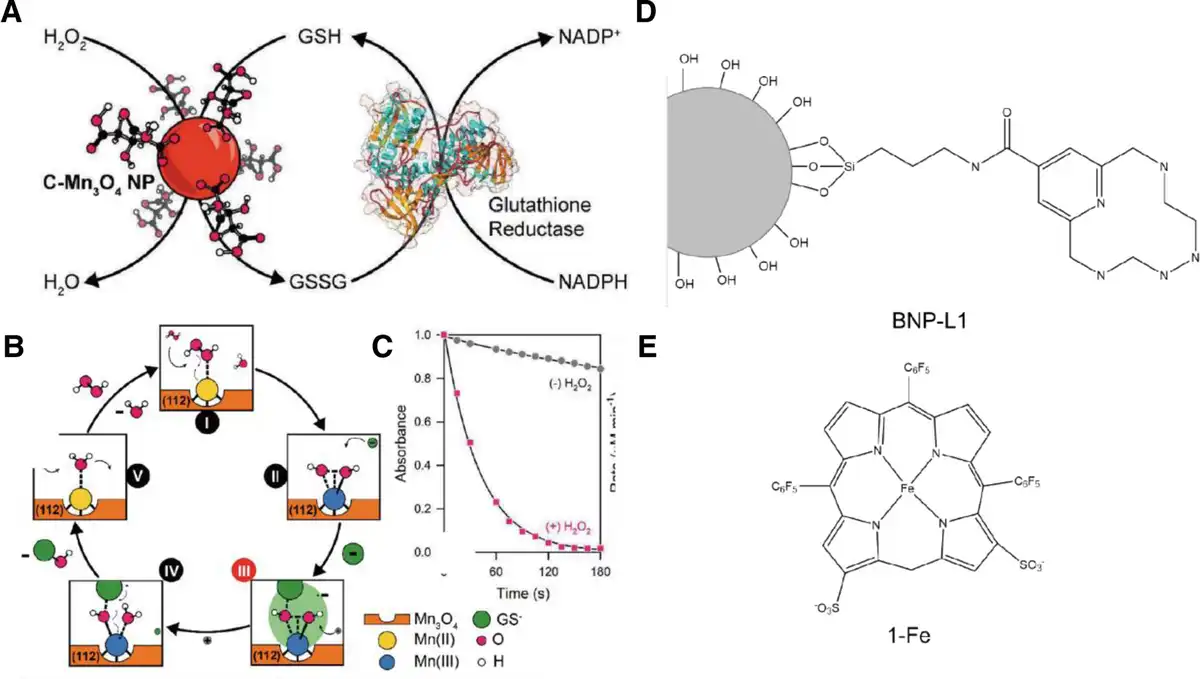
Figure 8.
The nanozyme material for HD and ALS. (A) Schematic diagram of the GPx-like activity of C-Mn3O4 NPs. (B) ROS scavenging mechanism of C-Mn3O4 NPs. (C) The change in NADPH with or without H2O2.[67] Copyright 2020, Wiley-VCH GmbH. (D) Cu@BNPs-L1. (E) The structure of 1-Fe.
During this cycle, •OH remains trapped. At the same time, GSOH condenses with GSH to form GSSG, which is reduced back to GSH by NADPH, maintaining the GSH cycle. This allows the nanozyme to continuously catalyze reactions within the cell, ensuring efficient H₂O₂ clearance (Figure 8C).
Martinez-Camarena et al[68] proposed a novel nanozyme (Cu@BNPs-L1). This nanozyme is based on boehmite nanoparticles (BNPs), functionalized with tetrazolopyridine (L1) and coordinated with Cu²+ (Figure 8D). Through the catalytic reaction of copper ions (Cu²⁺), the nanozyme mimics the function of natural SOD. The cycle between Cu⁺/Cu²⁺ oxidation states shows excellent effectiveness in reducing oxidative stress in HD cell models. In this system, the L1 ligand is responsible for forming stable complexes with Cu²⁺ and participating in the redox cycle. BNPs serve as carriers for the nanozyme. BNPs provide a stable coordination environment for Cu²⁺ and enhance attraction to negatively charged O2·− through their positive surface charge, improving the scavenging efficiency. When O2·− reacts with Cu²⁺, it produces Cu⁺, and O2·− is oxidized to O₂. Then, Cu⁺ reacts with another O2·−, reducing it to H₂O₂, while Cu⁺ is oxidized back to Cu²⁺.
3.2.4 Amyotrophic lateral sclerosis (ALS)
Amyotrophic lateral sclerosis (ALS) is a typical neurodegenerative disease characterized by the progressive degeneration of motor neurons in the brain and spinal cord.[69] Studies suggest that the cause of ALS may be mutations in superoxide dismutase 1 (SOD1), a key antioxidant enzyme involved in cellular redox balance.[70] Additionally, postmortem ALS patients show elevated levels of protein oxidative damage in neuronal tissues,[71] further indicating that ROS, protein misfolding, and protein aggregation play significant roles.[72]
In recent years, many examples have emerged where nanozymes are used to treat ALS. As shown in Figure 8E, Shaw et al[72] synthesized a SOD/CAT mimetic, 1-Fe. It catalyzes the decomposition of O2·− into oxygen and H₂O₂, which is further decomposed into water and oxygen, thus reducing oxidative stress-induced damage. 1-Fe mainly acts in the mitochondria of nerve cells, reducing ROS production and preventing mitochondrial damage caused by oxidative stress. It not only has antioxidant effects but also activates neuroprotective signaling pathways, promoting cell survival and reducing neuron death due to ROS accumulation. At a concentration of 1 µM, 1-Fe significantly improved motor ability in ALS zebrafish models, demonstrating the therapeutic potential of nanozymes for ALS.
Sarathi Nayak[73] developed a histidine (His)-functionalized SOD1 nanozyme with dual functions. It not only scavenges excess ROS in the body but also prevents misfolding and aggregation of SOD1 proteins, particularly reducing aggregation of ALS-associated mutant SOD1, such as apoSOD1G93A. Raman spectroscopy analysis showed that SOD1 undergoes structural changes (decreased α-helix, increased β-sheet) without the nanochaperone, whereas the abnormal protein structure changes were inhibited in the presence of the nanochaperone.
3.2.5 Ischemic stroke (IS)
Ischemic stroke (IS) is one of the neurodegenerative diseases threatening human health. From 1990 to 2019, the global incidence increased by 70%.[74] When IS occurs, the lack of blood and oxygen supply leads to the production of a large amount of ROS in the mitochondria.[75] This disrupts the redox balance and neuron function. Therefore, it is important to explore effective treatments for IS.
Nanozymes, as effective ROS scavengers, hold great potential in treating IS. Liao et al[76] reported a mitochondria-targeted nanodelivery system based on Ce nanozymes. It regulates mitochondrial function to alter oxidative stress levels. Figure 9A clearly shows the synthesis process of the nanomaterials. They used 1,2-distearoyl-sn-glycero-3-phosphorylethanolamine (DSPE) and TPP to coat the surface. After that, they covered the surface with the inhibitor drug roflumilast (ROF) for a synergistic effect. DSPE improved the circulation of the nanozymes in the blood, preventing being captured by the immune system and enhancing biocompatibility. TPP enables the nano system to precisely target mitochondria. The Ce component in the nanozymes can scavenge ROS by changing its valence state. Figure 9B demonstrates the ROS scavenging mechanism. Ce3+ consumes H2O2 to become Ce4+, generating water. And Ce4+ returns to Ce3+ by consuming H2O. Meanwhile, Ce nanoparticles inhibit the NF-κB pathway, reducing the secretion of proinflammatory cytokines by microglia and promoting their polarization to the anti-inflammatory M2 type. Figure 9C, D shows the ROS levels in cells after 24 h of coincubation with various drugs, measured by fluorescent probes. TPP@(CeO2 + ROF) nanozymes show the best scavenging effect.
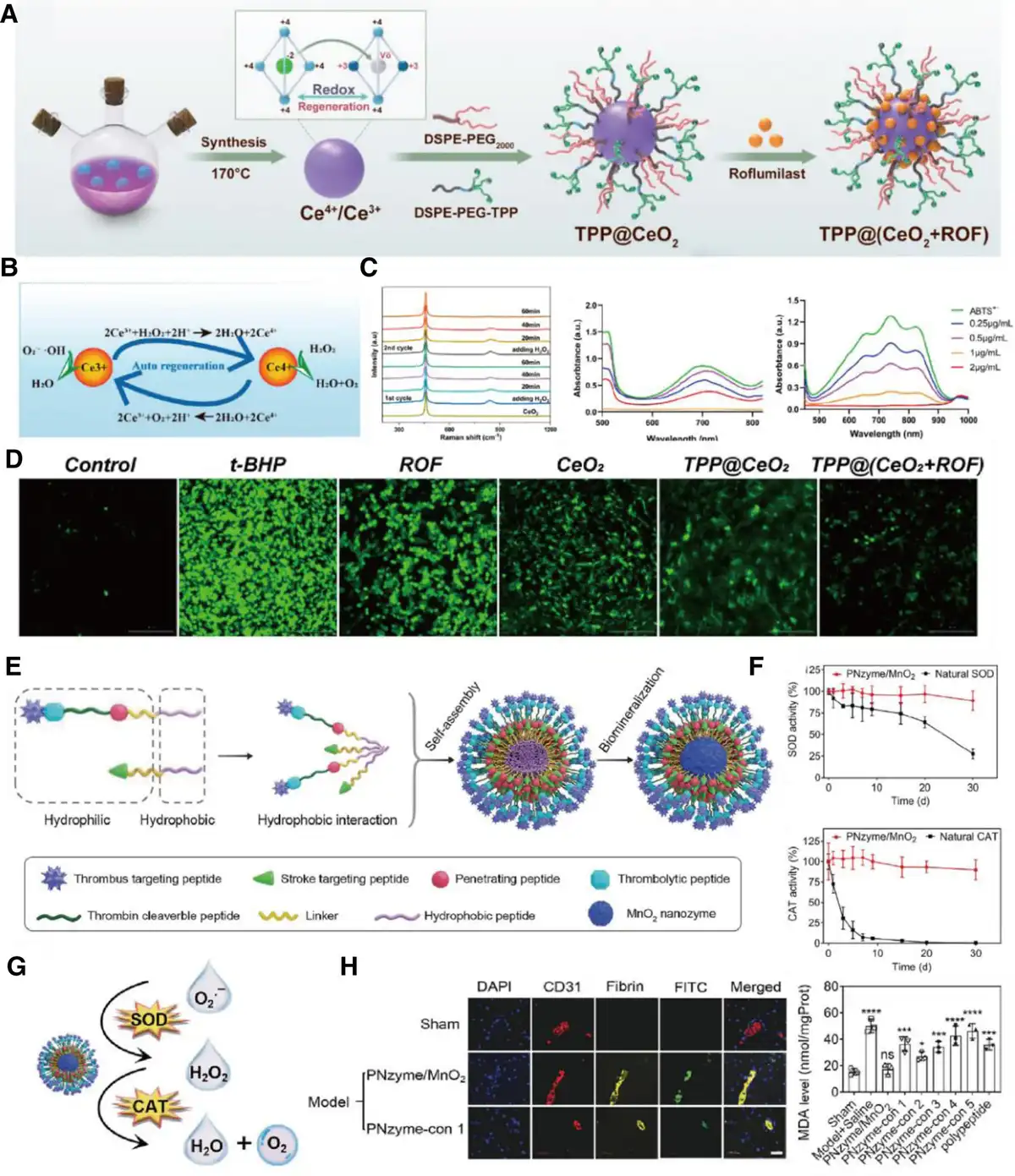
Figure 9.
Nanozyme material for ALS. (A) Schematic diagram of the preparation process of TPP@(CeO2 + ROF) material. (B) Diagram showing the mechanism of Ce nanoparticles scavenging ROS. (C) Raman and UV–Vis spectra of TPP@(CeO2 + ROF) material scavenging various types of ROS. (D) Images of intracellular ROS levels after 24 h of coincubation with different drugs.[76] Copyright 2024, American Chemical Society. (E) Schematic diagram of the preparation process of PNzyme/MnO2 material. (F) Comparison of long-term SOD and CAT activity of PNzyme/MnO2 with natural SOD or CAT. (G, H) Immunostaining showing PNzyme/MnO2 thrombosis and thrombus targeting ability. ROS scavenging capability in brain tissue.[77] Copyright 2023, Wiley-VCH GmbH.
Besides using ROS scavenging nanozymes as neuroprotectants, thrombolysis is another major treatment strategy. In this study, Wang et al[77] designed a new nanozyme. As shown in Figure 9E, its components include self-assembled peptide nanomaterials and manganese dioxide nanozymes (PNzyme/MnO2). This system combines the thrombolytic ability of functional peptides with the ROS scavenging ability of MnO2. The multifunctional self-assembled peptide nanozyme can bind fibrin in the thrombus, cross the BBB, and accumulate in ischemic neuronal tissue, exhibiting strong thrombolytic activity. Figure 9F–H demonstrates its good thrombolytic effect and the cascade scavenging effects of SOD and CAT in vivo.
Both ROS scavenging and thrombolytic approaches are critical in treating IS. The combination of these 2 strategies offers a promising therapy (Table 1).
Table 1
Nanozyme and neurodegeneration diseases.
| Disease | Nanozyme | Mechanism | Enzyme mimic activity | References |
|---|---|---|---|---|
| AD | Pd@PEG@Bor | Scavenge excess O₂⁻ and H₂O₂ and reduce oxidative stress damage | SOD, CAT | [49] |
| TPP-Ceria NPs | Target mitochondria, Ce³⁺/Ce4⁺ scavenge ROS | SOD, CAT | [50] | |
| KD8@N-MCNs | Near-infrared responsive, specifically recognize and bind to Aβ in the blood, and clear Aβ by sink effect | SOD, CAT | [51] | |
| CuxO@EM-K | Target and clear Aβ proteins, with multiple antioxidant activities | SOD, CAT, GPx | [52] | |
| KLVFF@Au−CeO2 | Photothermal effect, generate hot holes and electrons under near-infrared light | SOD, CAT | [78] | |
| PD | CuxO NCs | Mimic multiple enzyme activities and protect cells from oxidative damage | SOD, CAT, POD, GPx | [57] |
| PBzyme | Inhibit NLRP3 assembly and activation, prevent pyroptosis, and reduce proinflammatory factors release | POD | [58] | |
| PtCu nanoalloy | Biocompatible antioxidant nanozyme inhibits α-synuclein spread | SOD, CAT, POD | [59] | |
| Ptzyme@D-ZIF | Longer retention time and better clearance effect | SOD, CAT | [60] | |
| Mn3O4 | Mimic multiple enzyme activities and protect cells from oxidative damage | SOD, CAT, GPx | [79] | |
| CSPQ@CM | Promote microglia polarization to anti-inflammatory M2-like phenotype | SOD, CAT, POD | [80] | |
| PtCuSe | Developed with desirable CAT and SOD activities for the cascade scavenging of ROS | SOD, CAT | [81] | |
| HD | C-Mn3O4 NP | Reduce H₂O₂ using glutathione (GSH), while oxidizing NADPH | GPx | [67] |
| BNP-L1 | Cu²⁺/Cu⁺ consume O₂⁻, and BNPs provide a stable coordination environment and attract negatively charged O₂⁻ | SOD | [68] | |
| Ceria NPs | Cerium NPs balance oxygen production | SOD, CAT | [82] | |
| Nano-Se NPs | Inhibit mHTT aggregation, scavenge ROS, and reduce neurotoxicity | SOD, CAT | [83] | |
| IS | TPP@(CeO2 + ROF) | Target mitochondria, synergistic drug therapy, promoting microglial M2 polarization | SOD, CAT | [76] |
| PNzyme/MnO2 | Mimic multiple enzyme activities, target thrombus fibrin and thrombolytic function | SOD, CAT | [77] | |
| Fe2NC@Se | Multienzyme cascade antioxidant system | SOD, CAT, GPx | [84] | |
| HPBZs | Multienzyme activity, suppressed apoptosis, and counteracted inflammation | SOD, CAT, POD | [85] | |
| ALS | 1-Fe | Target mitochondria and mimic multiple enzyme activities | SOD, CAT | [69] |
| A histidine (His) based superoxide dismutase-I (SOD1) nanozyme | Functionalized histidine (His) group mimics SOD1 activity. Prevent SOD1 protein misfolding and aggregation. | SOD | [73] | |
| PEG-DET | Target mitochondria, with higher stability and lower toxicity | SOD | [86] | |
| CeVO4 | Prevent mitochondrial depolarization, and replace natural SOD1 and SOD2 functions in nerve cells | SOD | [87] |
4. Application of nanozyme
In recent years, nanozymes have shown remarkable effects in the treatment of AD, PD, and other neurodegenerative diseases due to their excellent designable physical and chemical properties. Additionally, the combination of nanozyme and advanced technologies, such as electrodes and artificial intelligence (AI), provides new technical means and application scenarios for the development of nanozyme and disease diagnosis and treatment.
4.1 The diagnostic and therapeutic applications of novel nanozymes
Nanozyme shows extraordinary potential in the treatment and diagnosis of neurodegenerative diseases while also showing a wide range of applications in other fields. This demonstrates the innovation and effectiveness of nanozyme in multiple fields, not only promoting the development of nanozyme in the field of neuroscience but also providing new directions for its application in other medical and technological fields.
4.1.1 Novel nanozymes for the diagnosis of neurodegenerative diseases
Neurochemical substances are important biomarkers in the progression of neurodegenerative diseases.[88] By monitoring these markers, the disease progression in the brain can be clearly visualized. It holds significant importance in the diagnosis of various brain diseases. Therefore, online in vivo detection systems based on electrochemical or optical sensing are current research hotspots.[5]
Dopamine (DA) is an important catecholamine neurotransmitter that transmits information between neurons and regulates hormone balance. In PD patients, neuromelanin and oxidized DA accumulate in dopaminergic neurons,[89] making abnormal DA levels a key indicator of PD-related neurodegenerative diseases. As shown in Figure 10A, Kang et al[90] reported a novel nanozyme based on hemin-doped HKUST-1 (also known as MOF-199). They synthesized hemin-doped HKUST-1 using a one-pot hydrothermal method and combined it with reduced graphene oxide (rGO) modified on a glassy carbon electrode (GCE), constructing the hemin-doped-HKUST-1/rGO/GCE sensor. With its nanochannels, this face-centered cubic metal–organic framework (MOF) material acts as a redox medium for detecting DA. The MOF and porous structure of Hemin-HKUST-1, along with the high conductivity of rGO, promote electron transfer, increasing the electrode’s active surface area and adsorbing more DA molecules. Hemin catalyzes DA oxidation through Fe³⁺/Fe²⁺ transitions, similar to POD. The Cu in HKUST-1 and the Fe in Hemin generate a synergistic effect, further enhancing the nanozyme’s catalytic activity toward DA and significantly improving its electrochemical oxidation capability for DA detection. The detection range for DA is 0.03 to 10 mM (Figure 10B, C).
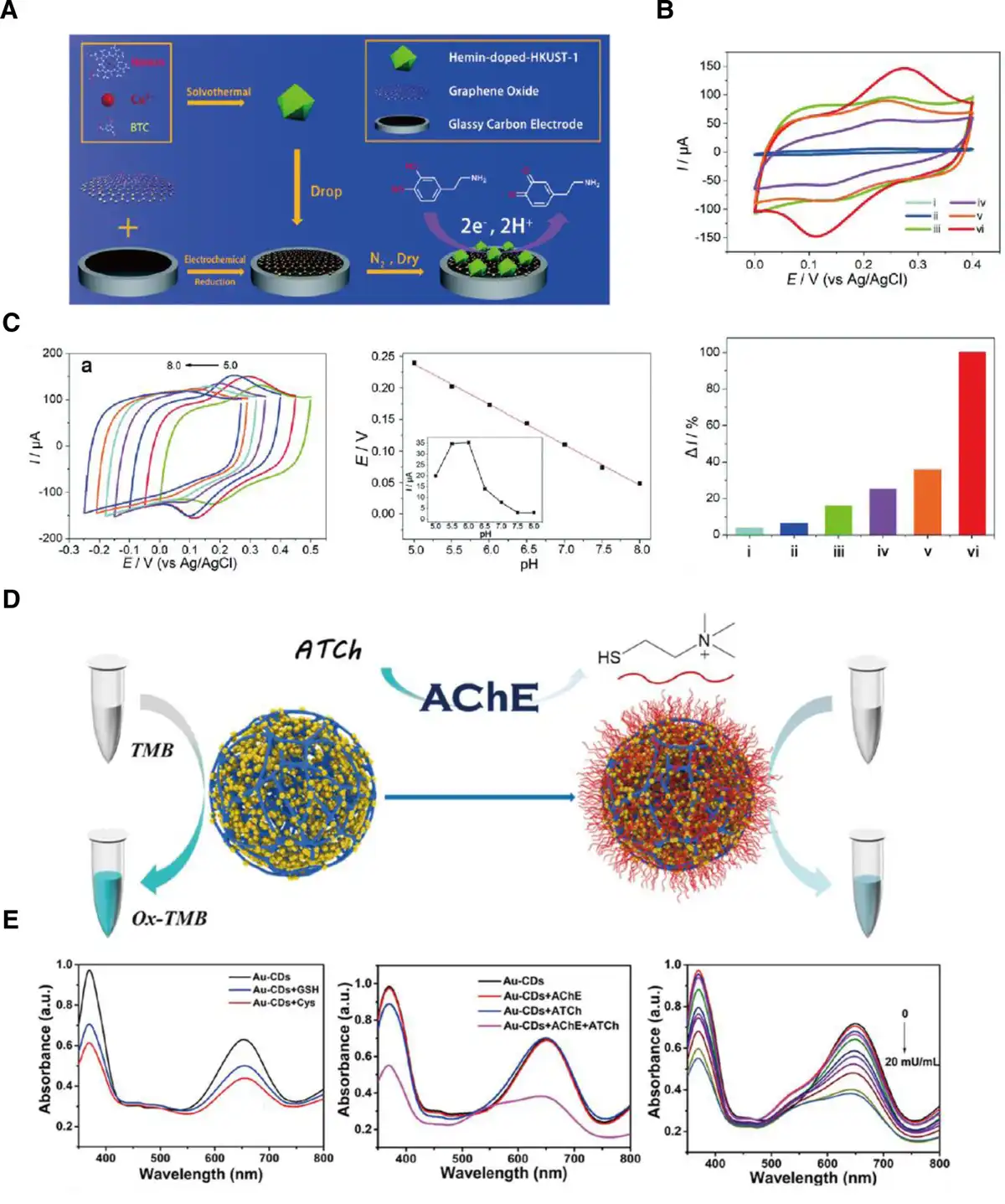
Figure 10.
Nanozymes for the diagnosis of neurodegenerative diseases. (A) Schematic diagram of the synthesis of Hemin-doped-HKUST-1 and electrocatalysis detection of DA. (B) DPV curves of different electrodes at the same DA concentration. (C) DPV curves of the Hemin-doped-HKUST-1/rGO/GCE at different DA concentrations.[90] Copyright 2021, the Royal Society of Chemistry. (D) Schematic illustration for AChE activity detection. (E) UV–Vis spectra of different reaction systems. It shows that the catalytic activity of Au-CDs significantly decreases after the addition of GSH or Cys. The catalytic activity decreases significantly only when AChE and ATCh coexist. There is a good linear relationship between absorbance and AChE activity.[91] Copyright 2022, American Chemical Society.
Similarly, acetylcholinesterase (AChE) is a key enzyme in the biological nervous system. It can effectively regulate the neurotransmitter acetylcholine (ACh). Abnormal levels of ACh are associated with common neurodegenerative diseases like AD and PD.[92] Therefore, monitoring AChE levels is crucial for disease treatment. Zhang et al[91] designed nitrogen-rich carbon dots modified with Au (Au-CDs), which mimic POD activity for detecting AChE (Figure 10D). AChE catalyzes the hydrolysis of acetylthiocholine (ATCh), producing thiocholine (TCh). The generated TCh binds to the surface of Au-CDs through Au-S bonds, inhibiting the POD-like activity of Au-CDs. As the nanozyme loses its catalytic activity, the oxidation reaction of TMB weakens, causing the solution color to fade. By measuring the change in optical absorbance, AChE activity can be quantitatively detected as shown in Figure 10E.
Thus, by utilizing the interaction between nanozyme activity and important biomarkers, fluctuations in these biochemical substances can be monitored. This highlights the potential of nanozymes as an efficient and sensitive diagnostic method, offering great promise for clinical diagnostics.
4.1.2 Novel nanozymes for the treatment of neurodegenerative diseases
In addition to the conventional nanozyme clearing ROS, there are some nanozymes with a special mechanism. They regulate pathological processes in organisms by achieving precise catalysis under specific conditions.
Ortega-Liebana et al[93] reported a method for the orthogonal catalytic reaction of gold-polymer composite catalysts in vivo. This special nanozyme can maintain catalytic activity in organisms and successfully catalyze the drug precursor into the antianxiety drug fluoxetine in the central nervous system of zebrafish. This achieves precise control of drug release and provides a new approach for targeted disease treatment. Fang et al proposed a responsive artificial enzyme (FNA-Fe3O4) based on functional nucleic acid. It is used to continuously generate DA in vivo, which can cross the BBB and target diseased neurons by means of transferrin receptor aptamers.[94] FNA-Fe3O4 responds to overexpressed α-synuclein mRNA in diseased neurons and undergoes antisense oligonucleotide therapy as well as fluorescence imaging. It simultaneously converts into an artificial enzyme composed of tyrosine aptamers that mimic tyrosine hydroxylase to continuously generate DA.
4.2 Nanozymes combined with advanced technology
Nanozymes have demonstrated broad application prospects in the field of neuroprotection and treatment of neurodegenerative diseases. However, to push this field further, nanozymes should be combined with advanced technologies, such as electrode detection, AI, and external fields. This will expand the range of applications of nanozymes and maximize their ability to accurately synthesize and efficiently treat disease.
4.2.1 Nanozymes and nerve electrode
In the field of nerve electrodes, electrical signals and neurotransmitters are mainly detected through electrodes. The sensitivity of electrode measurement can be significantly improved by combining the nanozymes with the nerve electrode. Liu et al[95] reported a general strategy for the design of neural electrodes based on nanozymes with heterogeneous design, which significantly improved the electrochemical performance by enhancing the ion current and electron transfer at the atomic layer interface. Nanozyme electrodes can be used for multiscale, ultra-sensitive neural recording, showing excellent performance. In local field potential acquisition, the sensitivity is about 10 times higher than that of PtIr electrodes, which significantly improves the signal-to-noise ratio of acute epileptic rats (Figure 11A). Chemicals such as DA, ascorbic acid (AA), and uric acid (UA) are messengers in the nervous system. The changes in their concentration link to a variety of neurodegenerative diseases. However, the sensitivity of existing electrodes is not enough to meet the detection conditions. Chen et al[96] proposed a method to modify Au24Cd nanozyme on electrodes (ACNE). As shown in Figure 11B, this work validated the performance of ACNE-modified electrodes by electrochemical detection methods, showing significant improvement in electrocatalytic activity and sensitivity. It is especially effective when detecting neurochemicals such as DA, AA, and UA. Thus, nanozyme modification can significantly improve the sensitivity and stability of metal electrodes, enhance their biomedical application potential, and provide a new idea for the development of multifunctional neural electrodes.
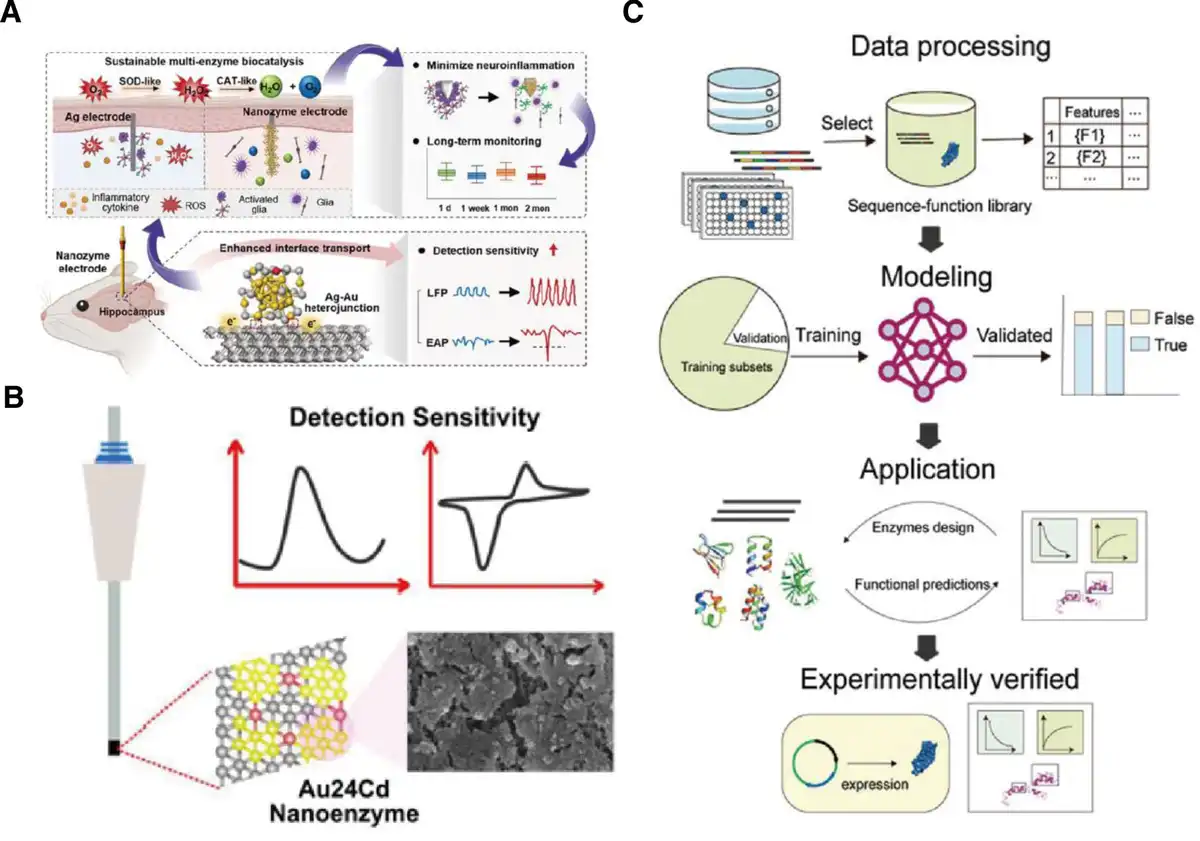
Figure 11.
Nanozymes combined with advanced technology. (A) The long-term effect of the interface between the nanozyme electrode and nerve tissue.[95] Copyright 2023, Wiley-VCH GmbH. (B) ACNE microelectrode structure and sensing performance.[96] Copyright 2024, the author(s). (C) Processes for the application of machine learning in the development of nanozymes.[16] Copyright 2023, Wiley-VCH GmbH.
4.2.2 Nanozyme and AI
At present, nanozyme has become an emerging artificial enzyme due to the combination of the advantages of catalytic materials and natural enzymes. The traditional material design is time-consuming and laborious. To obtain a more efficient and unique nanozyme, AI is introduced to carry out the material design of nanozyme, which is more conducive to disease treatment. AI-optimized design enables more efficient catalytic activity and improved selectivity for a variety of biomedical and engineering applications.
The main advantage of AI is its ability to quickly predict the properties of new material structures after a certain order of magnitude of training. Zhuang et al[16] reported the AI auxiliary nano enzyme design workflow as shown in Figure 11C: (1) get the data set and set design goals; (2) extract features from the database, and then build a feature database for model training; (3) the database is divided into learning subsets and validation subsets for machine training and model evaluation; (4) put the new material structure design into the database to predict the function of this material, and manually proofread until the expectation is reached. Wei et al[97] reported the use of machine learning to understand particle-attribute relationships and to classify and predict the enzyme-like activities of nanozymes.
4.2.3 Nanozymes and external fields
In recent years, the combination of external fields (such as electromagnetic fields and ultrasound) with nanozymes has shown great potential in treating neurodegenerative diseases. When external fields act on functionalized nanozymes, they produce unique responses, regulating the redox state within nerve cells. This interaction between external fields and nanozymes offers innovative, noninvasive therapies for neurodegenerative diseases like PD and AD.
To treat AD, Du et al[98] designed UCNP@C60-pep nanoparticles. Thanks to the properties of C60, this material can automatically switch functions under different light conditions. Under near-infrared (NIR) light, the Aβ-targeting nanoparticles produce ROS, leading to Aβ oxidation and inhibiting its aggregation. In the dark, the nanomaterials show ROS scavenging activity. UCNP is responsible for converting NIR light into visible light. Under NIR, UCNP transfers energy to the C60 component, generating ROS to oxidize Aβ proteins and inhibit their aggregation. As one of the components of UCNP@C60-pep, UCNP is also used for upconversion luminescence and magnetic resonance imaging in image-guided therapy. Pep (Aβ-target peptide KLVFF) targets Aβ proteins, ensuring that the generated ROS directly affects Aβ and reduces phototoxicity. The ability of UCNP@C60-pep to both generate and scavenge ROS helps reduce Aβ aggregation and slow the progression of AD. A light-responsive nanozyme material (Neu-MOF/Fla) was designed by Liu et al.[99] Its main components are MOF-808, Fla, and neutrophil membrane. MOF-808 acts as the core of the nanozyme. MOF-808 has high porosity and a large surface area, making it an efficient drug carrier. And it functions as a hydrolytic nanozyme. It can catalyze the hydrolysis of β-amyloid (Aβ), clearing Aβ deposits in the brain and reducing AD pathology. Fla is a molecule that releases carbon monoxide (CO) upon light activation. CO has strong anti-inflammatory effects, which help reduce neuroinflammation caused by Aβ. The neutrophil membrane is used to coat the MOF-808/Fla nanoparticles. This provides the nanozyme with targeting capabilities for neural tissues. The neutrophil membrane can recognize and respond to inflammation signals, aiding the nanozyme in crossing the BBB and delivering it to neuroinflammatory sites. This nanozyme material releases MOF-808 and CO under light exposure. It clears Aβ proteins and treats AD.
Both ultrasound and light are common external fields used in nanozyme applications. To treat PD, Gao et al[100] developed a cerium-based nanozyme (CeO2) and quercetin (Que) nanomaterial (Q@CeBG), combined with focused ultrasound. It provides neuroprotection by regulating ROS levels and polarizing microglia. The CeO2 nanozyme has strong multi-ROS scavenging capabilities, while Que promotes neuroprotection through anti-inflammatory and antioxidant actions. BG serves as the structural scaffold for the nanomaterial. Gao et al used focused ultrasound to open the BBB, allowing the nanoreactor to cross the BBB and accumulate in the brain. Experiments showed that Q@CeBG reduces proinflammatory factors, increases anti-inflammatory factor expression, and regulates the brain’s inflammatory microenvironment, improving motor and cognitive functions in PD mice. This study highlights the potential of focused ultrasound in nanozyme-based neurodegenerative disease treatments.
5. Conclusions and outlooks
ROS accelerates the process of neurodegenerative diseases due to its unique biological characteristics. With the remarkable progress of nanotechnology, many nanomaterials with unique ROS regulation abilities have been developed to regulate the spatiotemporal dynamic behavior of ROS, which has brought revolutionary therapeutic means to the biomedical field.[49] Nanozymes have shown extraordinary potential and prospects in the treatment of neurodegenerative diseases.
This review comprehensively explores the latest research progress in the field of nanozymes treating neurodegenerative diseases, focusing on the characteristics, production, and transformation of ROS in vivo. Subsequently, the role of ROS as pathogenic agents in the progression of neurodegenerative diseases is emphasized. Further, this review focuses on the classification, catalytic mechanism, and specific application of nanozyme in the treatment of neurodegenerative diseases. In addition, the fusion application of nanozymes with neural electrode technology, AI, and other emerging fields is also discussed, showing its great potential in future precision medicine. However, despite remarkable progress in the treatment of neurodegenerative diseases, nanozyme still faces many challenges in its further clinical application and research.
(1) Catalytic mechanisms and structure relationships: Future research requires a more comprehensive understanding of nanozyme catalytic mechanisms and detailed characterization of the active sites, including the kinetic and thermodynamic properties of their catalytic processes.
(2) Improve specific targeting of focal areas: By combining neuropathology features, intelligent delivery systems are developed. It is expected to improve the specificity and substrate selectivity and enhance the ability to penetrate the BBB.
(3) Bionic design: Based on the structure and function of natural enzymes, an in-depth exploration of bionic design of nanozymes is required. By mimicking the high efficiency and specificity of natural enzymes, the stability and catalytic efficiency of nanozymes are improved, and potential immune response and toxicity problems are expected to be reduced.
(4) AI and machine learning: High throughput screening is expected to be used to rapidly identify promising nanozyme candidates. By building predictive models, AI helps optimize the design of nanozyme and predict its effects in biological systems. In addition, machine learning algorithms are able to analyze large amounts of data to support personalization and precision medicine.
(5) Expand the application range: Explore the application of nanozyme in addition to ROS regulation, such as: treating metabolic disorders by regulating neurotransmitters; develop new noninvasive imaging techniques and diagnostic tools to improve the sensitivity and accuracy of early neurodegenerative disease diagnosis using nanozymes.
(6) Deepening in vitro and in vivo studies: Cell culture techniques, such as organoids, can be used to simulate the complex cell microenvironment and tissue structure in vitro. In vivo, multiomics techniques such as genomics, proteomics, and metabolomics are applied to comprehensively evaluate the impact of nanozyme on biological systems.
(7) Interdisciplinary collaboration and preclinical research: Promoting collaboration to address issues such as scale production, standardized testing, and preclinical evaluation of nanozyme among materials science, biomedicine, pharmacy, and clinical medicine.
(8) Limitations and challenges: First, the BBB may be a major limitation for nanozymes. As they may not effectively penetrate the BBB, their therapeutic efficacy will be affected, and the metabolic process of nanozymes is equally noteworthy after treatment. Long-term safety is also a challenge. The long-term stability and biocompatibility of nanozymes require more precise evaluation. Most studies use nonprimate animal models, which may affect the accuracy of nanozyme experiments. Therefore, systematic safety testing of nanozyme is a direction worth exploring to fill the gap in the biological safety of nanozymes. At the same time, more experiments involving primate animal models should be considered to provide more safety references. Additionally, nanozymes have not been successfully introduced into clinical treatment for neurodegenerative diseases so far. So further exploration of their clinical applications is needed.
In summary, ROS is a decisive factor in neurodegenerative diseases, and nanozyme has shown therapeutic potential due to its ability to regulate ROS. In the future, it is expected that nanozyme-related research can deepen the understanding of the catalytic mechanism, improve the targeting, and overcome the clinical application challenges through innovative methods. This will expand its applications in the field of neuroscience and bring hope for the treatment of neurodegenerative diseases.
Funding
The authors would greatly acknowledge the financial support by the National Natural Science Foundation of China Youth Fund (No. 52322213), and the National Funds for General Projects (No. 52272269).
Conflicts of interests
The authors declare that they have no conflicts of interest.
References
- [1] Vogel JW, Corriveau-Lecavalier N, Franzmeier N, et al. Connectome-based modelling of neurodegenerative diseases: towards precision medicine and mechanistic insight. Nat Rev Neurosci. 2023;24:620–639.
- [2] Borsook D. Neurological diseases and pain. Brain. 2012;135:320–344.
- [3] Feigin VL, Vos T, Alahdab F, et al.; GBD 2017 US Neurological Disorders Collaborators. Burden of neurological disorders across the US from 1990-2017. JAMA Neurol. 2021;78(2):165–176.
- [4] Zhou J, Jangili P, Son S, et al. Fluorescent diagnostic probes in neurodegenerative diseases. Adv Mater. 2020;32:2001945.
- [5] Xu R, Zhang S, Wang P, et al. Nanozyme-based strategies for efficient theranostics of brain diseases. Coord Chem Rev. 2024;501:215519.
- [6] Simpson DSA, Oliver PL. ROS generation in microglia: understanding oxidative stress and inflammation in neurodegenerative disease. Antioxidants (Basel). 2020;9:743.
- [7] Voet S, Srinivasan S, Lamkanfi M, et al. Inflammasomes in neuroinflammatory and neurodegenerative diseases. EMBO Mol Med. 2019;11:e10248.
- [8] D’Autreaux B, Toledano MB. ROS as signalling molecules: mechanisms that generate specificity in ROS homeostasis. Nat Rev Mol Cell Biol. 2007;8:813–824.
- [9] Jiang G, Xu Q, Xie J, et al. Emerging nanozymes in neurological disorder therapeutics: bridging oxidoreductase mimicry and antioxidant chemistry. Adv Funct Mater. 2024;34:2405190.
- [10] Zhang R, Jiang B, Fan K, et al. Designing nanozymes for in vivo applications. Nat Rev Bioeng. 2024;2:849–868.
- [11] Sheng J, Wu Y, Ding H, et al. Multienzyme-like nanozymes: regulation, rational design, and application. Adv Mater. 2024;36:e2211210.
- [12] Zhang A, Gao A, Zhou C, et al. Confining prepared ultrasmall nanozymes loading ATO for lung cancer catalytic therapy/immunotherapy. Adv Mater. 2023;35:e2303722.
- [13] Li S, Zhu X, Liu H, et al. Recent advances of covalent organic framework-based nanozymes for energy conversion. Coord Chem Rev. 2024;518:216046.
- [14] Xu B, Cui Y, Wang W, et al. Immunomodulation‐enhanced nanozyme‐based tumor catalytic therapy. Adv Mater. 2020;32:2003563.
- [15] Zhang Y, Wei G, Liu W, et al. Nanozymes for nanohealthcare. Nat Rev Methods Primers. 2024;4:36.
- [16] Zhuang J, Midgley AC, Wei Y, et al. Machine-learning-assisted nanozyme design: lessons from materials and engineered enzymes. Adv Mater. 2024;36:e2210848.
- [17] Chen D, Xu Q, Wang W, et al. Type I photosensitizers revitalizing photodynamic oncotherapy. Small. 2021;17:e2006742.
- [18] Rubio CP, Ceron JJ. Spectrophotometric assays for evaluation of reactive oxygen species (ROS) in serum: general concepts and applications in dogs and humans. BMC Vet Res. 2021;17:226.
- [19] Griendling KK, Touyz RM, Zweier JL, et al.; American Heart Association Council on Basic Cardiovascular Sciences. Measurement of reactive oxygen species, reactive nitrogen species, and redox-dependent signaling in the cardiovascular system: a scientific statement from the American Heart Association. Circ Res. 2016;119:e39–e75.
- [20] Nakai K, Tsuruta D. What are reactive oxygen species, free radicals, and oxidative stress in skin diseases? Int J Mol Sci. 2021;22:10799.
- [21] Vermot A, Petit-Hartlein I, Smith SME, et al. NADPH oxidases (NOX): an overview from discovery, molecular mechanisms to physiology and pathology. Antioxidants (Basel). 2021;10:890.
- [22] Holmstrom KM, Finkel T. Cellular mechanisms and physiological consequences of redox-dependent signalling. Nat Rev Mol Cell Biol. 2014;15:411–421.
- [23] Patten DA, Germain M, Kelly MA, et al. Reactive oxygen species: stuck in the middle of neurodegeneration. J Alzheimers Dis. 2010;20(Suppl 2):S357–S367.
- [24] Yu Z, Luo F. The role of reactive oxygen species in Alzheimer’s disease: from mechanism to biomaterials therapy. Adv Healthc Mater. 2024;13:e2304373.
- [25] Liu Z, Zhou T, Ziegler AC, et al. Oxidative stress in neurodegenerative diseases: from molecular mechanisms to clinical applications. Oxid Med Cell Longev. 2017;2017:2525967.
- [26] Wang B, Wang Y, Zhang J, et al. ROS-induced lipid peroxidation modulates cell death outcome: mechanisms behind apoptosis, autophagy, and ferroptosis. Arch Toxicol. 2023;97:1439–1451.
- [27] Weng M, Xie X, Liu C, et al. The sources of reactive oxygen species and its possible role in the pathogenesis of Parkinson’s disease. Parkinsons Dis. 2018;2018:9163040.
- [28] Ross CA, Tabrizi SJ. Huntington’s disease: from molecular pathogenesis to clinical treatment. Lancet Neurol. 2011;10:83–98.
- [29] Moulton MJ, Barish S, Ralhan I, et al. Neuronal ROS-induced glial lipid droplet formation is altered by loss of Alzheimer’s disease-associated genes. Proc Natl Acad Sci U S A. 2021;118:e2112095118.
- [30] Orfali R, Alwatban AZ, Orfali RS, et al. Oxidative stress and ion channels in neurodegenerative diseases. Front Physiol. 2024;15:1320086.
- [31] Wang SM, Lim S-W, Wang Y-H, et al. Astrocytic CCAAT/enhancer-binding protein delta contributes to reactive oxygen species formation in neuroinflammation. Redox Biol. 2018;16:104–112.
- [32] Verkhratsky A, Butt A, Li B, et al. Astrocytes in human central nervous system diseases: a frontier for new therapies. Signal Transduct Target Ther. 2023;8(396):396.
- [33] Chen N, Xu Y, Liu Y, et al. CEBPD aggravates apoptosis and oxidative stress of neuron after ischemic stroke by Nrf2/HO-1 pathway. Exp Cell Res. 2024;440(114127):114127.
- [34] Marschallinger J, Iram T, Zardeneta M, et al. Lipid-droplet-accumulating microglia represent a dysfunctional and proinflammatory state in the aging brain. Nat Neurosci. 2020;23:194–208.
- [35] Zhang B, Yang N, Mo ZM, et al. IL-17A enhances microglial response to OGD by regulating p53 and PI3K/Akt pathways with involvement of ROS/HMGB1. Front Mol Neurosci. 2017;10:271.
- [36] Yuan L, Wu Y, Ren X, et al. Isoorientin attenuates lipopolysaccharide-induced pro-inflammatory responses through down-regulation of ROS-related MAPK/NF-kappaB signaling pathway in BV-2 microglia. Mol Cell Biochem. 2014;386:153–165.
- [37] Park J, Min J-S, Kim B, et al. Mitochondrial ROS govern the LPS-induced pro-inflammatory response in microglia cells by regulating MAPK and NF-kappaB pathways. Neurosci Lett. 2015;584:191–196.
- [38] Zeng F, Wu Y, Li X, et al. Custom-made ceria nanoparticles show a neuroprotective effect by modulating phenotypic polarization of the microglia. Angew Chem Int Ed Engl. 2018;57:5808–5812.
- [39] Celardo I, Pedersen JZ, Traversa E, et al. Pharmacological potential of cerium oxide nanoparticles. Nanoscale. 2011;3:1411–1420.
- [40] Cong W, Wang Y, Yuan C, et al. Dietary cobalt oxide nanoparticles alleviate aging through activation of mitochondrial UPR in Caenorhabditis elegans. Theranostics. 2023;13:3276–3289.
- [41] Feng K, Wang Z, Wang S, et al. Elucidating the catalytic mechanism of Prussian blue nanozymes with self-increasing catalytic activity. Nat Commun. 2024;15:5908.
- [42] Zhang Y, Chen L, Sun R, et al. Multienzymatic antioxidant activity of manganese-based nanoparticles for protection against oxidative cell damage. ACS Biomater Sci Eng. 2022;8:638–648.
- [43] Yu Y, Zhang Y, Wang Y, et al. Multiscale structural design of MnO2@GO superoxide dismutase nanozyme for protection against antioxidant damage. Nano Res. 2023;16:10763–10769.
- [44] Ma M, Xie J, Zhang Y, et al. Fe3O4@Pt nanoparticles with enhanced peroxidase-like catalytic activity. Mater Lett. 2013;105:36–39.
- [45] Hardy JA, Higgins GA. Alzheimer’s disease: the amyloid cascade hypothesis. Science. 1992;256:184–185.
- [46] Starling S. Alzheimer disease: blood-derived αβ induces AD pathology. Nat Rev Neurol. 2018;14:2–3.Full TextGoogle Scholar
- [47] Zhu X, Raina AK, Lee H-G, et al. Oxidative stress signalling in Alzheimer’s disease. Brain Res. 2004;1000:32–39.
- [48] Zheng L, Kågedal K, Dehvari N, et al. Oxidative stress induces macroautophagy of amyloid beta-protein and ensuing apoptosis. Free Radic Biol Med. 2009;46:422–429.
- [49] Jia Z, Yuan X, Wei J-A, et al. A functionalized octahedral palladium nanozyme as a radical scavenger for ameliorating Alzheimer’s disease. ACS Appl Mater Interfaces. 2021;13:49602–49613.
- [50] Kwon HJ, Cha M-Y, Kim D, et al. Mitochondria-targeting ceria nanoparticles as antioxidants for Alzheimer’s disease. ACS Nano. 2016;10:2860–2870.
- [51] Ma M, Gao N, Li X, et al. A biocompatible second near-infrared nanozyme for spatiotemporal and non-invasive attenuation of amyloid deposition through scalp and skull. ACS Nano. 2020;14:9894–9903.
- [52] Ma M, Liu Z, Gao N, et al. Self-protecting biomimetic nanozyme for selective and synergistic clearance of peripheral amyloid-beta in an Alzheimer’s disease model. J Am Chem Soc. 2020;142:21702–21711.
- [53] Milekovic T, Moraud EM, Macellari N, et al. A spinal cord neuroprosthesis for locomotor deficits due to Parkinson’s disease. Nat Med. 2023;29:2854–2865.
- [54] Armstrong MJ, Okun MS. Choosing a Parkinson disease treatment. JAMA. 2020;323:1420–1420.
- [55] Armstrong MJ, Okun MS. Diagnosis and treatment of Parkinson disease: a review. JAMA. 2020;323:548–560.
- [56] Tansey MG, Wallings RL, Houser MC, et al. Inflammation and immune dysfunction in Parkinson disease. Nat Rev Immunol. 2022;22:657–673.
- [57] Hao C, Qu A, Xu L, et al. Chiral molecule-mediated porous Cu (x)O nanoparticle clusters with antioxidation activity for ameliorating Parkinson’s disease. J Am Chem Soc. 2019;141:1091–1099.
- [58] Ma X, Hao J, Wu J, et al. Prussian blue nanozyme as a pyroptosis inhibitor alleviates neurodegeneration. Adv Mater. 2022;34:e2106723.
- [59] Liu Y-Q, Mao Y, Xu E, et al. Nanozyme scavenging ROS for prevention of pathologic α-synuclein transmission in Parkinson’s disease. Nano Today. 2021;36:101027.
- [60] Jiang W, Li Q, Zhang R, et al. Chiral metal-organic frameworks incorporating nanozymes as neuroinflammation inhibitors for managing Parkinson’s disease. Nat Commun. 2023;14:8137.
- [61] DiFiglia M. An early start to Huntington’s disease. Science. 2020;369:771–772.
- [62] Leavitt BR, Kordasiewicz HB, Schobel SA. Huntingtin-lowering therapies for Huntington disease: a review of the evidence of potential benefits and risks. JAMA Neurol. 2020;77:764–772.
- [63] Tabrizi SJ, Estevez-Fraga C, van Roon-Mom WMC, et al. Potential disease-modifying therapies for Huntington’s disease: lessons learned and future opportunities. Lancet Neurol. 2022;21:645–658.
- [64] Xiao G, Fan Q, Wang X, et al. Huntington disease arises from a combinatory toxicity of polyglutamine and copper binding. Proc Natl Acad Sci U S A. 2013;110:14995–15000.
- [65] Poulson BG, Szczepski K, Lachowicz JI, et al. Aggregation of biologically important peptides and proteins: inhibition or acceleration depending on protein and metal ion concentrations. RSC Adv. 2019;10:215–227.
- [66] Zheng J, Winderickx J, Franssens V, et al. A mitochondria-associated oxidative stress perspective on Huntington’s disease. Front Mol Neurosci. 2018;11:329.
- [67] Adhikari A, Mondal S, Das M, et al. Incorporation of a biocompatible nanozyme in cellular antioxidant enzyme cascade reverses Huntington’s like disorder in preclinical model. Adv Healthc Mater. 2021;10:e2001736.
- [68] Martinez-Camarena A, Merino M, Sánchez-Sánchez AV, et al. An antioxidant boehmite amino-nanozyme able to disaggregate Huntington’s inclusion bodies. Chem Commun (Camb). 2022;58:5021–5024.
- [69] Soll M, Goldshtein H, Rotkopf R, et al. A synthetic SOD/catalase mimic compound for the treatment of ALS. Antioxidants (Basel). 2021;10:827.
- [70] Taylor JP, Brown RH Jr., Cleveland DW. Decoding ALS: from genes to mechanism. Nature. 2016;539:197–206.
- [71] Rosen DR, Siddique T, Patterson D, et al. Mutations in Cu/Zn superoxide dismutase gene are associated with familial amyotrophic lateral sclerosis. Nature. 1993;362:59–62.
- [72] Shaw PJ, Ince PG, Falkous G, et al. Oxidative damage to protein in sporadic motor neuron disease spinal cord. Ann Neurol. 1995;38:691–695.
- [73] Sarathi Nayak P. Nanozyme mediated SOD1 strategy linked to nanochaperone facilitate aggregation inhibition in amyotrophic lateral sclerosis. Biophys J. 2023;122:456a.
- [74] Feigin VL, Brainin M, Norrving B, et al. World Stroke Organization (WSO): global stroke fact sheet 2022. Int J Stroke. 2022;17:18–29.
- [75] Li HQ, Xia S-N, Xu S-Y, et al. Gamma-glutamylcysteine alleviates ischemic stroke-induced neuronal apoptosis by inhibiting ROS-mediated endoplasmic reticulum stress. Oxid Med Cell Longev. 2021;2021:2961079.
- [76] Liao J, Li Y, Fan LI, et al. Bioactive ceria nanoenzymes target mitochondria in reperfusion injury to treat ischemic stroke. ACS Nano. 2024;18:5510–5529.
- [77] Wang Z, Zhao Y, Hou Y, et al. A thrombin-activated peptide-templated nanozyme for remedying ischemic stroke via thrombolytic and neuroprotective actions. Adv Mater. 2024;36:e2210144.
- [78] Ge K, Mu Y, Liu M, et al. Gold nanorods with spatial separation of CeO(2) deposition for plasmonic-enhanced antioxidant stress and photothermal therapy of Alzheimer’s disease. ACS Appl Mater Interfaces. 2022;14:3662–3674.
- [79] Singh N, Savanur MA, Srivastava S, et al. A redox modulatory Mn(3) O(4) nanozyme with multi-enzyme activity provides efficient cytoprotection to human cells in a Parkinson’s disease model. Angew Chem Int Ed Engl. 2017;56:14267–14271.
- [80] Liu H, Han Y, Wang T, et al. Targeting microglia for therapy of Parkinson’s disease by using biomimetic ultrasmall nanoparticles. J Am Chem Soc. 2020;142:21730–21742.
- [81] Xu H, Ding X, Li L, et al. Tri-element nanozyme PtCuSe as an ingenious cascade catalytic machine for the amelioration of Parkinson’s disease-like symptoms. Front Bioeng Biotechnol. 2023;11:1208693.
- [82] Mustafa G, Hassan D, Zeeshan M, et al. Advances in nanotechnology versus stem cell therapy for the theranostics of Huntington’s disease. J Drug Delivery Sci Technol. 2023;87:104774.
- [83] Cong W, Bai R, Li YF, et al. Selenium nanoparticles as an efficient nanomedicine for the therapy of Huntington’s disease. ACS Appl Mater Interfaces. 2019;11:34725–34735.
- [84] Tian R, Ma H, Ye W, et al. Se‐containing MOF coated dual‐Fe‐atom nanozymes with multi‐enzyme cascade activities protect against cerebral ischemic reperfusion injury. Adv Funct Mater. 2022;32:2204025.
- [85] Zhang K, Tu M, Gao W, et al. Hollow Prussian blue nanozymes drive neuroprotection against ischemic stroke via attenuating oxidative stress, counteracting inflammation, and suppressing cell apoptosis. Nano Lett. 2019;19:2812–2823.
- [86] Jiang Y, Arounleut P, Rheiner S, et al. SOD1 nanozyme with reduced toxicity and MPS accumulation. J Control Release. 2016;231:38–49.
- [87] Singh N, NaveenKumar SK, Geethika M, et al. A cerium vanadate nanozyme with specific superoxide dismutase activity regulates mitochondrial function and ATP synthesis in neuronal cells. Angew Chem Int Ed Engl. 2021;60:3121–3130.
- [88] Hansson O. Biomarkers for neurodegenerative diseases. Nat Med. 2021;27:954–963.
- [89] Burbulla LF, Song P, Mazzulli JR, et al. Dopamine oxidation mediates mitochondrial and lysosomal dysfunction in Parkinson’s disease. Science. 2017;357:1255–1261.
- [90] Kang K, Wang B, Ji X, et al. Hemin-doped metal-organic frameworks based nanozyme electrochemical sensor with high stability and sensitivity for dopamine detection. RSC Adv. 2021;11:2446–2452.
- [91] Zhang D, Han Q, Liu W, et al. Au-decorated N-rich carbon dots as peroxidase mimics for the detection of acetylcholinesterase activity. ACS Appl Nano Mater. 2022;5:1958–1965.
- [92] Jing M, Zhang P, Wang G, et al. A genetically encoded fluorescent acetylcholine indicator for in vitro and in vivo studies. Nat Biotechnol. 2018;36:726–737.
- [93] Ortega-Liebana MC, Porter NJ, Adam C, et al. Truly-biocompatible gold catalysis enables vivo-orthogonal intra-CNS release of anxiolytics. Angew Chem Int Ed Engl. 2022;61:e202111461.
- [94] Fang X, Yuan M, Zhao F, et al. In situ continuous Dopa supply by responsive artificial enzyme for the treatment of Parkinson’s disease. Nat Commun. 2023;14:2661.
- [95] Liu S, Wang Y, Zhao Y, et al. A nanozyme-based electrode for high-performance neural recording. Adv Mater. 2024;36:e2304297.
- [96] Chen JY, Huang S, Liu S-J, et al. Au(24)Cd nanoenzyme coating for enhancing electrochemical sensing performance of metal wire microelectrodes. Biosensors (Basel). 2024;14:328.
- [97] Wei Y, Wu J, Wu Y, et al. Prediction and design of nanozymes using explainable machine learning. Adv Mater. 2022;34:e2201736.
- [98] Du Z, Gao N, Wang X, et al. Near-infrared switchable fullerene-based synergy therapy for Alzheimer’s disease. Small. 2018;14:e1801852.
- [99] Liu C, Zhang W, Zhang H, et al. Biomimetic engineering of a neuroinflammation-targeted MOF nanozyme scaffolded with photo-trigger released CO for the treatment of Alzheimer’s disease. Chem Sci. 2024;15:13201–13208.
- [100] Gao Y, Zhai L, Chen J, et al. Focused ultrasound-mediated cerium-based nanoreactor against Parkinson’s disease via ROS regulation and microglia polarization. J Control Release. 2024;368:580–594.
This article is available under Open Access.
© 2024 The Authors