Peptide–nanomaterial interactions: a key to controlled hierarchical morphology and assembly
Authors
Enbo Zhu*, Yan-Ruide Li, Zeyang Liu, Shaolei Wang
- aDepartment of Bioengineering, UCLA, Los Angeles, California, USA
- bDepartment of Microbiology, Immunology & Molecular Genetics, UCLA, Los Angeles, California, USA.
* Correspondence: Address: Enbo Zhu, Department of Bioengineering, UCLA, 410 Westwood Plaza, Los Angeles, CA 90095, USA. Email: enbozhu@ucla.edu (E. Zhu).
MedMat · 2024 · Vol. 1 · No. 2 · pp. 51-54
Translations
Long abstracts in additional languages. The English article is the version of record.
中文zh-Hans
生物分子与纳米材料之间的相互作用已成为研究的核心领域,对开发具有精确组装控制的层级结构具有深远意义。该跨学科领域位于纳米技术、生物化学和材料科学的交汇点,探讨DNA、肽及其衍生物如何引导纳米材料的合成与组装形成复杂的功能架构,反之亦然。然而,高性能材料的纳米结构设计虽已转变了功能材料的研究格局,但实现对其合成与组装的精确控制仍面临巨大挑战。目前,由于难以识别适合定向晶体成核和组织的候选分子,研究者往往依赖试错法并使用非特异性分子作为表面活性剂来应对这一难题。
本观点文章聚焦于利用多肽独特的结构复杂性和功能特性来解决上述问题。多肽具备自组装、特异性结合及分子识别等能力,使其成为模板化并引导纳米材料组装的理想候选者。通过利用肽与纳米材料之间的特定相互作用,研究人员能够实现对层级合成和组装过程的精细调控。这种设计策略旨在构建从纳米尺度到宏观尺度的多级排列结构,从而获得具有定制性能和增强功能的新型材料体系。
文章深入探讨了仿生学策略在实现层级结构化中的应用机制。研究发现,多肽不仅能作为模板引导无机材料的生长,还能通过特定的分子识别作用形成复杂的超分子组装体。同时,纳米材料独特的理化性质为多肽的固定化和操纵提供了卓越平台,能够诱导多肽发生构象变化。这种双向相互作用不仅揭示了生物系统如何在温和条件下实现复杂结构的自组织,也为理解难以在其他系统中观察到的基本机制提供了新视角。
本综述强调了肽–纳米材料相互作用在推动未来创新研究中的变革潜力,并概述了当前方法论与关键突破。尽管自然界的精密结构通常在环境友好、条件温和下形成,而传统化学合成即便调节温度和压力也难以完全复制这些过程,但通过仿生策略有望缩小这一差距。文章指出,虽然目前仍面临精确控制合成的挑战,但随着对相互作用机制理解的深入,未来将能创造出具有前所未有的能力的新颖合成系统,从而在纳米技术和材料科学领域开辟新的前沿。
Françaisfr
Les interactions entre les biomolécules et les nanomatériaux sont devenues un domaine de recherche pivotal, offrant des implications profondes pour le développement de structures hiérarchiques avec un contrôle précis de l'assemblage. À l'intersection des nanotechnologies, de la biochimie et de la science des matériaux, ce champ interdisciplinaire explore comment les biomolécules telles que l'ADN, les peptides et leurs dérivés peuvent diriger la synthèse et l'assemblage de nanomatériaux en architectures fonctionnelles complexes. Cependant, bien que les approches de nanostructuration aient transformé l'étude des matériaux fonctionnels, un défi majeur subsiste : atteindre un contrôle précis sur la synthèse et l'assemblage des nanostructures. Souvent, ce défi est relevé par essais et erreurs, en employant des molécules non spécifiques comme surfactants en raison de la difficulté à identifier des candidats adaptés pour une formation cristalline dirigée.
Cette perspective met en lumière les stratégies biomimétiques exploitant les propriétés intrinsèques des polypeptides. Dotés d'une sophistication structurelle et de fonctionnalités uniques, tels que l'auto-assemblage, la liaison spécifique et la reconnaissance moléculaire, les peptides constituent des candidats idéaux pour le matricage et la direction de l'assemblage des nanomatériaux. En tirant parti des interactions spécifiques entre les peptides et les nanomatériaux, les chercheurs peuvent obtenir un contrôle fin sur les processus d'assemblage hiérarchique. Cette approche vise à créer des matériaux dont les composants sont organisés en une disposition multilevel allant de l'échelle nanométrique à macroscopique, conférant ainsi des propriétés taillées et des performances améliorées.
L'article examine comment ces interactions permettent d'atteindre un structuration hiérarchique inspirée du vivant. Les résultats soulignent que les matériaux nanostructurés peuvent influencer significativement l'assemblage et l'organisation des peptides, offrant une plateforme exceptionnelle pour leur immobilisation et manipulation. Cette interaction peut induire des changements conformationnels chez les peptides, permettant d'étudier des mécanismes fondamentaux autrement difficiles à observer dans d'autres systèmes. De plus, la structuration hiérarchique émulant les processus naturels démontre que ces structures complexes se forment souvent sous conditions ambiantes, un aspect difficile à reproduire par synthèse chimique conventionnelle même avec le contrôle de température et pression.
En conclusion, cette perspective souligne le potentiel transformateur des interactions peptide–nanomatériau pour faire avancer la nanotechnologie et les sciences des matériaux. Elle met en avant les avancées récentes et les applications clés de ces systèmes hybrides, illustrant leur capacité à stimuler une recherche innovante. Bien que l'identification de candidats appropriés reste un défi face aux méthodes empiriques actuelles, cette approche ouvre la voie à la création de nouveaux systèmes synthétiques dotés de capacités sans précédent. L'étude des mécanismes fondamentaux et le développement de méthodologies plus précises sont essentiels pour surmonter les limitations actuelles et réaliser pleinement l'émulation des processus biologiques complexes dans un contexte environnemental minimaliste.
Españoles
Las interacciones entre biomoléculas y nanomateriales han emergido como un área de investigación pivotal, ofreciendo implicaciones profundas para el desarrollo de estructuras jerárquicas con control preciso del ensamblaje. En la intersección de las nanotecnologías, la bioquímica y la ciencia de materiales, este campo interdisciplinario explora cómo biomoléculas como el ADN, los péptidos y sus derivados pueden dirigir la síntesis y el ensamblaje de nanomateriales en arquitecturas funcionales complejas. Sin embargo, aunque las aproximaciones de nanostructuración para materiales de alto rendimiento han transformado el estudio de materiales funcionales, persiste un desafío mayor: lograr un control preciso sobre la síntesis y el ensamblaje de nanoestructuras. A menudo, este desafío se enfrenta mediante ensayo y error, empleando moléculas no específicas como surfactantes debido a la dificultad para identificar candidatos adecuados para la formación dirigida de cristales nanométricos.
Esta perspectiva examina estrategias biomiméticas que aprovechan las sofisticadas propiedades estructurales e intrínsecas de los polipéptidos. Los péptidos exhiben capacidades tales como autoensamblaje, unión específica y reconocimiento molecular, lo que los convierte en candidatos ideales para plantillas y dirección del ensamblaje de nanomateriales. Al aprovechar las interacciones específicas entre péptidos y nanomateriales, los investigadores pueden lograr un control fino sobre los procesos de síntesis jerárquica y ensamblaje, resultando en materiales con propiedades a medida y rendimiento mejorado. Este enfoque busca emular los procesos naturales donde los sistemas biológicos demuestran una organización jerárquica notable.
El análisis destaca que los nanomateriales pueden influir significativamente en el ensamblaje y la organización de péptidos, proporcionando una plataforma excepcional para su inmovilización y manipulación. Esta interacción puede inducir cambios conformacionales en los péptidos y aprovecharse para investigar mecanismos fundamentales difíciles de observar en otros sistemas. La estructuración jerárquica del material, donde los componentes se organizan en un arreglo multinivel desde la nanoescala hasta la macroescala, es esencial para alcanzar funcionalidades avanzadas. Además, se subraya que las intrincadas estructuras a nanoescalla encontradas en la naturaleza se forman bajo condiciones ambientales, lo cual sigue siendo difícil de replicar mediante síntesis química convencional incluso con el control de temperatura y presión.
En conclusión, esta perspectiva resalta el potencial transformador de las interacciones péptido–nanomaterial para avanzar los límites de la nanotecnología y la ciencia de materiales. Se destacan avances recientes y aplicaciones clave de estos sistemas híbridos, ilustrando su potencial para impulsar investigación e innovación futura. Aunque actualmente se enfrenta el desafío del control preciso mediante métodos empíricos, este enfoque allana el camino para crear nuevos sistemas sintéticos con capacidades sin precedentes. Al proporcionar una visión general completa de las metodologías actuales y los avances clave, se subraya la necesidad de comprender mejor estos mecanismos para superar las limitaciones y desarrollar estrategias más eficientes que emulen la eficiencia natural bajo condiciones benignas.
日本語ja
生体分子とナノ材料の相互作用は、精密なアセンブリ制御を備えた階層構造の開発において極めて重要な研究領域として浮上しています。この学際分野はナノテクノロジー、生化学、材料科学の交差点に位置し、DNAやペプチドなどの生体分子がどのように複雑で機能的なアーキテクチャへとナノ材料の合成とアセンブリを誘導するか、そして逆にナノ材料が生体分子のアセンブリと組織化にどのような影響を与えるかを探索しています。しかしながら、高性能材料のためのナノ構造化アプローチは機能性材料の研究を変革しましたが、ナノ構造の合成およびアセンブリに対する精密な制御を実現するという重大な課題はまだ残されています。多くの場合、適切な候補を特定する難しさから、試行錯誤法や非特異的な分子を界面活性剤として用いることでこの課題に対処しています。
本稿では、多肽(ポリペプチド)が持つ固有の構造的複雑性と機能的特性を活用したアプローチについて論じます。自己集合、特異的結合、分子認識などの能力を持つ多肽は、ナノ材料のアセンブリをテンプレート化し誘導するための理想的な候補です。ペプチドとナノ材料間の特定の相互作用を利用することで、研究者らは階層的合成およびアセンブリプロセスに対する微細な制御を実現できます。この設計思想により、ナノスケールからマクロスケールに至る多段階の配列で構成された材料が作製され、カスタマイズされた特性と強化された性能を有する新しいシステムへと導かれます。
本視点論文では、ペプチド–ナノ材料相互作用を通じて階層構造を実現するための生体模倣戦略を探求し、その科学的解釈を提供します。主要な知見として、ナノ材料がペプチドのアセンブリと組織化に著しく影響を与えることが示されています。ナノ材料のユニークな物理化学的特性は、ペプチドの固定化および操作のための卓越したプラットフォームを提供し、これによりペプチドのコンフォメーション変化を誘発できます。この相互作用を利用することで、他の系では観察が困難である基礎的な機構を探求することが可能となります。また、自然界で発見される複雑なナノスケール構造は通常環境条件下で形成されることが強調されています。
本稿の意義は、これらのハイブリッドシステムの最近の進展と主要な応用例を提示し、将来の研究開発への潜在的な推進力を示す点にあります。自然のプロセスが温和な条件で最小限の環境負荷により卓越した機能を発現する一方で、従来の化学合成では温度や圧力の制御があってもこれらを再現することは依然として困難です。本稿は現在の手法とブレークスルーを包括的に概観し、ペプチド–ナノ材料相互作用がナノテクノロジーおよび材料科学の最前線を推進するための変革的な可能性を強調しています。今後の研究においては、これらの相互作用メカニズムの理解を深め、従来の試行錯誤に代わる精密な制御手法の開発が不可欠であると考えられます。
العربيةar
لقد برزت التفاعلات بين الجزيئات الحيوية والمواد النانوية كمجال بحثي محوري، offering implications عميقة لتطوير الهياكل الهرمية مع تحكم دقيق في التجميع. يقع هذا المجال متعدد التخصصات عند تقاطع تقنية النانو والكيمياء الحيوية وعلوم المواد، ويستكشف كيف يمكن للجزيئات الحيوية مثل الحمض النووي DNA والببتيدات ومشتقاتها توجيه تخليق وتجميع المواد النانوية إلى هياكل وظيفية معقدة، والعكس صحيح. ومع ذلك، على الرغم من أن نهج البنية النانوية للمواد عالية الأداء قد حولت دراسة المواد الوظيفية، إلا أن تحدياً رئيسياً لا يزال قائماً في تحقيق تحكم دقيق في تخليق وتجميع الهياكل النانوية. غالباً ما يتم التعامل مع هذا التحدي عن طريق التجربة والخطأ، باستخدام جزيئات غير محددة كعوامل خافضة للتوتر السطحي نظراً لصعوبة تحديد المرشحين المناسبين لتكوين وتنظيم البلورات النانوية الموجهة.
تركز هذه المنظرة على استراتيجيات تحاكي الطبيعة لتحقيق البنية الهرمية من خلال التفاعلات بين الببتيدات والمواد النانوية. تتميز البوليببتيدات بتعقيدها الهيكلي الفطري وخصائصها الوظيفية، وتظهر قدرات مثل التجميع الذاتي والارتباط المحدد والتعرف الجزيئي. تجعل هذه الخصائص منها مرشدين مثاليين لتوجيه تجميع المواد النانوية. من خلال الاستفادة من التفاعلات المحددة بين الببتيدات والمواد النانوية، يمكن للباحثين تحقيق تحكم دقيق في عمليات التخليق الهرمي والتجميع، مما يؤدي إلى مواد ذات خصائص مصممة وأداء محسن. يهدف هذا النهج إلى محاكاة العمليات الطبيعية حيث تظهر الأنظمة البيولوجية تنظيمًا هرميًا مذهلاً.
تستعرض المنظرة كيف يمكن للمواد النانوية أن تؤثر بشكل كبير على تجميع وتنظيم الببتيدات، حيث توفر الخصائص الفيزيائية والكيميائية الفريدة للنانومواد منصة استثنائية لتثبيت ومعالجة الببتيدات. يمكن لهذا التفاعل أن يحفز تغيرات في التشكل (conformational changes) للببتيدات ويمكن تسخيره لاستكشاف الآليات الأساسية التي يصعب ملاحظتها في الأنظمة الأخرى. كما يسلط الضوء على أهمية الهيكلة الهرمية للمواد، حيث يتم تنظيم المكونات في ترتيب متعدد المستويات من المقياس النانوي إلى الماكرومتر، وهو أمر أساسي لتحقيق وظائف متقدمة. وتُظهر النتائج أن معظم البنى الدقيقة المعقدة الموجودة في الطبيعة تتشكل تحت ظروف بيئية معتدلة.
في الختام، تؤكد هذه المنظرة على الإمكانات التحويلية لتفاعلات الببتيد–المواد النانوية في دفع حدود تقنية النانو وعلوم المواد إلى الأمام. تسلط الضوء على التطورات الحديثة والتطبيقات الرئيسية لهذه الأنظمة الهجينة، مما يوضح إمكاناتها لدفع البحث والتطوير المبتكر في المستقبل. بينما لا تزال هناك تحديات تتعلق بالتحكم الدقيق عبر الطرق التقليدية التي تعتمد على التجربة والخطأ، فإن هذا النهج يمهد الطريق لإنشاء أنظمة اصطناعية جديدة بقدرات غير مسبوقة. من خلال تقديم نظرة شاملة للمنهجيات الحالية والانجازات الرئيسية، تبرز المنظرة الحاجة إلى فهم أعمق للآليات الأساسية لتطوير استراتيجيات أكثر كفاءة تحاكي الكفاءة الطبيعية في ظل ظروف بيئية مواتية.
Full Text
1. Introduction
The interactions between biomolecules and nanomaterials have emerged as a pivotal area of research, offering profound implications for the development of hierarchical structures with precise assembly control. At the intersection of nanotechnology, biochemistry, and materials science, this interdisciplinary field explores how biomolecules such as DNA, peptides, and their derivations can direct the synthesis and assembly of nanomaterials into complex, functional architectures and, conversely, how nanomaterials can influence the assembly and organization of biomolecules.
Polypeptides, with their inherent structural sophistication and functional properties, exhibit capabilities such as self-assembly, specific binding, and molecular recognition. These characteristics render them ideal candidates for templating and directing the assembly of nanomaterials. By leveraging the specific interactions between peptides and nanomaterials, researchers can achieve fine control over hierarchical synthesis and assembly processes, resulting in materials with tailored properties and enhanced performance. The hierarchical structuring of materials, where components are organized in a multilevel arrangement from the nanoscale to the macroscale, is essential for attaining advanced functionalities. This approach not only emulates natural processes, where biological systems demonstrate remarkable hierarchical organization, but also paves the way for the creation of novel synthetic systems with unprecedented capabilities.[1–2–3]
Conversely, nanomaterials can significantly influence the assembly and organization of peptides. The unique physicochemical properties of nanomaterials provide an exceptional platform for the immobilization and manipulation of peptides. This interaction can induce conformational changes in peptides and can be harnessed to investigate fundamental mechanisms that are otherwise challenging to observe in other systems.[4]
In this perspective, we explore biomimetic strategies employed to achieve hierarchical structuring through peptide–nanomaterial interactions. Additionally, we highlight recent advances and key applications of these hybrid systems, illustrating their potential to drive innovative research and development in the future. By providing a comprehensive overview of current methodologies and breakthroughs, this perspective underscores the transformative potential of peptide–nanomaterial interactions in advancing the frontiers of nanotechnology and materials science.
2. Biomimetic methods: learning from nature
Nanostructuring approaches for high-performance materials have transformed the study of functional materials. However, a major challenge remains in achieving precise control over nanostructure synthesis and assembly. Often, this challenge is met through trial and error, employing nonspecific molecules as surfactants due to the difficulty in identifying suitable candidates for directed nanocrystal formation and organization.
In contrast, nature provides simple, efficient strategies to precisely control material structures, yielding superior functions under benign conditions with minimal environmental impact. Notably, most intricate nanoscale structures found in nature are formed under ambient conditions, which remain difficult to replicate through conventional chemical synthesis, even with the control afforded by manipulating temperature and pressure.
The success of nature lies in the molecular recognition capabilities of biomolecules, refined through billions of years of evolution. Among these, proteins and polypeptides are particularly notable for their exceptional functional properties, offering insights into more sustainable and effective approaches for material design.
3. Peptide-assisted nanomaterial hierarchical assembly
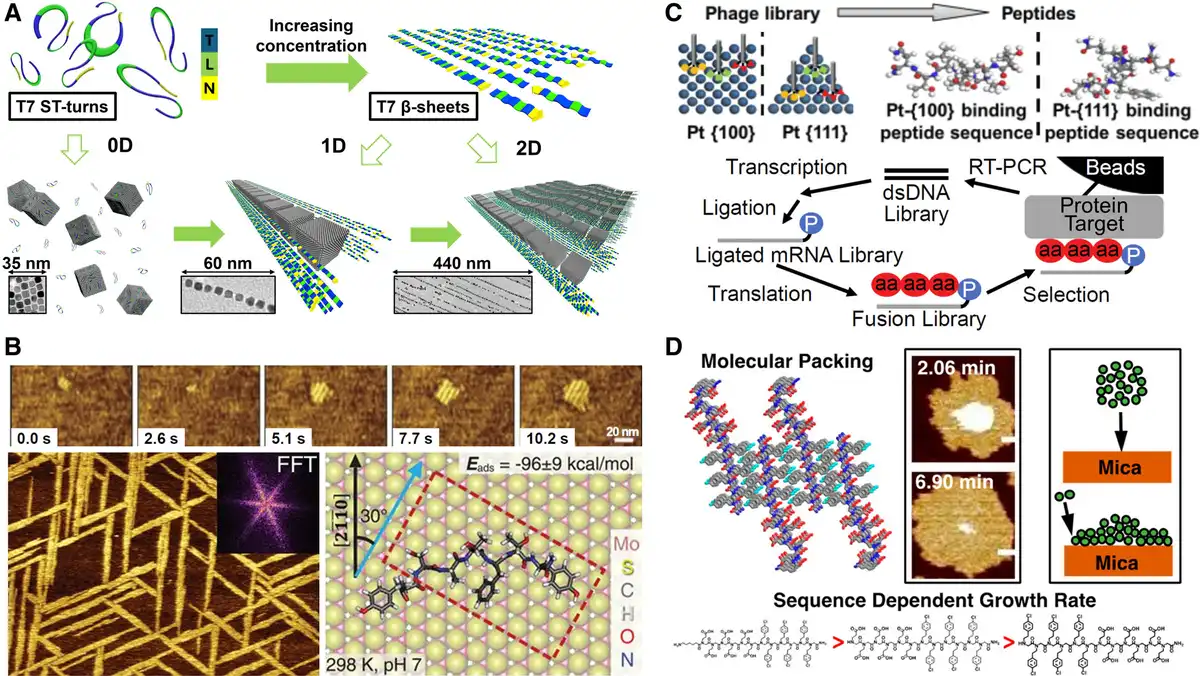
By manipulating the conformations and chemical compositions of peptides, nanocrystal formation and assemblies can be controlled hierarchically.[1] For example, using a biomimetic route combined with quantitative simulations, higher-order structures of the peptide T7 (Ac-TLTTLTN-CONH2) have been shown to drive the anisotropic growth and subsequent long-range anisotropic and unidirectional assembly of platinum (Pt) nanocrystals. The ST-turn motif, identified and experimentally validated, plays a crucial role in recognizing Pt{100} facets, leading to the formation of Pt cubes. At higher concentrations, T7 spontaneously transforms from an ST-turn to a β-sheet configuration. This self-assembly process, along with the specific interaction between T7 and cubic Pt nanocrystals, organizes the synthesized Pt nanocrystals into 2D sheets comprising unidirectional 1D assemblies along the [100] direction, extending over tens of micrometers (Figure 1A).
Figure 1.
Interactions of nanomaterials with peptides and peptoids for controlled hierarchical morphology and assembly. (A) The behavior of nanomaterials can be controlled by peptides. For example, molecular changes in T7 peptides drive the hierarchical organization of platinum (Pt) cubic nanocrystals. Reproduced with permission from Zhu et al[1] Copyright © 2019 American Chemical Society. (B) Conversely, peptides can be regulated by nanomaterials. The MoSBP1 peptide assembles on 2D MoS2 surfaces at preferred angles, demonstrating a bidirectional interaction. Reproduced with permission from Chen et al[4] Copyright © 2018, American Association for the Advancement of Science. (C) Phage display and mRNA display techniques are utilized for the selection of peptides, allowing for targeted interactions and enhanced assembly processes. (D) Influence of peptoid sequence on the mechanisms and kinetics of 2D assembly. Reproduced under the terms of a Creative Commons Attribution 4.0 Unported License.[5] Copyright © 2024, The Authors.
4. Peptide hierarchical assembly on nanomaterial surface
On the other hand, the behavior of peptides, including their configuration, assembly, and movement, is influenced by the material surfaces they contact. For instance, T7 peptides were found to spontaneously adopt ST-turn structures on the Pt{100} facet of Pt nanocubes.[1] The growth of 1D peptide crystals in rows on crystalline substrates has been reported, with these rows subsequently assembling laterally into films and ultimately forming 2D arrays. This process was investigated using molecularly resolved in situ atomic force microscopy, and the results were compared to molecular dynamics (MD) simulations. The findings revealed that the arrays assembled one row at a time, with the nuclei being ordered from the earliest stages and forming without a free energy barrier or critical size. The results verify long-standing but unproven predictions of classical nucleation theory in 1D while revealing key interactions underlying 2D assembly[4] (Figure 1B).
5. Applications of peptide–nanomaterial complexes
The rational design of peptide–nanomaterial complexes can enhance performance across multiple disciplines, including catalysis,[2,3] biomedicine,[6,7] and electronics.[8] For example, peptides can introduce grain boundaries in Pt nanostructures, enhancing oxygen reduction reaction activity, which demonstrates the potential of these engineered materials in catalytic applications.[2,3] Additionally, precise control over the shape and size of self-assembled peptide nanomaterials enables the creation of biologically inspired structures with diverse functions, including targeted transport at the subcellular level.[6,7] In electronics, peptide-based nanomaterials have attracted growing interest as novel charge transport materials due to their exceptional electrical properties and intrinsic biocompatibility, making them a compelling choice for bioelectronic applications.[8]
6. Methods in peptide–nanomaterial interaction research
Display techniques, including phage and mRNA display, can be used to select peptides with specific recognition. Phage display involves expressing a library of peptide variants on phage virions, linking each variant to its encoding DNA, and selecting based on binding affinity through panning. This process involves incubating phage-displayed peptides with a target-coated plate, washing away unbound phage, and eluting bound phage, followed by amplification and additional rounds to enrich binding sequences. DNA sequencing then identifies clones, which are analyzed for properties such as hydrophobicity, side-chain length, and functional group similarities. If no patterns emerge, further biopanning rounds are conducted.[1–2–3] Compared to phage display, mRNA display is more technically challenging but superior in peptide selection, with a higher probability of selecting rare sequences and greater diversity. mRNA display involves in vitro creation and selection of a library much larger than phage display, in a purely monovalent format, and with encoded libraries directly amenable to high throughput sequencing for structure-activity analysis[9] (Figure 1C).
Many techniques are involved in characterizing peptide–nanomaterial interactions.[10] Chromatographic methods, such as high-performance liquid chromatography, are employed to separate and quantify peptides. Spectroscopic methods, including ultraviolet-visible spectroscopy, Fourier transform infrared spectroscopy, Raman spectroscopy, and nuclear magnetic resonance Spectroscopy, provide structural information about the peptides.[1] Microscopic techniques, such as transmission electron microscopy, scanning electron microscopy, and atomic force microscopy, reveal the morphology of both peptides and nanomaterials.[1,4] Notably, atomic force imaging and spectroscopy offer unique tools for investigating molecular interactions and dynamics in biomolecular and biomineral systems in situ and therefore are increasingly utilized in studying peptide–nanomaterial interactions[4,11] (Figure 1B). Besides experimental methods, simulation methods are also important. MD simulation has become a reliable tool to gain insight into the details of molecular motion, nanoscale assembly, and crystal growth, where the interpretability of the force field parameters is essential to explain and predict the physical and chemical behavior.[12]
7. Peptoid: peptide derivation with unique properties
However, the higher-order structures formed in peptides can sometimes pose significant challenges. The side-chain chemistry of amino acid residues, combined with the stereostructure formed by hydrogen bonds, creates intricate and tangled relationships that are difficult to investigate comprehensively in mechanism studies and structure design. Additionally, peptide bonds in peptides exhibit low stability and are highly susceptible to proteolytic degradation. This inherent instability and complexity can hinder the design and application of peptide-based strategies, necessitating alternative approaches for more robust and controllable systems.
Peptoids, which are a type of sequence-defined peptide mimetic, are particularly attractive for this purpose, because they are easy to synthesize and exhibit low structural complexity, extensive side-chain diversity, and high stability. Unlike peptides and proteins, peptoids lack backbone hydrogen bond donors; thus they offer unique opportunities for tuning intermolecular and molecule–particle interactions solely through the variation of side-chain chemistry. They have already proven to be a promising class of ligands for controlling inorganic crystal formation.
To this end, peptoids, which are sequence-defined peptide mimetics, present a highly attractive solution due to their ease of synthesis, simplified structural complexity, extensive side-chain diversity, and remarkable stability. Unlike peptides and proteins, peptoids lack backbone hydrogen bond donors, which allows for unique opportunities to tune intermolecular and molecule–particle interactions solely through the variation of side-chain chemistry. This distinctive feature enhances their versatility and control in various applications. Recently, peptoids have been identified as effective ligands for directing nanomaterial formation and assembly,[13] and they have demonstrated the ability to self-assemble on material surfaces,[5] further expanding their potential in developing new functional nanomaterials for a range of applications.
The effect of peptoid sequence on the mechanism and kinetics of 2D assembly on mica surfaces was studied.[5] The results show that peptoid assembly on mica begins with aggregates forming 2D islands that grow by attaching monomers or small oligomers. Differences in growth rate and solubility are sequence dependent. The sequence with the slowest growth rate in bulk and the highest solubility shows almost no detachment. Furthermore, a peptoid sequence with a hydrophobic tail conjugated to the final carboxyl residue in the hydrophilic block exhibits enhanced hydrophobic interactions and rapid assembly both in bulk and on mica. These findings suggest that, although π–π interactions are crucial for assembly, sequence details and substrate interactions significantly affect stability and kinetics (Figure 1D).
8. Challenges and perspectives
Despite promising advancements in peptide–nanomaterial interactions for hierarchical morphology and assembly, several challenges remain. Addressing these can lead to future innovations and impactful applications.
A key challenge lies in the precise control of peptide sequences and structures, which is essential due to the complex nature of peptide–nanomaterial interactions. While peptide selection and design often rely on display techniques, their effectiveness can be limited. However, advancements in high-resolution microscopy, simulation, and machine learning offer opportunities to enhance peptide design, fostering more efficient and targeted assembly processes.[10]
Another significant hurdle is the susceptibility of peptides to protease degradation, compromising their stability and functionality. Solutions such as peptide mimetics (eg, peptoids) and chemical modifications are being explored to improve stability, particularly under harsh conditions.
Scalability and reproducibility pose further challenges. Methods effective in controlled, small-scale environments often struggle to transition to industrial applications. Robust, scalable approaches for peptide-assisted nanomaterial synthesis and assembly are critical to bridge this gap.
Additionally, integrating these nanostructures into functional devices without compromising their properties presents a complex task. To address these challenges, interdisciplinary collaboration is essential, involving biochemistry, materials science, nanotechnology, and engineering.
Finally, long-term biocompatibility must be ensured for applications in biomedical fields,[6,7] adding another layer of complexity to the scalability and reproducibility of peptide–nanomaterial systems.
Acknowledgments
E.Z. acknowledges Dr. Yu Huang for her guidance on related studies.
Conflicts of interests
The authors declare that they have no conflicts of interest.
Author contributions
E.Z. conceived, organized, and wrote the manuscript. All authors revised the manuscript. All authors discussed and approved the final manuscript.
References
- [1] Zhu E, Wang S, Yan X, et al. Long-range hierarchical nanocrystal assembly driven by molecular structural transformation. J Am Chem Soc. 2019;141(4):1498–1505.
- [2] Zhu E, Liu Y, Huang J, et al. Bubble-mediated large-scale hierarchical assembly of ultrathin Pt nanowire network monolayer at gas/liquid interfaces. ACS Nano. 2023;17(14):14152–14160.
- [3] Zhu E, Xue W, Wang S, et al. Enhancement of oxygen reduction reaction activity by grain boundaries in platinum nanostructures. Nano Res. 2020;13(12):3310–3314.
- [4] Chen J, Zhu E, Liu J, et al. Building two-dimensional materials one row at a time: avoiding the nucleation barrier. Science. 2018;362(6419):1135–1139.
- [5] Yadav Schmid S, Ma X, Hammons JA, et al. Influence of peptoid sequence on the mechanisms and kinetics of 2D assembly. ACS Nano. 2024;18(4):3497–3508.
- [6] Wang Y, Zhan J, Huang J, et al. Dynamic responsiveness of self-assembling peptide-based nano-drug systems. Interdiscip Med. 2023;1(1):e20220005.
- [7] An H-W, Mamuti M, Wang X, et al. Rationally designed modular drug delivery platform based on intracellular peptide self-assembly. Exploration (Beijing, China). 2021;1(2):20210153.
- [8] Zhao J, Liu Q, Tong X, et al. Rational design of bio-inspired peptide electronic materials toward bionanotechnology: strategies and applications. Adv Funct Mater. 2024;34(29):2401466.
- [9] Millward SW, Takahashi TT, Roberts RW. A general route for post-translational cyclization of mRNA display libraries. J Am Chem Soc. 2005;127(41):14142–14143.
- [10] Cai X, Xu W, Ren C, et al. Recent progress in quantitative analysis of self-assembled peptides. Exploration (Beijing, China). 2024;4(4):20230064.
- [11] De Yoreo JJ, Chung S, Friddle RW. In situ atomic force microscopy as a tool for investigating interactions and assembly dynamics in biomolecular and biomineral systems. Adv Funct Mater. 2013;23(20):2525–2538.
- [12] Liu J, Zeng J, Zhu C, et al. Interpretable molecular models for molybdenum disulfide and insight into selective peptide recognition. Chem Sci. 2020;11(33):8708–8722.
- [13] Jin B, Yan F, Qi X, et al. Peptoid-directed formation of five-fold twinned Au nanostars through particle attachment and facet stabilization. Angew Chem. 2022;134(14):e202201980.
This article is available under Open Access.
© 2024 The Authors