Active learning assisted piezoelectric materials synthesis on the basis of composite decision-making
Authors
En Zhao, Tingyu Wang, Yutong Wang, Fan Zeng, Ling Chen, Zhiyuan Zhu*, Wei Tang*
- aBeijing Institute of Nanoenergy and Nanosystems, Chinese Academy of Sciences, Beijing, China
- bChongqing Key Laboratory of Nonlinear Circuits and Intelligent Information Processing, College of Electronic and Information Engineering, Southwest University, Chongqing, China
- cInstitute of Applied Nanotechnology, Jiaxing, Zhejiang, China.
* Correspondence: Address: Zhiyuan Zhu, Chongqing Key Laboratory of Nonlinear Circuits and Intelligent Information Processing, College of Electronic and Information Engineering, Southwest University, Chongqing, 4000715, China. Email: zyuanzhu@swu.edu.cn (Z. Zhu); Wei Tang, Beijing Institute of Nanoenergy and Nanosystems, Chinese Academy of Sciences, Beijing, 101400, China. Email: tangwei@binn.cas.cn (W. Tang).
MedMat · 2024 · Vol. 1 · No. 2 · pp. 95-103
Abstract
The synthesis and development of novel materials for soft electronics, health monitoring, etc, have become a research hotspot. Traditional laboratory synthesis is significantly time and resource consuming. Machine learning therefore becomes an ideal approach for expediting the experimental process, constructing a virtual and automated closed-loop material synthesis, and evaluation approach. In this work, we combined piezoelectric materials’ synthesis with machine learning to achieve automatic design optimization. A total of 300 samples with different material recipes were used to train the initial active learning model. Thereafter, more samples were fabricated based on the recommended feasible recipes for each learning loop and then proceeded to the next round of learning. Through 10 active learning loops, 105 piezoelectric samples were stage-wise fabricated. Moreover, a reverse design model based on Bayesian optimization is demonstrated, and Spearman rank correlation coefficient and P values revealed the rules for the synthesis of piezoelectric materials. Finally, according to the setup model, we fabricate optimized piezoelectric materials and demonstrate their application in cycling monitoring. We anticipate this work establishes an essential approach to accelerate the development of new materials.
Translations
Long abstracts in additional languages. The English article is the version of record.
中文zh-Hans
随着柔性电子设备和健康监测技术的飞速发展,新型功能材料的合成与开发已成为当前科研领域的热点。然而,传统的实验室材料合成方法往往面临周期长、资源消耗大以及试错成本高等严峻挑战,严重制约了新材料的研发效率。针对这一瓶颈问题,本研究旨在探索将机器学习技术深度融入材料研发流程的可行性,构建一个虚拟化的自动化闭环合成与评估体系。我们的核心目标是利用主动学习算法优化压电材料的配方设计,从而显著缩短从概念提出到实验验证的时间周期,为软电子器件和生物监测应用提供高效的材料解决方案。
本研究采用了一种基于复合决策机制的主动学习策略来指导压电材料的自动化合成与筛选过程。研究团队首先构建了包含300个具有不同材料配方的初始样本数据集,用于训练基础的主动学习模型。在此基础上,系统根据算法推荐的可信配方在每一轮学习中自动制备新的实验样品,并立即进行性能测试以更新模型参数。该流程通过10次完整的主动学习迭代循环展开,累计分阶段成功合成了105个高性能压电材料样本。此外,研究还引入了一种基于贝叶斯优化的逆向设计模型,用于从目标性能反推最佳合成路径,实现了数据驱动的材料发现范式转变。
实验结果表明,通过多轮次的主动学习迭代,系统能够高效地识别出关键工艺参数与最终压电性能之间的非线性关联。统计分析显示,Spearman秩相关系数显著且P值具有统计学意义,这揭示了压电材料合成过程中的内在规律和决定性因素。基于逆向设计模型构建的优化配方成功指导了高性能压电材料的制备,其优异的电学响应特性在随后的循环监测应用中得到了充分验证。这一发现不仅证实了机器学习算法在复杂多变量材料体系中的预测能力,也展示了从数据中挖掘科学规律的可行性,为理解合成条件与微观结构演变提供了新的视角。
本工作建立了一套加速新材料开发的通用方法论,对于推动压电材料及软电子器件的产业化进程具有重要的战略意义。尽管该研究成功验证了主动学习在材料发现中的有效性,但目前的模型仍主要依赖于特定类型的复合材料体系,其泛化能力在不同化学组分间的迁移性尚需进一步评估。未来的工作将致力于扩展训练数据集的范围,探索更复杂的非线性优化算法,并尝试将该闭环系统应用于更多种类的生物相容性功能材料的开发中。通过持续迭代与验证,我们期望这一技术框架能够成为连接材料计算模拟与实际实验合成的关键桥梁,最终实现新材料研发的全面智能化和自动化。
Françaisfr
Le développement et la synthèse de nouveaux matériaux pour l'électronique souple, le suivi de santé et d'autres applications connexes sont devenus un domaine de recherche majeur. Cependant, les méthodes traditionnelles de synthèse en laboratoire s'avèrent considérablement consommatrices de temps et de ressources, freinant ainsi l'innovation rapide dans ce secteur. Pour surmonter ces défis, cette étude vise à intégrer le machine learning au processus de découverte de matériaux afin d'accélérer la conception automatique et l'évaluation des propriétés piézoélectriques. L'objectif principal est de construire une approche virtuelle et automatisée en boucle fermée qui permettrait d'optimiser les recettes expérimentales, réduisant ainsi considérablement le temps nécessaire pour identifier des candidats prometteurs dans le domaine des matériaux fonctionnels avancés.
Notre méthodologie repose sur l'utilisation de l'apprentissage actif assisté par une prise de décision composite pour guider la synthèse et la sélection des matériaux piézoélectriques. Un modèle initial a été entraîné à partir d'un ensemble de données comprenant 300 échantillons présentant diverses recettes matérielles différentes. Sur cette base, le système recommande itérativement les recettes réalisables pour chaque boucle d'apprentissage, permettant la fabrication ciblée de nouveaux échantillons suivie immédiatement par leur évaluation expérimentale. Ce processus a été répété sur dix cycles complets d'apprentissage actif, aboutissant à la synthèse échelonnée de 105 échantillons piézoélectriques optimisés. Parallèlement, un modèle de conception inverse basé sur l'optimisation bayésienne a été mis en œuvre pour inverser le processus de découverte.
Les résultats principaux démontrent que les règles sous-jacentes à la synthèse des matériaux piézoélectriques ont pu être clairement identifiées grâce aux analyses statistiques. Le coefficient de corrélation par rang de Spearman et les valeurs P obtenus révèlent avec précision les relations entre les paramètres de synthèse et les performances finales, validant ainsi l'efficacité du modèle d'apprentissage actif. En appliquant le modèle établi pour la conception inverse, nous avons réussi à fabriquer des matériaux piézoélectriques optimisés dont les propriétés ont été démontrées dans une application concrète de suivi cyclique. Ces données confirment que l'algorithme peut non seulement prédire avec succès les compositions idéales mais aussi extraire des connaissances scientifiques fondamentales sur la relation structure-propriété au sein du système composite étudié.
Ce travail établit une approche essentielle pour accélérer le développement de nouveaux matériaux, offrant un cadre robuste pour l'innovation dans le domaine des biomatériaux et de l'électronique flexible. Bien que les résultats soient prometteurs, il convient de noter certaines limitations actuelles, notamment la dépendance du modèle à la qualité initiale des données d'apprentissage et sa généralisation potentielle limitée à d'autres familles chimiques non explorées dans cette étude spécifique. Les travaux futurs se concentreront sur l'élargissement de la base de connaissances pour inclure une plus grande variété de systèmes matériaux et sur le raffinement des algorithmes d'optimisation bayésienne pour gérer des espaces de paramètres encore plus complexes. L'intégration continue de ce système en boucle fermée promet de transformer radicalement les paradigmes actuels de la recherche expérimentale en science des matériaux.
Españoles
La síntesis y el desarrollo de nuevos materiales para la electrónica blanda, el monitoreo de salud y otras aplicaciones emergentes se han convertido en un foco central de investigación actual. Sin embargo, los métodos tradicionales de síntesis en laboratorio consumen significativamente tiempo y recursos, lo que limita drásticamente la velocidad de innovación. Para abordar este desafío, esta investigación tiene como objetivo integrar técnicas de aprendizaje automático para lograr el diseño automatizado y optimización de materiales piezoeléctricos. El propósito principal es establecer un enfoque virtual y automatizado de bucle cerrado para la síntesis y evaluación de materiales, acelerando así el proceso experimental y reduciendo los costos asociados con el descubrimiento tradicional basado en ensayo y error.
En este trabajo, combinamos la síntesis de materiales piezoeléctricos con aprendizaje asistido por una toma de decisiones compuesta para lograr un diseño automático. Se utilizaron 300 muestras iniciales con diferentes recetas de material para entrenar el modelo base de aprendizaje activo. Posteriormente, se fabricaron nuevas muestras basadas en las recetas factibles recomendadas por el algoritmo en cada bucle de aprendizaje, procediendo a la siguiente ronda tras su evaluación. A través de 10 bucles completos de aprendizaje activo, se fabricaron escalonadamente un total de 105 muestras piezoeléctricas optimizadas. Además, se demostró un modelo de diseño inverso basado en optimización bayesiana para predecir las condiciones óptimas a partir de los objetivos deseados.
Los hallazgos principales revelan que el coeficiente de correlación por rangos de Spearman y los valores P indican claramente las reglas subyacentes para la síntesis de materiales piezoeléctricos. Estos resultados estadísticos validan la capacidad del modelo para identificar patrones complejos en datos experimentales multidimensionales. Basándonos en este modelo establecido, fabricamos materiales piezoeléctricos optimizados y demostramos su aplicación efectiva en el monitoreo cíclico. La evidencia sugiere que el enfoque de aprendizaje activo no solo acelera la búsqueda de composiciones ideales sino que también proporciona una interpretación científica profunda sobre cómo los parámetros de síntesis influyen en las propiedades finales del material.
Este trabajo establece un enfoque esencial para acelerar el desarrollo de nuevos materiales, ofreciendo un marco robusto para futuras innovaciones en ciencia de materiales. Aunque los resultados son prometedores, es importante reconocer limitaciones actuales, como la dependencia inicial de la calidad y cantidad de datos de entrenamiento y la necesidad de validar la generalización del modelo a otras familias químicas no exploradas en este estudio específico. El trabajo futuro se centrará en expandir el conjunto de datos para incluir una mayor diversidad de sistemas materiales y refinar los algoritmos de optimización bayesiana para manejar espacios de parámetros más complejos, asegurando así que esta metodología pueda aplicarse ampliamente a la síntesis automatizada de biomateriales avanzados.
日本語ja
ソフトエレクトロニクスやヘルスモニタリングなどの分野における新規材料の合成と開発は、現在研究の最前線となっています。しかしながら、従来の実験室での合成プロセスは時間と資源を著しく消費するため、新材料の開発速度に大きなボトルネックが生じています。本研究では、この課題に対処し、機械学習技術を組み合わせて自動設計最適化を実現することを目的としています。具体的には、仮想かつ自動化された閉ループ型の材料合成および評価アプローチを構築することで、実験プロセスの効率化を図り、従来の試行錯誤型手法に代わる新たなパラダイムを提供することを目指しています。
本稿では、複合意思決定に基づく能動学習(Active Learning)を活用した圧電性材料の自動合成戦略を採用しました。まず、異なる材料レシピを持つ300個のサンプルを用いて初期モデルを訓練し、その後に各学習ループで推奨される実現可能なレシピに基づき新たなサンプルを製造・評価するサイクルを繰り返します。このプロセスは10回の能動学習ループを経て実施され、段階的に105個の圧電性サンプルが合成されました。さらに、ベイズ最適化に基づく逆設計モデルも実証されており、これにより目標性能から最適な合成条件を導き出すことが可能となりました。
主要な知見として、Spearman順位相関係数およびP値を用いた統計解析を通じて、圧電性材料の合成における明確な規則性が明らかにされました。これらの指標は、学習モデルが材料特性と合成パラメータ間の複雑な関係を正確に捉えていることを示しています。最終的に、構築されたモデルに基づいて最適化された圧電性材料を製造し、その実用性を循環モニタリング応用の文脈で実証しました。この結果は、機械学習アルゴリズムが単なる予測ツールを超え、科学的知見の抽出と新材料設計への直接的な貢献を果たすことを裏付けています。
本研究は、新規材料の開発を加速するための本質的なアプローチを確立した点に大きな意義があります。しかしながら、現在のモデルはまだ特定の複合系に限定されており、他の化学組成群への一般化能力についてはさらなる検証が必要です。今後の課題としては、学習データの範囲拡大やアルゴリズムの高度化に加え、より複雑な材料体系における適用可能性の評価が挙げられます。この閉ループシステムを継続的に発展させることで、計算科学と実験科学の融合を深化させ、新材料発見のプロセス全体を自動化・効率化する未来への道筋を示すことが期待されます。
العربيةar
أصبح تركيب وتطوير مواد جديدة للإلكترونيات اللينة ومراقبة الصحة وغيرها من التطبيقات نقطة محورية في البحث العلمي الحالي. ومع ذلك، فإن طرق التركيب التقليدية في المختبرات تستهلك وقتًا وموارد بشكل كبير، مما يعيق الابتكار السريع. تهدف هذه الدراسة إلى دمج تقنيات التعلم الآلي لتحقيق التصميم الأمثل التلقائي للمواد الكهرضغطية. يهدف العمل الرئيسي إلى بناء نهج افتراضي وآلي مغلق الحلقة لتركيز وتقييم المواد، مما يسرع العملية التجريبية ويقلل من الاعتماد على الطرق التقليدية التي تعتمد بشكل كبير على التجربة والخطأ في اكتشاف مواد وظيفية متقدمة.
في هذا البحث، قمنا بدمج تركيب المواد الكهرضغطية مع التعلم النشط المعزز باتخاذ قرار مركب لتحقيق التصميم الآلي. تم استخدام ما مجموعه 300 عينة ذات وصفات مادية مختلفة لتدريب نموذج التعلم النشط الأولي. وبناءً على ذلك، تم تصنيع المزيد من العينات استنادًا إلى الوصفات القابلة للتنفيذ الموصى بها في كل حلقة تعلم، ثم الانتقال إلى الجولة التالية من التعلم. عبر 10 دورات من التعلم النشط، تم تصنيع 105 عينة كهرضغطية بشكل تدريجي. علاوة على ذلك، تم إظهار نموذج تصميم عكسي يعتمد على التحسين البايزي، مما يسمح بالتنبؤ بالوصفات المثلى بناءً على الخصائص المستهدفة.
تُظهر النتائج الرئيسية أن معامل ارتباط رتبة سبيرمان وقيم P قد كشفوا عن القواعد الأساسية لتركيب المواد الكهرضغطية. هذه المؤشرات الإحصائية تؤكد قدرة النموذج على تحديد العلاقات المعقدة بين معاملات التركيب والأداء النهائي للمادة. بناءً على النموذج المُعد، قمنا بتصنيع مواد كهرضغطية محسنة وأظهرنا تطبيقها في مراقبة الدورات. تثبت هذه النتائج أن خوارزميات التعلم الآلي لا يمكنها فقط التنبؤ بتركيبات مثالية ولكن أيضًا استخلاص معرفة علمية أساسية حول كيفية تأثير ظروف التركيب على البنية الدقيقة والخصائص النهائية للمادة.
يُعد هذا العمل نهجًا جوهريًا لتسريع تطوير مواد جديدة، مما يقدم إطار عمل قوي للابتكار في مجال المواد الحيوية والإلكترونيات المرنة. ومع ذلك، يجب الاعتراف ببعض القيود الحالية، مثل اعتماد النموذج على جودة البيانات الأولية وضرورة تقييم تعميمه على مجموعات كيميائية أخرى لم يتم استكشافها في هذه الدراسة المحددة. ستركز الأعمال المستقبلية على توسيع مجموعة بيانات التدريب لتشمل تنوعًا أكبر من الأنظمة المادية وتحسين خوارزميات التحسين البايزي للتعامل مع مساحات معاملات أكثر تعقيدًا، مما يضمن أن تصبح هذه المنهجية حجر الزاوية في البحث العلمي الحديث.
Keywords
Full Text
1. Introduction
Flexible electronic devices, soft machinery,[1–2–3] have been widely developed, in recent. Therefore, more soft functional materials are required, and many researchers focus on the topic,[4–5–6] especially the synthesis of composite materials. Taking the flexible piezoelectric materials as an example, recent advancements involve incorporating ZnO, PZT, or BaTiO3[7–8–9] into flexible substrates, such as polydimethylsiloxane (PDMS) or Ecoflex,[10–11–12] so as to obtain flexible piezoelectric materials. It serves important application scenarios such as smart medical treatment and life health.[13–14–15–16–17–18] However, traditional laboratory synthesis is definitely time and resource consuming. Thus, more intelligent approaches are needed. The rapidly advancing artificial intelligence (AI) technology is expected to provide solutions for this.
In the past, AI was used for material discovery,[19–20–21–22] structure optimization,[23,24] and performance prediction.[25–26–27] AI-driven autonomous experiments offer a novel paradigm for accelerating material research. However, one of the main challenges is to explore the huge design space of target properties that in the past relied on tremendous trial-and-error.[21,28] Williams et al[29] combined machine learning (ML) with elemental properties and material compositions to expand the search space and predict the performance of new catalysis materials, but it requires extra manual regulations for deep exploration. Active learning can navigate the design space iteratively, showing a promising solution for design space exploration.[21,30,31] Accordingly, various closed-loop material discovery approaches have been developed.[32–33–34] For instance, Kusne et al[22] utilized Bayesian active learning to predict phase-change materials, but the process lacks the real-time correction of experiments. Yang et al[30] employed active learning and data augmentation to achieve composite prediction of soft resistive materials, but the initial small sample number and insufficient richness of decision regression algorithms affected their exploration ability and prediction accuracy.[35,36]
Herein, we report an active learning model based on composite decision regression to investigate the synthesis of flexible piezoelectric materials. To ensure abundant initial space, 300 samples with different material recipes were fabricated under identical protocols. Then, we employed decision tree (DT), k-nearest neighbor algorithm (KNN), and random forest (RF) for composite decision regression, followed by space exploration. Afterwards, continuous iterative search begins, forming a closed-loop autonomous exploration, significantly accelerating the research of composite materials. Furthermore, we demonstrate that the reverse prediction model via Bayesian optimization can give out the optimal recipe according to the user’s needs. Finally, we use cycling monitoring as an example to demonstrate the as-fabricated high-performance piezoelectric materials’ applications.
2. Materials and methods
2.1 Materials
Polyvinyl alcohol (PVA, Aladdin, Mw=67,000), single-walled carbon nanotubes (SWCNT, Time-Nano, 1–2 nm), barium titanate (BaTiO3, Aladdin, 99.9%), isopropanol (Aladdin, AR, ≥99.7%), and ethyl alcohol (Aladdin, AR, water ≤ 0.3%). Organic microporous filter membrane (JINTENG, 0.2 μm), VHB tape (3 M, 6 cm × 3 m), conductive silver paste (HumiSeal), and deionized water (Smart-Q15 water purification system, 18.2 MΩ cm).
2.2 Characterization
A field emission scanning electron microscope (SEM) was used to test and analyze the surface morphology and element distribution of PVA/SWCNT/BaTiO3 piezoelectric nanocomposite material (pbs-PE material). X-ray photoelectron spectrometer (150 W, 650 μm) was used to perform X-ray photoelectron spectroscopy (XPS) tests and record X-ray photoelectron spectra. Raman spectrometers (laser: 633 nm, wave number range: 100–3500 cm−1) were used to characterize the Raman spectra of the pbs-PE material and analyze the material composition. The charge, voltage, and current were measured with the Keithley 6514 electrometer. The maximum tensile strain of the pbs-PE material was measured by the linear testing machine (R-LP4).
2.3 Calculation of RMSE
For the active learning loop model, the prediction accuracy of sample performance is calculated by root mean square error (RMSE) defined in equation (1):
where N is the number of data in the test set; prediction labels based on test set data point i are represented by predictioni; labelsi is the actual label for data point i of the test set.
2.4 Experiment
2.4.1 Solution preparation
(1) Preparation of PVA solution: add 100 mg PVA to 100 mL deionized water, prepare 1 mg/mL solution through a magnetic stirrer (50°C), and then add deionized water to further adjust the solution concentration to 0.1 mg/mL. (2) Preparation of SWCNT dispersion: 100 mg SWCNT was added to 1000 mL isopropanol to prepare 0.1 mg/mL dispersion. (3) Preparation of BaTiO3 solution: 100 mg BaTiO3 is dissolved in 20 mL isopropanol and prepared into 5 mg/mL solution.
2.4.2 Preparation of sample
PVA and BaTiO3 solutions were mixed with SWCNT dispersion at different mass ratios, and then the mixture was pumped on the microporous filter membrane by vacuum-assisted filtration device. The pbs-PE material was obtained after being fully dried in the vacuum drying chamber. Next, transfer the substrate and pbs-PE material to VHB tape, connect the copper wire to the pbs-PE material, and apply conductive silver adhesive to ensure good electrical contact. Finally, the PE layer is applied to the surface of the material (covering the entire material) to prepare piezoelectric nanogenerator (PENG) sensor.
2.5 Bayesian optimization
In the reverse design model based on Bayesian optimization, the loss function that evaluates the difference between the target performance and the predicted performance is defined by mean square error (MSE), as defined by equation (2):
where N is the number of data in the test set; prediction labels based on test set data point i are represented by predictioni; labelsi is the actual label for data point i of the test set.
Bayesian optimization algorithm is based on expected improvement (EI) strategy. In Bayesian optimization, we need to make a trade-off between exploring the region of uncertainty and focusing on the region known to have a better target value. In order to effectively sample, the acquisition function is used to determine the next sampling location. Since EI will select the point with the greatest EI as the feature of the next query point, we choose it as the acquisition function. As shown in equation (3):
where x is the position of the current point, xi+1 is the position of the query point in step i + 1, f is the objective function (function to be optimized), and hi+1 is the posterior mean of the proxy model in step i + 1. , is the training data, and x* is the actual position where f is maximized.
3. Results
3.1 Material synthesis and assembly characterization
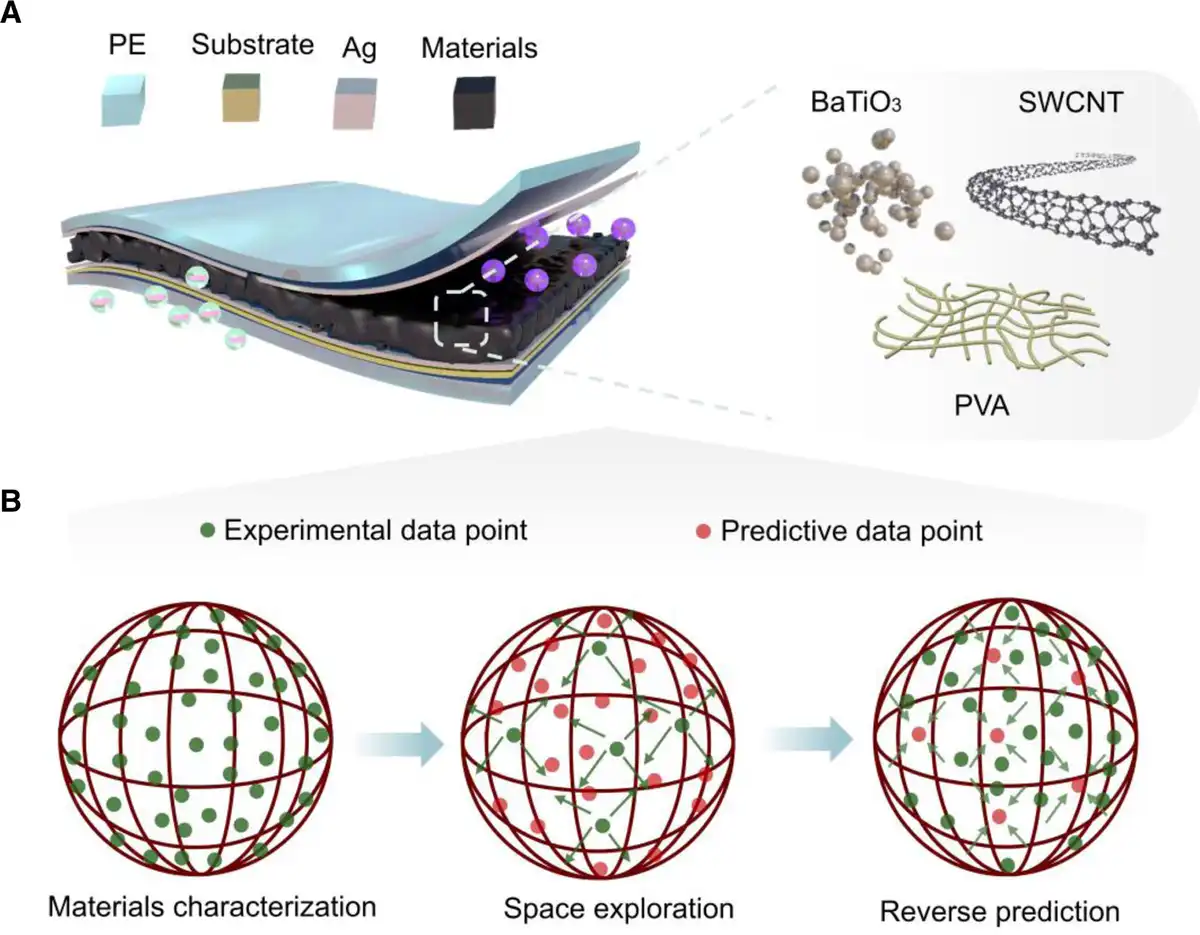
By combining ML with experiments, a material discovery approach was reported to investigate the influence of varying material recipes on piezoelectric properties. Figure 1A illustrates the selection of 3 materials: PVA, BaTiO3, and SWCNT. These materials were chosen to fabricate the flexible piezoelectric sensing material. To achieve this, we developed a 3-stage ML framework as depicted in Figure 1B. The framework encompassed materials characterization, space exploration, and reverse prediction.
Figure 1.
Automatic synthesis system of piezoelectric material. (A) Nanocomposite piezoelectric materials were prepared from 3 typical materials, PVA, SWCNT, and BaTiO3. (B) The automatic synthesis of piezoelectric materials comprises 3 stages, materials characterization, space exploration, and reverse design.
The construction process of the piezoelectric sensing material incorporating PVA, BaTiO3, and SWCNT is elucidated in Figure 2A. First, PVA, BaTiO3, and SWCNT solutions are prepared and blended in precise proportions. Next, the mixture is deposited on the polycaprolactam (Nylon-6) microporous filter membrane through a vacuum-assisted filtration device, resulting in the creation of the pbs-PE material. Following that, the pbs-PE material was transferred to the substrate and wires were connected to assemble the PENG sensor. To assess the effective integration of the 3 materials, a series of characterizations were conducted. SEM images of the pbs-PE material are shown in Figure 2B and Supplementary Figure 1, http://links.lww.com/MEDMAT/A2, revealing interwoven SWCNT and uniformly distributed BaTiO3 nanoparticles on the surface, providing preliminary evidence of successful material assembly. Elemental analysis of the pbs-PE material was performed by energy dispersive spectrometer (EDS) (Figure 2C and Supplementary Figure 2, http://links.lww.com/MEDMAT/A2), displaying a homogeneous distribution of elements such as Ba, Ti, O, and C. To further demonstrate that the 3 materials were well assembled, XPS tests were performed on both of the individual materials and pbs-PE material (Figure 2D and Supplementary Figure 3, http://links.lww.com/MEDMAT/A2). The energy spectrum exhibits characteristic peaks corresponding to Ba 3d, O 1s, Ti 2p, and C 1s. Additionally, the Raman spectra in Figure 2E substantiate the promising integration of PVA, BaTiO3, and SWCNT components.
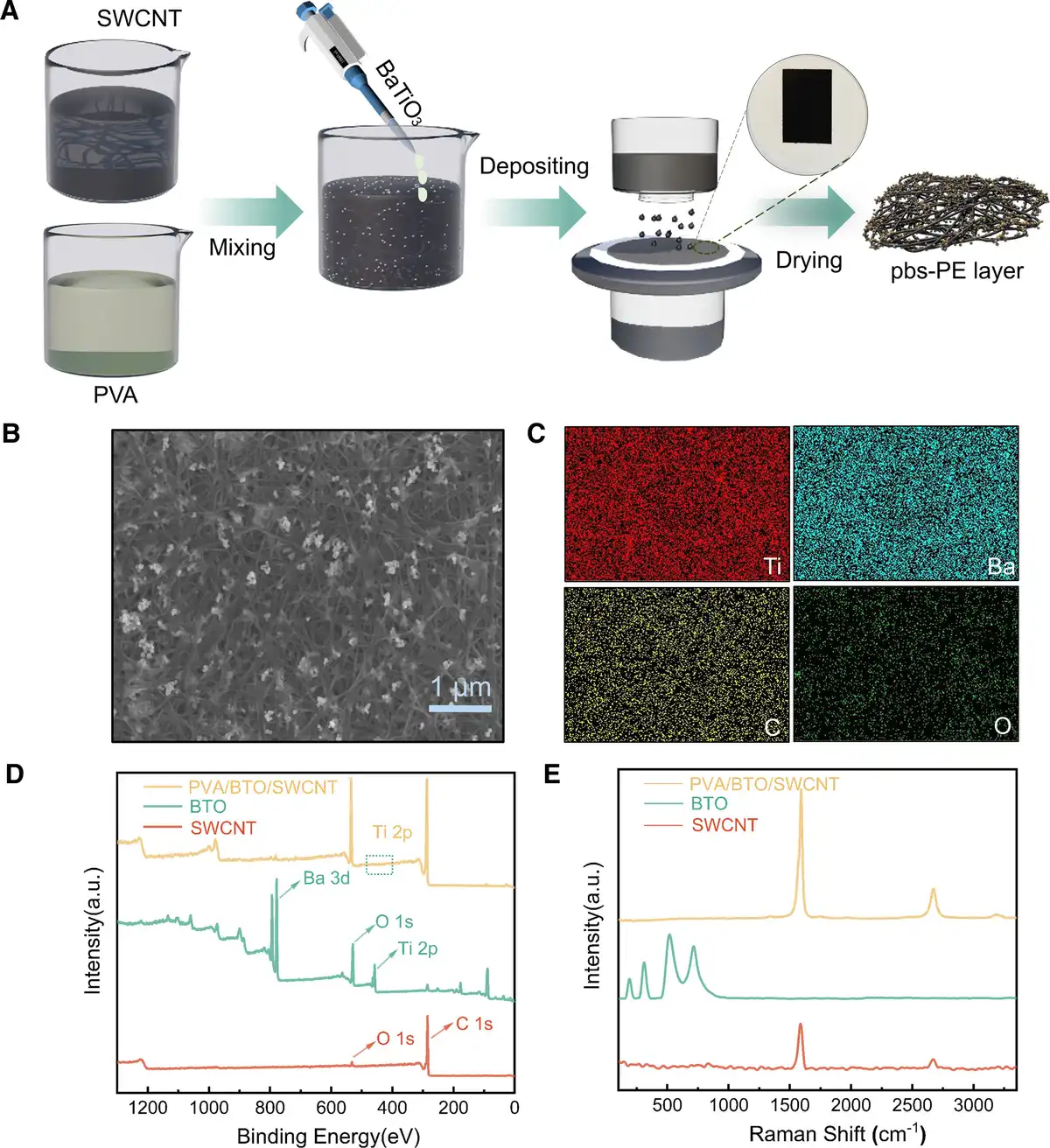
Figure 2.
Preparation process and characterization diagram of pbs-PE material (PVA/SWCNT/ BaTiO3 mass ratio is 20/45/35). (A) PVA/SWCNT/BaTiO3 nanocomposite piezoelectric material is prepared through the mixing of PVA, SWCNT, and BaTiO3 solutions, filtration, and drying. (B) SEM image of the surface morphology of the pbs-PE material. (C) EDS spectra of Ti, Ba, C, and O in the pbs-PE material. (D) XPS spectra of SWCNT, BaTiO3, and pbs-PE materials. (E) Raman spectra of SWCNT, BaTiO3, and pbs-PE materials.
3.2 Space exploration via active learning
In this study, we introduce 2 parameters aimed at evaluating the sample characteristics of sample throughout the experimental process: charge-change (ΔQ/Q0) and maximum tensile strain (εmax). The charge-change is defined by equation (4):
where Qi represents the peak–peak charge under different positive pressures and Q0 is defined as the peak–peak charge under initial pressure 0.5 N. In addition, the maximum tensile strain was described in Note S1.
During the stage of design space exploration, we constructed an active learning loop model, illustrated in Figure 3A. First, all fabrication recipes (the distribution of fabrication recipes is shown in Figure 3B) yield 300 samples. Subsequently, characterize the characteristics of each sample, including piezoelectric transfer charge-changes and maximum tensile strain. For each sample, the peak–peak charge under 3 different pressures (0.5 N, 2 N, and 5 N) was identified, denoted as the corresponding peak–peak charges Q1 for 2 N, and Q2 for 5 N, and 2 charge-change values were calculated by equation (4) to serve as a charge-change label. Finally, 2 recipe labels (PVA loading and SWCNT loading), 2 charge-change labels (∆Q1/Q0, ∆Q2/Q0), and maximum strain labels (εmax) are integrated into an input data point for the active learning loop model, recording a total of 300 data points (Supplementary Table 1, http://links.lww.com/MEDMAT/A2).
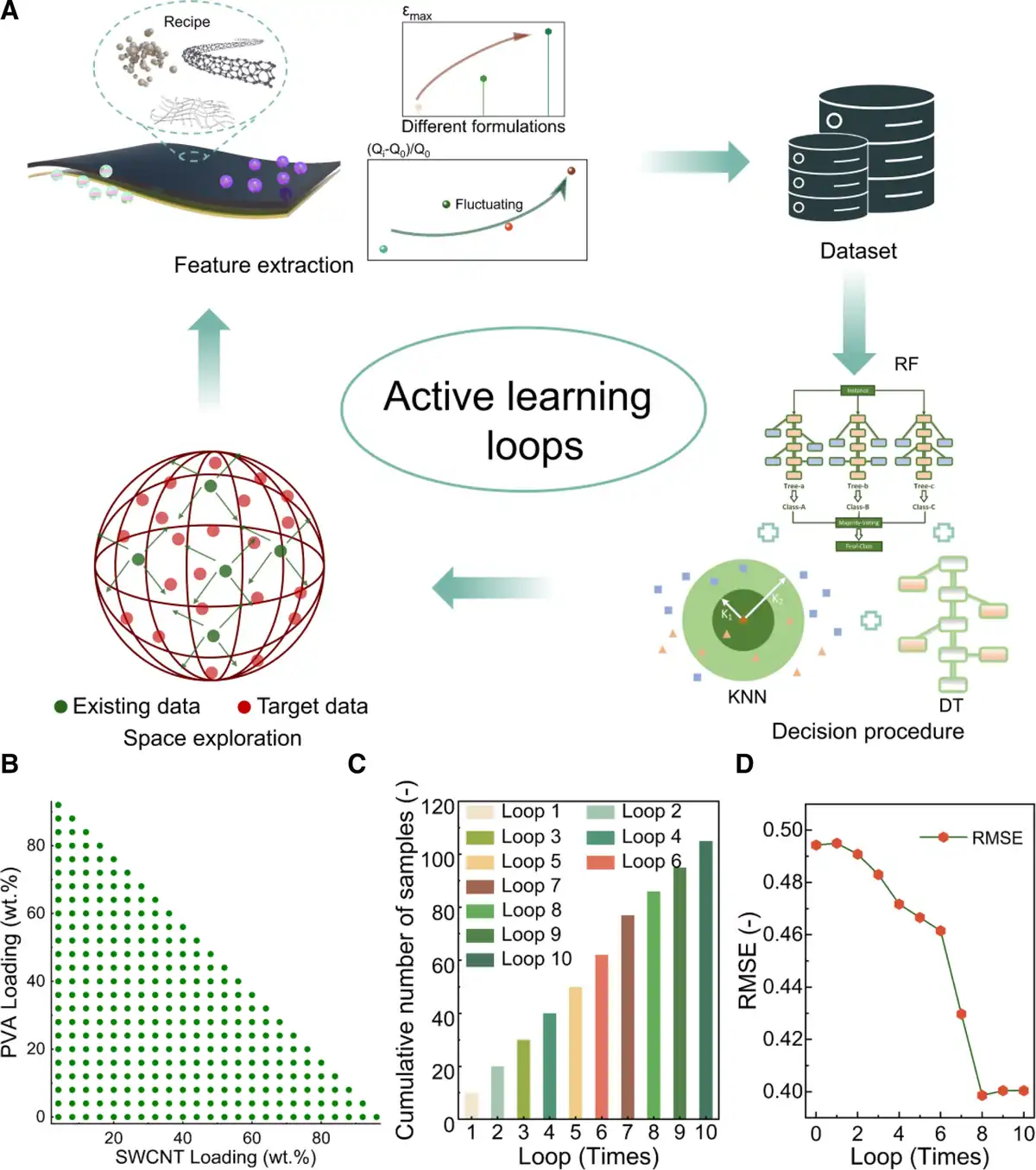
Figure 3.
Spatial exploration process of sample design based on active learning. (A) The automatic material synthesis model is constructed through an active learning loop, including feature extraction (recipe, charge-change, and maximum tensile strain), data set construction, decision program construction (3 nonlinear algorithms RF, KNN, and DT), and data search. (B) Map of 300 different sample fabrication recipes, where the step of PVA and SWCNT loading change is set to 4%. (C) Cumulative number of samples manufactured in each active learning loop phase. (D) The trend of RMSE value changes during the active learning loop optimization process. (-) indicates that the parameter is dimensionless.
To explore the design space, we inputted 300 data points into the active learning loop model. The model consists of 3 nonlinear algorithms: DT, KNN, and RF, as detailed in Note S2 for specific model construction. The training set constitutes 80% of the data points, while the remaining 20% comprises the test set, enabling the separate training of the 3 decision programs. Through iterative parameter adjustments, optimal training outcomes were obtained for each decision program. To assess the unfamiliarity level of the active learning model with the design space, the acquisition function based on 3 nonlinear algorithms is defined in equation (5):
where L2 represents the nearest mathematical distance between the current recipe label and the target recipe label and represents the variance of the predicted label from the 3 decision procedures (detailed calculations of A-score are provided in Note S3). By calculating the A-score value for each input data point, we select the candidate with the highest A-score recommended by the active learning loop model. The target data point situated farthest from the current data point is selected, leading to further exploration of the design space.
However, significant uncertainty in the candidate with the highest A-score value is recommended by the model. In order to enhance the model’s effectiveness in training these candidates, we collected the recommended recipes and labels for each loop. Subsequently, we generated novel samples through experiments and assessed the actual labels (∆Q1/Q0, ∆Q2/Q0, and εmax). Then added these data points into the original dataset, constituting a novel dataset for the subsequent active learning loop. The initial loop involved the collection of 10 data points. Following training with this updated dataset, the design space was further explored, and the model calculated the A-score. Similarly, data points recommended by the model with the highest A-score were selected and subjected to experimental testing. By iteratively combining experiments with active learning loops to optimize the dataset, the design space is constantly explored. In the experiment, a total of 10 active learning loops were performed, and 105 samples were collected and tested. Figure 3C shows the cumulative number of samples after each active learning loop, while Supplementary Table 2, http://links.lww.com/MEDMAT/A2 details the sample recipe, charge-change, and maximum tensile strain label for each loop.
In this study, the active learning loop model continually evolves in its exploration of the design space and prediction accuracy. The predictive accuracy of the 3 decision programs was evaluated using the preprepared test set of 60 points. The trained model predicts labels from the test set data, including ∆Q1/Q0, ∆Q2/Q0, and εmax. These predicted labels were then compared with the actual values of the test set data to calculate the RMSE, as defined in methods (refer to Note S4 for detailed instructions). The larger the RMSE, the lower the model prediction accuracy, and vice versa.
Figure 3D illustrates that the RMSE of the initial active learning loop model is relatively high, approximately 0.494. From the second to eighth loop, the increase in sample data enhances familiarity with the design space, leading to a consistent decline in RMSE. By the eighth loop, the RMSE reached approximately 0.398, which decreased by ~19.4% from the initial. After the eighth loop, RMSE basically stabilized at ~0.4. Via 10 loops, RMSE remained stable, and the model could basically predict the piezoelectric properties of PVA, SWCNT, and BaTiO3 nanocomposite materials (Supplementary Figure 4, http://links.lww.com/MEDMAT/A2 also shows the RMSE trends of the three decision procedures in each stage of the 10-round active learning loop). On this basis, we also realize the reverse prediction of the recipe through the label.
3.3 Reverse design based on Bayesian optimization and correlation analysis
The reverse design model is used to formulate the sample fabrication recipe for the user-specified performance, as illustrated in Figure 4A. Initially, the design space and boundaries are established based on 300 initial samples and 105 samples generated through the active learning loop. Subsequently, 3 decision models from the final round of the active learning model are integrated into the optimization objective program. By amalgamating these decision models with performance metrics and search space, we define a loss function using MSE to evaluate the difference between target performance and predicted performance. To minimize the loss function, we employ the EI strategy within the Bayesian optimization algorithm (refer to methods) to explore the optimal combination of features in a given design space.
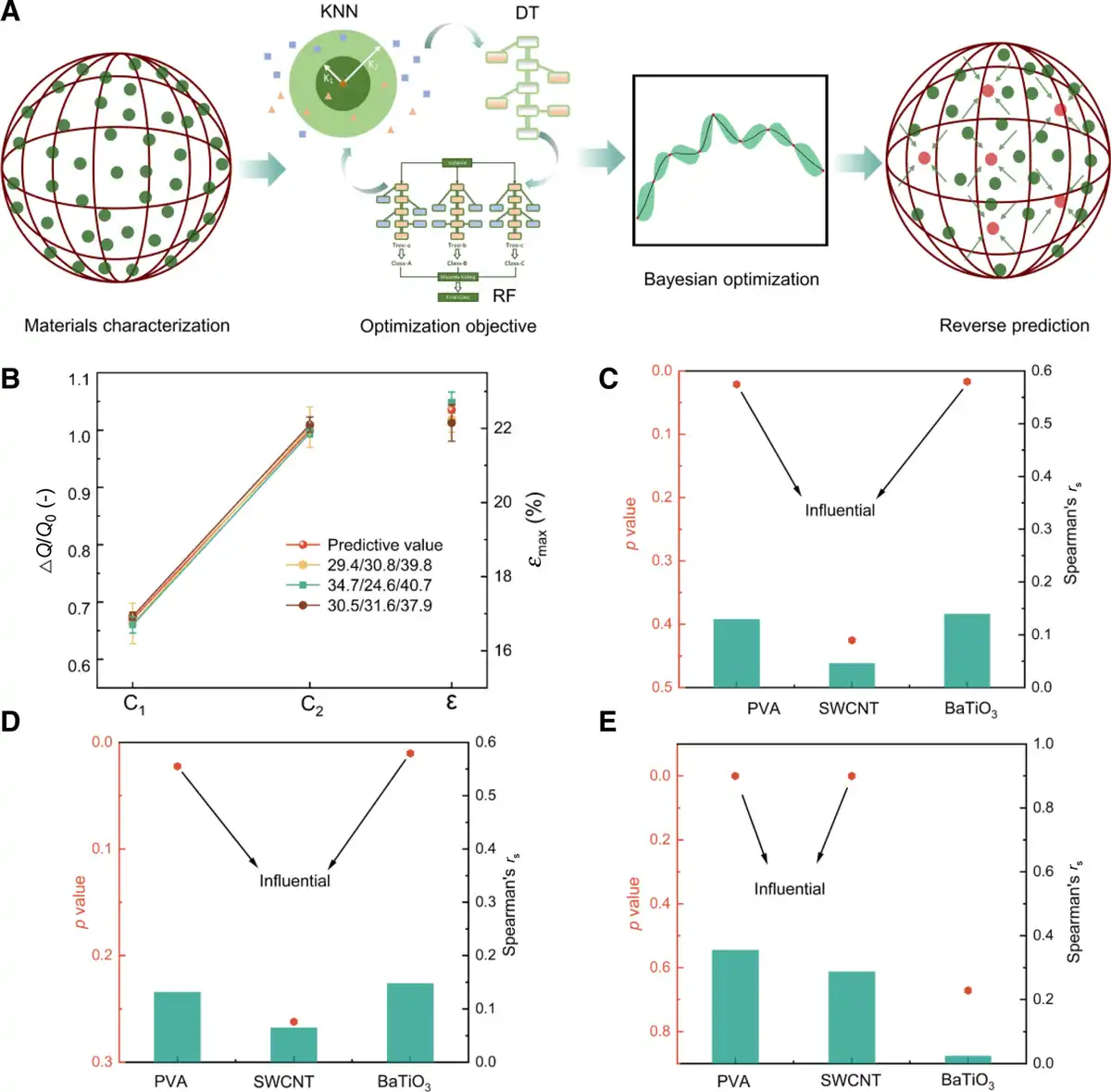
Figure 4.
Reverse design model using Bayesian optimization and statistical analysis. (A) Reverse design flowchart through Bayesian optimization. (B) Comparison between the predicted value and actual value in the final reverse design model. Statistical analysis of the Spearman rank correlation coefficient between the sample recipe loading (PVA loading, SWCNT loading, and BaTiO3 loading) and ∆Q1/Q0, ∆Q2/Q0, and εmax, (C) ∆Q1/Q0, (D) ∆Q2/Q0, and (E) εmax.
Then, we established the performance indicators as ∆Q1/Q0 = 0.67, ∆Q2/Q0 = 1, and εmax = 22.5% for testing the accuracy of the reverse prediction model. We sorted the search results according to the loss function and selected the 3 groups of recipes with the smallest scores as feasible fabrication recipes (Supplementary Table 3, http://links.lww.com/MEDMAT/A2 provides 3 predicted recipes). These recipes were then used to produce samples for performance comparison. As depicted in Figure 4B, the deviation between the predicted recipes’ performance and the actual performance indices is minimal, which indicates that the reverse prediction model is relatively accurate in predicting the charge-change and maximum strain.
In the experiment, samples were fabricated using various material recipes, and peak–peak charge-changes and maximum tensile strain were measured under varying pressures. However, there is a nonlinear relationship between the material recipe and its properties, which cannot be obtained by simple observation. Therefore, in order to reveal this connection and search for reliable rules for material synthesis, Spearman rank correlation coefficient (Spearman rs)[37] and P values[30] are introduced (Spearman rank correlation coefficient and P values are detailed in Note S5).
Here, we examine the correlation between the material recipe and ∆Q1/Q0. As shown in Figure 4C, the Spearman rs corresponding to BaTiO3 and PVA is larger and the corresponding P value is smaller, while the Spearman rs corresponding to SWCNT is smallest and the P value is largest. This indicates that the influence of BaTiO3 and PVA on charge-change is greater than that of SWCNT. Figure 4D shows the correlation between the material recipe and ∆Q2/Q0, and the results are consistent with Figure 4C, which again proves the above conclusion. In addition, we also analyzed the nonlinear correlation between the material recipe and the εmax of the pbs-PE material. As shown in Figure 4E, PVA and SWCNT have almost the same influence on εmax, and the influence is larger, while BaTiO3 has the least effect.
3.4 Health exercise monitoring
Here, the motion sensing of PENG based on the pbs-PE material is discussed. Due to pbs-PE-based PENG demonstrating exceptional mechanical durability and flexibility, these properties render it promising for applications in flexible wearable health motion sensors, particularly those designed for seamless integration onto human joints and motion devices (Figure 5A). In the experiment, we use the reverse prediction model to recommend a feasible recipe (~30%) of the estimated maximum tensile strain. Figure 5B, Supplementary Figure 5, http://links.lww.com/MEDMAT/A2, and Supplementary Movie 1, http://links.lww.com/MEDMAT/A3 show the motion monitoring feedback when the PENG sensor is installed at the joint and bent at 45°. Supplementary Figures 6 and 7, http://links.lww.com/MEDMAT/A2, and Supplementary Movie 2, http://links.lww.com/MEDMAT/A4 show the signal feedback of each joint bending at 90°. Remarkably, distinct electrical signals were observed for different joints bending at the same angle, showing the potential of joint posture monitoring.
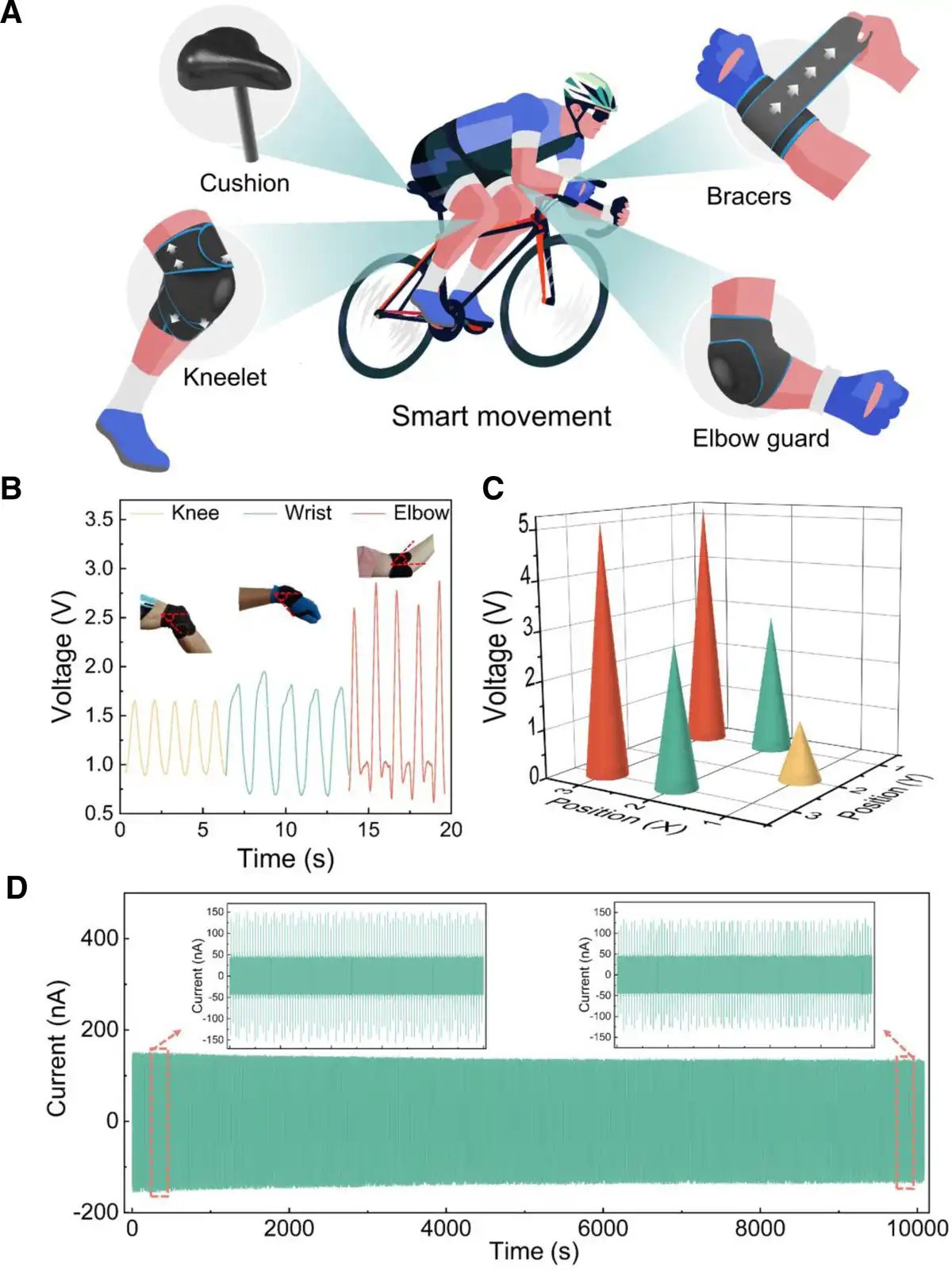
Figure 5.
Application of sensors based on piezoelectric nanogenerators as flexible wearable devices. (A) Smart movement with PENG sensor, attaching to human joints (knees, wrists, elbows, etc.) and sports equipment (such as cushions) for energy collection and sensing. (B) The output voltage of different joints in the human body when bending 45°. (C) The maximum output voltage of the sensor array on the cushion while riding in an upright sitting position. (D) Mechanical durability.
As shown in Supplementary Figure 8, http://links.lww.com/MEDMAT/A2, we also integrated multiple PENG sensors into the bike seat cushion to form an array of piezoelectric sensors. By affixing 5 PENG sensors on the seat cushion, the output signal of each sensor under different riding postures can be monitored in real time. Figure 5C shows the maximum output voltage of each sensor under the upright sitting. Notably, sensor-4 and sensor-5 yielded the highest output (~5.2 V), whereas sensor-1 produced the lowest output (~1.2 V). At the same time, signals from different sitting positions were monitored and analyzed by COMSOL Multiphysics simulation (Supplementary Figures 9–12, http://links.lww.com/MEDMAT/A2 and Supplementary Movie 3, http://links.lww.com/MEDMAT/A5). The results revealed distinctive outputs from various sensors corresponding to different sitting positions. This variance presents a valuable means for real-time movement status monitoring, offering potential applications in guiding cycling and other physical activities for enhanced health.
Finally, we also tested the mechanical durability of PENG sensor, as shown in Figure 5D. After continuous operation for 10,000 s, the sensor still maintains stable output performance, which enables it to be used for long-term monitoring.
4. Conclusions
In summary, we report a composite material synthesis method that combines experiments with ML algorithms. This approach can achieve performance prediction of multiple material composites. We selected 3 typical materials (PVA, SWCNT, and BaTiO3) to produce 300 samples. Through a closed-loop active learning model primarily constructed by nonlinear algorithms (DT, KNN, and RF), the design space is explored and the dataset is optimized. After 10 learning loops, 105 samples were fabricated, with an error reduction of 19.4% compared to the initial test. Additionally, the reverse prediction model based on Bayesian optimization was trained with 405 samples to recommend feasible sample recipes according to the user’s needs. Correlation analysis was used to further investigate the rules of material synthesis, revealing the effects of 3 materials on the performance of the composite piezoelectric material. Finally, the reverse prediction model was used to recommend the sensor recipe suitable for health exercise monitoring, and the real-time monitoring of human joints and exercise equipment was realized. This work is expected to accelerate material synthesis and has great potential in realizing intelligent movement.
Funding
This research was supported by the National Natural Science Foundation of China (No. 52192610) and National Key R & D Project from Minister of Science and Technology (No. 2020YFC2005800).
Conflicts of interests
The authors declare that they have no conflicts of interest.
Data availability
Data will be made available on request.
Author contributions
W.T. initiated and directed the project. E.Z. fabricated the devices. E.Z., T.W., Y.W., F.Z., L.C., and Z.Z. performed measurements and analyzed the data. E.Z., T.W., and W.T. wrote the manuscript. All authors contributed to discussions.
References
- [1] Rus D, Tolley MT. Design, fabrication and control of soft robots. Nature. 2015;521(7553):467–475.
- [2] Cooper CB, Root SE, Michalek L, et al. Autonomous alignment and healing in multilayer soft electronics using immiscible dynamic polymers. Science. 2023;380(6648):935–941.
- [3] Lee Y, Koehler F, Dillon T, et al. Magnetically actuated fiber-based soft robotsarticle; early access. Adv Mater. 2023;2023:e2301916.
- [4] Fischer P, Nelson BJ, Yang GZ. New materials for next-generation robots. Sci Robot. 2018;3:eaau0448.
- [5] Laschi C, Mazzolai B, Cianchetti M. Soft robotics: technologies and systems pushing the boundaries of robot abilities. Sci Robot. 2016;1:eaah3690.
- [6] Sheiko SS, Everhart MH, Dobrynin AV, et al. Encoding tissue mechanics in silicone. Sci Robot. 2018;3:eaat7175.
- [7] Sinar D, Knopf GK. Disposable piezoelectric vibration sensors with PDMS/ZnO transducers on printed graphene-cellulose electrodes. Sens Actuators A. 2020;302:111800.
- [8] Park KI, Jeong CK, Ryu J, et al. Flexible and large-area nanocomposite generators based on lead zirconate titanate particles and carbon nanotubes. Adv Energy Mater. 2013;3(12):1539–1544.
- [9] Yan JH, Han YH, Xia SH, et al. Polymer template synthesis of flexible BaTiO3 crystal nanofibers. Adv Funct Mater. 2019;29(51):1907919.
- [10] Qian YT, Kangg DJ. Poly(dimethylsiloxane)/ZnO nanoflakes/three-dimensional graphene heterostructures for high-performance flexible energy harvesters with simultaneous piezoelectric and triboelectric generation. ACS Appl Mater Interfaces. 2018;10(38):32281–32288.
- [11] Meisak D, Kinka M, Plyushch A, et al. Piezoelectric nanogenerators based on BaTiO3/PDMS composites for high-frequency applications. ACS Omega. 2023;8(15):13911–13919.
- [12] Wang M, Hou XJ, Qian S, et al. An intelligent glove of synergistically enhanced ZnO/PAN-based piezoelectric sensors for diversified human-machine interaction applications. Electronics. 2023;12(8):1782.
- [13] D’Ambrogio G, Zahhaf O, Bordet M, et al. Structuring BaTiO3/PDMS nanocomposite via dielectrophoresis for fractional flow reserve measurement. Adv Eng Mater. 2021;23(10):2100341.
- [14] You YM, Liao WQ, Zhao DW, et al. An organic-inorganic perovskite ferroelectric with large piezoelectric response. Science. 2017;357(6348):306–309.
- [15] Deng W, Zhou Y, Libanori A, et al. Piezoelectric nanogenerators for personalized healthcare. Chem Soc Rev. 2022;51(9):3380–3435.
- [16] Su Y, Li W, Yuan L, et al. Piezoelectric fiber composites with polydopamine interfacial layer for self-powered wearable biomonitoring. Nano Energy. 2021;89:106321.
- [17] Su Y, Chen C, Pan H, et al. Muscle fibers inspired high-performance piezoelectric textiles for wearable physiological monitoring. Adv Funct Mater. 2021;31(19):2010962.
- [18] Libanori A, Chen G, Zhao X, et al. Smart textiles for personalized healthcare. Nat Electron. 2022;5(3):142–156.
- [19] Raccuglia P, Elbert KC, Adler PDF, et al. Machine-learning-assisted materials discovery using failed experiments. Nature. 2016;533(7601):73–76.
- [20] Jiao PC. Emerging artificial intelligence in piezoelectric and triboelectric nanogenerators. Nano Energy. 2021;88(21):106227.
- [21] Lookman T, Balachandran PV, Xue DZ, et al. Active learning in materials science with emphasis on adaptive sampling using uncertainties for targeted design. npj Comput Mater. 2019;5:17.
- [22] Kusne AG, Yu HS, Wu CM, et al. On-the-fly closed-loop materials discovery via Bayesian active learning. Nat Commun. 2020;11(1):5966.
- [23] Wang YQ, Liu XZ, Zheng ZH, et al. Numerical analysis and structural optimization of cylindrical grating-structured triboelectric nanogenerator. Nano Energy. 2021;90:106570.
- [24] Jiao PC, Alavi AH. Artificial intelligence-enabled smart mechanical metamaterials: advent and future trends. Int Mater Rev. 2021;66(6):365–393.
- [25] Jing HR, Guan CH, Yang Y, et al. Machine learning-assisted design of AlN-based high-performance piezoelectric materials. J Mater Chem A. 2023;11(27):14840–14849.
- [26] Muraoka K, Sada Y, Miyazaki D, et al. Linking synthesis and structure descriptors from a large collection of synthetic records of zeolite materials. Nat Commun. 2019;10:4459.
- [27] Schmidt J, Marques MRG, Botti S, et al. Recent advances and applications of machine learning in solid-state materials science. npj Comput Mater. 2019;5:36.
- [28] Bassman L, Rajak P, Kalia RK, et al. Active learning for accelerated design of layered materials. npj Comput Mater. 2018;4:9.
- [29] Williams T, McCullough K, Lauterbach JA. Enabling catalyst discovery through machine learning and high-throughput experimentation. Chem Mat. 2020;32(1):157–165.
- [30] Yang HT, Li JL, Lim KZ, et al. Automatic strain sensor design via active learning and data augmentation for soft machines. Nat Mach Intell. 2022;4(1):84–94.
- [31] Liu YT, Kelley KP, Vasudevan RK, et al. Experimental discovery of structure-property relationships in ferroelectric materials via active learning. Nat Mach Intell. 2022;4(4):341–350.
- [32] Ament S, Amsler M, Sutherland DR, et al. Autonomous materials synthesis via hierarchical active learning of nonequilibrium phase diagrams. Sci Adv. 2021;7(51):eabg4930.
- [33] Epps RW, Bowen MS, Volk AA, et al. Artificial chemist: an autonomous quantum dot synthesis bot. Adv Mater. 2020;32(30):e2001626.
- [34] MacLeod BP, Parlane FGL, Morrissey TD, et al. Self-driving laboratory for accelerated discovery of thin-film materials. Sci Adv. 2020;6(20):eaaz8867.
- [35] Zhang JQ, Tian HR, Wang PX, et al. Improving wheat yield estimates using data augmentation models and remotely sensed biophysical indices within deep neural networks in the Guanzhong Plain, PR China. Comput Electron Agric. 2022;192:13.
- [36] Hansen TM, Stavem K, Rand K. Sample size and model prediction accuracy in EQ-5D-5L valuations studies: expected out-of-sample accuracy based on resampling with different sample sizes and alternative model specifications. MDM Policy Pract. 2022;7(1):23814683221083839.
- [37] Schober P, Boer C, Schwarte LA. Correlation coefficients: appropriate use and interpretation. Anesth Analg. 2018;126(5):1763–1768.
Supplemental Digital Content
This article is available under Open Access.
© 2024 The Authors