Bioorthogonal catalysis for antimicrobial therapy
Authors
Aarohi Gupta, William Ndugire, Liang Liu, Soham Chakraborty, Maged Abdelaziz, Derek Rainboth, Vincent M. Rotello*
MedMat · 2024 · Vol. 1 · No. 1 · pp. 2-5
Translations
Long abstracts in additional languages. The English article is the version of record.
中文zh-Hans
生物正交化学利用不干扰自然生物过程的非天然反应,而催化剂的引入使得在复杂生命系统中控制这些反应成为可能。该新兴领域已整合到前药激活、蛋白质转化等多种合成生化反应中。然而,传统抗生素在治疗细菌生物膜和胞内病原体等挑战性感染时往往因无法穿透屏障或浓度不足而失效。随着抗菌耐药性的迅速蔓延及新药研发管道的匮乏,开发新型策略迫在眉睫。本文旨在综述利用生物正交催化在感染部位原位生成高浓度抗菌药物这一前沿策略,以解决抗生素渗透性差和耐药性问题。
该策略的核心在于将催化剂封装于纳米材料支架中,通过非天然反应实现前药激活或分子偶联。主要机制包括去笼化反应(由过渡金属催化剂TMC介导)和耦合反应(如铜催化的叠氮 - 炔环加成CuAAC)。为解决TMC在生理介质中的疏水性和失活问题,研究设计了阳离子聚合物纳米酶(polyzymes),利用其正电荷增强对带负电生物膜的穿透力。此外,还开发了负载催化剂的红细胞载体及甘露糖修饰的金纳米颗粒,分别用于靶向细菌毒素诱导的溶血释放和巨噬细胞表面的CD206受体摄取,从而实现药物在感染位点的精准定位与原位生成。
研究证实,阳离子聚合物纳米酶能有效穿透大肠杆菌或铜绿假单胞菌生物膜并激活莫西沙星或环丙沙星前药,且对成纤维细胞表现出优异的生物相容性。利用红细胞作为载体时,负载的铁卟啉催化剂可被细菌毒素特异性裂解,选择性杀灭金黄色葡萄球菌和大肠杆菌生物膜而不引起免疫反应。在胞内感染治疗中,甘露糖修饰的纳米颗粒通过CD206受体进入巨噬细胞,原位生成环丙沙星有效清除沙门氏菌,且未对肠道有益菌群产生毒性。这些发现表明该策略能显著提高抗生素局部浓度并减少脱靶效应。
生物正交催化为应对耐药性和难治性感染提供了极具潜力的解决方案,其核心优势在于将药物工厂直接部署于感染部位,克服了传统药物的渗透障碍和全身毒性局限。尽管目前展示了在体外及动物模型中的有效性,但过渡金属催化剂的长期体内稳定性、纳米载体的规模化制备以及临床转化路径仍需进一步验证。未来的工作应聚焦于优化光控或近红外激活系统以提高时空分辨率,并探索更多种类的生物正交反应体系以扩大抗菌谱。该领域的发展有望为抗生素耐药性危机提供新的化学工具和治疗范式。
Françaisfr
La chimie bioorthogonale utilise des réactions abiotiques qui n'interfèrent pas avec les processus biologiques naturels, et l'intégration de catalyseurs permet le contrôle localisé de ces réactions au sein de systèmes vivants complexes. Ce domaine émergent a été appliqué à la prodrogue activation, la transformation protéique et l'ingénierie cellulaire. Cependant, les antibiotiques traditionnels échouent souvent face aux infections persistantes comme les biofilms bactériens ou les pathogènes intracellulaires en raison d'une pénétration insuffisante et de concentrations locales inadéquates. Face à la propagation alarmante des résistances antimicrobiennes et au manque de nouveaux antibiotiques, cette approche offre une solution potentielle pour générer in situ des agents thérapeutiques actifs directement sur le site infecté.
L'approche repose sur l'utilisation de catalyseurs encapsulés dans des échafaudages nanomatériaux pour activer les prodrogues via deux mécanismes principaux : la réaction d'élimination (caging) par un catalyseur métallique à transition (TMC) et les réactions de couplage comme l'azoture-alcyne cycloaddition (CuAAC). Pour surmonter l'inactivité des TMC en milieu physiologique, des polymères cationiques chargés positivement ont été conçus pour pénétrer la couche négative des biofilms. Des stratégies avancées incluent le greffage de nanoparticules d'or contenant du fer sur les globules rouges (RBC) pour une libération déclenchée par les toxines bactériennes, et l'utilisation de nanocatalyseurs fonctionnalisés au mannose ciblant spécifiquement les récepteurs CD206 des macrophages infectés.
Les résultats démontrent que ces polyzymes chargées positivement activent efficacement la moxifloxacine ou la ciprofloxacine protégée par un groupe aryl-azide au sein de biofilms d'Escherichia coli et Pseudomonas aeruginosa, tout en montrant une faible toxicité pour les cellules fibroblastes NIH/3T3. L'utilisation des globules rouges comme véhicules permet l'éradication sélective des biofilms sans réponse immunitaire significative, tandis que la stratégie de ciblage du mannose dans les macrophages génère localement assez d'antibiotique pour tuer Salmonella intracellulaire sans affecter les bactéries intestinales bénéfiques comme Lactobacillus. Ces données confirment la capacité des catalyseurs bioorthogonaux à agir comme usines de médicaments ciblées, minimisant ainsi les effets hors cible.
Cette stratégie représente une avancée majeure pour contourner les barrières physiques et biologiques qui limitent l'efficacité des antibiotiques classiques contre les infections récalcitrantes. Bien que prometteuse, la traduction clinique nécessite encore d'améliorer la stabilité à long terme des catalyseurs métalliques dans le corps humain et de valider leur sécurité sur une plus grande échelle avant essais cliniques. Les travaux futurs devront explorer l'optimisation des systèmes activés par lumière infrarouge proche pour un meilleur contrôle temporel, ainsi que l'élargissement du spectre d'action à travers la découverte de nouvelles paires réactives bioorthogonales compatibles avec divers environnements pathologiques. L'intégration continue de ces outils chimiques pourrait révolutionner le traitement des infections résistantes aux médicaments.
Españoles
La química bioortogonal utiliza reacciones abióticas que no interfieren con los procesos biológicos naturales, y la incorporación de catalizadores permite controlar estas reacciones dentro de sistemas vivos complejos para generar moléculas bioactivas localizadas. Este campo emergente se ha integrado en diversas aplicaciones como la activación de profármacos y la ingeniería celular. Sin embargo, los antibióticos tradicionales fallan frecuentemente contra infecciones desafiantes como las biopelículas bacterianas o patógenos intracelulares debido a su incapacidad para penetrar barreras físicas en concentraciones suficientes. Ante el alarmante aumento de la resistencia antimicrobiana y la escasez de nuevos antibióticos, esta estrategia ofrece una solución potencial mediante la generación in situ de agentes terapéuticos directamente en el sitio de infección.
El enfoque se basa en encapsular catalizadores metálicos de transición (TMC) dentro de andamios nanomateriales para activar profármacos mediante reacciones de desenmascaramiento o acoplamiento, como la cicloadición azida-alquino (CuAAC). Para superar la hidrofobicidad y desactivación de los TMC en medios fisiológicos, se diseñaron polímeros catiónicos cargados positivamente que facilitan la penetración en biopelículas con carga negativa. Estrategias avanzadas incluyen el uso de glóbulos rojos (RBC) como vehículos para liberar catalizadores sensibles a toxinas bacterianas y nanopartículas funcionalizadas con manosa dirigidas específicamente a los receptores CD206 en macrófagos infectados, logrando así una acumulación selectiva del fármaco.
Los hallazgos demuestran que estos nanocatalizadores poliméricos activan eficientemente moxifloxacina o ciprofloxacina protegidas por grupos aril-azida dentro de biopelículas de Escherichia coli y Pseudomonas aeruginosa, mostrando excelente biocompatibilidad con células fibroblásticas NIH/3T3. El uso de glóbulos rojos permite la erradicación selectiva de biofilms sin respuesta inmune significativa, mientras que el sistema dirigido a macrófagos genera localmente suficiente ciprofloxacina para eliminar Salmonella intracelular sin afectar bacterias intestinales beneficiosas como Lactobacillus. Estos resultados confirman la capacidad de los catalizadores bioortogonales para actuar como fábricas de medicamentos dirigidas, minimizando efectos fuera del objetivo.
Esta estrategia representa una solución prometedora para superar las limitaciones físicas y biológicas que restringen la eficacia de los antibióticos convencionales contra infecciones recalcitrantes. Aunque ha demostrado éxito en modelos experimentales, su traducción clínica requiere validar la estabilidad a largo plazo de los catalizadores metálicos in vivo y optimizar procesos de fabricación escalables. El trabajo futuro debe centrarse en mejorar sistemas activados por luz infrarroja cercana para un control temporal preciso y explorar nuevas parejas reactivas bioortogonales para ampliar el espectro antibacteriano, consolidando así esta tecnología como una herramienta química vital frente a la crisis global de resistencia antimicrobiana.
日本語ja
生体直交化学は、自然な生物学的過程に干渉しない非天然反応を利用する技術であり、触媒の導入により複雑な生命システム内でこれらの反応を局所的に制御し、活性分子を生産することが可能になります。この分野は前薬活性化やタンパク質変換などに応用されていますが、従来の抗生物質は細菌バイオフィルムや細胞内病原体に対する治療において、十分な濃度で膜や層を透過できないという課題を抱えています。抗菌耐性の急速な拡大と新規薬剤開発の不足により、感染部位での局所的かつ継続的な抗菌薬生成を目指す生体直交触媒戦略が新たな解決策として注目されています。
本アプローチは、遷移金属触媒(TMC)をナノ材料スケールに封入し、脱カゴ反応やカップリング反応を通じて前薬を活性化するものです。生理環境での不溶性と失活を防ぐため、陽イオン性ポリマーを用いた「ポライザム」が設計され、負電荷を持つバイオフィルムへの浸透性を高めています。さらに、細菌毒素による溶血を利用した赤血球(RBC)キャリアや、マクロファージ表面のCD206受容体を標的とするマンノース修飾金ナノ粒子の開発が進められています。これらはそれぞれ感染部位での選択的な薬剤放出と細胞内への取り込みを可能にし、局所的な抗菌薬生成を実現します。
研究により、陽イオン性ポライザムが大腸菌や銅緑假単胞菌のバイオフィルム内でアジル基保護されたモキシフロキサシンやシプロフロキサシンを効率的に活性化し、線維芽細胞に対する毒性が極めて低いことが確認されました。赤血球キャリアを用いた場合、細菌毒素によって特異的に分解され、非病原性菌株やマクロファージへの影響なくバイオフィルムを除去できます。また、マンノース標的化により感染したマクロファージ内に選択的に取り込まれた触媒がシプロフロキサシンを生成し、細胞内サルモネラ菌を殺菌すると同時に腸管の有益な乳酸桿菌には無害であることが示されました。
生体直交催化は、難治性感染に対する抗生物質の浸透性と耐性という二重の課題に対処する有望な解決策を提供しますが、臨床応用に向けて触媒の体内長期安定性の確認やナノキャリアの大規模製造プロセスの確立が必要です。将来的には、近赤外光による制御システムの最適化により時間・空間分解能を高め、より多様な生体直交反応系を開発して抗菌スペクトラムを広げる研究が求められます。この分野は既存抗生物質の有効利用と新規治療法の開発において重要な役割を果たし、薬剤耐性危機に対する新たな化学的ツールとして期待されています。
العربيةar
تستخدم الكيمياء الحيوية غير المتداخلة تفاعلات لا تتداخل مع العمليات البيولوجية الطبيعية، ويوفر استخدام المحفزات القدرة على التحكم في التفاعلات غير الأصلية داخل الأنظمة الحية المعقدة، مما يتيح توليد محلي للجزيئات النشطة بيولوجيًا. وقد تم دمج هذا المجال الناشئ في مجموعة واسعة من التطبيقات بما في ذلك تنشيط الأدوية الأولية وتحويل البروتينات. ومع ذلك، فإن المضادات الحيوية التقليدية غالبًا ما تفشل في علاج الالتهابات الصعبة مثل الأغشية الحيوية البكتيرية والعدوى داخل الخلايا بسبب عدم قدرتها على اختراق الحواجز بتركيزات كافية. وفي ظل الانتشار المقلق لمقاومة مضادات الميكروبات ونقص الأدوية الجديدة، تقدم استراتيجية التحفيز الحيوي غير المتداخل حلاً محتملاً من خلال التوليد في الموقع للعوامل العلاجية مباشرة عند موقع العدوى.
يعتمد هذا النهج على تغليف المحفزات المعدنية الانتقالية (TMC) داخل هياكل نانوية لتفعيل الأدوية الأولية عبر تفاعلات إزالة الحماية أو الاقتران مثل إضافة حلقة الآزويد-الألكين. ولتجاوز مشكلة عدم ذوبانية وفقدان نشاط هذه المحفزات في الوسط الفسيولوجي، تم تصميم بوليمرات موجبة الشحنة لتعزيز اختراق الأغشية الحيوية سالبة الشحنة. وتشمل الاستراتيجيات المتقدمة استخدام خلايا الدم الحمراء كوسيلة لنقل المحفزات التي يتم تحريرها استجابة لسموم البكتيريا، واستخدام جسيمات نانوية ذهبية مغطاة بالمانوز لاستهداف مستقبلات CD206 على سطح البلاعم المصابة، مما يضمن تراكمًا انتقائيًا للدواء في موقع الإصابة.
أظهرت النتائج أن هذه المحفزات النانوية البوليمرية تنشط بفعالية أدوية مثل موكسيفلوكساسين وسيبروفلوكساسين محمية بمجموعات الآزويد الأريلية داخل الأغشية الحيوية، مع إظهار توافق حيوي ممتاز مع الخلايا الليفية. كما سمح استخدام خلايا الدم الحمراء بالتخلص الانتقائي من الأغشية الحيوية دون استجابة مناعية كبيرة، بينما مكّن النظام الموجه للبلاعم من توليد سيبروفلوكساسين محليًا لقتل السالمونيلا داخل الخلايا دون الإضرار بالبكتيريا المعوية المفيدة. وتؤكد هذه النتائج قدرة المحفزات الحيوية غير المتداخلة على العمل كمصانع أدوية موجهة تقلل الآثار الجانبية خارج الهدف.
تمثل هذه الاستراتيجية حلاً واعدًا للتغلب على العقبات الفيزيائية والبيولوجية التي تحد من فعالية المضادات الحيوية التقليدية ضد الالتهابات المستعصية. ورغم نجاحها في النماذج التجريبية، فإن التطبيق السريري يتطلب التحقق من الاستقرار طويل الأمد للمحفزات المعدنية داخل الجسم البشري وتحسين عمليات التصنيع على نطاق واسع. يجب أن تركز الأعمال المستقبلية على تحسين أنظمة التنشيط بالضوء تحت الأحمر للتحكم الدقيق زمنيًا ومكانيًا، واستكشاف أزواج تفاعلية جديدة لتوسيع الطيف المضاد للبكتيريا، مما يعزز من دور هذه التقنية كأداة كيميائية حيوية في مواجهة أزمة مقاومة الأدوية عالميًا.
Full Text
1. Introduction
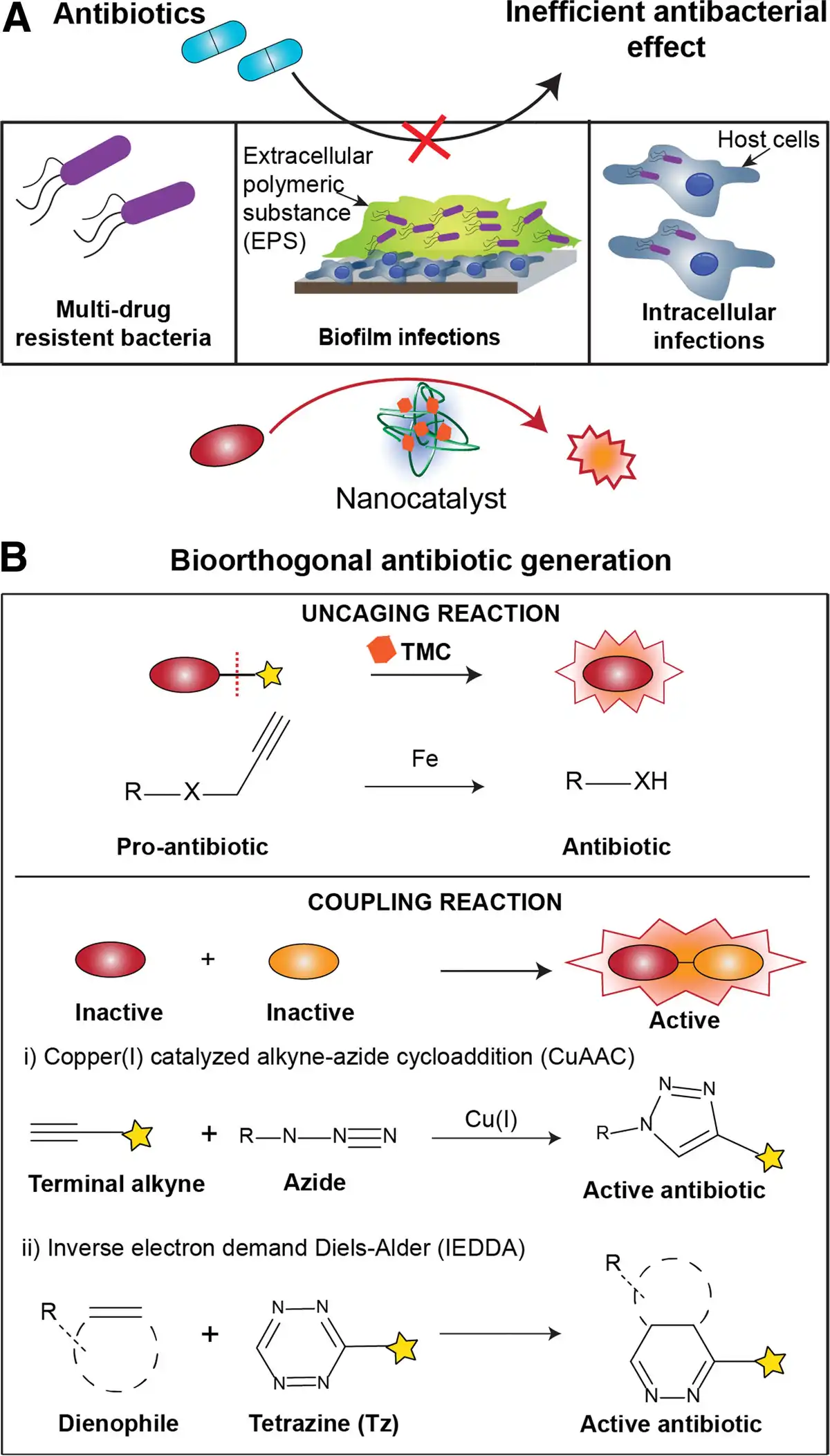
Bioorthogonal chemistry uses abiotic reactions that do not interfere with natural biological processes.[1] The use of catalysts in bioorthogonal chemistry offers the ability to control nonnative reactions inside complex living systems, enabling localized generation of bioactive molecules. This emerging field of bioorthogonal catalysis has been integrated into a wide range of synthetic biochemical reactions, including prodrug activation, protein transformation, and cellular engineering. In antibacterial applications, bioorthogonal catalysis enables the positioning of these catalytic reactions within close proximity of microbes to allow continual production of antimicrobials at high local concentrations. This strategy is both effective and timely in addressing increasingly challenging infections such as bacterial biofilms and intracellular pathogens (Figure 1).[1] Traditional antibiotics fare poorly in these therapies as they often fail to penetrate biofilms and cell membranes at sufficient concentrations necessary to kill microbes.[2,3] The alarming spread of antimicrobial resistance to antibiotics has also significantly reduced their efficacy toward recalcitrant infections.[4] Additionally, a lack of novel antibiotics in the discovery pipeline worsens the ongoing crisis. Consequently, recent developments in bioorthogonal catalytic activation of antibiotic prodrugs provide a potential solution to both resistance development and access to bacteria (Figure 1). These catalytic reactions also offer chemical tools for utilizing existing antibiotics more effectively by increasing their production at infection sites.
Figure 1.
Bioorthogonal antibiotic generation as an alternative to antimicrobial therapy. (A) Traditional antibiotics are inefficient for challenging bacterial infections. (B) Bioorthogonal strategies for in situ antibiotic generation.
2. Discussion
Bioorthogonal reactions applied in antimicrobial therapy can be broadly categorized into uncaging reactions and coupling reactions (Figure 1).[1] Uncaging reactions involve the removal of a cleavable group by a transition metal catalyst (TMC) (Figure 1B). A protecting group, such as aryl azide, conjugated to antibiotics results in pro-antibiotics that are stable and biologically inert to minimize side effects.[4–5–6] The caged molecule can then be reactivated by TMC-mediated cleavage at the site of infection. However, the direct use of TMCs in uncaging reactions is challenging as they tend to be hydrophobic and are deactivated in physiological media.[1] Encapsulation of TMCs within nanomaterial scaffolds separates the catalyst from the biological environment limiting these effects. As the interface between the catalyst and the biological systems, the nanomaterial platform provides a tool for tuning these interactions to maximize antibiotic efficacy.
A common strategy in targeting bacterial biofilms with TMC-encapsulating platforms is to design nanomaterials with positive charges to enhance penetration.[5] Bacterial biofilms represent crucial targets for bioorthogonal therapeutics, as their development leads to persistent infections on wounds and medical devices. A major hurdle in treating biofilms is the impenetrable extracellular polymeric substance layer that shields the bacterial cells within and prevents the entry of antimicrobial agents. Lipopolysaccharides and excretion of genetic material confer an overall negative charge to the surface of biofilms. Gupta et al. utilized a quaternary ammonium polymer with hydrophobic side chains as carriers for 5,10,15,20-tetraphenyl-21H,23H-porphine (TPP)-containing complex, [Fe(TPP)]Cl for better penetration into Escherichia coli or Pseudomonas aeruginosa biofilms (Figure 2A). The TMCs were readily stabilized by the hydrophobic environment and the cationic charge facilitated the penetration into biofilms. These polymer nanocatalysts (polyzymes) were utilized to uncage aryl-azide carbamate-protected moxifloxacin or ciprofloxacin within biofilms showing efficient drug activation. The polyzymes also demonstrated excellent biocompatibility, showing minimal toxicity against NIH/3T3 fibroblast cells. This selectivity toward pathogens relative to host is essential for the use of this strategy in the clinic.
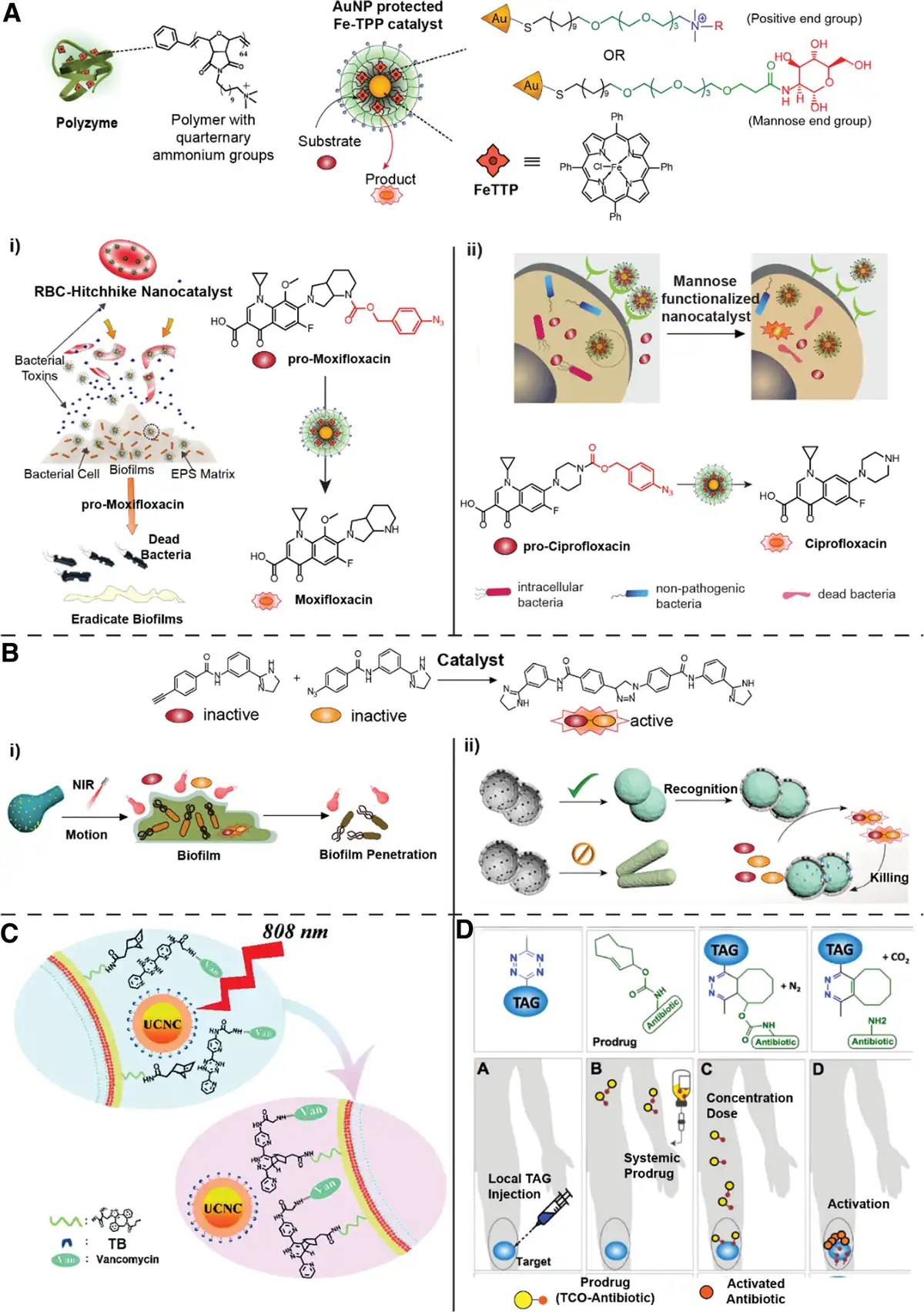
Figure 2.
Bioorthogonal approaches to treat challenging infections. (A) Use of either functionalized polymers or gold nanoparticles for protected transition metal catalyst-based antibiotic generation. (i) Selective targeting of biofilm infections with nanocatalysts hitchhiked on red blood cells. Adapted from Gupta et al.[6] with permission from the Royal Society of Chemistry. (ii) Eradication of intracellular infections in macrophages through targeting of CD206 receptors with mannose-presenting nanocatalysts. Adapted from Hardie et al.[7] with permission from the Royal Society of Chemistry. (B) CuAAC-based coupling of alkyne-azide precursors. (i) Near-IR activation of molecular motors embedded with Cu catalysts for biofilm penetration and CuAAC activity. Adapted with permission from Liu et al.[8] Copyright 2022 American Chemical Society. (ii) Bacteria morphology selective bioorthogonal catalysts for strain-selective killing through CuAAC activation. Adapted with permission from Niu et al.[9] Copyright 2021 American Chemical Society. (C) Near-IR-controlled conjugation of vancomycin to methicillin-resistant S aureus peptidoglycans through inverse electron-demand Diels−Alder using Nd3+ upconversion nanocrystals. Reproduced from Du et al.[10] with permission from the Royal Society of Chemistry. (D) Tetrazine-modified alginate gel for in situ activation of trans-cyclooctene-modified vancomycin and daptomycin prodrugs. Adapted from Czuban et al.[11] under the terms of the CC-BY Creative Commons Attribution 4.0 International License (https://creativecommons.org/licenses/by/4.0/).
Another strategy for biofilm-selective bioorthogonal accumulation of antibiotics was designed by Gupta et al.[6] using red blood cells (RBCs) as the delivery vehicle for Fe catalysts (Figure 2Ai). RBCs provide a natural mode of targeted cargo release at biofilms because they are hemolyzed by bacterial toxins, which are abundant in bacterial biofilms. Additionally, RBCs are biocompatible, possess low immunogenicity and long circulation times in vivo. To load the catalysts onto RBCs, [Fe(TPP)]Cl was first encapsulated within the monolayer of positively charged ~2 nm gold nanoparticles (AuNPs), which were then attached onto negatively charged erythrocytes. The RBC nanocatalysts could selectively activate pro-moxifloxacin to successfully eradicate E coli and Staphylococcus aureus biofilms over nonvirulent bacterial strains and macrophages. The hitchhiked [FeTPP]Cl on RBCs were nonimmunogenic as measured by tumor necrosis factor alpha cytokine expression in RAW 264.7 macrophage cells, an important consideration for nanoparticles (NPs) in nanomedicine. Another area where traditional antibiotics are ineffective is in the treatment of intracellular infections.[2] The challenge arises from their poor penetration into host cell membranes and susceptibility to enzymatic degradation in the cytosol. Certain bacteria such as Salmonella exploit these flaws to hide from antibiotics and immune cells by dwelling within phagocytes, for example, macrophages. To tackle this problem with bioorthogonal catalysis, Hardie et al.[7] reported a mannose-targeting strategy directed toward macrophages infected with Salmonella (Figure 2Aii). [Fe(TPP)]Cl catalysts were encapsulated in AuNPs functionalized with d-mannose ligands. These nanocatalysts were selectively uptaken by macrophages through interaction with mannose-binding CD206 receptors. By this enhanced accumulation, the internalized nanocatalysts allowed sufficient generation of ciprofloxacin in macrophages that killed the intracellular bacteria. The local generation of the broad-spectrum ciprofloxacin within macrophages was not toxic to beneficial gut bacteria such as Lactobacillus, unlike the direct application of the antibiotic, demonstrating the capability of targeted bioorthogonal catalysts as drug factories, minimizing off-target effects of therapeutics.
The other bioorthogonal antimicrobial approach utilizes coupling reactions where 2 nontoxic substrates react to generate antimicrobial activity (Figure 1B). The classic click coupling reaction Cu-catalyzed azide-alkyne cycloaddition (CuAAC) was used by Niu et al.[8,9] to construct a 1,4-triazole antimicrobial in situ from inactive azide and alkyne precursors (Figure 2B). Based on this chemistry, they proceeded to tackle 2 hurdles that face antibacterial therapy: (1) biofilm penetration (Figure 2Bi) and (2) strain selectivity in bacteria-killing (Figure 2Bii). To penetrate biofilm and perform CuAAC, they fabricated carbonaceous calabash-shaped nanomaterials implanted with copper (CNC-Cu) that were capable of molecular motion.[8] CNC-Cu have a gourd-like morphology that permits forward locomotion as heated water is expelled from their cavity under near-IR (NIR) irradiation. With continual motion, the CNC-Cu can be propelled into biofilms from where local generation of antibiotics can be achieved. The nanocatalysts were successfully used to clear E coli biofilms in a mouse implant-related periprosthetic infection model. The successful wound healing in an in vivo murine model demonstrates the translatability of TMC-mediated bioorthogonal catalysis in biofilm treatment.
To achieve strain-selective antibacterial treatment, Niu et al.[9] developed shape-selective bioorthogonal catalysts that could select between different bacterial strains based on cell morphology. To do this, the group deposited layers of Cu and SiO2 onto S aureus and E coli, then etched away the organic material to recover the empty bacterial-templated shells. These antibody structures could preferentially bind to bacteria of the same shape providing a method for delivery of the Cu catalyst selectively. With Cu-mediated antimicrobial activation, spherical S aureus could be selectively killed over rod-shaped E coli bacteria and vice versa.
The inverse electron-demand Diels−Alder (IEDDA) reaction between tetrazines and a strained dienophile is a bioorthogonal coupling reaction that does not require a TMC—a potential source of cytotoxicity (Figure 1Bii). Du et al.[10] utilized this reaction to target vancomycin to methicillin-resistant S aureus (MRSA) (Figure 2C). Vancomycin is a last resort antibiotic that kills MRSA by complexing with the peptidoglycan of the cell wall leading to cell lysis. However, vancomycin-resistant MRSA strains have restructured cell walls that prevent binding with the antibiotic. Du and coworkers modified MRSA peptidoglycans with norbornene to allow IEDDA coupling with tetrazine-derivatized vancomycin (Van-Tz) thereby increasing local antibiotic concentration. To control the reaction, the group developed Van-dHTz, an unreactive precursor that requires oxidization to IEDDA-reactive Van-Tz. This oxidation was achieved using Nd3+-based upconversion nanocrystals coated with toluidine blue O (TB-UCNC). When excited by 808 nm NIR light, TB-UCNC catalyzes the oxidation of Van-dHTz to Van-Tz, which can then conjugate with the norbornene-tagged peptidoglycan. Further testing of this strategy with other Gram-positive bacteria (B subtilis, E faecalis, and E faecium) showed a general trend of 6- to 7-fold drop in Minimum inhibitory concentration (MIC) over vancomycin.
Czuban et al.[11] reported the use of a bioorthogonal IEDDA strategy using trans-cyclooctene (TCO) as the strained dienophile (Figure 2D). In their approach, an alginate gel with tetrazine-modification (TAG) was injected at the site of infection, and a TCO-modified vancomycin or daptomycin prodrug was administered intravenously. When the prodrug encounters the TAG, it reacts via IEDDA chemistry and then isomerizes to release the active drug at the infection site. The prodrug approach avoids issues facing the systemic administration of antibiotics especially in treatments of antibiotic-resistant bacterial strains in biofilm-infected implants. In these therapies, high dosages are needed that can cause significant off-target effects, including the destruction of commensal gut bacteria. The TAG activation of TCO-vancomycin could successfully eliminate bioluminescent MRSA, injected into the thighs of neutropenic mice, by 3 orders of magnitude compared to unmodified alginate gel. While IEDDA chemistry is fast and selective, providing a biocompatible approach for generating antimicrobials bioorthogonally, the requirement of 2 substrates and their mutual accessibility should be considered for sufficient antimicrobial production.
3. Conclusion
The rising rates of antimicrobial resistance have placed great stress on the traditional antibiotic pipeline. As newer drugs develop resistance, it is imperative to develop strategies that reduce resistance generation and increase the efficiency of current therapies. Bioorthogonal catalysis promises a timely intervention in this vein through controlled activation of inactive prodrugs. A common approach to achieve this selectivity is by localizing the catalyst close to the site of bacterial infection. Nanomaterial scaffolds have proved invaluable in this process, allowing targeting of planktonic bacteria, intracellular infections, and biofilms. Nanomaterials also provide the ability to modulate the catalytic activity of TMCs using exogenous agents such as pH, light, and temperature. As such, the progress of bioorthogonal catalysis in antimicrobial applications goes hand in hand with the advancement of new nanomaterials that will enhance both the stability and specificity of catalysts operating within biological settings.
The toxicity of metal catalysts is a significant challenge that faces the translation of bioorthogonal catalysis to clinical application. However, NP-protected TMCs showed minimal mammalian cytotoxicity and hemolytic activity in all studies, suggesting that TMC toxicity can be reduced using NPs. Another approach to mitigate toxicity is the formulation of TMCs with biodegradable carriers and the use of less toxic TMCs, such as naturally occurring Fe catalysts, for example, hemin. Alternatively, the development of catalyst-free reactions such as IEDDA can obviate the need for TMCs.
There is still a significant knowledge gap between TMC administration and the subsequent fate of catalysts intracellularly and systemically, and their long-term effects, issues that need to be addressed in ongoing research. Nonetheless, as highlighted in this perspective, the bioorthogonal approach to addressing persistent and resistant infections is rapidly progressing. Advanced imaging techniques could be employed to monitor the distribution and activity of these catalysts in real time, offering more comprehensive insights into their behavior within living organisms. Reports of successfully treated infections in vivo that the next step—translating to higher mammals and human trials—is a challenging but achievable goal.
Conflicts of interests
The authors declare that they have no conflicts of interest.
Funding
This research was funded by the National Institutes of Health grants EB022641 and AI134770 (Vincent M. Rotello). William Ndugire was funded by EB022641-S.
References
- [1] Fedeli S, Im J, Gopalakrishnan S, et al. Nanomaterial-based bioorthogonal nanozymes for biological applications. Chem Soc Rev. 2021;50(24):13467–13480.
- [2] Ciofu O, Moser C, Jensen PO, et al. Tolerance and resistance of microbial biofilms. Nat Rev Microbiol 2022;20(10):621–635.
- [3] Kamaruzzaman NF, Kendall S, Good L. Targeting the hard to reach: challenges and novel strategies in the treatment of intracellular bacterial infections. Br J Pharmacol. 2017;174(14):2225–2236.
- [4] Brooks BD, Brooks AE. Therapeutic strategies to combat antibiotic resistance. Adv Drug Deliv Rev. 2014;78:14–27.
- [5] Huang R, Li CH, Cao-Milán R, et al. Polymer-based bioorthogonal nanocatalysts for the treatment of bacterial biofilms. J Am Chem Soc. 2020;142:10723–10729.
- [6] Gupta A, Das R, Makabenta JM, et al. Erythrocyte-mediated delivery of bioorthogonal nanozymes for selective targeting of bacterial infections. Mater Horiz. 2021;8:3424–3431.
- [7] Hardie J, Makabenta JM, Gupta A, et al. Selective treatment of intracellular bacterial infections using host cell-targeted bioorthogonal nanozymes. Mater Horiz. 2022;9(5):1489–1494.
- [8] Liu C, Niu J, Cui T, et al. A motor-based carbonaceous nanocalabash catalyst for deep-layered bioorthogonal chemistry. J Am Chem Soc. 2022;144(42):19611–19618.
- [9] Niu J, Wang L, Cui T, et al. antibody mimics as bio-orthogonal catalysts for highly selective bacterial recognition and antimicrobial therapy. ACS Nano. 2021;15(10):15841–15849.
- [10] Du Q, Wu X, Bi W, et al. Increasing antibiotic activity by rapid bioorthogonal conjugation of drug to resistant bacteria using an upconverted light-activated photocatalyst. J Mater Chem B. 2021;9(14):3136–3142.
- [11] Czuban M, Srinivasan S, Yee NA, et al. Bio-orthogonal chemistry and reloadable biomaterial enable local activation of antibiotic Prodrugs and enhance treatments against Staphylococcus aureus infections. ACS Cent Sci. 2018;4(12):1624–1632.
This article is available under Open Access.
© 2024 The Authors