ECM hybrid scaffolds decipher the dual code of organ aging
Authors
Wenzhen Yin, Jinmei Diao, Qingru Song, Juan Liu*
- aClinical Translational Science Center, School of Clinical Medicine, Tsinghua Medicine, Beijing Tsinghua Changgung Hospital, Tsinghua University, Beijing, China
- bHepato-Pancreato-Biliary Center, Key Laboratory of Digital Intelligence Hepatology, Ministry of Education, School of Clinical Medicine, Tsinghua Medicine, Beijing Tsinghua Changgung Hospital, Tsinghua University, Beijing, China.
* Correspondence: Address: Juan Liu, Hepato-Pancreato-Biliary Center, Key Laboratory of Digital Intelligence Hepatology, Ministry of Education, School of Clinical Medicine, Tsinghua Medicine, Beijing Tsinghua Changgung Hospital, Tsinghua University, No. 168 Litsang Road, Changping District, Beijing 102218, China. Email: lja02720@btch.edu.cn (J. Liu).
MedMat · 2025 · Vol. 2 · No. 3 · pp. 133-136
Translations
Long abstracts in additional languages. The English article is the version of record.
中文zh-Hans
器官衰老是一个系统性生物学过程,表现为各器官系统功能的协调性下降,是心血管疾病及神经退行性疾病、代谢综合征和免疫衰老等年龄相关共病的基础。当前研究正从描述性观察转向机制驱动的治疗策略,旨在通过重编程老化组织微环境而非单纯细胞替代来恢复功能稳态。关键共识将细胞外基质(ECM)重塑列为第13个衰老标志物,强调其作为动态信号实体与结构框架的双重角色,但传统模型无法复现老化的生化-机械耦合效应,导致对退化级联反应的理解存在局限。
为突破这一瓶颈,新加坡国立大学团队开发了DECIPHER(脱细胞ECM偶联合成水凝胶)支架系统。该材料通过三步法制备:首先利用甲醛功能化丙烯酰胺溶液渗透组织切片并在紫外线下交联以维持结构;其次采用优化的去氧胆酸钠/DNase处理,在去除细胞成分的同时保留95.8%以上的胶原和糖胺聚糖及原生纤维架构;最后实现正交刚度调节。该系统成功构建了生理相关的刚度水平(年轻组约10 kPa,老化组约40 kPa),同时保持配体呈现不变,且扫描电镜证实了胶原纤维形态与天然组织高度一致。
研究发现,DECIPHER平台揭示了生化信号对机械信号的调控作用:年轻的ECM生物活性配体能覆盖高刚度带来的促衰老信号。在模拟老化环境的高刚度条件下,年轻CFs(心肌成纤维细胞)表现出显著抑制的α-SMA表达和应力纤维形成,YAP核转位被阻断从而维持静息状态;反之,老化的ECM底物无论机械环境如何均激活成纤维细胞衰老。转录组分析显示,957个差异表达基因受基质刚度或ECM成分驱动,其中Lox、Mmp2和Col12a1的表达模式证实了生化与力学信号的协同作用在驱动退化级联中的核心地位。
该研究确立了ECM作为多尺度衰老标志物中心调节器的新范式,阐明了老化心肌中LOX介导的胶原交联及糖胺聚糖脱硫酸化等具体机制如何导致纤维化和功能衰竭。尽管DECIPHER平台在解析年龄特异性生化线索与机械刺激协同作用方面取得突破,但其在体内长期稳定性及复杂病理模型中的普适性仍需验证。未来工作将聚焦于开发能同时阻断纤维化硬化循环并激活内源性再生通路的响应型基质,以推动从基础机制向靶向干预的临床转化。
Françaisfr
Le vieillissement organique constitue un processus biologique systémique caractérisé par une déclin fonctionnel coordonné, sous-tendant les pathologies cardiovasculaires et exacerbant des comorbidités liées à l'âge telles que la neurodégénérescence et le syndrome métabolique. Le domaine évolue vers des stratégies thérapeutiques axées sur les mécanismes visant à restaurer l'homéostasie par le reprogrammation du microenvironnement tissulaire, reconnaissant désormais la matrice extracellulaire (ECM) comme une entité de signalisation dynamique et non plus un échafaudage statique. Cependant, les modèles conventionnels ne peuvent pas reproduire le couplage biochimico-mécanique spécifique à l'âge, limitant ainsi notre compréhension des cascades dégénératives initiées par la rigidification pathologique (>15 kPa) et les altérations de séquestration des facteurs de croissance.
Pour surmonter ces défis, une équipe du National University of Singapore a conçu le scaffold DECIPHER (hydrogel couplé à l'ECM décellularisé), intégrant des hydrogels polyacrylamide avec un tissu cardiaque. La fabrication en trois étapes inclut : infiltration d'une solution d'acrylamide fonctionnalisée au formaldéhyde suivie de réticulation UV pour prévenir l'effondrement structural ; traitement par désoxycholate de sodium/DNase conservant plus de 95,8 % du collagène et des glycosaminoglycanes tout en préservant l'architecture native ; et enfin un réglage orthogonal de la rigidité atteignant environ 10 kPa pour les conditions jeunes ou 40 kPa pour les conditions âgées. La microstructure confirmée par microscopie électronique à balayage montre une morphologie des fibres de collagène fidèle au tissu natif.
Les résultats principaux démontrent que la plateforme DECIPHER révèle un phénomène où les ligands biochimiques du ECM jeune dominent le signal de rigidité élevée. Les fibroblastes cardiaques (CFs) jeunes cultivés sur des substrats ECM jeunes montrent une expression d'α-SMA et une formation de fibres de stress significativement supprimées, même sous haute rigidité simulant l'environnement âgé, avec un blocage de la translocation nucléaire de YAP maintenant les cellules en état quiescent. À l'inverse, le substrat ECM âgé active la sénescence des CFs indépendamment du milieu mécanique. L'analyse transcriptomique identifie 957 gènes différentiellement exprimés pilotés par la rigidité ou la composition de l'ECM, confirmant que les axes mécano-biochimiques régulent directement la prolifération et la sénescence.
Cette étude établit un nouveau paradigme en identifiant le remodelage de l'ECM comme une caractéristique centrale du vieillissement multiscale, expliquant comment des altérations biochimiques synergisent avec la dégradation micromécanique pour déclencher une cascade d'injury auto-entretenue menant à la fibrose et à la dysfonction ventriculaire. Bien que le DECIPHER comble les lacunes de connaissance sur l'interplay entre signaux spécifiques à l'âge, des défis subsistent concernant le développement de matrices sensibles aux stimuli capables de stopper simultanément le cycle de rigidification fibrotique et d'activer les voies régénératives endogènes. Les travaux futurs devront valider ces mécanismes dans des modèles in vivo complexes pour développer des interventions ciblées contre la dégénérescence liée à l'âge.
Españoles
El envejecimiento orgánico representa un proceso biológico sistémico caracterizado por el declive funcional coordinado de diversos sistemas, subyaciendo a patologías cardiovasculares y exacerbando comorbilidades relacionadas con la edad como trastornos neurodegenerativos y síndrome metabólico. El campo está transitando hacia estrategias terapéuticas impulsadas por mecanismos que buscan restaurar la homeostasis mediante el reprogramamiento del microambiente tisular, reconociendo ahora a la matriz extracelular (ECM) no solo como un andamio estructural sino como una entidad de señalización dinámica. Sin embargo, los modelos convencionales no pueden replicar el acoplamiento bioquímico-mecánico en la ECM envejecida, limitando el estudio de fenómenos críticos como la rigidez patológica (>15 kPa) y las alteraciones en la secuestración de factores de crecimiento mediadas por proteoglicanos.
Para abordar estos desafíos, un equipo del National University of Singapore desarrolló el andamio DECIPHER (hidrogel acoplado a ECM descelularizada), integrando hidrogeles de poliacrilamida con tejido cardíaco mediante un proceso en tres pasos. Primero, una solución de acrilamida funcionalizada con formaldehído se infiltra y forma enlaces covalentes durante el entrecruzamiento UV para prevenir el colapso estructural. Segundo, un tratamiento optimizado con desoxicolato de sodio/DNase preserva más del 95.8% del colágeno y los glicosaminoglicanos manteniendo la arquitectura nativa de las fibras. Tercero, se logra una sintonización ortogonal de rigidez alcanzando niveles fisiológicamente relevantes (aproximadamente 10 kPa para condiciones jóvenes o 40 kPa para envejecidas) sin alterar la presentación de ligandos.
Los hallazgos principales revelan que los ligandos bioquímicos del ECM joven anulan las señales de alta rigidez. Los fibroblastos cardíacos (CFs) jóvenes cultivados sobre sustratos de ECM joven muestran una expresión significativamente suprimida de α-SMA y formación reducida de fibras de estrés, incluso bajo condiciones de alta rigidez que simulan el entorno envejecido; la translocación nuclear de YAP se bloquea manteniendo a las células en estado quiescente. Por el contrario, los sustratos de ECM envejecida activan la senescencia de CFs independientemente del ambiente mecánico. El análisis genómico muestra que 957 genes diferencialmente expresados están impulsados por la rigidez o composición de la ECM, confirmando que ejes mecano-bioquímicos regulan directamente programas celulares como proliferación y senescencia.
Este estudio establece un nuevo paradigma al identificar el remodelado de la ECM como un regulador central de los signos del envejecimiento multiescala, explicando cómo las alteraciones bioquímicas sinérgicamente interactúan con la degradación micromecánica para desencadenar una cascada de daño auto-perpetuante que conduce a fibrosis intersticial y disfunción ventricular irreversible. Aunque el DECIPHER supera limitaciones en cuantificar la interacción entre señales específicas de edad, persisten desafíos bioingenieriles en desarrollar matrices sensibles a estímulos que detengan simultáneamente el ciclo de endurecimiento fibrótico y reactiven vías regenerativas endógenas. El trabajo futuro se centrará en validar estos mecanismos in vivo para diseñar intervenciones dirigidas contra la degeneración relacionada con la edad.
日本語ja
臓器老化は、心血管疾患や神経変性障害、代謝症候群などの年齢関連合併症の基盤となる全身的生物プロセスであり、機能協調性の低下が特徴です。現在の研究動向は記述的観察からメカニズム駆動型治療戦略へ移行し、細胞置換だけでなく老化組織微小環境のリプログラミングによる機能恒常性回復を目指しています。ECM(細胞外マトリックス)の再構築が第13の老化徴候として認識され、その動的なシグナル伝達機能が注目されていますが、従来のモデルでは加齢に伴う生化学的・機械的な結合を再現できず、特にLOX介在のコラーゲン架橋やグリコサミノグリカンの脱硫酸化などによる自己増幅性の損傷カスケードの解明に限界がありました。
この課題に対処するため、シンガポール国立大学のチームはDECIPHER(脱細胞ECM結合合成水ゲル)スキャフォールドを開発しました。これはポリアクリアミド水ゲルと脱細胞化心臓組織を3段階のプロセスで統合したものです。まずホルムアルデヒト機能化アクリルアミド溶液が組織切片に浸透し、UV架橋により共結合して構造崩壊を防ぎます。次に最適化したデオキシコール酸塩/DNase処理により、コラーゲンとグリコサミノグリカンの95.8%以上を保持しつつ原生繊維アーキテクチャを維持します。最後に直交する剛性調整を行い、若年条件で約10 kPa、老化条件で約40 kPaの生理学的な剛性を配体提示を変えずに達成し、走査型電子顕微鏡によりコラーゲン繊維形態が天然組織と一致していることを確認しました。
主要な知見として、DECIPHERプラットフォームは若年ECMの生化学的リガンドが高剛性シグナルを上書きすることを明らかにしました。老化心臓環境を模擬する高剛性条件下でも、若年CFs(線維芽細胞)ではα-SMA発現とストレス繊維形成が顕著に抑制され、YAP核移行がブロックされて静息状態が維持されます。一方、老化ECM基質は機械的環境に関わらずCFの衰老を活性化します。957個の異なる遺伝子発現変動(DEGs)が基質剛性またはECM組成によって駆動されており、Lox、Mmp2、Col12a1などの遺伝子発現パターンが生化学的・力学的シグナルの相乗作用が退化カスケードを駆動する中心的役割を果たすことを裏付けています。
本研究は多規模老化徴候におけるECMの中核調節機能を確立し、加齢心筋での線維化と不可逆的な収縮・拡張機能不全に至るメカニズムを解明しました。DECIPHERプラットフォームは年齢特異的生化学的シグナルと機械的刺激の相乗相互作用を定量化する点で画期的ですが、体内における長期安定性や複雑な病理モデルへの適用可能性にはまだ検証が必要です。今後の課題として、線維化硬化サイクルを同時に停止し内因性の再生経路を再活性化させる刺激応答型マトリックスの開発が求められており、これにより加齢関連変性を緩和する標的介入の実現に向けた道が開かれます。
العربيةar
يمثل شيخوخة الأعضاء عملية بيولوجية جهازية تتسم بانخفاض منسق في الوظائف عبر أنظمة أعضاء مختلفة، وهو ما يستند إليه الأمراض القلبية الوعائية ويزيد من حدة المراضات المرتبطة بالعمر مثل الاضطرابات التنكسية العصبية ومتلازمة الأيض. ينتقل المجال حالياً من الملاحظات الوصفية نحو استراتيجيات علاجية مدفوعة بالآليات تهدف إلى استعادة التوازن الوظيفي ليس فقط عبر استبدال الخلايا بل بإعادة برمجة بيئة النسيج المسنّة، مع الاعتراف بأن إعادة تشكيل المادة خارج الخلية (ECM) هي العلامة الحادية عشرة للشيخوخة. ومع ذلك، لا تستطيع النماذج التقليدية تكرار الاقتران بين الخصائص الكيميائية والميكانيكية في ECM المسنة، مما يحد من فهم الآليات التي تقود سلاسل الضرر التنكسي الناتجة عن التصلب المرضي (>15 كيلو باسكال) وتدهور الألياف.
لمعالجة هذه التحديات، طور فريق من الجامعة الوطنية بسنغافورة منصة DECIPHER (هيدروجيل مقترن بـ ECM منزوع الخلايا)، وهو نظام يدمج هيدروجيلات البولي أكريلاميد مع الأنسجة القلبية عبر عملية مكونة من ثلاث خطوات. أولاً، يتم ترشيح محلول أكريلاميد وظيفي بالفلورالدهايد ليشكل روابط تساهمية أثناء التشابك بالأشعة فوق البنفسجية لمنع الانهيار الهيكلي. ثانياً، يعالج باستخدام صوديوم ديوكسي كولات/DNase المحسن للحفاظ على أكثر من 95.8% من الكولاجين والجليكوزامينوجلايكانات مع الحفاظ على البنية الألياف الأصلية. ثالثاً، يتم تحقيق ضبط متوازي للصلابة لتحقيق مستويات فيزيولوجية ذات صلة (حوالي 10 كيلو باسكال للحالات الشابة أو 40 كيلو باسكال للحالات المسنة) دون تغيير عرض الروابط.
تُظهر النتائج الرئيسية أن المنصة تكشف عن قدرة روابط ECM الشاب على تجاوز إشارات الصلابة العالية. تظهر الخلايا الليفية القلبية (CFs) الشابة المزروعة على ركائز ECM شاب تعبيراً منخفضاً بشكل ملحوظ لـ α-SMA وتشكلاً أقل للألياف الإجهادية، حتى في ظل ظروف صلابة عالية تحاكي البيئة المسنة؛ حيث يتم حظر الانتقال النووي لبروتين YAP مما يحافظ على الخلايا في حالة سكون. بالمقابل، فإن ركائز ECM المسنّة تنشط شيخوخة CFs بغض النظر عن البيئة الميكانيكية. يُظهر التحليل الجيني أن 957 جيناً معبراً بشكل مختلف مدفوعان بصلابة الركيزة أو تكوين ECM، مما يؤكد أن المحاور الكيميائية-الميكانيكية تنظم مباشرة برامج الخلايا مثل التكاثر والشيخوخة.
يُرسخ هذا البحث نموذجاً جديداً يحدد إعادة تشكيل ECM كمنظم مركزي لعلامات الشيخوخة متعددة المقاييس، موضحاً كيف تتفاعل التغييرات البيوكيميائية بشكل تآزري مع التحلل الميكروميكانيكي لتسلسل ضرر ذاتي الاستمرار يؤدي إلى التليف والوظيفة الانقباضية والانبساطية غير القابلة للانعكاس. على الرغم من أن منصة DECIPHER تغلق فجوات معرفية حول التفاعل بين الإشارات المحددة بالعمر والمحفزات الميكانيكية، إلا أن هناك تحديات هندسية في تطوير مصفوفات تستجيب للمنبهات يمكنها إيقاف دورة تصلب التليف وإعادة تنشيط المسارات التجديدية الذاتية. ستعمل الأعمال المستقبلية على التحقق من هذه الآليات في نماذج حيوية معقدة لتطوير تدخلات مستهدفة لتخفيف التنكس المرتبط بالعمر.
Full Text
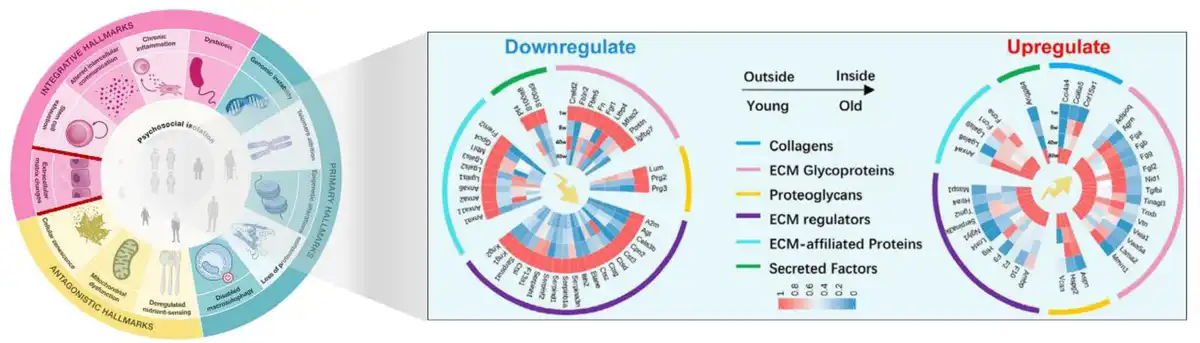
Organ aging represents a systemic biological process, characterized by a coordinated decline in functionality across various organ systems. This process underpins cardiovascular pathologies and exacerbates age-related comorbidities, including neurodegenerative disorders, metabolic syndrome, and immunosenescence. Elucidating the cross-tissue regulatory mechanisms governing this decline is pivotal for advancing human healthspan and devising targeted interventions to mitigate age-related degeneration. Importantly, the field is transitioning from descriptive observations toward mechanism-driven therapeutic strategies. Regenerative approaches now aim to restore organ functional homeostasis not solely via cellular replacement but through reprogramming the aging tissue microenvironment.[1] A pivotal consensus review identified extracellular matrix (ECM) remodeling as the 13th hallmark of aging,[2] acknowledging ECM as a mechanistic contributor to degeneration mediated by dynamic bidirectional signaling, thereby overturning its historical perception as a static scaffold. Moreover, it underscores the ECM’s dual role as both a structural framework and a dynamic signaling entity, whose spatiotemporal evolution determines tissue regenerative competence[3] (Fig. 1).
Beyond serving as a passive scaffold, the ECM functions as a dynamic regulatory hub. It integrates its biochemical composition—such as laminin conformations, elastin-derived matrikines, and glycosaminoglycan sulfation patterns—with mechanical cues (eg, rigidity, viscoelasticity) to orchestrate tissue morphostasis through multiscale interactions.[4] Key mechano-biochemical axes, including integrin–FAK–ERK and Piezo1–Ca²⁺ signaling, directly regulate cellular programs such as proliferation, differentiation, autophagy, and senescence.[5,6] In the aging myocardium, pronounced network dysregulation manifests in pathological stiffening (>15 kPa compared with <5 kPa in youth), primarily driven by lysyl oxidase (LOX)-mediated collagen crosslinking and elastin degradation.[7] Simultaneously, aberrant undersulfation of chondroitin sulfate glycosaminoglycans impairs heparan sulfate proteoglycan-dependent growth factor sequestration, while hyaluronan fragmentation generates proinflammatory damage-associated molecular patterns (DAMPs).[8] These biochemical alterations interact synergistically with micromechanical degradation, triggering a self-perpetuating injury cascade. Crucially, aged ECM persistently activates the integrin α11–DDR2 complex,[9] thereby inducing compensatory cardiomyocyte apoptosis, promoting myofibroblast differentiation, and accelerating excessive collagen deposition. This triad leads to interstitial and perivascular fibrosis, ventricular stiffening, and irreversible systolic and diastolic dysfunction.
Conventional models cannot replicate the biochemical-mechanical coupling in aged ECM, limiting mechanistic studies of cardiac aging.[7] Isolated biochemical analyses lack the physico-structural context required to capture critical phenomena such as fiber tension-regulated integrin clustering or strain-dependent collagen conformational switching. While tunable synthetic hydrogels (eg, polyacrylamide, polyethylene glycol) enable precise control of bulk tissue elasticity, they fail to reproduce native ECM ligand biochemistry—including conformation-specific integrin-binding motifs, MMP-cleavable domains, hypoxia-responsive cryptic peptides, and time-resolved DAMP release kinetics. Consequently, 2 fundamental knowledge gaps persist. First, the synergistic interplay between age-specific biochemical cues and mechanical stimuli remains unquantified, particularly regarding their role in driving degenerative signaling cascades. Second, bioengineering challenges exist in developing stimuli-responsive matrices that concurrently halt the fibrotic stiffening cycle and reactivate endogenous regenerative pathways.
To address these challenges, the DECIPHER (Decellularized ECM-Coupled Synthetic Hydrogel) scaffold developed by the National University of Singapore team represents a paradigm-shifting innovation in material science (Fig. 2A). This system integrates polyacrylamide hydrogels with decellularized cardiac tissue through a 3-step process. First, formaldehyde-functionalized acrylamide solution infiltrates tissue slices and forms covalent bonds with proteins during ultraviolet (UV) crosslinking, preventing structural collapse in subsequent decellularization. Second, an optimized sodium deoxycholate (SDC)/DNase treatment preserves over 95.8% of collagen and glycosaminoglycans while maintaining native fiber architecture. This preservation is confirmed by collagen alignment metrics revealing 23% higher branch-point density in aged ECM. Third, orthogonal stiffness tuning achieves physiologically relevant stiffness levels (approximately 10 kPa for youthful or 40 kPa for aged conditions) without altering ligand presentation (Fig. 2B). The hybrid scaffold preserves over 95.8% of collagen and glycosaminoglycans, with scanning electron microscopy confirming collagen fiber morphology consistent with native tissue (Fig. 2C). Crucially, the interpenetrating hydrogel–ECM network replicates physiological viscoelasticity, overcoming limitations of conventional elastic scaffolds. This platform reveals that young ECM biochemical ligands override high-stiffness signaling. Aged cardiac fibroblasts (CFs) cultured on young ECM substrates exhibit significantly suppressed α-SMA expression and reduced stress fiber formation. This suppression persists even under high-stiffness conditions that simulate aged cardiac environments (Fig. 2D). Concurrently, yes-associated protein (YAP) nuclear translocation is blocked (Fig. 2E), maintaining CFs in a quiescent state. Conversely, aged ECM substrates activate CF senescence regardless of the mechanical environment.
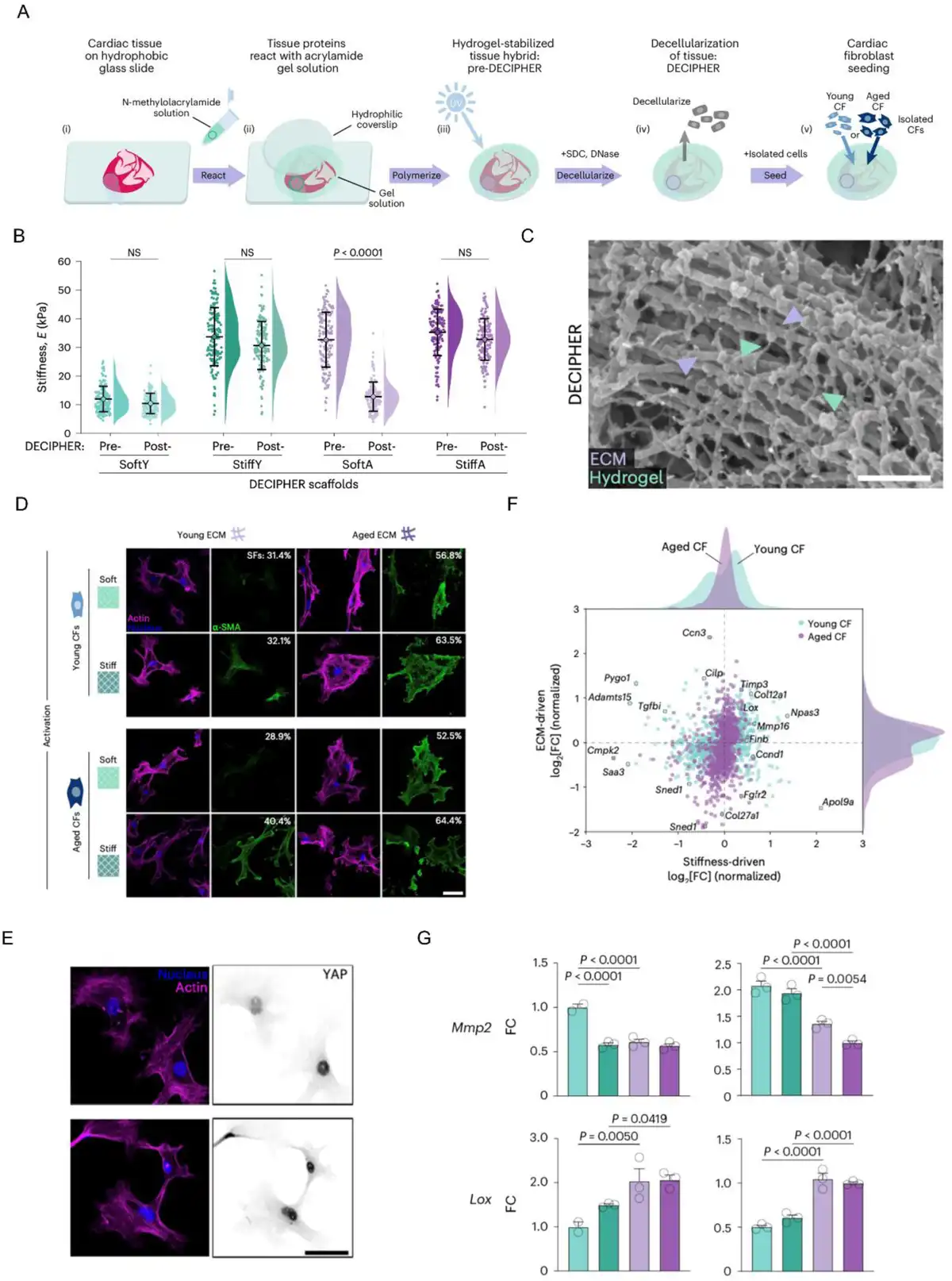
Figure 2.
DECIPHER platform illustrates the biochemical and mechanical hallmarks of cardiac aging. (A) Schematic representation of DECIPHER hydrogel fabrication. (B) Stiffness mapping of DECIPHER samples highlights the tunable mechanical properties of the scaffold. Samples exhibited baseline stiffness (SoftY, StiffA), increased stiffness (StiffY), or decreased stiffness (SoftA) following treatment. (C) Scanning electron microscopy (SEM) images showing the microstructural features of DECIPHER samples. (D) Immunofluorescence images of young CFs cultured on SoftY and StiffY DECIPHER substrates, showing nuclear staining (blue), α-SMA (purple), and cytoskeletal structures (green). (E) Immunofluorescence images of young CFs cultured on SoftY and StiffY DECIPHER substrates, showing nuclear staining (blue), YAP localization (purple), and cytoskeletal structures (green). (F) Scatter plot depicting normalized log2(FC) values of 957 differentially expressed genes (DEGs) in DECIPHER samples, driven by substrate stiffness (x-axis) or ECM composition (y-axis). Data are shown for young (purple) and aged (cyan) CFs, with marginal probability densities illustrating the distribution of stiffness- and ECM-driven genes for each age group. (G) Normalized gene expression (mean ± SEM) of Lox, Mmp2, and Col12a1 across experimental conditions. Adapted with permission from Sun al.[7]
CFs exhibit age-dependent responses to ECM signals. Young CFs demonstrate integrated mechanosensing, characterized by stiffness-induced α5 integrin clustering and ECM age-regulated β3 expression. In stark contrast, aged CFs display mechanosensing impairment. Zyxin—a mechanosensitive actin regulator—requires both aged ECM ligands and high stiffness for significant upregulation. Conversely, LOX-mediated collagen crosslinking increases 3.2-fold exclusively on aged ECM substrates, independent of mechanical stiffness (Fig. 2F). Notably, aged CFs cultured on young ECM exhibit a rejuvenation-like response, marked by downregulation of senescence markers such as p53. Native ECM architecture critically determines functional outcomes. Conventional reconstituted films with fragmented fibers elevate α-SMA expression by 2.3-fold. In contrast, DECIPHER-preserved fibrillar structures suppress pathological CF activation by maintaining ligand spatial orientation, evident in collagen fiber-guided CF migration patterns. Mechanistically, young ECM maintains homeostasis by elevating matrix metalloproteinase (MMP2/3) expression, whereas aged ECM drives collagen crosslinking via increased LOX activity, exacerbating myocardial stiffening (Fig. 2G). These findings challenge the prevailing view that mechanical signals dominate fibrotic progression.
The DECIPHER platform establishes a transformative foundation for targeted regenerative interventions by leveraging its unique capacity to decouple ECM properties. This dynamic decoupling enables precise engineering of therapeutic strategies. Young ECM-derived ligands (eg, laminin α5 peptides) can be formulated into nanotherapeutics to disrupt fibrotic cascades. Separately, targeting senescence receptors such as anti-integrin α11 antibodies or crosslinking enzymes (eg, LOXL2 inhibitor PXS-5505) might reverse pathological collagen crosslinking and activate endogenous repair mechanisms. Innovatively, the platform’s ability to convert native ECM into functional bioink facilitates the construction of patient-specific aging models using autologous fibroblasts. These models enable high-throughput screening of combination therapies (eg, YAP inhibitors + LOXL2 blockers) tailored to individual ECM phenotypes, thereby optimizing anti-fibrotic efficacy. Critically, the mechanistic insights from DECIPHER reveal that ECM biochemical composition dominates over mechanical signaling in driving aging phenotypes. This redefines the ECM as the central orchestrator of senescence pathways, overturning reductionist mechanobiology-centric paradigms and establishing a universal framework for multiorgan rejuvenation. The conserved molecular signatures of ECM stiffening and ligand dysregulation observed across cardiac, hepatic, and renal pathologies enable synchronized multiorgan regeneration through targeting unified pathways such as the integrin β3-STAT3 axis or LOXL2-mediated collagen crosslinking.
Building on this paradigm shift, DECIPHER’s spatiotemporal recombination of ECM properties provides a foundational platform to accelerate regenerative medicine’s transition from passive tissue repair toward active biological age reversal. Future integration with single-cell spatial multiomics will elucidate context-dependent ECM remodeling dynamics across aging trajectories, while the incorporation of photo-responsive hydrogels aims to engineer adaptive microenvironments for precision rejuvenation.[10] Within such next-generation systems, light-triggered release of young ECM peptides is projected to dynamically suppress pathological crosslinking, and patient-derived induced pluripotent stem cell (iPSC)-based aging models are expected to enable high-throughput screening of mechanistically informed combination therapies. This synergistic convergence—spanning material science, multiomics, and synthetic biology—will ultimately decipher the competitive-synergistic dynamics governing ECM-driven aging, unlocking molecular blueprints for scalable organ regeneration.
Collectively, this breakthrough represents a transformative advancement in programmable aging research. By reprogramming the ECM into a modifiable biological framework that is decodable, rewritable, and functionally implementable, this approach deciphers molecular-level blueprints for organ regeneration. This paradigm shift enables precision medicine to evolve from reactive therapeutic correction toward proactive rejuvenation strategies, ultimately advancing healthy aging.
Funding
This work was supported by the National Natural Science Foundation of China (Nos. 82090051and 32371477).
Conflicts of interests
The authors declare that they have no conflicts of interest.
References
- [1] Ma S, Ji Z, Zhang B, et al. Spatial transcriptomic landscape unveils immunoglobin-associated senescence as a hallmark of aging. Cell. 2024;187(24):7025–7044.e34.
- [2] Kroemer G, Maier AB, Cuervo AM, et al. From geroscience to precision geromedicine: understanding and managing aging. Cell. 2025;188(8):2043–2062.
- [3] Liu J, Song Q, Li C, et al. Deciphering age-dependent ECM remodelling in liver: proteomic profiling and its implications for aging and therapeutic targets. Cell Prolif. 2025:e70087.
- [4] Zhang H, Tsui CK, Garcia G, et al. The extracellular matrix integrates mitochondrial homeostasis. Cell. 2024;187(16):4289–4304.e26.
- [5] Liu X, Niu W, Zhao S, et al. Piezo1: the potential new therapeutic target for fibrotic diseases. Prog Biophys Mol Biol. 2023;184:42–49.
- [6] Mai Z, Lin Y, Lin P, et al. Modulating extracellular matrix stiffness: a strategic approach to boost cancer immunotherapy. Cell Death Dis. 2024;15(5):307.
- [7] Sun AR, Ramli MFH, Shen X, et al. Hybrid hydrogel-extracellular matrix scaffolds identify biochemical and mechanical signatures of cardiac ageing [published online ahead of print June 12 , 2025]. Nat Mater.
- [8] Santinha D, Vilaça A, Estronca L, et al. Remodeling of the cardiac extracellular matrix proteome during chronological and pathological aging. Mol Cell Proteomics. 2024;23(1):100706.
- [9] Leitinger B. Discoidin domain receptor functions in physiological and pathological conditions. Int Rev Cell Mol Biol. 2014;310:39–87.
- [10] Bril M, Saberi A, Jorba I, et al. Shape-morphing photoresponsive hydrogels reveal dynamic topographical conditioning of fibroblasts. Adv Sci (Weinh). 2023;10(31):e2303136.
This article is available under Open Access.
© 2025 The Authors