Piezoelectric interfaces pioneering autonomous and personalized diagnostics
Authors
Lisha Hua, Yun Ke, Tong Li, Mingliang Pei, Shuting Zhuang, Ruijun Pan*, Fan Yang*, Steven Wang*
- aDepartment of Mechanical Engineering, City University of Hong Kong, Hong Kong, China
- bDepartment of Anaesthesiology, The University of Hong Kong, Hong Kong, China
- cDepartment of Orthopaedics, Shanghai Key Laboratory for Prevention and Treatment of Bone and Joint Diseases, Shanghai Institute of Traumatology and Orthopaedics, Ruijin Hospital, Shanghai Jiao Tong University School of Medicine, Shanghai, China
- dDepartment of General Surgery, Ruijin Hospital, Shanghai Jiao Tong University School of Medicine, Shanghai, China
- eShanghai Minimally Invasive Surgery Center, Ruijin Hospital, Shanghai Jiao Tong University School of Medicine, Shanghai, China
- fResearch Institute of Frontier Science, Southwest Jiaotong University, Chengdu, Sichuan, China.
* Correspondence: Address: Ruijun Pan, Department of General Surgery, Ruijin Hospital, Shanghai Jiao Tong University School of Medicine, No. 197, Ruijin 2nd Road, Shanghai 200025, China. Email: prj11522@rjh.com.cn (R. Pan); Fan Yang, Department of Orthopaedics, Shanghai Key Laboratory for Prevention and Treatment of Bone and Joint Diseases, Shanghai Institute of Traumatology and Orthopaedics, Ruijin Hospital, Shanghai Jiao Tong University School of Medicine, No. 197, Ruijin 2nd Road, Shanghai 200025, China. Email: yf12498@sjtu.edu.cn (F. Yang); Steven Wang, Department of Mechanical Engineering, City University of Hong Kong, Tat Chee Avenue Kowloon, Hong Kong 999077, China. Email: steven.wang@cityu.edu.hk (S. Wang). Lisha Hua and Yun Ke have contributed equally to this work.
MedMat · 2025 · Vol. 2 · No. 3 · pp. 145-181
Abstract
Piezoelectric interfaces are emerging as powerful tools for autonomous and personalized biomedical diagnostics by enabling real-time sensing and energy harvesting from physiological activities. Among them, piezoelectric nanogenerators (PENG) exemplify the integration of mechanical-to-electrical transduction with wearable and implantable applications, supporting self-powered operation without external power supplies. This review summarizes the fundamental principles of piezoelectricity and the development of representative materials, including inorganic ceramics, organic polymers, and hybrid composites, all tailored for biomedical use. Advances in fabrication strategies such as nanoscale patterning, multilayer assembly, and additive manufacturing have enhanced the flexibility, sensitivity, and biocompatibility of PENG-based systems. These devices have shown significant promise in applications such as cardiovascular and respiratory monitoring, neuromuscular sensing, and wound healing, where continuous and accurate physiological tracking is essential. Despite these advances, challenges remain in improving energy conversion efficiency under low-frequency biological motions, ensuring stable long-term biocompatibility, and integrating energy harvesting with storage and signal processing. Future directions include the incorporation of artificial intelligence for intelligent data analysis and the adoption of sustainable materials to enable next-generation diagnostic tools that are autonomous, eco-friendly, and suitable for precision medicine.
Translations
Long abstracts in additional languages. The English article is the version of record.
中文zh-Hans
压电界面技术正迅速成为自主化和个性化生物医学诊断领域的强大工具,其核心优势在于能够从生理活动中实时采集信号并实现能量收集。当前医疗监测面临的主要挑战是如何在无需外部电源的情况下,实现对心血管、呼吸及神经肌肉活动的连续精准追踪。本文旨在综述压电纳米发电机(PENG)在这一领域的应用前景,探讨其如何将机械能转化为电能以支持可穿戴和植入式设备的自供能运行,从而推动诊断技术向更智能、更个性化的方向发展。
本综述系统梳理了压电效应的基本原理及代表性生物医用材料的发展现状,涵盖无机陶瓷、有机聚合物以及混合复合材料等多种体系。在设计与制造策略方面,纳米级图案化、多层组装和增材制造等先进工艺被重点讨论,这些方法显著提升了基于PENG系统的柔韧性、灵敏度及生物相容性。通过优化材料微观结构与界面设计,研究致力于解决传统刚性器件难以适应人体复杂运动环境的问题,为构建高性能的自供能诊断平台奠定了坚实的材料与结构基础。
综述指出,经过优化的压电接口在心血管监测、呼吸功能评估以及伤口愈合促进等关键应用中展现出巨大潜力。这些设备能够实现对生理信号的连续且准确的追踪,特别是在低频率生物运动产生的微弱机械信号转换方面取得了显著进展。然而,科学解读表明,尽管能量收集效率已有提升,但在应对极低频的生理活动时仍面临转化效率不足的瓶颈;同时,长期植入环境下的稳定性与免疫反应控制仍是当前技术必须直面的核心挑战,这直接影响了设备的临床适用性。
压电界面技术的未来发展方向将聚焦于解决现有局限性并拓展其应用边界。首要任务是进一步提高在低频率生物运动中的能量转换效率,并确保材料在体内长期使用的生物相容性与稳定性。此外,亟需实现能量收集、存储与信号处理的一体化集成。展望未来,引入人工智能进行智能数据分析以及采用可持续环保材料将成为关键趋势,这将推动下一代诊断工具向自主化、生态友好型及精准医疗方向演进,最终满足个性化医疗的迫切需求。
Françaisfr
Les interfaces piézoélectriques émergent comme des outils puissants pour le diagnostic biomédical autonome et personnalisé, permettant la détection en temps réel et la récupération d'énergie à partir des activités physiologiques. Le problème central réside dans la nécessité de surveiller continuellement les fonctions cardiovasculaires, respiratoires et neuromusculaires sans dépendre de sources d'alimentation externes. L'objectif de cette revue est de synthétiser le potentiel des générateurs piézoélectriques (PENG) pour intégrer la transduction mécanique-électrique dans des applications portables et implantables, favorisant ainsi une opération autonome qui soutient les avancées vers une médecine personnalisée.
Cette analyse examine les principes fondamentaux de la piézoélectricité et présente le développement de matériaux représentatifs adaptés à l'usage biomédical, incluant des céramiques inorganiques, des polymères organiques et des composites hybrides. Les stratégies de fabrication avancées telles que le motifage à l'échelle nanométrique, l'assemblage multicouche et la fabrication additive sont détaillées comme étant essentielles pour améliorer la flexibilité, la sensibilité et la biocompatibilité des systèmes basés sur les PENG. Ces approches techniques visent à adapter les dispositifs aux contraintes physiologiques complexes tout en maintenant une intégrité structurelle optimale pour le transfert d'énergie efficace.
Les résultats présentés indiquent que ces interfaces ont démontré un potentiel significatif dans la surveillance cardiovasculaire et respiratoire, ainsi que dans le capteur neuromusculaire et la cicatrisation des plaies. L'interprétation scientifique souligne leur capacité à assurer un suivi physiologique continu et précis, bien qu'il subsiste des défis majeurs concernant l'efficacité de conversion énergétique sous les mouvements biologiques à basse fréquence. La stabilité à long terme de ces dispositifs dans le corps humain reste une préoccupation critique, nécessitant une évaluation rigoureuse pour garantir que la collecte d'énergie ne compromet pas la sécurité biologique du patient.
L'importance de cette technologie réside dans sa capacité à permettre des outils diagnostiques autonomes et écologiques pour la médecine de précision. Les limitations actuelles incluent l'amélioration nécessaire de l'efficacité énergétique lors de mouvements physiologiques lents, ainsi que l'intégration complexe entre la récolte d'énergie, le stockage et le traitement du signal. Les perspectives futures suggèrent l'incorporation de l'intelligence artificielle pour une analyse intelligente des données et l'adoption de matériaux durables. Ces évolutions sont essentielles pour développer les outils diagnostiques de prochaine génération qui répondront aux exigences croissantes d'autonomie, de respect environnemental et de personnalisation thérapeutique.
Españoles
Las interfaces piezoeléctricas están emergiendo como herramientas poderosas para el diagnóstico biomédico autónomo y personalizado, permitiendo la detección en tiempo real y la recolección de energía a partir de actividades fisiológicas. El problema central radica en la necesidad de realizar un seguimiento continuo y preciso de funciones cardiovasculares, respiratorias y neuromusculares sin depender de fuentes de alimentación externas. Este artículo tiene como objetivo resumir el potencial de los generadores piezoeléctricos (PENG) para integrar la transducción mecánico-eléctrica en aplicaciones portátiles e implantables, apoyando así una operación autónoma que impulsa las tecnologías diagnósticas hacia un enfoque más personalizado y eficiente.
La revisión examina sistemáticamente los principios fundamentales de la piezoelectricidad y el desarrollo de materiales representativos adaptados para uso biomédico, incluyendo cerámicas inorgánicas, polímeros orgánicos y compuestos híbridos. Se destacan estrategias avanzadas de fabricación como el patrón a nanoescala, el ensamblaje multicapa y la manufactura aditiva, las cuales han mejorado significativamente la flexibilidad, sensibilidad y biocompatibilidad de los sistemas basados en PENG. Estos enfoques técnicos buscan adaptar los dispositivos a las complejas condiciones fisiológicas mientras mantienen una integridad estructural óptima para garantizar un funcionamiento confiable en entornos corporales dinámicos.
Los hallazgos principales indican que estas interfaces han demostrado un potencial significativo en aplicaciones como la monitorización cardiovascular y respiratoria, el sensor neuromuscular y la curación de heridas. La interpretación científica subraya su capacidad para lograr un seguimiento fisiológico continuo y preciso; sin embargo, se reconoce que persisten desafíos importantes relacionados con la eficiencia de conversión energética bajo movimientos biológicos de baja frecuencia. Además, garantizar una compatibilidad biológica estable a largo plazo sigue siendo una preocupación crítica que afecta directamente la viabilidad clínica de estos dispositivos en entornos in vivo.
La importancia de esta tecnología reside en su capacidad para habilitar herramientas diagnósticas autónomas y ecológicas destinadas a la medicina de precisión. Las limitaciones actuales incluyen la necesidad de mejorar la eficiencia energética durante movimientos fisiológicos lentos, así como integrar eficazmente la recolección de energía con el almacenamiento y el procesamiento de señales. Las direcciones futuras apuntan hacia la incorporación de inteligencia artificial para un análisis inteligente de datos y la adopción de materiales sostenibles. Estos avances son esenciales para desarrollar herramientas diagnósticas de próxima generación que sean autónomas, respetuosas con el medio ambiente y adecuadas para las demandas crecientes de la medicina personalizada.
日本語ja
圧電界面は、生理活動からのリアルタイムセンシングとエネルギー収集を可能にすることで、自律的かつ個別化された生体医学診断の強力なツールとして登場しています。現在の医療モニタリングにおける主要な課題は、外部電源なしで心血管系や呼吸機能、神経筋活動を継続的に正確に追跡することです。本レビューでは、圧電ナノジェネレーター(PENG)が機械的エネルギーを電気的能量に変換し、ウェアラブルおよび埋め込み型アプリケーションにおいて自立動作をサポートする仕組みについて概説します。これにより、外部電源への依存を排除した診断技術の発展と、個別化医療の実現に向けた重要な基盤を提供することを目指しています。
本稿では、圧電性の基本原理と生体医学用途に特化した代表的な材料開発について体系的に整理しました。対象には無機セラミックス、有機ポリマー、およびハイブリッド複合材料が含まれます。製造戦略の進展として、ナノスケールパターニング、多層アセンブル、そして付加製造(3Dプリンティング)などの手法が紹介され、これらがPENGベースシステムの柔軟性、感度、生体適合性を著しく向上させたことが示されています。これらの設計アプローチは、人体の複雑な運動環境に適応しつつ、高いエネルギー変換効率を維持するための材料と構造の最適化に寄与しています。
得られた知見として、心血管・呼吸モニタリング、神経筋センシング、および創傷治癒における継続的かつ正確な生理学的追跡が可能な装置としての有望性が確認されました。しかしながら、科学的解釈においては、低周波数の生物運動下でのエネルギー変換効率の向上や、長期にわたる生体適合性の確保といった課題が残されていることが指摘されています。特に体内埋め込み環境における安定性と免疫反応への影響は、臨床応用に向けた重要な障壁であり、現在の技術が直面している核心的な問題として強調されています。
圧電界面技術の意義は、自律的で環境に優しい次世代診断ツールの開発を通じて精密医療を推進する点にあります。今後の課題としては、低周波生物運動におけるエネルギー変換効率のさらなる向上と、長期使用時の生体適合性の確保が挙げられます。また、エネルギー収集、貯蔵、信号処理の統合も不可欠です。将来的には、人工知能(AI)を用いたインテリジェントなデータ解析や持続可能な材料の採用が進むことが期待され、これにより自律性、環境配慮、および個別化医療に適応した診断技術が実現されるでしょう。
العربيةar
تظهر الواجهات الكهروضغطية كأدوات قوية في مجال التشخيص الطبي الحيوي المستقل والشخصي، حيث تتيح الاستشعار الفوري وجمع الطاقة من الأنشطة الفسيولوجية. تكمن المشكلة الرئيسية في الحاجة إلى تتبع مستمر ودقيق لوظائف القلب والأوعية الدموية والجهاز التنفسي والعضلات العصبية دون الاعتماد على مصادر طاقة خارجية. يهدف هذا المقال النظري إلى تلخيص إمكانات مولدات الكهروضغطية النانوية (PENG) في دمج تحويل الطاقة الميكانيكية إلى كهربائية ضمن التطبيقات القابلة للارتداء والغرس، مما يدعم التشغيل الذاتي ويدفع نحو تطوير أدوات تشخيصية أكثر ذكاءً وتخصيصًا.
يستعرض هذا العمل مبادئ الكهربية الأساسية وتطوير المواد التمثيلية المخصصة للاستخدام الطبي الحيوي، بما في ذلك السيراميك غير العضوي والبوليمرات العضوية والمركبات الهجينة. تركز المناهج على استراتيجيات التصنيع المتقدمة مثل النمذجة النانوية والتجميع متعدد الطبقات والتصنيع الإضافي، والتي حسنت بشكل كبير من مرونة وحساسية وتوافق الأنظمة القائمة على PENG مع الجسم البشري. تهدف هذه التصميمات إلى التغلب على قيود الأجهزة الصلبة التقليدية وضمان كفاءة عالية في نقل الطاقة ضمن البيئات الفسيولوجية المعقدة.
تُظهر النتائج المستخلصة أن هذه الواجهات تمتلك إمكانات كبيرة في تطبيقات مراقبة القلب والأوعية الدموية والجهاز التنفسي، واستشعار العضلات العصبية، وعلاج الجروح. وتؤكد التفسيرات العلمية قدرتها على تتبع الحالة الفسيولوجية بدقة مستمرة؛ ومع ذلك، لا تزال هناك تحديات جوهرية تتعلق بتحسين كفاءة تحويل الطاقة تحت حركات بيولوجية ذات تردد منخفض وضمان توافق حيوي مستقر على المدى الطويل داخل الجسم البشري، مما يؤثر بشكل مباشر على الجدوى السريرية لهذه الأجهزة.
تكمن أهمية هذه التقنية في تمكين أدوات تشخيصية مستقبلية تكون مستقلة وصديقة للبيئة لدعم الطب الدقيق. تشمل القيود الحالية الحاجة إلى رفع كفاءة تحويل الطاقة أثناء الحركات البيولوجية البطيئة، بالإضافة إلى دمج جمع الطاقة مع التخزين ومعالجة الإشارات بشكل فعال. وتوجهات المستقبل تتضمن دمج الذكاء الاصطناعي لتحليل البيانات بذكاء واعتماد مواد مستدامة بيئيًا. هذه التطورات ضرورية لتطوير جيل جديد من أدوات التشخيص التي تلبي متطلبات الطب الشخصي من حيث الاستقلالية، والاستدامة البيئية، والدقة العالية في الرعاية الصحية.
Keywords
Full Text
1. Introduction
The field of biomedical diagnostics is undergoing a paradigm shift driven by the demand for continuous, noninvasive, and real-time health monitoring systems. Traditional diagnostic tools, such as blood tests and imaging techniques, often necessitate bulky equipment, intermittent sampling, and external power sources, thereby limiting their applicability in personalized and remote medicine.[1–2–3] While wearable and implantable devices have emerged as promising alternatives, their dependence on traditional batteries introduces challenges such as the need for frequent replacements, limited lifespan, and environmental concerns.[4–5–6] Given the aging global population and the rise in chronic diseases,[7] there is an urgent need for self-sufficient, miniaturized technologies that can seamlessly integrate with the human body while providing precise, actionable insights.[8,9]
Piezoelectric nanogenerators (PENG) have emerged as a transformative solution to these challenges, leveraging their unique ability to convert ambient mechanical energy—from heartbeats[10] to joint movements[11–12–13]—into electrical energy.[14] Unlike traditional energy sources, PENG requires no external charging, instead converting biomechanical forces into usable energy through advanced piezoelectric materials such as zinc oxide (ZnO) nanowires,[15] polyvinylidene fluoride (PVDF),[16] and biocompatible composites.[17,18] Recent breakthroughs in flexible and stretchable designs enable PENG to conform to dynamic biological tissues, thereby powering sensors that monitor vital signs,[19] biochemical markers, and even cellular-level activity.[20–21–22] For instance, wearable devices integrating PENG can detect arrhythmias by analyzing heart vibrations,[10,23] while implantable variants can monitor blood glucose levels in diabetic patients through vascular pressure fluctuations.[24–25–26] This self-powered capability not only enhances diagnostic accuracy but also eliminates the risks associated with battery leakage or the need for surgical battery replacement.
The integration of PENG with biomedical diagnostics heralds a future of autonomous, patient-centered healthcare. Through synergy with emerging technologies such as artificial intelligence (AI)[27–28–29–30–31] and wireless communications,[32–33–34] PENG-driven systems can facilitate real-time data analysis,[35,36] early disease detection,[10,37–38–39–40] and adaptive therapeutic interventions.[11,41] Furthermore, advances in environmentally friendly materials, such as biodegradable polymers and lead-free piezoelectric materials, align these devices with global sustainable development goals by reducing electronic waste and toxicity.[42–43–44] Despite these promising advancements, several challenges remain. Optimizing energy conversion efficiency, ensuring long-term biocompatibility, and scaling up production for widespread adoption are critical areas that require further research and development. This article delves into the principles of piezoelectric materials and the mechanisms of PENG. It also provides an overview of synthesis strategies for PENG, highlighting their current applications in various fields, including cardiovascular monitoring, respiratory detection, muscle movement analysis, metabolic tracking, neural brain activity, and wound healing. Finally, the article addresses the existing challenges and proposes potential solutions to overcome them, paving the way for the broader implementation of PENG technology in biomedical diagnostics.
2. Fundamental of piezoelectricity
2.1 Piezoelectric effect and mechanism
The piezoelectric effect is a fascinating phenomenon in physics and materials science that describes the ability of certain materials to generate an electric charge when subjected to mechanical stress.[45,46] Discovered by brothers Pierre and Jacques Curie in 1880, this effect has since been widely studied and applied.[47,48] The piezoelectric effect predominantly occurs in materials with noncentrosymmetric crystal structures, such as quartz, lead zirconate titanate (PZT), and PVDF.[49,50] When these materials experience mechanical stress, their crystal lattices deform, leading to a relative displacement of the centers of positive and negative charges, thereby forming electric dipoles.[45,51] This separation of charges generates a potential difference across the material, resulting in a measurable voltage.[15,52] It is important to note that the piezoelectric effect is reversible.[51,53] This means that such materials can also undergo mechanical deformation when an external electric field is applied—a property known as the inverse piezoelectric effect.[54,55] The microscopic mechanism underlying the piezoelectric effect is intimately linked to the crystal structure of the material.[56,57] In noncentrosymmetric crystals, the distribution of positive and negative charges is inherently asymmetric.[58,59] The direct piezoelectric effect is essentially the process of converting mechanical energy into electrical energy. When an external force is applied, the deformation of the lattice further amplifies this asymmetry, and the polarization strength of the crystal is:
where is the piezoelectric constant, the unit is C/N, is the stress, the unit is N/m2.[60,61] This polarization creates an electric field, which can generate an electric current if the material is connected to an external circuit.[62,63] Conversely, when an electric field is applied, the dipoles within the material realign themselves, resulting in mechanical deformation.[62,64] This bidirectional energy conversion capability makes piezoelectric materials highly versatile for a wide range of applications.
The piezoelectric effect has important practical applications across various fields. In sensing and actuation, piezoelectric materials are utilized in devices such as accelerometers,[65–66–67] pressure sensors,[68–69–70] and ultrasonic transducers.[71–72–73–74] In energy harvesting, they are employed in nanogenerators to convert mechanical energy generated by vibrations, footsteps, or other movements into electrical energy.[75,76] Within the medical field, piezoelectric materials play a critical role in ultrasound imaging,[77–78–79] piezoelectric motors,[80–81–82] and implantable devices.[83–84–85] Additionally, they are used in acoustic devices such as speakers,[86,87] microphones,[88,89] and sonar systems.[90,91] The ability to convert mechanical energy into electrical energy and vice versa makes piezoelectric materials indispensable in modern technology. In the realm of biomedical diagnostics, the piezoelectric effect and devices based on piezoelectric materials, such as PENG, have shown remarkable potential. A PENG is a device that can convert mechanical energy (such as vibration, pressure, or movement) into electrical energy.[92] In biomedical applications, PENG can harvest energy from physiological activities of the human body (such as heartbeat, breathing, or blood flow) and convert it into electrical signals.[92,93] This capability allows PENG to develop self-powered medical devices, PENG can be integrated into wearable devices for real-time monitoring of vital signs such as heart rate (HR),[10,37] blood pressure,[29,94] or respiratory rate.[95–96–97] Moreover, PENG can be used in implantable devices to detect abnormalities in organ function.[10,98] The advantages of PENG in biomedical diagnostics lie in their high sensitivity, compact size, and the absence of an external power supply. These features make PENG highly suitable for continuous and noninvasive health monitoring. For example, PENG can harvest energy from the natural movements of the human body,[99] thereby reducing dependence on batteries, extending the life of devices, and improving patient comfort.[11] Additionally, PENG can be combined with other sensing technologies to detect biomarkers[100,101] or environmental parameters,[102] thus supporting early disease diagnosis and personalized treatment.
2.2 Overview of piezoelectric materials
Piezoelectric materials are fascinating substances with unique properties: they can generate an electric charge in response to mechanical stress or, conversely, deform when subjected to an electric field.[62] This dual functionality makes them essential in a variety of scientific, industrial, and technological applications. The Curie brothers first observed the piezoelectric effect in crystals such as quartz in the late 19th century, where mechanical stress leads to the generation of an electric charge.[103,104] Since then, researchers have discovered and synthesized a number of materials with piezoelectric properties, greatly expanding their uses.
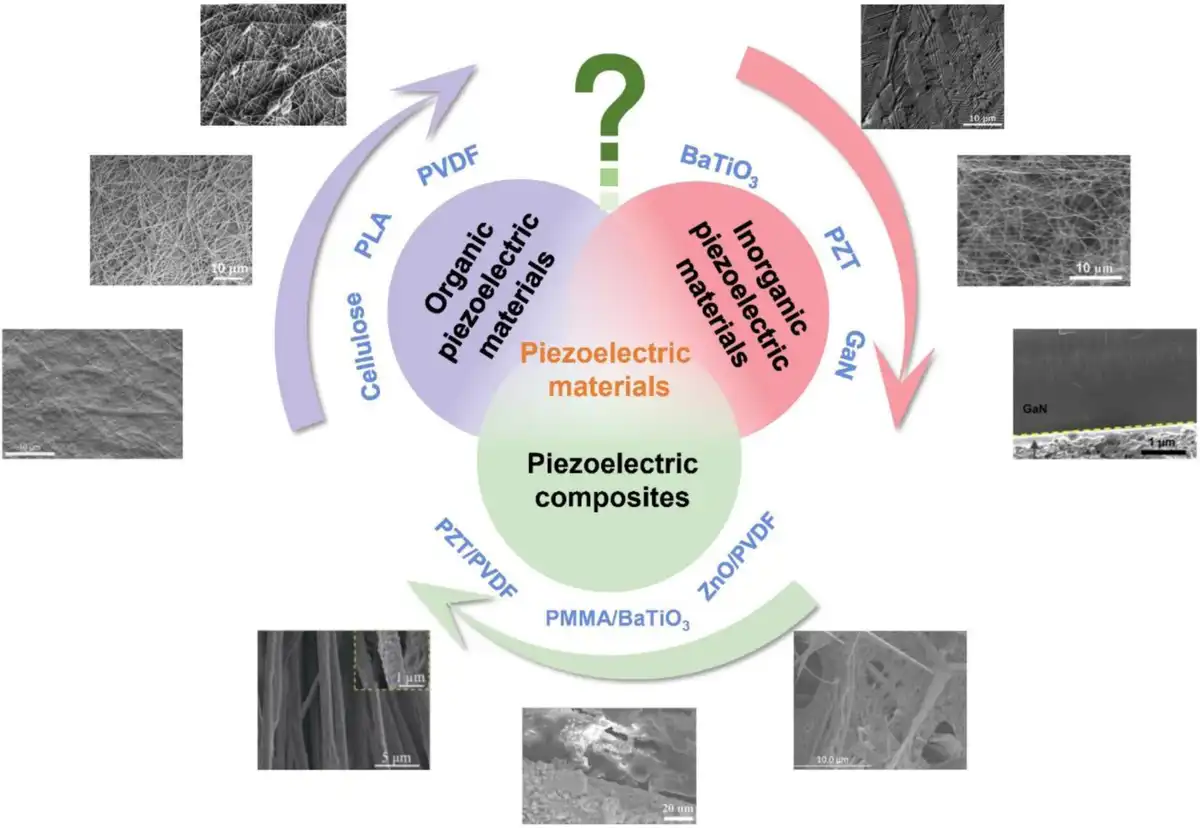
One of the most notable features of piezoelectric materials is their ability to convert mechanical energy into electrical energy and vice versa.[105] This property is used in a wide range of devices, such as piezoelectric sensors,[106,107] actuators,[80,82] transducers,[54,108] and even energy harvesters.[109,110] Piezoelectric sensors are often used in pressure sensors, accelerometers, and ultrasonic devices because of their high sensitivity and fast response time.[111] Piezoelectric actuators, on the other hand, are used in precision positioning systems, valves, and switches.[80] Piezoelectric materials are able to deform with extreme precision and speed, which makes them invaluable in applications where fine control is crucial. In the field of energy harvesting, piezoelectric materials can convert ambient vibrations and mechanical motion into electrical energy.[112] This technology is particularly useful for powering small electronic devices and sensors in remote or hard-to-reach places.[113] Piezoelectric materials come in a variety of forms, including organic, inorganic, and composite materials (Figure 1). Each type has its own unique properties and characteristics that make it suitable for different applications, as shown in Table 1. For example, PZT is a widely used ceramic material known for its high piezoelectric coefficient and excellent electromechanical coupling.[114–115–116] PVDF is a popular piezoelectric polymer that is flexible and biocompatible, making it ideal for wearable devices, medical sensors, and energy harvesting applications.[114,117,118] In recent years, researchers have also explored the potential of new types of materials, such as two-dimensional (2D) materials (eg., graphene),[119] organic crystals,[120,121] and nanowires[122,123] with enhanced piezoelectric properties. These advances have opened up new possibilities for developing more efficient and versatile piezoelectric devices. Despite their many advantages, piezoelectric materials also have some limitations. For example, they are sensitive to temperature changes,[124] humidity,[125] and mechanical fatigue,[126,127] which can affect their performance over time. Researchers are actively working to address these challenges through material design,[128] processing techniques, and device optimization.[129] In summary, piezoelectric materials play a vital role in modern technology and continue to drive innovation in a variety of fields. Their unique ability to convert mechanical energy into electrical energy and electrical energy into mechanical energy makes them indispensable in a wide range of applications, from sensors and actuators to energy harvesting devices. As research in this field progresses, we can expect to see even more exciting developments and applications of piezoelectric materials in the future.
Table 1
Classification of piezoelectric materials for PENG.
| Material type | Examples | Advantages | Limitations | |
|---|---|---|---|---|
| Inorganic piezoelectric materials | Lead-based ceramics | PZT | Ultrahigh piezoelectric coefficient; excellent electromechanical coupling; superior thermal stability | Lead toxicity; brittleness; high-energy processing |
| Lead-free ceramics | BaTiO3, KNN, ZnO | Eco-friendly and biocompatible; tunable nanostructures; semiconductor compatibility | Moderate performance; complex synthesis; lower Curie temperatures | |
| Single crystals | Quartz, LiNbO3 | Near-zero hysteresis; extreme chemical/thermal resilience; frequency stability | Very low d33; high cost; difficult machining | |
| Organic piezoelectric materials | Synthetic polymers | PVDF | Exceptional flexibility; biocompatible; easy processing | Low d33; requires poling for β-phase |
| Biopolymers | Collagen, PLLA | Biodegradable; native tissue compatibility; sustainable sourcing | Very weak piezoelectricity; humidity sensitivity; poor mechanical strength | |
| Piezoelectric composites | Ceramic-polymer hybrids | PZT/PVDF, BaTiO3/PMMA, ZnO/PVDF | Balanced performance-flexibility; lightweight and scalable; multifunctionality | Interfacial defects; lead contamination risk; polymer aging/creep |
| Advanced hybrids | MXene/PLA | Multimodal coupling (piezo/photo/thermal); molecularly engineered performance; neural/cellular interfacing capability | Immature mass production; high cost; unverified long-term biosafety | |
Figure 1.
Overview of piezoelectric materials. Reproduced with permission from Liao et al.[130] Copyright 2013, Elsevier. Reproduced with permission from Zheng et al.[131] Copyright 2022, IOP Publishing. Reproduced with permission from Rajala et al.[132] Copyright 2016, American Chemical Society. Reproduced with permission from Zheng et al.[133] Copyright 2012, Elsevier. Reproduced with permission from Chen et al.[134] Copyright 2010, American Chemical Society. Reproduced with permission from Chen et al.[135] Copyright 2018, American Chemical Society. Reproduced with permission from Du et al.[136] Copyright 2022, Tsinghua University. Reproduced with permission from Wang et al.[137] Copyright 2024, American Chemical Society. Reproduced with permission from He et al.[138] Copyright 2017, Elsevier.
2.2.1 Inorganic piezoelectric materials
Inorganic piezoelectric materials, including ceramics and single crystals, are central to modern electromechanical systems due to their high piezoelectric coefficients, thermal stability, and efficient energy conversion capabilities.[139,140] Their functionality arises from noncentrosymmetric crystal structures that enable polarization under mechanical or electrical stimuli. These materials are broadly categorized into lead-based ceramics, lead-free ceramics, and single crystals,[139–140–141] each with distinct performance profiles and application scopes.
Lead-based ceramics: PZT remains the most widely utilized piezoelectric ceramic due to its outstanding piezoelectric coefficient and electromechanical coupling efficiency, attributed to its perovskite lattice structure. It is extensively used in high-performance applications such as ultrasonic transducers, precision actuators, and energy harvesters.[142,143] However, its brittleness and lead content raise environmental and regulatory concerns, limiting its use in flexible or biomedical systems.
Lead-free ceramics: To address the toxicity of lead-based materials, alternatives such as barium titanate (BaTiO3), potassium sodium niobate (KNN), and ZnO have gained attention.[144] BaTiO3 offers moderate piezoelectric performance and biocompatibility, making it suitable for eco-friendly devices, including biomedical sensors and consumer electronics.[145–146–147–148] KNN exhibits enhanced properties through morphotropic phase boundaries, although it requires stringent control of composition and processing.[149] ZnO, with its wurtzite structure, is well suited for nanoscale devices due to its ability to form nanowires and thin films.[150,151] Gallium nitride (GaN), another wurtzite-structured material, provides high piezoelectricity, thermal stability, and compatibility with semiconductor technologies, supporting its integration into compact, high-performance PENG.[152–153–154]
Single crystal piezoelectric materials: Single crystal piezoelectric materials, such as quartz (SiO₂) and lithium niobate (LiNbO₃), offer unparalleled thermal and chemical stability.[155] Quartz, a naturally occurring piezoelectric crystal, operates reliably over a wide temperature range and exhibits near-zero hysteresis, making it an indispensable material in frequency control devices.[156]
2.2.2 Organic piezoelectric materials
The functionality of organic piezoelectric materials arises from the molecular asymmetry and dipole alignment within their polymer chains or crystalline phases.[157] In contrast to inorganic ceramics, which depend on rigid lattice structures, organic materials achieve piezoelectricity through mechanisms such as polarization (alignment of dipoles under an electric field) or mechanical stretching.[158] This inherent structural and processing flexibility enables organic materials to conform to curved surfaces, endure repeated strains, and safely interface with biological tissues.[159,160] Consequently, organic piezoelectric materials have become pivotal in the advancement of biomedical diagnostic technologies, particularly in the development of PENG. Unlike their inorganic counterparts, organic piezoelectric materials—primarily polymers and biopolymers—exhibit unparalleled flexibility, lightweight properties, and biocompatibility, making them highly suitable for integration with biological systems.[120,160] These materials effectively bridge the gap between rigid electronic systems and the soft, dynamic properties of human tissue, thereby driving innovations in wearable health monitors,[150,161] implantable sensors,[84,151] and biodegradable diagnostic devices.[42,84] By converting mechanical energy from physiological movements (such as muscle contraction, blood flow, or breathing) into electrical signals, organic piezoelectric materials facilitate self-powered systems that eliminate the need for external batteries, minimize device footprint, and enhance patient comfort.[162]
PVDF is the most widely used organic piezoelectric polymer, renowned for its strong piezoelectric response and versatility.[163] Its piezoelectricity is derived from the arrangement of β-phase crystals, which can be induced through polarization, stretching, or nanostructuring. The β-phase configuration generates a net dipole moment, enabling charge generation under mechanical stress.[164] PVDF’s flexibility, chemical resistance, and biocompatibility make it an ideal choice for wearable and implantable devices. For instance, PVDF films embedded in textiles can harvest energy from limb movements,[165] while ultrathin PVDF films laminated onto the skin can monitor vital signs such as pulse and respiration.[166,167] Recent advancements include doping PVDF with nanoparticles (eg., graphene, ZnO) to enhance its β-phase content and piezoelectric output, thereby expanding its applicability in highly sensitive biosensors.[168]
Biopolymers represent a subclass of organic piezoelectric materials that are sustainable and biocompatible. Collagen, a structural protein found in connective tissue, exhibits weak intrinsic piezoelectricity due to its helical molecular arrangement.[169] Similarly, cellulose and chitin, derived from plants and crustaceans, respectively, generate small amounts of charge under mechanical stress.[170] Although they possess low piezoelectric coefficients, their biodegradability and natural compatibility with human tissue render them promising candidates for transient diagnostic implants.[171] Poly(L-lactic acid) (PLLA), a biodegradable polymer derived from renewable resources, offers an environmentally friendly alternative to traditional piezoelectric materials.[172,173] Although PLLA has a relatively low piezoelectric coefficient compared to other polymers such as PVDF or inorganic materials, its flexibility, lightweight properties, and biocompatibility make it ideal for wearable electronics and biomedical diagnostic applications.[172,174] For example, PLLA-based PENG has demonstrated potential in biological applications such as electronic skin,[175] energy harvesting,[176] and neural stimulation.[177,178] Collagen-based PENG can be surgically implanted to monitor bone healing[179,180] and gradually dissolve as tissue regenerates.[181]
2.2.3 Piezoelectric composites
Piezoelectric composites represent a class of advanced materials that synergistically combine the advantageous properties of inorganic piezoelectric fillers with those of organic matrices.[182] These composites are meticulously engineered to leverage the high piezoelectric coefficients of inorganic materials alongside the flexibility, lightweight nature, and biocompatibility of organic polymers.[183] By integrating inorganic fillers into organic matrices, piezoelectric composites address the limitations of traditional piezoelectric materials, such as the brittleness of ceramics and the lower piezoelectric performance of polymers.[184] This unique combination renders them highly suitable for applications in energy harvesting, sensing, and biomedical diagnostics, particularly in the development of PENG.
PMMA/BaTiO3 piezoelectric composites combine the optical clarity, flexibility, and biocompatibility of PMMA with the lead-free piezoelectric properties of BaTiO3.[185] By dispersing BaTiO3 nanoparticles or nanowires within a PMMA matrix, these composites achieve a balance of moderate piezoelectric activity and mechanical adaptability, making them ideal for biomedical and environmentally friendly applications. The PMMA matrix ensures a lightweight, compliant structure that can seamlessly interface with human tissue, while BaTiO3 provides the necessary electromechanical coupling to harvest energy from low-frequency biomechanical sources such as joint motion or arterial pulsation.[185]
ZnO/PVDF piezoelectric composites represent another promising material system for PENG, combining the excellent piezoelectric properties of ZnO with the flexibility, lightness, and biocompatibility of PVDF.[186] These composites exploit the piezoelectric properties of ZnO nanostructures (eg., nanowires[187,188] or nanoparticles[189,190]) to effectively convert mechanical energy generated by vibrations, pressure, or motion into electrical energy, while the PVDF matrix provides the flexibility and durability needed for integration into wearable or implantable devices.[190] For example, the shear stress generated by ultrasonic impact between ZnO and PVDF can transform the α phase of PVDF into the polar β phase, thereby enhancing the piezoelectricity and output power of the PENG.[191]
Recent innovations in piezoelectric composites leverage molecular engineering and structural design to overcome historical limitations. Biocompatible amino acid crystals and modified PLLA systems now enable transient implants with enhanced piezoelectric performance, prioritizing biodegradability and eliminating toxic components.[192,193] Concurrently, MXene-based hybrids demonstrate multifunctional synergy, combining photothermal, electrical, and biochemical properties for targeted cancer therapy,[193] oxidative stress modulation,[194] and neural interface engineering.[195] Breakthroughs in peptide-based biomaterials reveal new pathways for high-performance piezoelectric response through computationally guided molecular design. Advanced fabrication strategies employing nanoconfinement and in situ polarization achieve crystalline alignment at scale, while self-assembled microstructures confer tissue-like mechanical compliance.[196–197–198] These integrated approaches, spanning molecular control, domain alignment, and microarchitectural innovation, collectively address the traditional constraints of weak electromechanical coupling, polarization randomness, and rigidity. The convergence of biocompatible polymers, MXene nanocomposites, and structurally engineered biomaterials thus establishes a versatile platform for next-generation implantable and wearable devices.
2.3 Outlook on piezoelectric materials
Fueled by advancements in materials science, nanotechnology, and interdisciplinary innovation, piezoelectric materials are poised to play a transformative role in the evolution of energy harvesting, sensing, and biomedical technologies. As the demand for sustainable, self-powered systems intensifies across various industries, the development of next-generation piezoelectric materials will focus on overcoming existing limitations while unlocking new capabilities. Key trends shaping the future of this field include the adoption of lead-free and biocompatible materials, the integration of hybrid and composite systems, and the convergence of piezoelectrics with emerging domains such as flexible electronics and AI.
2.3.1 Lead-free and sustainable solutions
Environmental and health concerns are driving the transition away from lead-based piezoelectrics towards eco-friendly alternatives. Lead-free ceramics are being optimized through doping, texturing, and nanostructuring to achieve performance levels comparable to their toxic counterparts.[199] Additionally, organic polymers such as PVDF and PLLA, as well as biopolymers like cellulose and chitin, are gaining traction for biodegradable, implantable, and wearable applications.[200] Future research will prioritize scalable synthesis methods such as three-dimensional (3D) printing and green chemistry to produce cost-effective, high-performance lead-free materials for widespread use in consumer electronics, medical devices, and Internet of Things (IoT) sensors.
2.3.2 Hybrid and composite systems
Composites that combine inorganic fillers with organic polymers bridge the gap between flexibility and efficiency. These hybrid materials leverage the high piezoelectric coefficients of ceramics while maintaining the mechanical adaptability of polymers, making them ideal for deformable sensors, energy-harvesting textiles, and implantable diagnostics. Innovations in nanostructures, such as aligned nanowires, core-shell structures, and 2D material interfaces, will enhance stress transfer and charge collection in composites. Furthermore, hybrid systems that integrate piezoelectric, triboelectric, and thermoelectric effects are emerging to harvest energy from multiple ambient sources, thereby improving overall efficiency and reliability.
2.3.3 Nanotechnology and miniaturization
Nanomaterials, including GaN nanowires and ZnO nanofibers, enable the miniaturization of piezoelectric devices, paving the way for applications in microscale biomedical diagnostics and ultra-low power electronics. Nanostructured piezoelectric materials exhibit a high surface area to volume ratio, which can enhance sensitivity to minute mechanical stimuli such as cell movement or subtle vibrations.[159] Advances in nanofabrication techniques, such as electrospinning and atomic layer deposition, will enable precise control of material morphology, facilitating the development of ultrathin, transparent, stretchable PENG for next-generation wearable devices and smart implants.
2.3.4 Integration with AI and IoT
The integration of piezoelectric materials with AI-driven analytics and IoT networks is revolutionizing real-time health monitoring and predictive maintenance. Self-powered piezoelectric sensors can continuously collect biomechanical or structural data and transmit them wirelessly for cloud-based analysis. Machine learning (ML) algorithms will enhance the interpretation of piezoelectric signals, enabling early detection of medical anomalies or mechanical failures in infrastructure. This synergy will drive the development of autonomous intelligent systems that operate without human intervention, thereby reducing energy consumption and operating costs.
Realizing the biomedical potential of piezoelectric materials requires fabrication methods that preserve their electromechanical properties while enabling structural flexibility and biocompatibility. Diverse techniques have thus been developed to meet the performance and application-specific demands of PENG.
3. Fabrication strategies for PENG
3.1 Fabrication methods
The performance and scalability of PENG depend on fabrication methods tailored to material properties and applications. Table 2 summarizes key techniques, including sputtering, sol–gel spin coating, CVD, hydrothermal synthesis, electrospinning, nanoimprint lithography (NIL), solution casting, 3D printing, and poling. Each method offers unique advantages: sputtering and CVD produce high-quality films, hydrothermal synthesis and sol–gel coating enable cost-effective processing, and electrospinning and NIL enhance flexibility and performance. While solution casting and 3D printing offer design versatility, poling is essential for optimizing piezoelectric properties. The selection of a fabrication technique depends on the specific application and performance requirements.
Table 2
Comparison of fabrication methods for PENG.
| Method | Principle | Material compatibility | Advantages | Limitations | Main applications |
|---|---|---|---|---|---|
| Sputtering/PVD | Ejection of target atoms via ion bombardment, followed by deposition on a substrate | Inorganic materials (ZnO, AlN, PZT), metallic electrodes (Au, ITO) | High-quality, dense films; precise thickness control; scalable | High equipment cost; slow deposition rate; internal stress issues | Implantable devices, MEMS sensors, wearable electronics |
| Sol–gel spin coating | Deposition of precursor solution followed by thermal annealing | Oxides (ZnO, PZT, BaTiO3); composite films (ceramic-polymer hybrids) | Uniform coating; tunable composition; compatible with flexible substrates | Residual organics may degrade properties; adhesion issues under stress | Flexible sensors, self-powered skin patches, biointegrated devices |
| Chemical vapor deposition | Gas-phase chemical reactions for thin film growth | High-purity inorganic films (ZnO, AlN, MoS2) | Superior crystallinity; excellent adhesion; high performance | High-temperature process limits flexible substrate compatibility | High-performance sensors, MEMS devices, nanogenerators |
| Hydrothermal synthesis | Crystallization of nanostructures from aqueous solutions under high pressure and temperature | ZnO nanowires, BaTiO3 nanoparticles, hybrid materials | Low-temperature processing; scalable; tunable nanostructures | Long reaction time; difficult to achieve large-area uniformity | Wearable energy harvesters, biomedical sensors, eco-friendly devices |
| Electrospinning | High-voltage field stretches polymer solutions into nanofibers | Polymers (PVDF, PVDF-TrFE), hybrid nanofibers (PVDF, BaTiO3, ZnO) | High surface area; scalable; easy integration with other materials | Fiber alignment control is challenging; solvent toxicity concerns | Smart textiles, artificial skin, motion energy harvesters |
| Nanoimprint lithography | Stamping nanoscale patterns onto polymer surfaces | Piezoelectric polymers (PVDF, PVDF-TrFE), hybrid materials | High resolution; cost-effective for mass production | High-quality molds are expensive; large-area uniformity is challenging | Tactile sensors, haptic interfaces, flexible electronics |
| Solution casting and mixing | Dissolution of piezoelectric materials in solvents, then casting into films | Polymers (PVDF, PVDF-TrFE); composites (BaTiO3, ZnO, graphene-based) | Easily scalable; customizable properties with fillers | Solvent toxicity; challenges in optimizing β-phase alignment | Energy-harvesting films, self-powered sensors, smart textiles |
| 3D printing/additive manufacturing | Layer-by-layer deposition of piezoelectric materials | Polymers (PVDF, PVDF-TrFE), ceramics (BaTiO3, ZnO), hybrid inks | Highly flexible design; rapid prototyping; compatible with multimaterials | Lower resolution; mechanical properties may not match traditional methods | Customized implants, electronic prosthetics, wearable devices |
| Poling techniques | Application of an electric field to align dipoles in piezoelectric materials | Polymers (PVDF, PVDF-TrFE), ceramics (PZT, BaTiO3), composites | Enhances piezoelectric performance; applicable to various materials | Requires high voltage; difficult to achieve uniform polarization | High-efficiency energy harvesters, soft robotics, precision sensors |
3.1.1 Sputtering/physical vapor deposition
Sputtering, a form of physical vapor deposition (PVD), is an efficient and versatile method for fabricating PENG (Figure 2A). This technique involves the ejection of atoms from a solid target material through the impact of high-energy ions within a vacuum chamber.[201] These ejected atoms are subsequently deposited onto a substrate, forming a thin, uniform film.[201] Sputtering is particularly suitable for PENG fabrication due to its ability to produce high-quality, dense, and adherent films with precise control over thickness and composition.[202] This method is extensively employed for the deposition of piezoelectric materials such as ZnO,[203] aluminum nitride (AlN),[204] and PZT,[205] as well as conductive electrodes including gold (Au)[206] and indium tin oxide (ITO).[207] Consequently, sputtering has become a cornerstone technology for the fabrication of efficient and durable PENG. Its compatibility with flexible substrates such as polyethylene terephthalate (PET) and PDMS further facilitates the development of wearable and implantable devices, broadening the potential applications of PENG in healthcare, IoT, and environmental monitoring.[208]
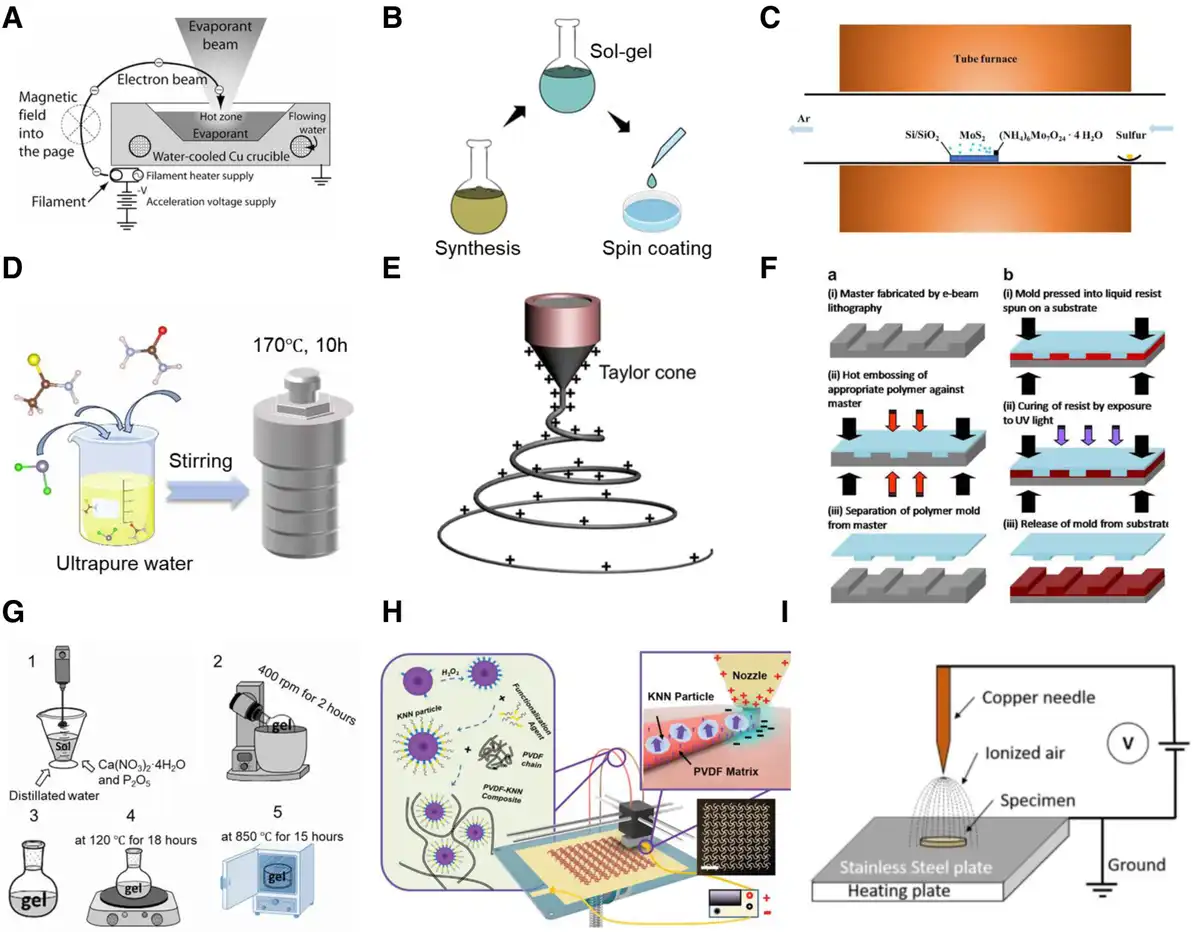
Figure 2.
The fabrication methods of PENG. (A) A schematic cross-section of a typical electron beam evaporator. Reproduced with permission from Rockett[201] Copyright 2008, Springer Science Business Media. (B) Photograph of automatic sol–gel deposition apparatus. Reproduced with permission from Lo Presti et al.[253] Copyright 2024, MDPI. (C) Schematic diagram of CVD experimental setup. Reproduced with permission from Wang et al.[254] Copyright 2024, MDPI. (D) Schematic diagram of hydrothermal synthesis. Reproduced with permission from Liu et al.[223] Copyright 2024, Royal Society of Chemistry. (E) Schematic diagram of electrostatic spinning. Reproduced with permission from Xue et al.[229] Copyright 2019, American Chemical Society. (F) Schematic process of (a) polymer mold fabrication from a master and (b) UV nanoimprint with the polymer mold. Reproduced with permission from Lan and Liu[236] Copyright 2009, Elsevier. (G) The synthesis route (sol–gel method) of HA. Reproduced with permission from Markuniene et al.[241] Copyright 2023, MDPI. (H) Schematic illustration of the electric field-assisted FDM 3D printing system. Reproduced with permission from Li et al.[243] Copyright 2020, Wiley-VCH. (I) Poling process. Reproduced with permission from Rotan et al.[250] Copyright 2020, Elsevier.
The advantages of sputtering for PENG fabrication are substantial. It offers high precision in controlling film thickness at the nanoscale, ensuring optimal piezoelectric performance. The process is versatile, capable of depositing a wide range of materials, and is scalable for industrial production. Additionally, sputtering can be performed at low temperatures, making it suitable for temperature-sensitive substrates. Nevertheless, the method is not without its challenges. The high cost of equipment and target materials, the complexity of maintaining a vacuum environment, and the need for precise control of process parameters can present significant barriers.[209] Moreover, sputtered films may develop internal stresses that impact device performance, and deposition rates can be slower compared to other methods, such as spin coating.[210] Despite these drawbacks, ongoing advancements in sputtering technology, including the development of environmentally friendly materials and hybrid manufacturing techniques, are addressing these limitations and enhancing its applicability.
3.1.2 Sol–gel spin coating
The sol–gel spin-coating method offers a versatile and cost-effective approach for the fabrication of thin, uniform piezoelectric films (Figure 2B). This technique allows for precise control over film thickness and composition by depositing precursor solutions, such as zinc acetate for ZnO[211] or lead-based compounds for PZT,[212] onto both flexible and rigid substrates. The process comprises 3 primary stages: sol preparation, spin coating, and thermal treatment. During the annealing stage, the film crystallizes, thereby activating its piezoelectric properties.[213] However, challenges arise in balancing the high-temperature requirements for optimal crystallinity with the thermal constraints of flexible substrates. Recent advancements, including low-temperature annealing and ultraviolet (UV)-assisted curing for ZnO films, have improved compatibility with temperature-sensitive materials, making this method particularly suitable for wearable and implantable devices.[214]
Despite its advantages, such as scalability and uniformity, the sol–gel spin-coating method faces several challenges. These include the presence of residual organic solvents, which can degrade electrical properties, and adhesion issues under mechanical stress. Innovations such as composite formulations that mix polymers with ceramic nanoparticles have been developed to enhance flexibility and piezoelectric response while mitigating brittleness.[215] The integration of electrodes remains a critical aspect, with flexible options such as silver nanowires or conductive polymers ensuring durability in dynamic applications.[216] Case studies, such as a ZnO-based PENG on a PET substrate, have demonstrated practical outputs of 1–5 V under bending stress, making them suitable for powering low-energy wearable sensors.[217]
3.1.3 Chemical vapor deposition
Chemical vapor deposition (CVD) is a critical technology for the fabrication of high-performance PENG, offering unparalleled advantages in terms of material quality and precision. By enabling the deposition of uniform, high-purity piezoelectric films such as ZnO[218] and AIN,[219] CVD ensures optimal crystallinity and adhesion—key factors for enhancing energy conversion efficiency and device durability[220] (Figure 2C). The method allows for precise control over film thickness and composition, facilitating the customization of piezoelectric properties, thus making it ideal for applications demanding high reliability, such as industrial sensors and implantable medical devices. Despite these numerous advantages, CVD faces challenges, including the high operating temperatures required, which can limit its compatibility with flexible substrates commonly used in wearable PENG. Innovative approaches such as plasma-enhanced CVD address this limitation by enabling low-temperature processing, thereby expanding the technology’s applicability in flexible electronics.[221] Moreover, nanostructured materials, such as vertically aligned ZnO nanowires grown via CVD, have demonstrated enhanced piezoelectric performance due to increased surface area and strain sensitivity.[222] These advancements underscore the potential of nanostructures to significantly advance PENG technology.
3.1.4 Hydrothermal synthesis
Hydrothermal synthesis is an efficient and environmentally friendly manufacturing technique that offers a cost-effective and scalable approach to growing high-quality piezoelectric nanostructures[223] (Figure 2D). This method involves the crystallization of materials from aqueous solutions at elevated temperatures and pressures within a sealed autoclave.[224] Hydrothermal synthesis is particularly well-suited for producing ZnO nanowires,[225] BaTiO₃ nanoparticles,[226] and other piezoelectric materials with controlled morphology and excellent crystallinity.[227] Its widespread adoption in PENG fabrication is attributed to its ability to create nanostructures with high surface area and enhanced piezoelectric properties, which are essential for efficient energy harvesting. One of the primary advantages of hydrothermal synthesis is its simplicity and cost-effectiveness.[224] Unlike high-temperature methods such as CVD, hydrothermal synthesis operates at relatively low temperatures, making it compatible with a diverse range of substrates, including flexible polymers and temperature-sensitive materials.[228] This compatibility facilitates the development of flexible and wearable PENG for applications such as health monitoring and self-powered sensors. Additionally, the process is environmentally benign, typically utilizing water as a solvent and thereby avoiding the use of toxic chemicals or complex vacuum systems. The ability to precisely control the size, shape, and arrangement of the nanostructures through parameters such as temperature, pH, and reaction time further enhances the method’s attractiveness for PENG fabrication. Despite the numerous benefits of hydrothermal synthesis, there are also certain limitations. The process can be time-consuming, often requiring several hours or even days to complete. Additionally, achieving uniform growth over large areas can be challenging, potentially limiting its scalability for industrial applications.
3.1.5 Electrospinning
Electrospinning offers a straightforward and cost-effective method for the production of nanofibers with exceptional piezoelectric properties (Figure 2E). This technique involves the application of a high-voltage electric field to a polymer solution or melt, which stretches the solution into ultrafine fibers that are subsequently deposited onto a collector.[229] Electrospinning is particularly effective for fabricating PVDF and its copolymers, such as polyvinylidene fluoride-trifluoroethylene (PVDF-TrFE), into nanofibers with a high β-phase content, which is critical for achieving strong piezoelectric performance.[230] The resultant nanofibers exhibit high surface area, flexibility, and mechanical durability, making them ideally suited for flexible and wearable PENG. A key advantage of electrospinning is its ability to produce highly aligned and porous nanofiber mats, which enhance the piezoelectric response and energy harvesting efficiency of PENG.[231] The technique allows for precise control over fiber diameter, alignment, and morphology by adjusting parameters such as voltage, flow rate, and collector design.[231,232] This flexibility facilitates the fabrication of customized nanostructures tailored to specific applications, including wearable electronics, biomedical devices, and environmental sensors. Moreover, electrospinning is compatible with a wide range of materials, including polymers, composites, and hybrid materials, enabling the incorporation of piezoelectric fillers such as ZnO nanoparticles or BaTiO₃ to further enhance performance.[233] The scalability and low cost of the technique also render it attractive for the mass production of PENG. Despite its numerous advantages, electrospinning faces challenges in achieving consistent fiber quality and uniform β-phase distribution, particularly in large-scale production. The integration of electrospun layers with electrodes and encapsulation materials necessitates careful design to maintain structural integrity and functionality.[234] Additionally, the incorporation of nanofillers such as ZnO or BaTiO₃ to enhance piezoelectricity complicates solution preparation and dispersion, potentially leading to defects such as agglomeration.[235] Environmental and economic considerations also arise due to the use of hazardous solvents and energy-intensive processes, underscoring the need for greener alternatives and sustainable practices.
3.1.6 Nanoimprint lithography
NIL represents an advanced manufacturing technique for the development of PENG, offering exceptional precision and scalability in the fabrication of nanostructured piezoelectric materials (Figure 2F). This method involves pressing a patterned mold into a soft polymer or resin to replicate nanoscale features, which are subsequently cured using thermal or UV light.[236] NIL is particularly well-suited for patterning piezoelectric polymers, such as PVDF and its copolymers, as well as hybrid materials, to enhance their piezoelectric properties.[237] By creating well-defined nanostructures such as nanopillars, nanogratings, or nanodomes, NIL can significantly increase the surface area and strain sensitivity of piezoelectric films, thereby improving the energy conversion efficiency of PENG. One of the primary advantages of NIL is its high resolution and repeatability, which facilitates the large-scale production of nanostructured PENG with consistent performance. Unlike traditional lithography methods, NIL does not depend on complex optical systems or expensive masks, making it a cost-effective solution for large-scale manufacturing.[238] Additionally, NIL is compatible with a diverse range of substrates, including flexible polymers, silicon, and glass, making it suitable for both rigid and flexible PENG. This versatility has enabled its application in wearable electronics, biomedical devices, and environmental sensors, where precise nanostructuring is essential to optimize energy harvesting performance. Furthermore, NIL can be integrated with other techniques, such as sputtering or electrospinning, to create hybrid PENG with enhanced functionality.[239] Despite its numerous advantages, NIL faces several challenges. The process requires high-quality molds, which can be costly and time-consuming to fabricate. Moreover, achieving uniform imprinting over large areas can be challenging, potentially limiting its scalability for industrial applications.[240]
3.1.7 Solution casting and mixing
Solution casting and mixing is a straightforward and cost-effective method for the fabrication of PENG, offering a versatile approach for producing piezoelectric thin films and composites (Figure 2G). This technique involves dissolving piezoelectric material, such as PVDF or its copolymers, in a solvent and subsequently casting the solution onto a substrate to form a thin film.[241] Alternatively, piezoelectric fillers such as ZnO nanoparticles, BaTiO₃, or graphene can be incorporated into a polymer solution to create a composite film with enhanced piezoelectric properties.[241] The advantages of solution casting include its simplicity, low cost, and compatibility with a wide range of materials and substrates, making it a popular choice for fabricating flexible and large-area PENG.[242] A key advantage of solution casting is its ability to produce uniform, flexible films with controllable thickness, which is essential for wearable and implantable PENG.[242] The process facilitates the easy incorporation of additives or fillers to tailor the mechanical, electrical, and piezoelectric properties of the film. For instance, the addition of nanoparticles or conductive fillers can significantly enhance the energy output and durability of PENG.[241] Furthermore, solution casting is amenable to roll-to-roll processing, enabling scalable production of flexible PENG for applications such as smart textiles, health monitoring devices, and environmental sensors. The method’s simplicity and low equipment requirements also make it valuable for research and small-scale production. Nevertheless, the process often necessitates the use of toxic solvents, which can pose environmental and health risks if not managed properly. Additionally, achieving high crystallinity and alignment of piezoelectric phases can be challenging, potentially limiting the energy conversion efficiency of the film.[241]
3.1.8 3D printing/additive manufacturing
3D printing, also known as additive manufacturing, represents a revolutionary approach for the fabrication of PENG, offering unparalleled design flexibility, customization, and scalability[243,244] (Figure 2H). This technology involves the layer-by-layer deposition of piezoelectric materials to create intricate 3D structures with precise control over geometry and functionality. 3D printing enables the fabrication of PENG with tailored shapes, sizes, and mechanical properties, making them well-suited for applications in wearable electronics, biomedical devices, and IoT sensors. The capability to print multifunctional materials and integrate multiple components within a single process further enhances the potential of 3D printing in developing high-performance PENG. A significant advantage of 3D printing is its ability to produce customized, complex designs that are challenging or infeasible to achieve with traditional manufacturing methods. For example, 3D-printed PENG can be designed with optimized geometries (honeycomb or lattice structures, to maximize strain sensitivity and energy output).[245] Additionally, 3D printing facilitates the direct integration of conductive electrodes and flexible substrates into the device, thereby simplifying assembly and enhancing durability.[246] The technology is also highly scalable, with advancements in multimaterial printing and high-speed printers making PENG viable for large-scale applications. Moreover, 3D printing supports the use of environmentally friendly materials and biodegradable polymers, addressing the growing demand for sustainable energy harvesting solutions.[246] Despite these advantages, 3D printing faces certain challenges compared to traditional nanofabrication techniques. The resolution of 3D printed features is often limited, which can impact the performance of microscale PENG.[247] Furthermore, the mechanical and piezoelectric properties of 3D printed materials may not always match those of conventionally manufactured materials, necessitating further optimization of printing parameters and material formulations.
3.1.9 Poling techniques
Poling techniques are critical for enhancing the piezoelectric properties of materials used in PENG, as they align the dipoles within the material to maximize its energy conversion efficiency. Poling involves the application of an external electric field to a piezoelectric material to orient its molecular or crystal dipoles in a uniform direction. This process is essential for activating the piezoelectric effect in materials that are inherently nonpolar or have randomly oriented dipoles.[248] Common poling methods include corona poling, thermal poling, and contact poling, each offering distinct advantages depending on the material and application.[249] The primary benefit of poling techniques is their ability to significantly enhance the piezoelectric coefficient and energy output of PENG. For instance, corona poling, which utilizes a high-voltage corona discharge, is particularly effective for thin films and flexible materials because it avoids direct contact with the sample, thereby reducing the risk of damage[250] (Figure 2I). Thermal polling, which involves heating the material above its Curie temperature while applying an electric field, is widely used for ceramics such as PZT, as it more effectively aligns dipoles at elevated temperatures.[251] Contact poling, on the other hand, is a simpler method that applies an electric field directly through electrodes, making it suitable for bulk materials and rigid substrates.[252] These techniques facilitate the production of high-performance PENG for applications ranging from wearable electronics to industrial sensors. However, the poling process typically requires high voltages and precise control of temperature and time, complicating manufacturing and increasing costs. Additionally, achieving uniform polarization over large areas or complex geometries can be challenging, potentially limiting the scalability of PENG.
3.2 Structural innovations
Structural innovations in PENG have revolutionized their design, enabling significant advancements in efficiency, adaptability, and integration across diverse applications. By reimagining device architectures, researchers have addressed long-standing challenges such as limited energy conversion efficiency, material brittleness, and scalability. Advanced layered and nanostructured designs have markedly improved the performance of PENG by optimizing their structural and functional properties. Vertical nanowire arrays, such as oriented ZnO or GaN nanowires grown on flexible substrates, enhance surface area and strain sensitivity, thereby increasing charge separation under compressive stress and producing higher output voltages.[255] Electrospun nanofibers, particularly from piezoelectric polymers like PVDF or PVDF-BaTiO₃ composites, form porous, oriented mats that improve strain distribution and β-phase crystallinity, resulting in higher piezoelectric coefficients.[256] Core-shell structures, where a piezoelectric core is coated with a conductive shell (eg., graphene or silver nanoparticles), further enhance charge collection efficiency and reduce leakage current.[257] Collectively, these innovative designs have significantly improved the energy conversion efficiency, mechanical adaptability, and overall performance of PENG, making them highly suitable for applications in wearable electronics, energy harvesting, and sensing technologies.
Flexible and stretchable architectures have significantly advanced the development of PENG, transforming them into highly adaptable and durable energy-harvesting devices. The implementation of wavy and kirigami patterns, achieved through prestrained substrates or laser-cut designs, allows PENG to endure strains exceeding 50% without performance degradation.[258] This capability is particularly advantageous for wearable sensors designed to monitor joint motion. Textile-integrated PENG, which incorporates piezoelectric fibers such as PVDF or nylon 11 into fabrics, enables energy harvesting from body motion while maintaining breathability and comfort, thereby seamlessly blending functionality with wearability.[183] Additionally, island-bridge electrode designs utilize rigid piezoelectric “islands” connected by stretchable serpentine electrodes, ensuring consistent performance even under extreme deformations.[259] These innovations in flexible and stretchable architecture significantly broaden the potential applications of PENG, facilitating their integration into wearable electronics, soft robotics, and other applications that demand high mechanical adaptability and durability.
Hybrid and multilayer systems significantly enhance the performance and versatility of PENG by integrating multiple energy harvesting mechanisms and optimizing structural designs. Piezoelectric-triboelectric hybrids, such as PVDF and PDMS bilayer devices, combine PENG with triboelectric nanogenerators (TENG) to simultaneously harvest energy from mechanical strain and friction, thereby substantially increasing power density.[260] Multilayer stacks, composed of alternating piezoelectric and electrode layers, amplify charge generation by synchronizing the stress between multiple active layers, resulting in enhanced overall efficiency.[261] Furthermore, 3D-printed architecture enables the creation of complex geometries, such as honeycomb or lattice structures, which optimize stress distribution and resonant frequency for specific mechanical inputs.[262] These advancements in hybrid and multilayer systems expand the capabilities of PENG, making them more efficient and adaptable to a broad spectrum of applications, including wearable electronics and ambient energy harvesting.
Biomimetic and nature-inspired designs offer innovative approaches to enhance the functionality and integration of PENG. Bone-mimicking composites, which replicate the hierarchical structure of bones using materials such as hydroxyapatite and polymers, improve biocompatibility and mechanical elasticity, making them particularly suitable for implantable PENG.[263] Leaf vein-inspired fractal or branched electrode patterns optimize charge collection efficiency in large-area devices by emulating the efficient nutrient distribution systems of plant leaves.[264] Additionally, mussel-inspired adhesives, in conjunction with dopamine-modified surfaces, enable PENG to adhere firmly to biological tissues such as skin or organs, ensuring stable and long-term monitoring capabilities.[265] These nature-inspired designs not only enhance the performance and durability of PENG but also expand their potential applications in biomedical devices, wearable sensors, and other fields requiring seamless integration with biological systems.
Advanced electrode engineering has significantly contributed to enhancing the performance, durability, and versatility of PENG. Interdigitated electrodes with a comb-like pattern maximize the effective area for charge generation, thereby substantially increasing the output current of thin-film PENG.[266] Transparent electrodes, composed of materials such as ITO or graphene, facilitate the development of transparent PENG, which can be seamlessly integrated into applications like touch screens and smart windows.[267] Moreover, self-healing electrodes, utilizing materials such as liquid metals (eg., eutectic gallium-indium) or dynamic polymers, possess the capability to autonomously repair cracks induced by cyclic stress, thereby extending the operational lifespan of PENG.[268] These innovations in electrode design not only enhance the efficiency and reliability of PENG but also broaden their applicability in transparent electronics, wearable devices, and environments demanding long-term durability.
Despite substantial advancements, PENG continues to face several challenges that must be addressed to fully realize their potential. Scalability remains a significant issue, as many nanostructure designs, such as vertical nanowires, present difficulties in mass production. Durability is another concern, with repeated stress cycles potentially degrading the polymer-ceramic interface in composites, thereby limiting their long-term performance. Additionally, integrating PENG with energy storage systems, such as supercapacitors or batteries, to ensure a stable power supply remains a complex challenge that necessitates further innovation. Looking ahead, emerging trends offer promising opportunities for the future development of PENG. These include four-dimensional (4D)-printed PENG with shape-morphing capabilities that can adapt to dynamic environments, AI-optimized designs that leverage ML to predict ideal geometries for specific applications, and the exploration of quantum piezoelectricity in 2D materials such as molybdenum disulfide (MoS₂) for ultrasensitive nanogenerators. By addressing these current challenges and embracing these advanced trends, the field of PENG can continue to progress, enabling transformative applications in energy harvesting, wearable electronics, and beyond.
3.3 Challenges in miniaturization
The miniaturization of PENG offers both compelling opportunities and formidable challenges, as reducing the size of these devices while maintaining or enhancing their performance is crucial for applications in wearable electronics, biomedical devices, and IoT sensors. One of the primary challenges is sustaining high energy output in smaller devices. As PENG is miniaturized, the active piezoelectric material volume decreases, which results in diminished power generation.[182] To address this issue, researchers are investigating advanced nanostructuring techniques, such as nanowires, nanorods, and nanocomposites, to maximize the surface area and strain sensitivity of miniaturized PENG. However, achieving uniform and precise nanostructuring at such a diminutive scale remains technically challenging and often necessitates complex fabrication methods, including NIL or CVD.[269]
Another significant challenge is the integration of PENG with other components in miniaturized systems. PENG must be seamlessly incorporated into compact devices without compromising their functionality or the performance of other components, such as sensors, processors, or energy storage units. This necessitates innovative design and packaging techniques to ensure efficient energy transfer and mechanical stability. Additionally, the mechanical durability of miniaturized PENG is a concern, as smaller devices are more susceptible to damage from repeated mechanical stress or environmental factors. The development of flexible and robust materials, such as polymer-based composites or hybrid structures, is essential to address this limitation and ensure long-term reliability.
Scalability and cost also pose significant barriers to the widespread adoption of miniaturized PENG. Many of the advanced manufacturing techniques required for miniaturization, such as electron beam lithography or atomic layer deposition, are expensive and not easily scalable for mass production.[270] Researchers are actively exploring cost-effective alternatives, such as roll-to-roll printing and 3D printing, but these approaches often involve trade-offs in resolution and material properties.[271] Despite these challenges, the potential of miniaturized PENG to enable self-powered, portable, and implantable devices continues to drive innovation in the field.
4. Recent advances in PENG for biomedical monitoring
PENG has revolutionized biomedical monitoring by enabling self-powered, noninvasive, and real-time detection of physiological signals. Recent advances in material design, structural engineering, and integration with wearable/implanted systems have expanded their applications to various medical fields. As shown in Figure 3, PENG has made progress in cardiovascular, respiratory, muscle and motion, metabolic, neural/brain activity, and wound healing monitoring.
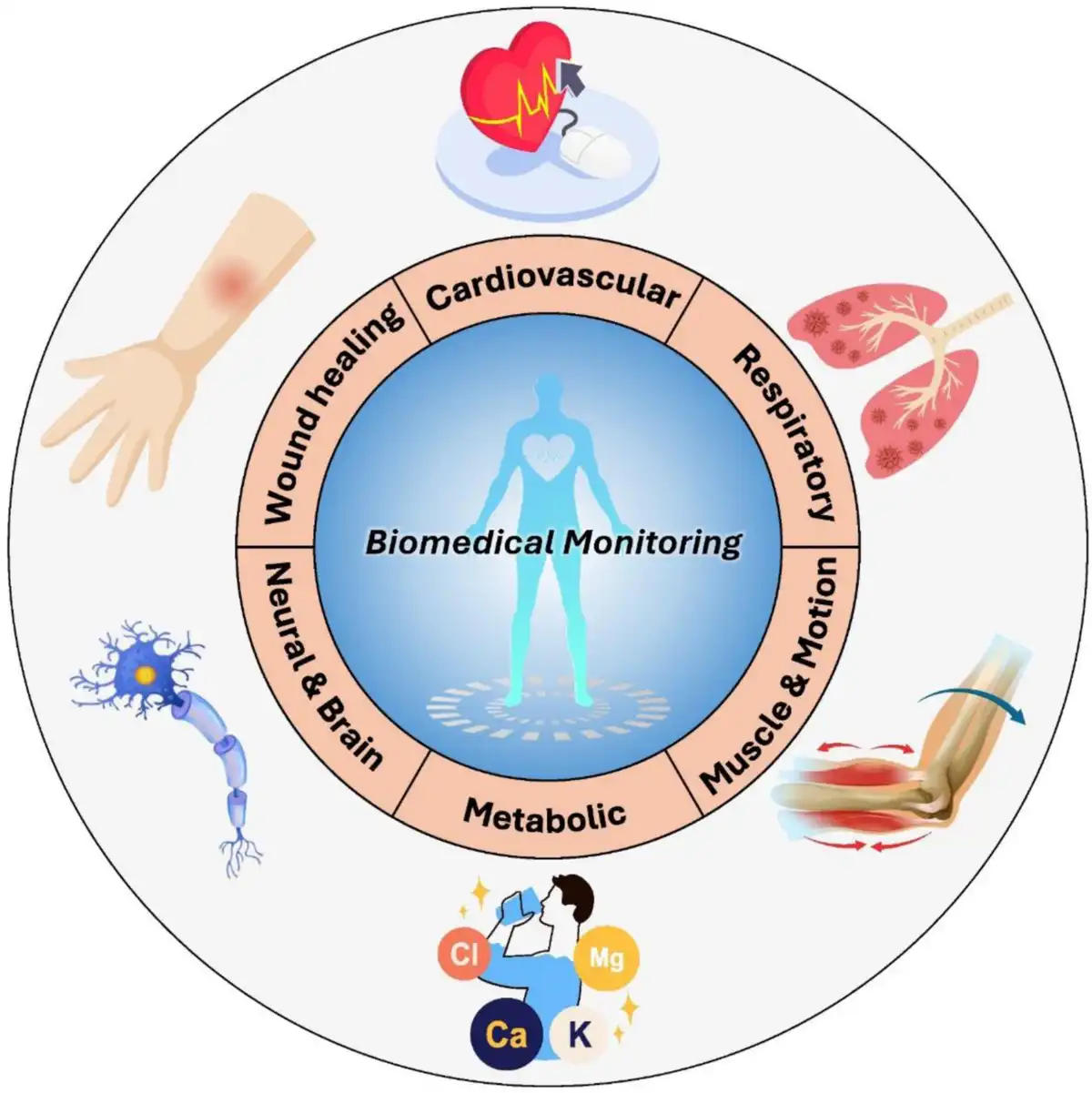
Figure 3.
PENG for biomedical monitoring, including cardiovascular, respiratory, muscle and motion, metabolism, neural/brain activity, and wound healing monitoring.
4.1 Cardiovascular
PENGs have emerged as a transformative tool in cardiovascular monitoring, enabling real-time tracking of HR, blood pressure, and vascular health by harvesting mechanical energy from arterial pulsations and heartbeats. The development of sensors capable of accurately detecting micropressure changes in vivo is critical for monitoring chronic pressure-related conditions such as vascular occlusion, arterial hypertension, and brain injury. However, traditional pressure sensors face limitations in detecting micropressures below 1 kPa over extended periods due to poor flexibility and biocompatibility, particularly in implantable applications. To address these challenges, researchers have proposed an innovative approach using ultrathin, flexible smart patches based on piezoelectric AIN (Figure 4A).[272] These patches, integrated onto the extraluminal surface of artificial blood vessels, exhibit high sensitivity and biocompatibility, enabling real-time monitoring of hemodynamic parameters without compromising the mechanical properties of the graft. Experimental results demonstrate the sensors’ stable response to flow changes, highlighting their potential for continuous monitoring and optimizing patient treatment (Figure 4B).[272] Additionally, the innovative PVDF/hydroxylamine hydrochloride (HHE) organic piezoelectric nanofibers (OPNs) sensor has been successfully implanted in living pigs to monitor micropressure changes within and around the cardiovascular wall, demonstrating its feasibility for real-time monitoring under various physiological conditions (Figure 4C).[273] These advancements offer new possibilities for enhancing vascular health monitoring and early detection of complications.
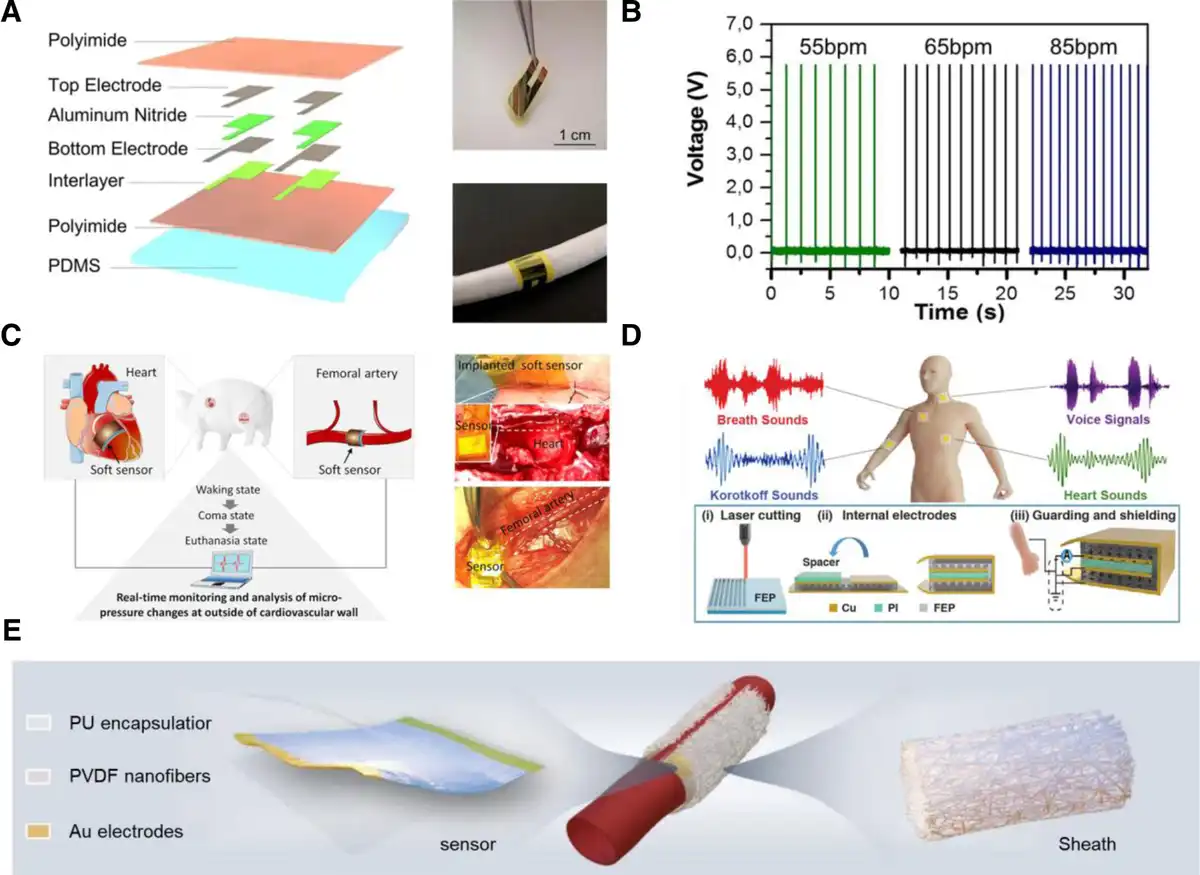
Figure 4.
PENG for cardiac monitoring. (A) Image of e-PTFE graft integrated with flexible smart patch (PSP-20) sensor for hemodynamic parameter monitoring. Reproduced with permission from Natta et al.[272] Copyright 2019, Springer Nature. (B) Output voltage generated by the PSP-20 sensor under different flow rate conditions. Reproduced with permission from Natta et al.[272] Copyright 2019, Springer Nature. (C) Schematic diagram of sensor implantation for recording micropressure changes and surgical images of implanted soft sensors on the cardiovascular wall of the heart and femoral artery. Reproduced with permission from Li et al.[273] Copyright 2019, American Chemical Society. (D) Illustration of piezoelectric electret sensor patch at different body locations and schematic diagram of prototype sensor showing key aspects such as (i) laser processing of FEP grooves; (ii) internal electrodes for electromechanical transduction; (iii) external electrodes for protection and shielding structure. Reproduced with permission from Han et al.[274] Copyright 2023, Wiley-VCH. (E) Exploded schematic diagram of the sensor fixed to the arterial surface by a sheath. Reproduced with permission from Tang et al.[275] Copyright 2024, Wiley-VCH.
In the field of physiological signal detection, accurately capturing sound signals emitted by the human body—such as breathing, heartbeat, and vascular sounds—poses significant challenges due to their complexity. While microelectromechanical system (MEMS)-based sensors provide high accuracy, their manufacturing processes limit their flexibility and compliance. To overcome these limitations, researchers have developed novel sensors using piezoelectric electret technology, which achieve higher sensitivity and compliance (Figure 4D).[274] These sensors are integrated into flexible patches, leveraging unique structures and materials to ensure accurate detection of physiological signals while maintaining comfort and usability. By strategically placing these sensors on the body, comprehensive monitoring of vital signs and physiological parameters can be achieved, enhancing diagnostic capabilities and enabling early intervention for cardiovascular and respiratory diseases.
Implantable pulse sensors play a critical role in monitoring hemodynamic parameters postsurgery, providing real-time data on cardiovascular health and hemodynamics. However, conventional rigid sensors suffer from mechanical incompatibility and long-term stability issues, prompting researchers to explore adaptive sensors made from degradable materials or optimized structures. An innovative approach involves integrating piezoelectric sensors with biomimetic conformal sheaths to create an implantable vascular electronic system for wireless hemodynamic monitoring (Figure 4E).[275] This system combines flexible piezoelectric sensors, stretchable sheaths, and wireless modules to enable real-time monitoring and data transmission without impeding arterial growth. Utilizing highly aligned PVDF nanofiber membranes and elastic nanofiber PU tubes, the system sensitively and stably monitors hemodynamic parameters while adapting to dynamic changes in arterial geometry. Alternatively, all-in-one piezoelectric vascular grafts feature layered nanofibrous scaffolds with embedded electrodes, achieving native tissue-like mechanical behavior while enabling real-time hemodynamic assessment.[276] These grafts demonstrate rapid endothelial integration and exceptional biocompatibility with minimal blood cell damage. Both solutions transcend traditional rigidity issues, the former through stretchable interfacial design, the latter via structural biomimicry, and operate without external power sources.[276] By facilitating continuous physiological tracking and early detection of vascular complications, they establish new paradigms for patient-specific cardiovascular management. Validated through physiological testing, these technologies converge toward intelligent implants capable of supporting precision interventions across diverse clinical scenarios.
Two millennia ago, pulse diagnosis served as the cornerstone of ancient Chinese medicine for diagnosing cardiovascular diseases. Today, the field of medical technology has undergone a transformative evolution, shifting toward the development of portable, wearable systems capable of continuous monitoring of vital signs, particularly arterial pulse monitoring for blood pressure assessment. Achieving accurate wearable blood pressure monitoring, however, presents significant challenges, especially when utilizing piezoelectric sensors. Known for their dynamic response characteristics and high fidelity, piezoelectric sensors have played a pivotal role in advancing continuous blood pressure monitoring technology. Yet, issues such as time synchronization errors, sensor positioning discrepancies, and variations in piezoelectric response have raised concerns about their reliability in blood pressure monitoring. To address these challenges, recent studies have extensively investigated the piezoelectric response of arterial pulses across functional layers of varying thicknesses (Figure 5A).[277] By establishing a direct correlation between blood pressure waves and piezoelectric arterial pulse waves, the feasibility of blood pressure monitoring using a single piezoelectric sensor has been demonstrated (Figure 5B).[277] This breakthrough not only deepens the understanding of arterial pulse dynamics but also paves the way for the development of accurate and convenient wearable blood pressure monitoring devices.
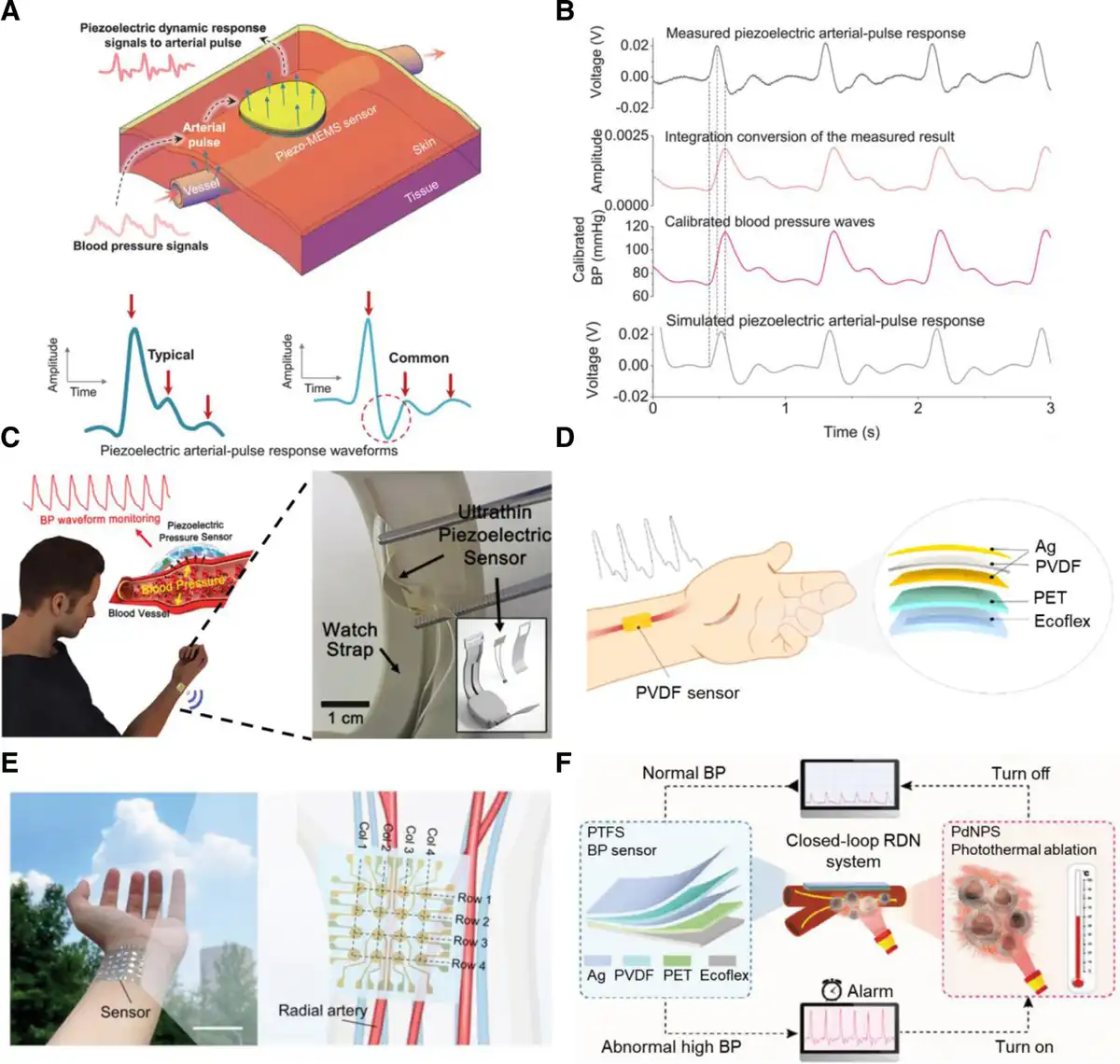
Figure 5.
PENG for blood pressure monitoring. (A) Piezoelectric dynamic response diagram of arterial pulse from artery to skin. And a typical arterial pulse piezoelectric response waveform and a common arterial pulse piezoelectric response waveform. Reproduced with permission from Yi et al.[277] Copyright 2022, Wiley-VCH. (B) Verification of the correlation between blood pressure waveform and arterial pulse piezoelectric response. From top to bottom: measured piezoelectric sensor output voltage, pulse waveform after integrating the measured output voltage, blood pressure waveform calibrated according to the integration result, and simulated output voltage using the calibrated blood pressure waveform as input pulse load. Reproduced with permission from Yi et al.[277] Copyright 2022, Wiley-VCH. (C) Schematic diagram of the overall concept of WPBPS. The piezoelectric pressure sensor attached to the user’s skin can accurately detect arterial pulse signals and can continuously convert them into blood pressure values. And a photo of the ultrathin piezoelectric sensor built into the inside of the WPBPS installation watch strap. The inset shows the design of the WPBPS embedded watch. Reproduced with permission from Min et al.[278] Copyright 2023, Wiley-VCH. (D) The basic structure of the pulse sensor and the principle of pulse wave measurement are attached to the skin surface near the radial artery. Reproduced with permission from Zhang et al.[279] Copyright 2024, American Chemical Society. (E) Optical image of the thin film piezoelectric array sensor and schematic diagram of the test radial artery (scale bar is 5 cm). Reproduced with permission from Tian et al.[280] Copyright 2024, Wiley-VCH. (F) The operation process of the closed-loop RDN system. The blue box indicates the PTFS-based BP sensor structure, and the red box indicates the synthesis steps of PdNPS with NIR-II photothermal ablation. Reproduced with permission from Liu et al.[281] Copyright 2024, Wiley-VCH.
The importance of continuous blood pressure monitoring is particularly critical in the context of combating hypertension, a global health issue affecting millions and a leading cause of cardiovascular diseases and related mortality. With the growing demand for noninvasive, continuous arterial pressure monitoring devices, the development of wearable sensors that seamlessly integrate into daily life has become a top priority. The wearable piezoelectric blood pressure sensor (WPBPS) exemplifies such innovation, designed for continuous noninvasive arterial pressure monitoring (Figure 5C).[278] With high sensitivity and rapid response times, the sensor is ingeniously embedded into a watch band, showcasing the seamless integration of cutting-edge technology with practical healthcare solutions. Through a wireless communication system, real-time arterial pulse data is transmitted to portable devices, enabling continuous blood pressure monitoring without the discomfort associated with traditional measurement techniques. Furthermore, researchers are advancing sensor technology by exploring the role of elastic media in enhancing pulse wave signal transmission to optimize sensing performance and accuracy (Figure 5D).[279] In another breakthrough, a wearable sensor utilizing heterogeneous graded piezoelectric composites has achieved accuracy comparable to commercial sphygmomanometers. This sensor not only supports continuous blood pressure monitoring but also provides hemodynamic parameters essential for comprehensive cardiac function analysis (Figure 5E).[280] By combining innovation with precision, this sensor heralds a new era of personalized medical systems, offering a powerful tool for early diagnosis and intervention in cardiovascular diseases.
Moreover, the integration of cutting-edge technologies holds immense potential. For instance, the closed-loop renal denervation system combines piezoelectric film sensors with photothermal ablation technology, demonstrating the possibility of targeted and effective hypertension treatment by regulating renal sympathetic nerve activity (Figure 5F).[281] This integrated approach not only provides a novel strategy for managing refractory hypertension but also opens new avenues for treating chronic diseases related to sympathetic nerve activity, underscoring the transformative potential of technology in healthcare.
Wearable piezoelectric blood pressure sensors represent a significant advancement in preclinical continuous noninvasive arterial pressure monitoring, addressing longstanding accuracy challenges through material innovation and signal processing. The first approach employs a flexible piezoelectric sensor with optimized sensitivity and dynamic response, coupled with a linear regression transfer function to directly convert mechanical signals into clinically valid systolic and diastolic pressures.[278] Rigorous clinical validation across 35 subjects demonstrated exceptional alignment with commercial, enabling integration into wrist-worn devices for real-world cardiovascular monitoring. A second strategy utilizes a flexible piezocomposite ultrasonic sensor featuring PZT-5A/PDMS anisotropic composites and silver nanowire electrodes.[282] This design achieves nonocclusive vessel wall motion tracking through optimized acoustic impedance matching, capturing full arterial waveforms without calibration. Preliminary human trials confirmed accurate continuous pressure waveform acquisition at the ulnar artery, correlating strongly with clinical ultrasound probes and conventional monitors. Together, these PENG-based approaches, leveraging direct mechanical transduction and ultrasonic kinematics, establish robust preclinical frameworks for wearable blood pressure management, overcoming critical limitations in signal fidelity, calibration dependency, and long-term wearability while demonstrating viable pathways toward clinical deployment.
In summary, the convergence of advanced sensor technology, innovative materials, and strategic design is revolutionizing the field of physiological monitoring. From detecting micropressure changes within the body to monitoring vascular grafts and capturing critical physiological signals, these advancements provide powerful tools for enhancing diagnostic capabilities and enabling real-time insights into cardiovascular health. By leveraging piezoelectric materials, flexible sensors, and wireless communication technologies, researchers are developing more effective and patient-centric medical solutions, paving the way for the future of precision medicine. From ancient pulse diagnosis to modern wearable piezoelectric sensors, blood pressure monitoring technology has undergone a revolutionary transformation. Through the integration of innovative materials, advanced sensor technologies, and wireless communication systems, researchers are driving the advancement of personalized medicine, offering robust support for the early diagnosis, continuous monitoring, and precise treatment of cardiovascular diseases. These technological breakthroughs not only enhance the efficiency and quality of healthcare but also bring new hope for improving global cardiovascular health, marking a monumental leap from traditional to modern medical technology.
4.2 Respiratory
PENG have emerged as a powerful tool for respiratory monitoring, capable of capturing the biomechanical energy generated by chest movements during breathing to assess critical parameters such as respiratory rate, tidal volume, and obstruction status. As a frontier in healthcare and physiological monitoring, respiratory function measurement provides vital insights into overall health and aids in the diagnosis of lung diseases. While respiratory rate serves as a key biomarker, the need for comprehensive data on respiratory flow and volume underscores the urgent demand for advanced wearable devices. In this context, self-powered multifunctional sensor technologies have gained prominence. For instance, a flexible hybrid nanofiber sensor based on a PAN/TMAB composite nanofiber membrane (Figure 6A) exhibits dual piezoelectric and pyroelectric properties, enabling the accurate detection of various physiological signals, including elbow flexion angle, foot posture, and respiratory status.[283] Its versatility extends beyond human health monitoring to energy conversion and human–computer interaction, setting a new benchmark for wearable sensor technology.
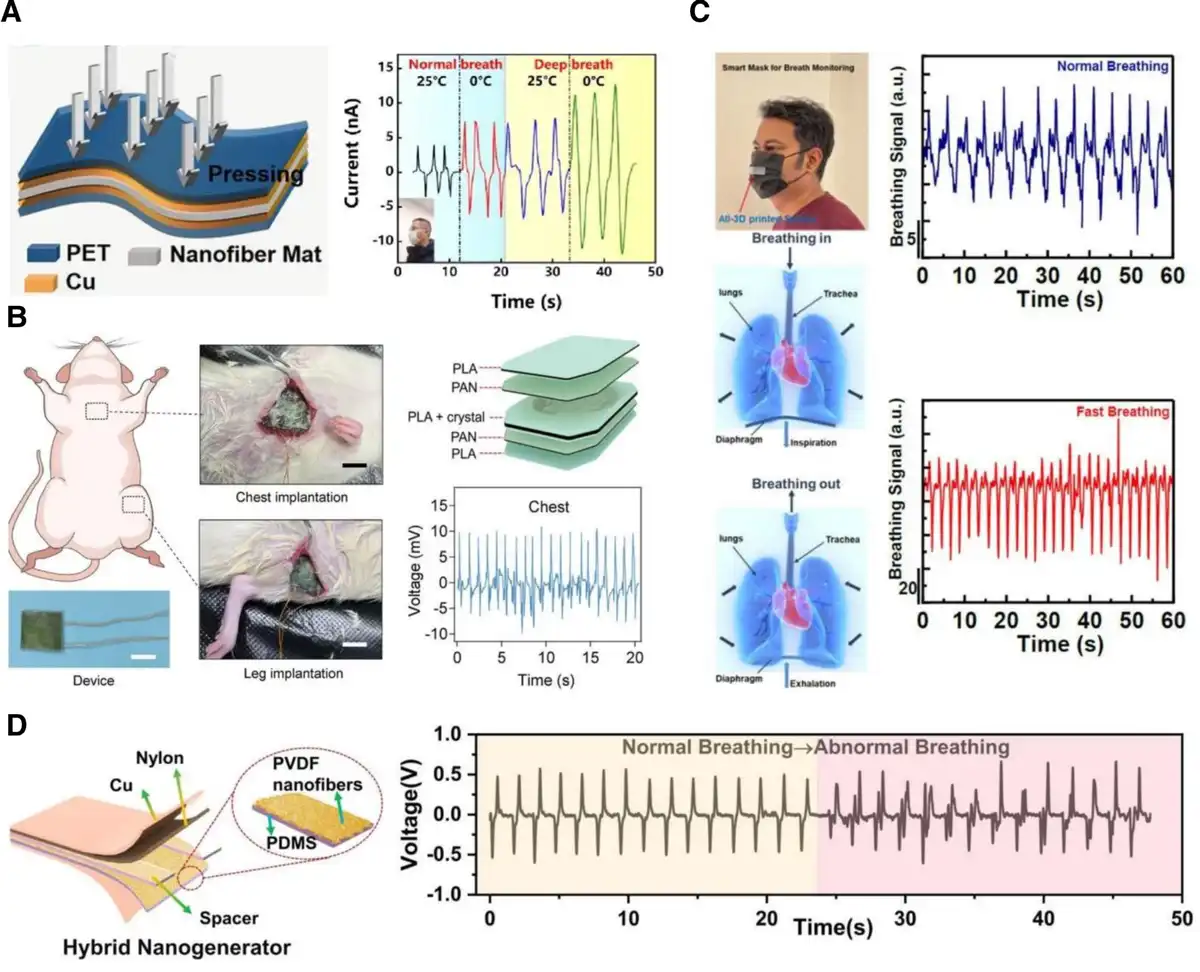
Figure 6.
PENG for respiratory monitoring. (A) Schematic of the polyacrylonitrile and trimethylamine borane (TMAB) composite nanofiber mat prepared by electrospinning and its output current under normal and deep breathing at 0 and 25 °C. Reproduced with permission from Li et al.[283] Copyright 2022, American Chemical Society. (B) Illustration and photograph of force sensors implanted in the chest and leg regions of Sprague–Dawley rats. Scale bar = 5 mm. Illustration of the packaged force sensor and various components, and the open circuit voltage of the force sensor implanted in the chest under respiratory drive. Reproduced with permission from Cheng et al.[192] Copyright 2023, Wiley-VCH. (C) Photographs showing the fully 3D printed sensor (upper left) and lung conditions during inspiration and expiration (lower left) for the smart mask-based respiratory monitoring demonstration. The corresponding output electrical signals recorded during (upper right) normal breathing and (lower right) rapid breathing. Reproduced with permission from Maity et al.[285] Copyright 2023, American Chemical Society. (D) Structure of the PVDF-PDMS composite membrane and detection of respiratory electrical signals generated by PT-NG. Reproduced with permission from Chen et al.[284] Copyright 2024, American Chemical Society.
Further advancements are exemplified by the development of all-organic, degradable piezoelectric force sensors based on amino acid crystals (Figure 6B),[192] marking a significant milestone in biomedical applications. Designed for dynamic physiological monitoring in model animals, these sensors are biocompatible and fully biodegradable, heralding a new era in medical sensor design. Through in vivo testing in adult Sprague–Dawley rats, these sensors have demonstrated superior capabilities in capturing muscle contractions and respiratory activity, outperforming existing nanogenerators and showcasing immense potential for clinical applications.
Major breakthrough in energy harvesting and physiological monitoring. When integrated into a smart mask, these sensors enable continuous, self-powered respiratory status monitoring, offering a critical tool for disease prevention and personalized healthcare. Their ability to distinguish between normal and rapid breathing patterns through temperature fluctuations within the mask highlights their significance in real-time health monitoring applications.
Finally, the integration of piezoelectric/triboelectric hybrid nanogenerators (PT-NGs) (Figure 6D) provides a simple yet efficient solution for energy conversion and wearable sensor technology.[284] By combining piezoelectric charge generation with triboelectric charging, this composite film-based device excels in energy conversion efficiency and is ideal for monitoring finger movements, gestures, and breathing patterns. When placed externally on a mask, these sensors can accurately monitor breathing rate and patterns, offering valuable insights into respiratory health and facilitating timely health alerts and interventions.
Additionally, the development of fully 3D-printed thermos PENG utilizing cellulose nanocrystals (Figure 6C) has further propelled progress in this field.[285] These state-of-the-art sensors can autonomously detect cardiac pulses and respiratory activity, representing a new class of self-powered, wearable biomedical devices for continuous, noninvasive health monitoring and potential human–machine interface applications.
The integration of innovative technologies into wearable devices for monitoring metabolic and respiratory functions has driven significant advancements in this field. Among these, wearable piezoelectric airflow sensors (WPATs) offer a novel, cost-effective, and accurate solution for tracking metabolic and respiratory activities (Figure 7A).[286] A notable design, the double-layer PLLA BS (PLLA2BS), demonstrates enhanced piezoelectric signals at varying air velocities compared to single-layer PLLA BS. This design significantly improves airflow sensing capabilities by stacking 2 piezoelectric PLLA films at a specific cutting angle. Finite element simulations in ABAQUS support the hypothesis that respiratory airflow generates a pressure differential across the PLLA2BS, inducing the piezoelectric effect. Variations in airflow rate further amplify this effect, directly influencing piezoelectric signal generation.
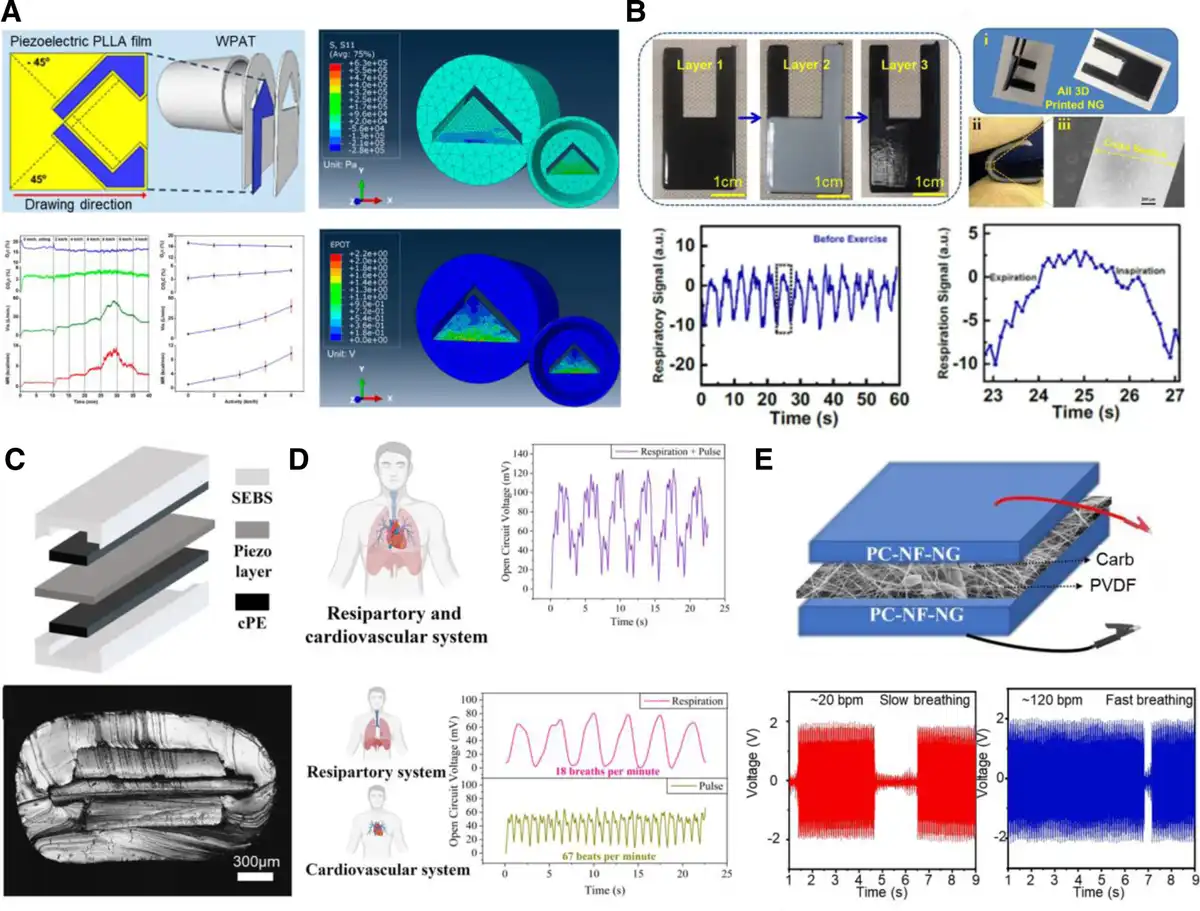
Figure 7.
Innovative technology of PENG for respiratory monitoring. (A) Design concept diagram of the WPAT and simulation of airflow sensing of the WPAT. And sample data and averages of O2, CO2, Vis, and MR recorded from participants. Reproduced with permission from Jin et al.[286] Copyright 2022, American Chemical Society. (B) Optical images of the layer-by-layer printing of the fully 3D printed NG and its output electrical signals before exercise (resting state). Reproduced with permission from Maity et al.[285] Copyright 2023, American Chemical Society. (C) Exploded view of the preform and fiber, and laser DIC image of the fiber cross-section. Reproduced with permission from Hasan et al.[287] Copyright 2024, American Chemical Society. (D) Schematic diagram of the respiratory and cardiovascular system and voltage output waveforms of the chest, breathing, and pulse during breathing. Reproduced with permission from Hasan et al.[287] Copyright 2024, American Chemical Society. (E) Schematic diagram of the structure of the PVDF-CS-NF (PC-NF) composite material and its voltage response to slow and fast breathing as a respiratory sensor. Reproduced with permission from Divya et al.[288] Copyright 2025, Elsevier.
Innovative strategies, such as fully 3D-printed manufacturing methods, have revolutionized the production of wearable devices (Figure 7B).[285] For instance, fully 3D-printed nanogenerators simplify production steps and reduce equipment requirements by utilizing ink as both the active thermos-piezoelectric material and electrode. Conductive carbon nanotubes (CNTs) embedded in the polymer matrix enhance electrode conductivity and optimize the printing process. This layer-by-layer printing strategy enables the creation of complex, multilayer devices suitable for diverse applications, including respiratory monitoring.
Additionally, the thermal stretching technique for embedding transition metal dichalcogenides into fluoropolymer fibers offers a novel approach for noninvasive cardiovascular signal monitoring (Figure 7C).[287] By quantitatively measuring arterial pressure changes at different skin locations, this technology assesses cardiovascular health. Simultaneously, integrating piezoelectric fibers into respiratory monitoring systems allows for the concurrent capture of pulse and respiratory waveforms (Figure 7D).[287] Signal processing techniques, combined with low-pass and band-pass filters, effectively separate vital sign data, providing detailed insights into physiological responses during the respiratory cycle.
In the realm of sustainable technology, PENG fabricated from household crab shell waste and PVDF demonstrates the potential for environmentally friendly and cost-effective sensor production (Figure 7E).[288] Voltage-time graphs depict various respiratory states, such as slow and fast breathing, showcasing the device’s ability to detect and distinguish different respiratory conditions. This application not only advances breathing detection technology but also offers a versatile and eco-friendly solution for monitoring respiratory activity across diverse environments.
Piezoelectric sensors demonstrate versatile preclinical utility in respiratory monitoring, spanning from home-based sleep studies to critical care applications. In residential settings, stretchable piezoelectric sensors effectively tracked respiration across all age groups, noninvasively identifying sleep patterns including stable breathing, apnea events, and age-dependent respiratory variations.[289] A hospital-deployable piezoelectric system was developed for continuous systemic inflammatory response syndrome screening in COVID-19 patients.[290] This noninvasive monitor combined under-mattress respiratory sensing with fingertip pulse detection, achieved high sensitivity and high negative predictive value in 29 hospitalized patients monitored around the clock, validating its potential for preliminary SIRS assessment in clinical environments.
By focusing on advancements in respiratory detection applications, these developments pave the way for enhanced medical monitoring, disease prevention, and personalized interventions, highlighting the immense potential of wearable sensor technology in improving human health and well-being. These innovations not only propel medical technology forward but also provide robust support for the future of precision medicine and personalized health management.
4.3 Muscle and motion
PENG have the capability to convert mechanical strains generated by muscle contractions into electrical signals, enabling the tracking of muscle activity, gait, and rehabilitation progress. With growing concerns over work-related upper limb musculoskeletal disorders (MSDs) and neuromuscular diseases, the development of innovative monitoring and response solutions has become increasingly critical. MSDs, particularly neck pain and shoulder fatigue, are highly prevalent in the European population, underscoring the urgent need for continuous monitoring systems to prevent and rehabilitate such conditions. However, current wearable sensor systems face limitations, including complex structures and insufficient data acquisition, which hinder their practical application. To address these challenges, researchers are advancing new sensor technologies aimed at revolutionizing monitoring capabilities across various health domains.
In the realm of neuromuscular diseases, such as amyotrophic lateral sclerosis (ALS), the impairment of motor skills and communication abilities highlights the necessity for advanced monitoring systems. ALS patients often struggle with fine motor tasks and speech expression, necessitating innovative solutions to facilitate communication and task completion. The introduction of flexible facial code extrapolation sensors (cFaCES) and highly anisotropic piezoelectric network composite (HAPNC) sensors offers groundbreaking opportunities for tracking dynamic facial skin strain and monitoring joint movement patterns (Figure 8A, B).[291,292] These sensors provide a noninvasive and efficient means of tracking physiological changes and movement disorders, enabling ALS patients to communicate more effectively and engage more easily in daily activities.
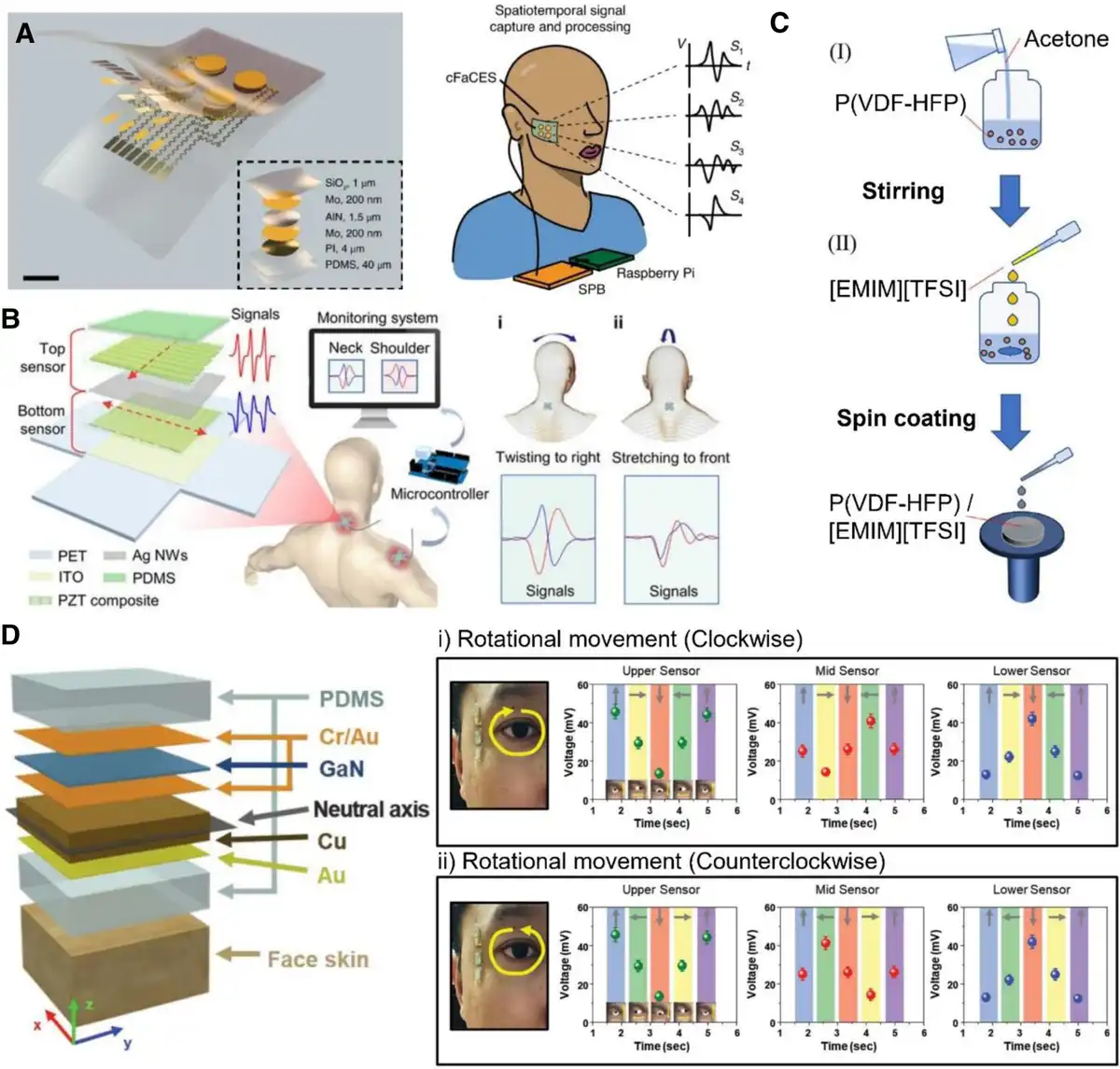
Figure 8.
PENG for muscle monitoring. (A) Exploded view of cFaCES, including each layer encapsulating the sensing elements (bottom right) and RTD system schematic. cFaCES is laminated to the face, and its 4 sensing elements are connected to the SPB for differential signal amplification and analog-to-digital conversion. Reproduced with permission from Sun et al.[291] Copyright 2020, Springer Nature. (B) Schematic diagram of the system for monitoring MSD. The signals generated by the connected sensors are transmitted to the smart terminal through a microcontroller for further analysis. The multilayer HAPNC sensor consists of a cross-shaped PET substrate, a square top sensor, and a square bottom sensor. And 2 typical signals of the HAPNC sensor for distinguishing neck movements, including rightward twisting and forward extension. Reproduced with permission from Hong et al.[292] Copyright 2021, American Association for the Advancement of Science. (C) Preparation process of ion gel membrane. Reproduced with permission from Chen et al.[293] Copyright 2023, American Chemical Society. (D) Schematic diagram of the sensor layer structure attached to the facial skin and the output characteristics of F-PEMSA for eye movement in 2 different rotational directions. Reproduced with permission from Kim et al.[294] Copyright 2024, Wiley-VCH.
Furthermore, piezoelectric capacitive flexible sensors developed through laser direct printing methods, as well as sensors based on single-crystal III-nitride films, have expanded the application of innovative sensing technologies. The piezoelectric capacitive sensor features a hybrid microstructure and an ion gel dielectric layer (Figure 8C),[293] offering high sensitivity and stability, making it suitable for monitoring physiological signals such as throat movement, speech, facial gestures, and pulse. Meanwhile, the flexible piezoelectric eye movement sensor array (F-PEMSA) based on III-nitride films provides a comfortable and noninvasive method for eye movement tracking (Figure 8D),[294] demonstrating excellent sensitivity and repeatability. These technological advancements pave the way for practical applications in health monitoring, facilitating continuous and safe monitoring of eye movements and breathing patterns.
The integration of state-of-the-art sensor technologies into wearable devices represents a paradigm shift in the continuous and unobtrusive monitoring of physiological activities. Li et al.[295] proposed an electrospun PVDF piezoelectric nanofibre membrane with functional modulation of CNT and barium titanate (BTO) to construct wearable piezoelectric tactile sensors with self-supply capability, fast response, high sensitivity and good durability, and successfully applied to human body multisite motion monitoring and recognition, which provides a new solution with practical prospects for flexible health sensing electronic devices (Figure 9A, B). Figure 9C showcases a flexible piezoelectric sensor designed to monitor laryngeal motion by detecting skin deformation resulting from hyoid bone displacement.[296] Fabricated using AIN on a Kapton polyimide substrate, this smart patch offers critical insights into swallowing kinematics, enabling the quantitative assessment of dysphagia and related clinical conditions. The sensor’s compact, lightweight, and biocompatible design ensures conformal integration with the neck’s curved anatomy, facilitating uninterrupted monitoring of laryngeal dynamics without impeding natural swallowing functions (Figure 9D).[296] Equipped with Bluetooth connectivity for wireless data transmission to smartphones, this system represents a significant advancement in real-time diagnostic capabilities, providing clinicians with actionable data for timely therapeutic interventions.
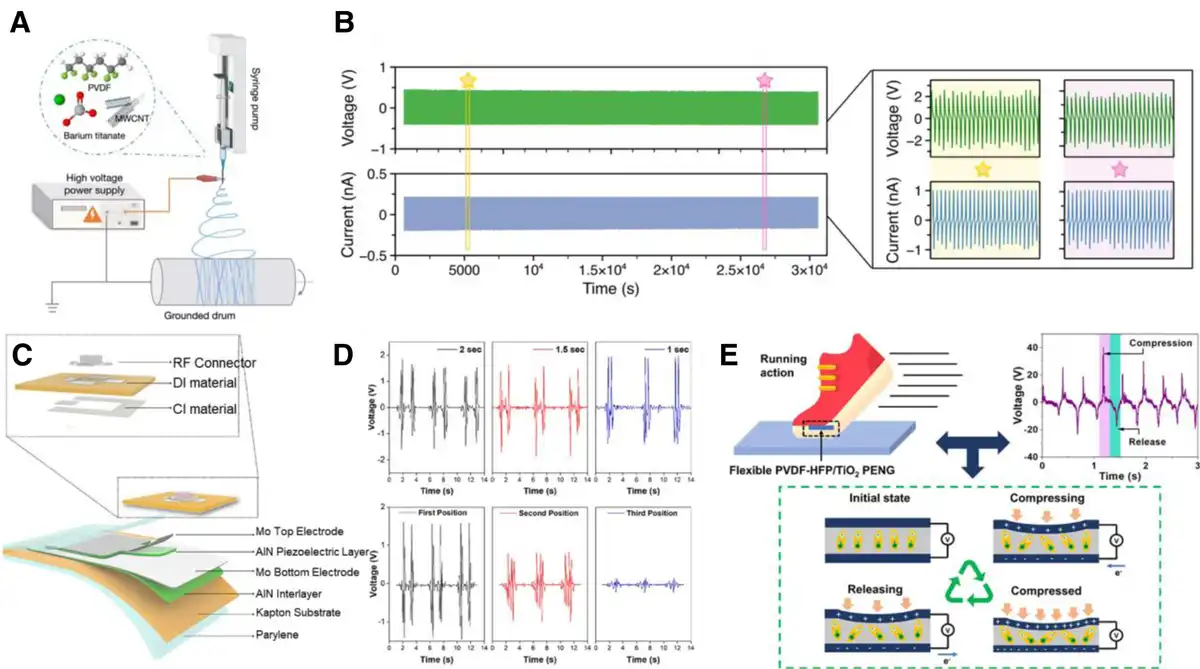
Figure 9.
PENG for motion monitoring. (A) Schematic diagram of the electrospinning process. Reproduced with permission from Li et al.[295] Copyright 2023, Donghua University. (B) The device shows great dynamic durability and performs stability after over 12,000 pressing-releasing cycles (left). Zoomed-in waveform electric responses (right) of generated open circuit voltage (upper section) and current (lower section). Reproduced with permission from Li et al.[295] Copyright 2023, Donghua University. (C) Flexible piezoelectric sensor structure. Schematic diagram of the exploded multilayer flexible transducer. Reproduced with permission from Natta et al.[296] Copyright 2021, American Chemical Society. (D) Output voltage generated by the sensor at different swallowing cycles (top); voltage signal changes due to the sensor position relative to the initial point of the simulated thyroid cartilage. In the 3D reconstruction, the location of the device is reported (bottom). Reproduced with permission from Natta et al.[296] Copyright 2021, American Chemical Society. (E) The working mechanism of the PT-10-based PENG includes 4 key stages, including the initial state, compression state, compression state, and release state. Piezoelectric signals are generated during the pressing and releasing stages. Reproduced with permission from Priyadarshini et al.[297] Copyright 2023, American Chemical Society.
Figure 9E highlights a novel motion-sensing device that exploits the polar β-phase nucleation characteristics of electroactive polymers.[297] By incorporating TiO₂ nanoparticles into poly(vinylidene fluoride-co-hexafluoropropylene) films, the device achieves enhanced β-phase crystallization, resulting in superior remnant polarization and energy density. This configuration enables ultra-low frequency detection, making it highly effective for monitoring a broad spectrum of voluntary motions, ranging from joint movements to fine motor actions such as finger tapping. The device’s ability to accurately track activities from ambulation to running demonstrates its versatility in applications spanning smart wearables, sports biomechanics, and medical diagnostics.
The convergence of these advanced sensing technologies not only enhances the quality of life for individuals with specific health conditions but also expands the scope of health monitoring applications, underscoring the pivotal role of sensor innovation in advancing proactive healthcare management. By synergizing breakthroughs in materials science, microfabrication techniques, and signal processing algorithms, researchers are driving the development of wearable devices that are more efficient, precise, and sustainable. These advancements provide a robust foundation for personalized medicine and continuous health monitoring, ultimately contributing to improved patient outcomes and preventive healthcare strategies.
4.4 Metabolic
PENGs are emerging as a transformative platform for indirect metabolic monitoring, leveraging their ability to transduce mechanical or pressure fluctuations associated with biochemical processes into quantifiable electrical signals. Conventional metabolic assessment techniques, such as maximal oxygen uptake testing and blood lactate analysis, are often constrained by their invasiveness, operational complexity, and interference with physical activity. To overcome these limitations, a novel biosensor utilizing PVDF/T-ZnO composite piezoelectric materials has been developed (Figure 10A).[298] This device, integrated onto human skin or tissues via a flexible substrate, exploits the piezoelectric effect to simultaneously capture biomechanical signals and metabolic fluctuations, enabling real-time dynamic monitoring of the maximal lactate steady state (MLSS) (Figure 10B).[298] MLSS, recognized as the gold standard for evaluating aerobic endurance, plays a critical role in optimizing athletic training regimens and designing rehabilitation protocols for cardiovascular patients. Furthermore, lactate, a pivotal metabolic marker in the tumor microenvironment, exhibits concentration abnormalities that reflect the metabolic reprogramming of cancer cells. The PENG-based sensing system offers a noninvasive approach for cancer prognosis by detecting localized tissue stiffness variations induced by lactate accumulation, particularly for early detection of solid tumors such as breast and liver carcinomas.
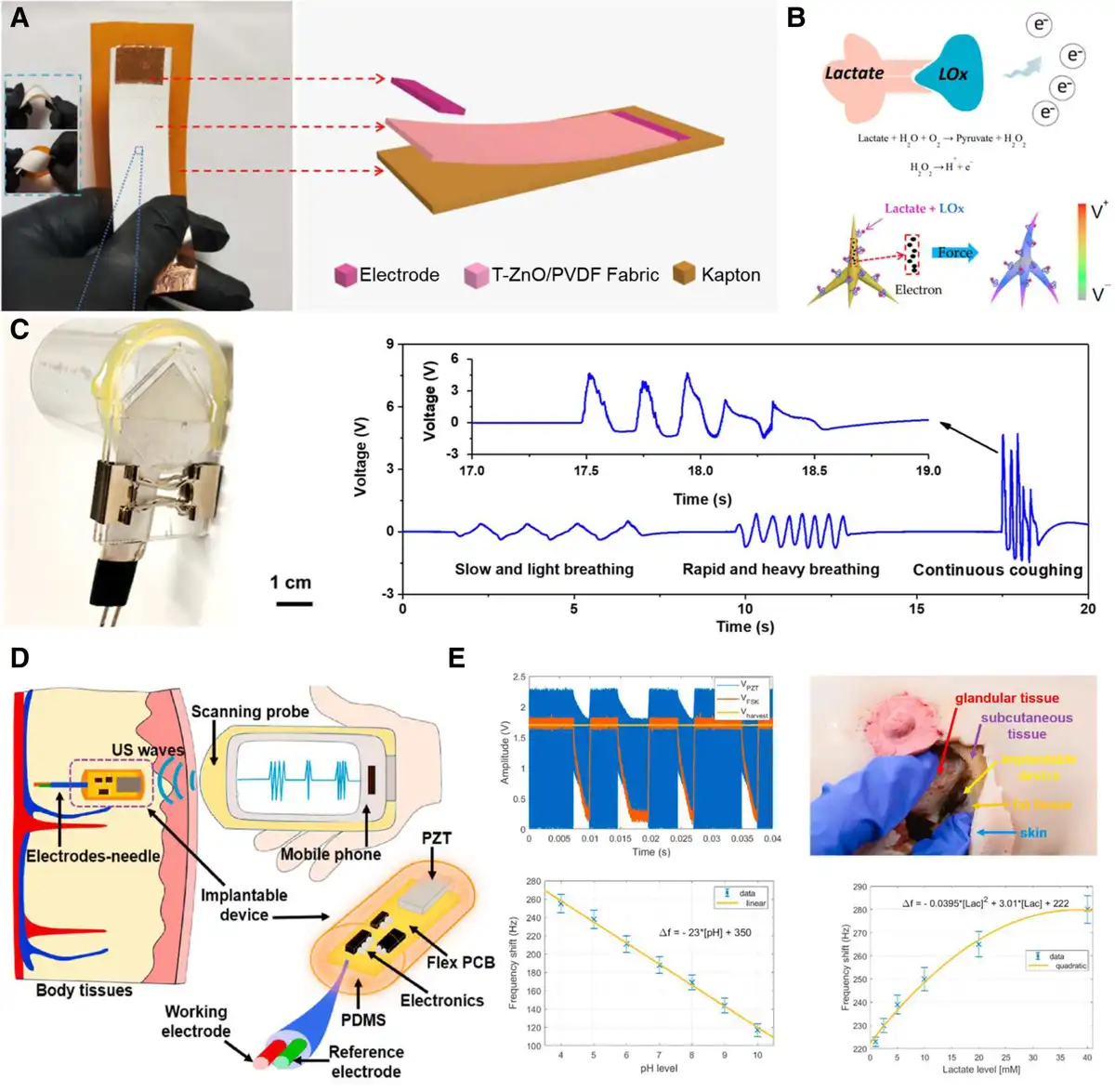
Figure 10.
PENG for metabolic monitoring. (A) Optical image of the device and device structure. Reproduced with permission from Mao et al.[298] Copyright 2020, MDPI. (B) Schematic diagram of the enzymatic reaction (top) and the working of the piezoelectric surface coupling effect. Reproduced with permission from Mao et al.[298] Copyright 2020, MDPI. (C) Photographs of the WPAT prototype and the human breathing pattern detection. WPAT2 recorded various breathing patterns, such as slow and brisk breathing, fast and heavy breathing, and continuous coughing (inset, 5 times). Reproduced with permission from Jin et al.[286] Copyright 2022, American Chemical Society. (D) Scenario image of ultrasonic transcutaneous energy transmission to an implantable device in the body. Reproduced with permission from Gil et al.[299] Copyright 2021, Elsevier. (E) Detected voltage signals and acoustics at specific points inside the implantable device. The test device consists of a realistic breast anatomical model (1.5 cm deep) with an implantable device built in, connected to pH or lactate solutions through developed electrodes. The frequency changes caused by different pH solutions (average) and the frequency changes caused by lactate solutions were tested on the detected FSK signal, expressed in terms of the statistical indicators involved (average and error bars). Reproduced with permission from Gil et al.[299] Copyright 2021, Elsevier.
Additionally, wearable experiments have elucidated the correlation between minute ventilation and metabolic rate (Figure 10C),[286] underscoring the potential of sensor technology to deepen our understanding of human metabolic dynamics. An advanced implantable device utilizing ultrasound-mediated data transmission presents a promising solution for monitoring pH and lactate levels in soft tissues, which is critical for postoperative care and disease progression evaluation. The integration of electrochemical sensors into implantable systems (Figure 10D) has the potential to revolutionize soft tissue parameter assessment, enabling home-based monitoring and improving patient outcomes, particularly in scenarios where hospitalization is impractical.[299] By seamlessly integrating these cutting-edge technologies—from MLSS-monitoring biosensors to ultrasound-enabled implantable devices (Figure 10E)—a comprehensive framework is established to advance healthcare practices, enhance sports performance analytics, and facilitate remote patient management.[299] This convergence of innovations paves the way for more efficient, personalized, and noninvasive health monitoring solutions, ultimately driving progress in precision medicine and proactive healthcare delivery.
4.5 Neural and brain activity
PENG have demonstrated the potential to detect neural oscillations and changes in intracranial pressure, offering insights into neural and brain activity. However, challenges related to sensitivity and invasiveness remain. By integrating ultrasonic energy transmission, piezoelectric material engineering, and targeted biological delivery technologies, researchers have developed a range of wireless, noninvasive, or minimally invasive diagnostic and therapeutic platforms. These innovations provide novel solutions for deep brain stimulation, interventions for neurodegenerative diseases, and obesity treatment.
Conventional DBS systems, which rely on implanted electrodes, are hindered by issues such as surgical trauma, electrode corrosion, and charge diffusion. To address these limitations, a novel piezoelectric ultrasonic energy harvesting device utilizing Sm-doped PMN-PT single crystals has been developed (Figure 11A).[300] This device leverages the piezoelectric response to ultrasound, efficiently converting externally emitted ultrasonic energy into electrical power. Upon implantation into the periaqueductal gray matter of rat midbrains, the device instantaneously activates analgesia-related neural circuits. Behavioral experiments demonstrate that wireless stimulation significantly alleviates pain responses without inducing tissue damage (Figure 11B).[300] Complementarily, regenerative strategies employ hybrid nanomaterials that attach to neural stem cells, functioning as membrane-integrated piezoelectric actuators. Under ultrasonic excitation, these materials generate electrical cues that accelerate neuronal differentiation and maturation through calcium-mediated signaling pathways.[301] When transplanted into injured brain tissue, such engineered constructs promote substantial structural repair and functional recovery in neurodegenerative models. Both paradigms circumvent traditional electrode drawbacks, eliminating mechanical trauma, corrosion risks, and charge diffusion, while leveraging wireless energy transfer. By enabling precise neuromodulation and enhancing neurogenesis, these innovations establish versatile frameworks for treating conditions ranging from chronic pain to traumatic brain injury, marking a shift toward biointegrated neural interfaces.
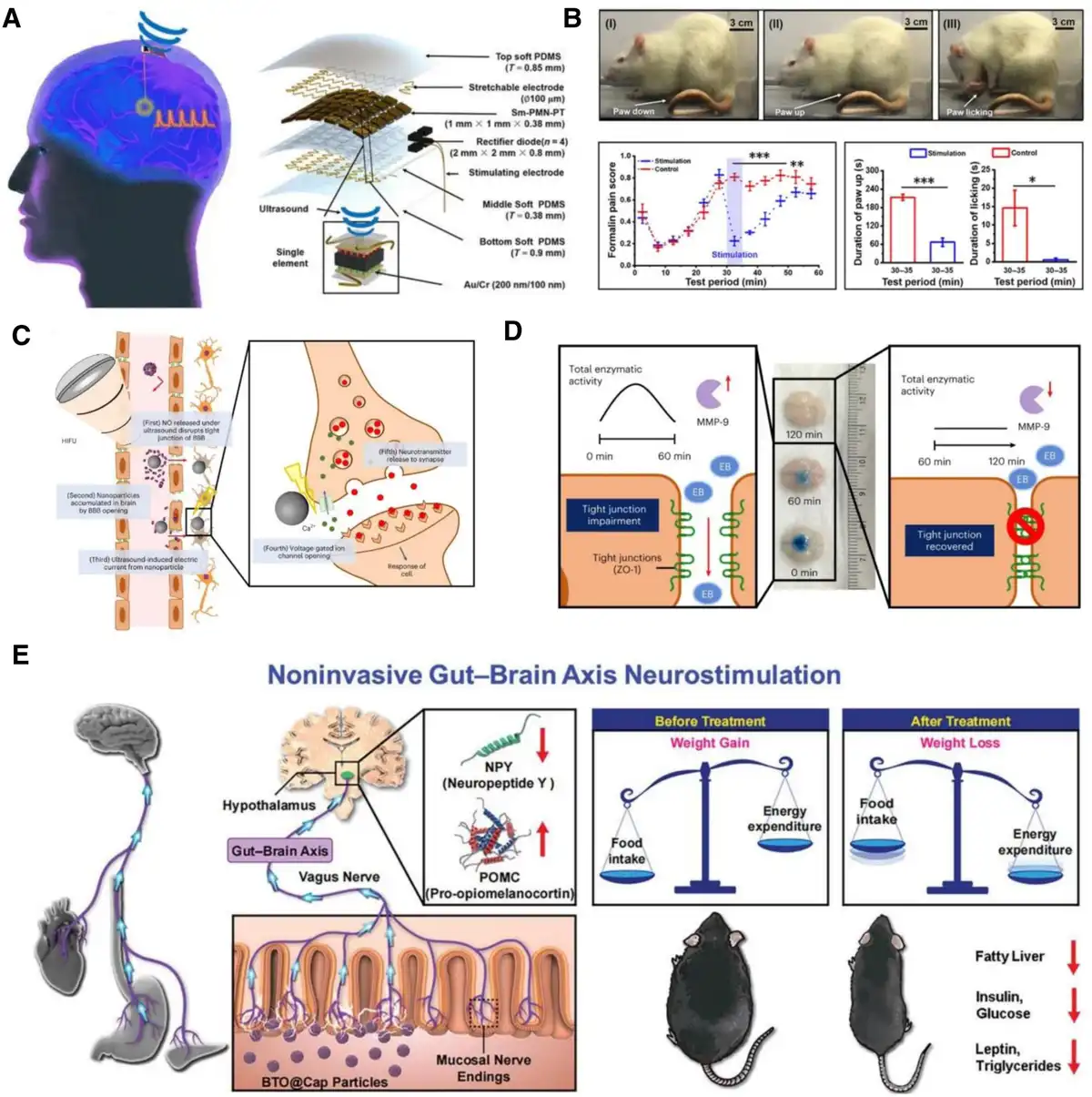
Figure 11.
PENG for brain stimulation. (A) Schematic diagram of the Sm-PUEH device for DBS and analgesia. Reproduced with permission from Zhang et al.[300] Copyright 2022, American Association for the Advancement of Science. (B) Three main behavioral responses of rats to formalin: (I) paw down, (II) paw up, and (III) paw licking, showing different pain levels from no pain to the most severe pain. And comparison of weighted pain scores induced by formalin in the stimulation group (n = 6) and the control group (n = 6). Total time (s) for paw lifting (left) and paw licking (right) within 30–35 min in the formalin test. Reproduced with permission from Zhang et al.[300] Copyright 2022, American Association for the Advancement of Science. (C) Schematic diagram of nanoparticles for BBB opening and DBS under ultrasound application. Systemically administered nanoparticles release NO locally under ultrasound, which then accumulates in the brain through the BBB opening. Then, ultrasound-mediated nanoparticles are polarized and stimulate neurons by opening voltage-gated ion channels, thereby performing neurostimulation. Reproduced with permission from Kim et al.[302] Copyright 2023, Springer Nature. (D) Images showing the accumulation of EB in brain tissue over time. Inset: The mechanism of BBB opening and closing speculated based on MMP-9 activity. Reproduced with permission from Kim et al.[302] Copyright 2023, Springer Nature. (E) After oral administration, piezoelectric BTO@Cap particles specifically target and bind to Cap-sensitive nerve endings. These particles then generate mild electrical pulses in response to gastric movements. The self-generated pulse electrical signals stimulate vagus nerve afferent fibers, leading to reduced food intake and increased metabolic rate in mice, ultimately improving dietary obesity and obesity-related metabolic disorders. Reproduced with permission from Mac et al.[303] Copyright 2024, Wiley-VCH.
Another significant challenge in DBS is the noninvasive targeting of neurons within the brain parenchyma. Systemically administered piezoelectric nanoparticles offer a promising solution (Figure 11C).[302] When exposed to high-intensity focused ultrasound, these nanoparticles generate direct current stimulation through the piezoelectric effect, triggering the release of nitric oxide (NO). NO temporarily disrupts the tight junctions of the blood–brain barrier, facilitating nanoparticle penetration into the brain parenchyma. In a Parkinson’s disease mouse model, this strategy significantly increased striatal dopamine levels (Figure 11D) and alleviated motor dysfunction by electrically stimulating dopaminergic neuron-like cells.[302] Histological analysis confirmed minimal toxic accumulation of nanoparticles in the brain. This technology combines the energy conversion advantages of piezoelectric materials with the deep penetration capabilities of ultrasound, opening new avenues for minimally invasive treatments of neurodegenerative diseases such as Alzheimer’s.
For obesity and related metabolic disorders, noninvasive treatment methods are urgently needed. An oral self-powered voltage stimulator has been developed to achieve metabolic regulation by targeting the gastric vagus nerve (Figure 11E).[303] Capsaicin (Cap) on the particle surface binds to TRPV1 receptors in the gastric mucosa, converting the mechanical energy of gastric peristalsis into electrical pulses via BTO piezoelectric materials. These pulses directly stimulate the afferent fibers of the vagus nerve. Animal experiments demonstrated that this stimulation suppresses appetite, enhances energy expenditure, and reduces fat production through the gut-brain axis, leading to significant weight loss in diet-induced obese mice. This technology operates without external power sources and avoids the gastrointestinal side effects associated with traditional drug therapies, offering a safe and reversible physical intervention strategy for obesity treatment.
Traditional neural probe implantation often results in tissue damage and chronic inflammation due to mechanical friction during insertion. Silicon-based ultrasonic neural probes (Figure 12A) address this issue through an innovative piezoelectric ceramic-driven mechanism: the probe tip incorporates a longitudinally resonant piezoelectric plate capable of generating micron-level, high-frequency vibrations at ultrasonic frequencies.[304] This design leverages the tissue-hardening effect induced by high tip speed, which minimizes deformation and frictional resistance along the insertion path. Additionally, the silicon-based ultrasonic horn exhibits superior acoustic impedance matching with neural tissue compared to titanium alloys, enabling higher vibration amplitude transmission while maintaining mechanical integrity. Experimental validation in rat cortical implants (Figure 12B) demonstrates that the silicon-based ultrasonic neural probe significantly reduces tissue damage, suppresses inflammatory responses, and ensures long-term recording stability, offering a safer and more reliable tool for neuroscience research.[304]
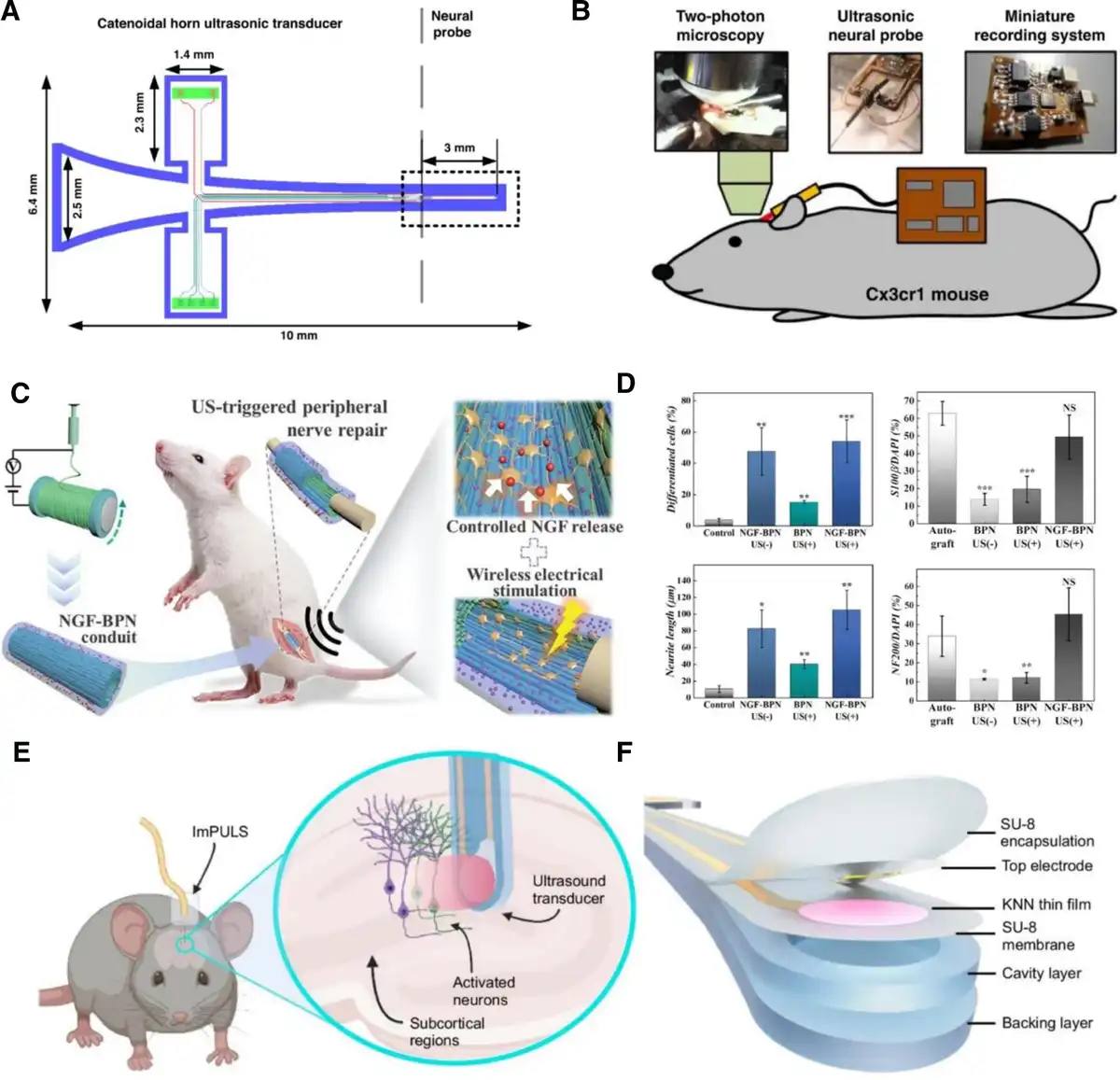
Figure 12.
PENG for neural stimulation. (A) Catenary horn and cofabricated neural probe. Reproduced with permission from Chen et al.[304] Copyright 2022, Springer Nature. (B) Chronic animal model with a cranial window and microrecording system for 2-photon excitation fluorescence imaging at the tip of the inserted ultrasonic neural probe (left). Reproduced with permission from Chen et al.[304] Copyright 2022, Springer Nature. (C) Schematic diagram of ultrasound-responsive oriented piezoelectric nanofiber-derived hydrogel conduit for peripheral nerve regeneration. Reproduced with permission from Xu et al.[305] Copyright 2024, Advanced Materials. (D) Percentage of neurons differentiated from PC12 cells and the neurite length of differentiated PC12 cells. Positive areas for S-100β and NF200 (n = 4). Reproduced with permission from Xu et al.[305] Copyright 2024, Wiley-VCH. (E) Schematic diagram of an implantable piezoelectric ultrasonic stimulator (ImPULS) implanted in the subcortical brain region of wild-type mice. A magnified view shows the neurons activated by ultrasound. Reproduced with permission from Hou et al.[306] Copyright 2024, Springer Nature. (F) Schematic diagram of a peeled view of ImPULS showing each layer. ImPULS is a piezoelectric micromachined ultrasonic transducer (pMUT) structure in which biocompatible KNN is sandwiched between 2 thin SU-8 layers and forms an air-filled cavity and a backing layer below the piezoelectric film membrane. Reproduced with permission from Hou et al.[306] Copyright 2024, Springer Nature.
Peripheral nerve injury repair requires both physical guidance and biological activity regulation. The BTNPs/P(VDF-TrFE) oriented nanofiber hydrogel (Figure 12C) overcomes this challenge through a multimodal design.[305] Electrospinning technology constructs aligned nanofibers, while BTNPs doping enhances the crystallinity of the β phase. Under ultrasonic thermal stimulation, the thermosensitive drug release layer, composed of pNIPAM hydrogel, undergoes volume contraction, triggering the controlled release of encapsulated nerve growth factor. This promotes neuronal growth (Figure 12D) and accelerates the reconstruction of damaged nerve structures and functions in a rat sciatic nerve defect model.[305] These results highlight the dual functionality of BTNPs/P(VDF-TrFE) oriented nanofiber hydrogels in providing physical guidance and bioactive regulation, offering an effective therapeutic strategy for peripheral nerve injury repair.
Conventional deep brain stimulation is constrained by electrode size and energy diffusion limitations. The implantable piezoelectric ultrasonic stimulator (ImPULS) (Figure 12E) achieves a breakthrough through micro-nano fabrication.[306] The device features an SU-8 substrate (0.8 μm in thickness), encapsulation and backing layers (0.5 and 15 μm in thickness, respectively), a piezoelectric KNN layer (1 μm in thickness, 100 μm in diameter), and Cr/Au (10/250 nm) and Pt (100 nm) as top and bottom electrodes, respectively, with Cr/Au serving as metal interconnects (10/250 nm in thickness). The fabrication process involves wet etching, patterning, and transfer printing of the piezoelectric film onto a polymer SU-8 substrate (Figure 12F).[306] Experimental results demonstrate that ImPULS successfully stimulates mouse hippocampal neurons, activates c-Fos expression, and modulates dopamine release, showcasing its efficient neuromodulatory capabilities.
From ultrasound-driven probes to intelligent neural scaffolds and deep brain stimulators, piezoelectric technology has established a comprehensive “precision implantation-functional reconstruction-neural modulation” solution through multiscale innovation. These advancements not only significantly reduce the invasiveness of neural devices but also provide a transformative, integrated therapeutic platform for intractable conditions such as Parkinson’s disease and peripheral nerve injuries, enabled by energy autonomy and closed-loop feedback designs. With ongoing advancements in materials science and micro-nano fabrication, ultrasound-piezoelectric systems are poised to become the cornerstone of next-generation neural interface technologies.
4.6 Wound healing
PENG is revolutionizing wound care by enabling intelligent and dynamic solutions that integrate sensing and therapeutic functionalities. PENG facilitates real-time monitoring of wound healing stages, early detection of infection risks, and active promotion of tissue regeneration, offering a multimodal approach for managing chronic wounds, such as diabetic ulcers, and postoperative recovery.
The persistent biofilm in diabetic wounds is a major contributor to delayed healing. A sonocatalytic polysaccharide/NADH composite system has been developed to address this issue (Figure 13A).[307] Under ultrasonic activation, this system generates reactive hydrogen species that rapidly penetrate and disrupt bacterial membrane potentials, inhibiting bacterial energy metabolism. Simultaneously, hydrogen (H₂) reacts with catalase within the biofilm, blocking the bacterial oxidative phosphorylation pathway (Figure 13B).[307] Another innovative approach incorporates BTO nanoparticles to enable ultrasound-triggered piezoelectric catalytic therapy. Ultrasonic excitation of BTO generates a piezoelectric field, driving electron-hole separation and producing hydroxyl radicals (·OH) and superoxide anions (O₂⁻), thereby enhancing bactericidal efficiency. The composite hydrogel dressing, which embeds BTO nanoparticles within a gelatin/oxidized hyaluronic acid matrix (Figure 13C),[308] exhibits strong adhesion, self-healing properties, and controlled reactive oxygen species (ROS) release, significantly accelerating skin wound repair (Figure 13D).[308]
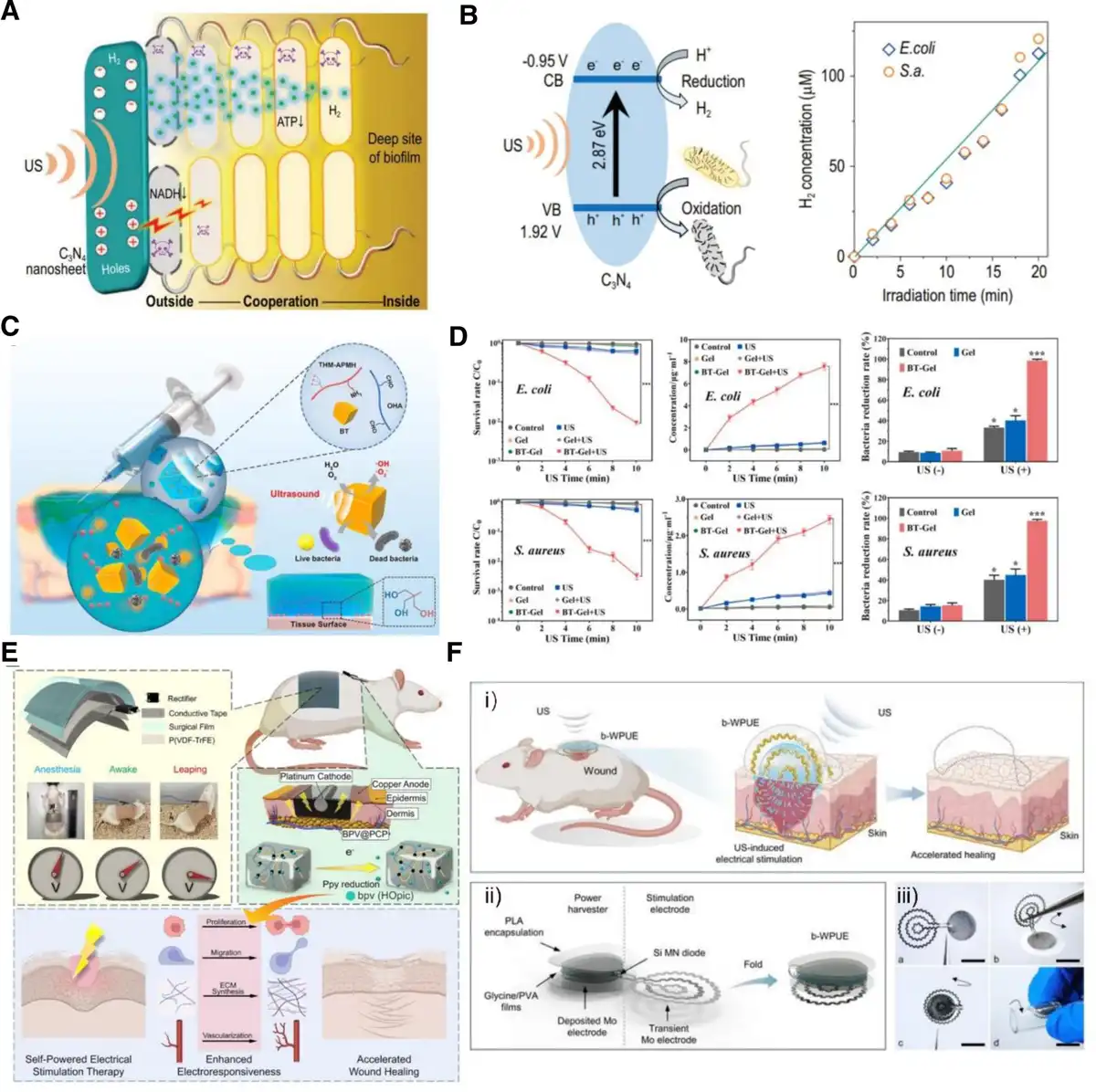
Figure 13.
PENG for wound healing. (A) Schematic illustration of the strategy and mechanism of sonocatalytic hydrogen/hole-combined “inside/outside-cooperation” antibiofilm. Reproduced with permission from Xu et al.[307] Copyright 2023, China Science Publishing & Media Ltd. (B) the schematic illustration of band structure (versus NHE [normalized hydrogen electrode]) and sonocatalytic H2 production and bacterial oxidation, and the time-dependent sonocatalytic performances of C3N4 nanosheets. Reproduced with permission from Xu et al.[307] Copyright 2023, China Science Publishing & Media Ltd. (C) Schematic diagram of ultrasound-activated piezoelectric catalytic gel for wound healing. Reproduced with permission from Liu et al.[308] Copyright 2023, Elsevier. (D) In vitro US-triggered piezocatalytic antibacterial therapy of BT-Gel against E. coli and S. aureus. Reproduced with permission from Liu et al.[308] Copyright 2023, Elsevier. (E) P(VDF-TrFE)-based nanogenerator mounted on an experimental rat converted motion into electricity that synchronously charges the wound, realizes self-powered electrical stimulation therapy, and promotes wound healing. Reproduced with permission from Fu et al.[309] Copyright 2023, American Chemical Society. (F) Working principle and layouts of b-WPUE. Reproduced with permission from Xue et al.[310] Copyright 2024, American Association for the Advancement of Science.
Electrical stimulation promotes epithelial regeneration by modulating cellular electrophysiological behavior, but traditional ES therapies are limited by the heterogeneous electrical responsiveness of cells. A breakthrough has been achieved with an electroresponsive hydrogel system loaded with a phosphatase and tensin homolog (PTEN) inhibitor. The synergistic effects of electrical stimulation and PTEN inhibition enhance vascular endothelial growth factor secretion and accelerate angiogenesis. Furthermore, a wearable DC pulse PENG converts the mechanical energy from rat movement into electrical signals (Figure 13E), enabling pulsed on-demand release of PTEN inhibitors from the hydrogel.[309] This approach optimizes wound healing by improving cellular electrical responsiveness while minimizing the adverse effects associated with prolonged PTEN inhibition.
Conventional electronic dressings often require surgical removal, increasing infection risks. A biodegradable piezoelectric transient device, composed of γ-glycine/PVA piezoelectric film, addresses this limitation through optimized synthesis guided by density functional theory (Figure 13F).[310] First-principles calculations and experimental validation reveal that γ-glycine crystals grow preferentially along the orientation, achieving a piezoelectric coefficient (d₃₃) of 10.4 pC/N, comparable to traditional PVDF. The film hydrolyzes in the slightly acidic wound environment within 14-days postimplantation, leaving no toxic residues and achieving a balance between effective treatment and safe degradation.
Chronic wounds often fail to heal due to the attenuation of bioelectric signals. To address this, ZnO nanoparticle-modified PVDF/sodium alginate (ZPFSA) scaffolds have been developed to reconstruct the electrical microenvironment through a dual piezoelectric effect (Figure 14A).[311] The synergistic interaction between the β-phase of PVDF and ZnO nanoparticles enables the scaffold to mimic the natural wound potential in response to mechanical stress, thereby accelerating wound healing and minimizing scar formation. Notably, the ZPFSA 0.5 scaffold demonstrates exceptional biocompatibility, antibacterial properties, and a stable piezoelectric response, significantly enhancing the wound healing process within 2 weeks (Figure 14B).[311] Complementarily, electrostimulation via flexible piezoelectric films offers another approach to restore bioelectric fields. Surface-functionalized BTO nanoparticles (BT@CDs@ArPFTU) were incorporated into electrospun P(VDF-TrFE) matrices, yielding films with elevated β-phase crystallinity and piezoelectric output. These P(VDF-TrFE)/BT@CDs@ArPFTU films were assembled into PENG, exhibiting robust electrical performance suitable for wireless electrostimulation.[312]
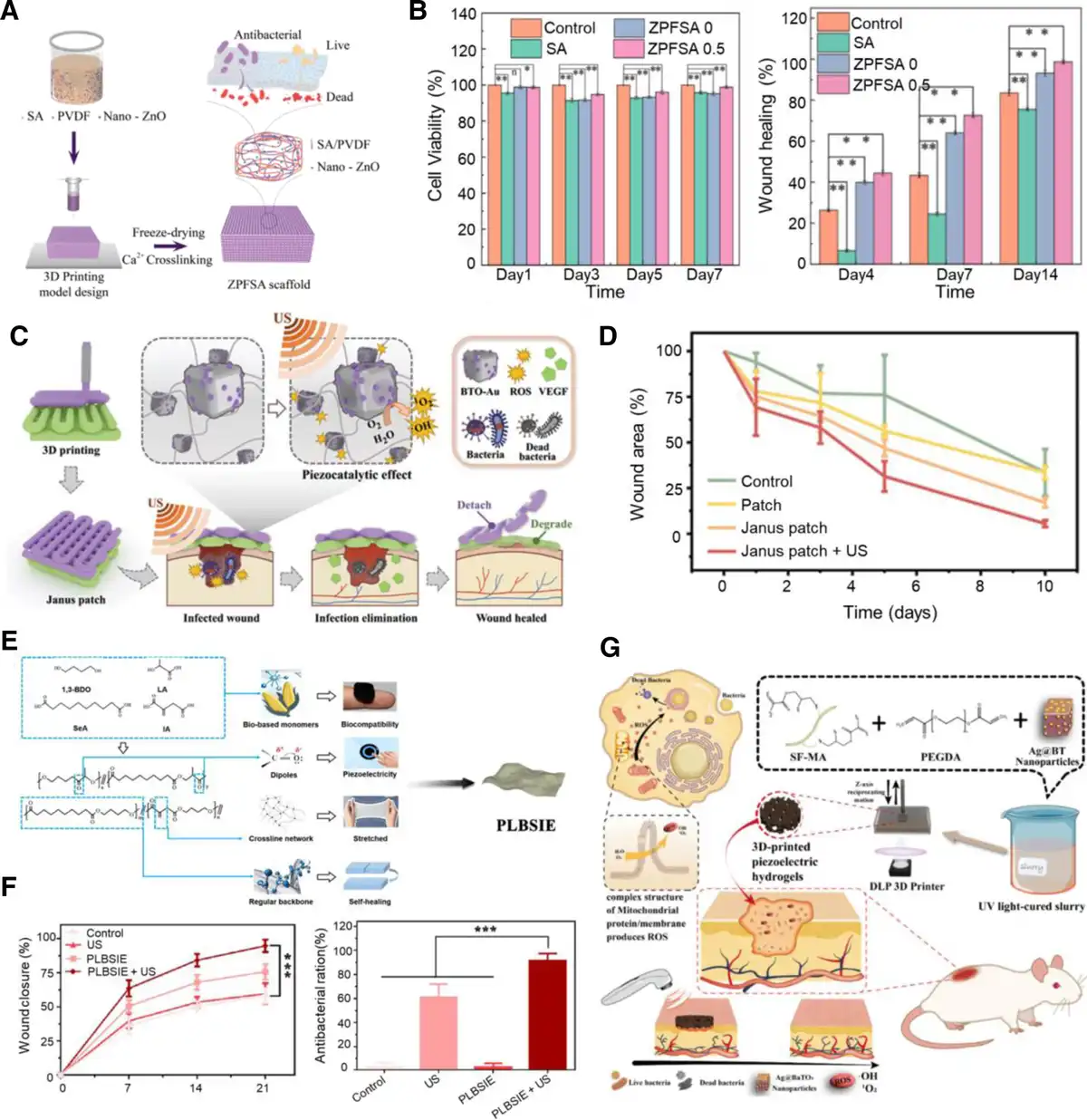
Figure 14.
PENG for wound healing. (A) Schematic illustration of preparing and applying the ZPFSA piezoelectric scaffold. Reproduced with permission from Liang et al.[311] Copyright 2022, American Chemical Society. (B) Biocompatibility test and wound healing rate of ZPFSA piezoelectric scaffold. Reproduced with permission from Liang et al.[311] Copyright 2022, American Chemical Society. (C) Schemes of the fabrication and application of the Janus patch. The piezoelectric materials and growth-factor-coloaded Janus hydrogel patch realized the US-excited bacteria elimination and promoted wound healing. Reproduced with permission from Huang et al.[313] Copyright 2023, American Association for the Advancement of Science. (D) The relative wound area with different treatments from day 0 to 10. Reproduced with permission from Huang et al.[313] Copyright 2023, American Association for the Advancement of Science. (E) Schematic Illustration of the Synthesis Process of PLBSIE. Reproduced with permission from Deng et al.[315] Copyright 2023, American Chemical Society. (F) Wound healing rates with different treatments in the 21 days and quantitative analyses of antibacterial efficiency after different treatments. Reproduced with permission from Deng et al.[315] Copyright 2023, American Chemical Society. (G) The magnified image reveals the generation of ROS by mitochondria inside the body, as well as the customizable wound repair using SF-MA/PEGDA/Ag@BT hydrogels. Reproduced with permission from Chen et al.[316] Copyright 2024, Elsevier.
Infected wounds necessitate simultaneous sterilization and tissue regeneration. A 3D-printed Janus piezoelectric patch has been designed to achieve dual-modal intervention via a cocktail therapy approach (Figure 14C).[313] This patch comprises a polyethylene glycol diacrylate hydrogel layer enriched with tetragonal BTO and a methacrylate gelatin layer loaded with growth factors. Under ultrasound activation, the patch generates ROS for targeted sterilization while delivering growth factors to promote tissue regeneration. In vivo studies confirm the patch’s efficacy in mitigating infection and facilitating healing, underscoring its potential in programmable wound management strategies (Figure 14D).[313] Addressing the specific challenge of tendon-to-bone healing, Janus asymmetric piezoelectric adhesives were developed. These consist of an adhesive hydrogel and a nonadhesive hydrogel assembled on a piezoelectric PLLA nanofiber mat, enabling minimally invasive application on irregular interfaces.[314] Crucially, these adhesives exert superior anti-inflammatory effects. Mechanistic studies revealed that the piezoelectric stimulation activates the TRPV1 ion channel, promoting Ca²⁺ influx in macrophages and enhancing the cAMP signaling pathway.
Postoperative tumor recurrence and delayed wound healing are often concurrent challenges. A lactic acid-butylene glycol-sebacic acid-itaconic acid copolymer elastomer (PLBSIE) addresses these issues through a piezoelectric-chemodynamic synergistic design (Figure 14E).[315] The ultrasound-activated PLBSIE platform demonstrates significant potential in eradicating tumor cells and accelerating wound healing via ROS generation and piezoelectric therapy, showcasing its multifunctionality in treating postoperative tumor-induced wounds (Figure 14F).[315] This elastomer represents a promising solution for comprehensive postoperative care in osteosarcoma, highlighting its therapeutic versatility.
Complex wounds require both mechanical support and infection control. Silk fibroin/polyethylene glycol diacrylate/Ag@BT (SPAB) hydrogels, fabricated using digital light processing 3D printing, offer customizable structures to meet these needs (Figure 14G).[316] Under ultrasound stimulation, these hydrogels exhibit remarkable antibacterial efficacy against Escherichia coli and Staphylococcus aureus, achieving antibacterial rates of 99.23% and 99.96%, respectively. The ultrasound-induced piezoelectric catalytic effect enhances ROS production, further promoting wound healing and combating bacterial infections.
A novel rotary jet-spun all-organic piezoelectret textile overcomes the functionality-comfort trade-off in wearables. Electrical poling significantly enhances its piezoelectric output, attributed to trapped polarized charges. The textile demonstrates high pressure sensitivity, effective waterproofness, and excellent breathability, ensuring user comfort. Beyond monitoring physiological signals like pulse and respiration, it functions as a deep learning-assisted pressure-mapping sensor array with high accuracy. Crucially, its piezoelectricity induces electrical stimulation that accelerates cell proliferation and migration, highlighting its dual potential for advanced biosensing and smart wound dressings, offering a scalable biomedical solution.
PENG have established a new paradigm for intelligent wound healing through multidisciplinary innovation. These advancements address critical challenges in chronic wound management, such as biofilm resistance, slow cell regeneration, secondary surgical trauma, scar formation, and postoperative recurrence. By integrating energy autonomy and closed-loop feedback designs, PENG-based systems provide a scalable platform for personalized medicine, paving the way for next-generation wound care solutions.
5. Challenges
5.1 Power generation efficiency and energy storage challenges
The energy conversion efficiency of PENG is fundamentally limited by several material, structural, and electrical factors. The choice of piezoelectric materials remains a primary constraint, as many exhibit suboptimal energy harvesting performance compared to alternative technologies.[317] Low power output—typically in the microwatt to milliwatt range—further restricts their applicability in high-energy-demand scenarios, due to limited charge generation per deformation cycle and high internal impedance.[318,319] Structural inefficiencies, including inadequate mechanical coupling, nonoptimized architectures, and long-term material fatigue, can also degrade performance.[320] In addition, charge loss through recombination and leakage, compounded by internal capacitance and resistance, reduces effective output.[321] Impedance mismatching between the PENG and external circuits leads to further power loss, highlighting the need for optimized load-matching strategies.[322] PENG To overcome energy conversion limitations in PENG, we transition from passive optimization to active intelligent systems. ML—particularly graph neural networks—accelerates the discovery of application-tailored piezoelectric materials. Concurrently, quantum-confined architectures incorporating strain-engineered quantum wells in piezoelectric semiconductors radically enhance charge separation efficiency by directly converting nanoscale lattice vibrations into usable electrons.
Efficient energy storage is paramount to overcoming the inherent challenges of PENG, which produce intermittent and low-power output. A key issue is the low energy density of PENG, as the energy harvested per mechanical cycle is minimal.[323] This necessitates the use of advanced storage solutions, such as supercapacitors or microbatteries, capable of efficiently storing small, irregular energy bursts.[323] Additionally, the intermittent and unpredictable nature of PENG output, driven by mechanical stimulation, complicates direct power utilization. Energy storage systems must not only capture these fluctuating inputs but also stabilize them to deliver a consistent power supply. Another challenge lies in energy transfer inefficiencies, where losses during rectification, impedance matching, and energy conversion reduce overall system efficiency.[320] Scalability and integration further present significant hurdles, particularly for applications requiring compact, lightweight, and flexible designs, such as wearable or implantable devices.[320] Developing energy storage solutions that balance high capacity, flexibility, and compatibility with PENG is complex, as it involves navigating trade-offs between size, weight, and functionality. Addressing these challenges is essential for advancing PENG-based energy harvesting systems, enabling their practical application in powering low-energy devices such as sensors, wearables, and biomedical implants. Addressing PENG energy storage demands a shift from discrete devices to biointegrated systems. We propose intelligent energy ecosystems where biocoupled supercapacitors, using DNA-origami electrodes that mimic mitochondrial morphology, achieve ultrahigh Coulombic efficiency; meanwhile, self-regulating near-zero-power wake-up controllers enable event-driven prioritization of critical biomedical data transmission during energy-scarce conditions. This integrated approach fundamentally transforms intermittent outputs into reliable power for sustained medical device operation, ensuring clinical-grade reliability.
5.2 Biocompatibility and long-term stability in the human body
PENG holds significant promises such as self-powered biomedical implants, wearable health monitors, and drug delivery systems due to their ability to convert mechanical energy into electrical energy. However, their successful integration into the human body hinges on 2 critical factors: biocompatibility and long-term stability. Ensuring that PENG do not elicit adverse biological responses while maintaining functional efficiency over extended periods remains a major challenge.
5.2.1 Biocompatibility challenges
Biocompatibility is a fundamental requirement for implantable PENG. However, many traditional piezoelectric materials pose toxicity risks, making them unsuitable for biomedical use.[324] To address this, lead-free and bioderived alternatives have been developed to improve tissue compatibility while retaining functional performance.[325] Immune responses to implanted devices also present major challenges, potentially causing inflammation or fibrotic encapsulation. These effects can be mitigated through biocompatible encapsulation layers or surface modifications that promote integration and reduce immunogenicity.[326,327]
Next-generation research prioritizes programmable biointerfaces to transcend biocompatibility limits. Synthetic piezoelectric tissues, genetically engineered collagen hybrids incorporating integrin-binding RGD motifs, promote host tissue integration. Concurrently, CRISPR-designed extracellular vesicles deliver PD-L1 proteins for immune-stealth functionality, mitigating foreign-body responses through transient immunosuppression. These biologically encoded interfaces transform PENG from passive implants into actively integrated systems, overcoming fundamental biocompatibility barriers.
5.2.2 Long-term stability challenges
For PENG to function effectively in biomedical applications, they must remain stable under physiological conditions and operate reliably over extended periods. The human body presents a harsh environment for electronic devices, with factors such as moisture, enzymatic degradation, temperature fluctuations, and mechanical stress potentially degrading PENG materials over time.
A significant challenge is material degradation due to prolonged exposure to bodily fluids.[328] Conventional piezoelectric materials may undergo hydrolysis, corrosion, or loss of mechanical integrity. To address this, researchers are exploring water-repellent and bioinert coatings, such as silicon dioxide (SiO₂), graphene oxide, and fluorinated polymers, to extend the lifespan of PENG.[220] Additionally, the development of flexible and stretchable PENG based on materials like PVDF-TrFE and hybrid inorganic-organic composites enables better resistance to dynamic mechanical forces within the body.[16,242] Another issue is the loss of energy efficiency over time. Repeated mechanical stress can lead to fatigue and microstructural damage, degrading the device’s piezoelectric performance. To enhance durability, researchers are investigating self-healing materials capable of autonomously repairing microcracks and defects.[324] Furthermore, integrated hybrid energy harvesting systems, such as combining PENG with biofuel cells or TENG, can help maintain stable power output over extended periods.[329]
To achieve long-term stability, we suggest that transition from passive encapsulation to dynamic self-adaptive architectures. Topology-optimized gyroid nanolattices harness geometric confinement to resist enzymatic degradation. Meanwhile, 4D-printed shape-memory scaffolds intelligently reconfigure their microstructure in response to physiological variations. These biologically responsive systems transform implants into seamlessly integrated components, sustaining functionality through continuous adaptation to the living environment.
In summary, while PENG offers exciting potential for self-powered biomedical devices, their long-term success depends on advancements in biocompatibility and stability. Innovations in lead-free materials, biomimetic coating, flexible structures, and self-healing mechanisms are essential to ensure their safe and effective operation within the human body. Continued interdisciplinary research in materials science, bioengineering, and nanotechnology is crucial to fully realizing the potential of PENG in medical applications.
5.3 Mechanical durability and flexibility for biomedical monitoring
PENG faces substantial challenges in achieving mechanical durability and flexibility for biomedical use, as they must withstand repeated mechanical stress while conforming to dynamic biological surfaces. Many conventional materials are brittle and prone to fatigue, leading to functional degradation under cyclic loading. In contrast, flexible alternatives often suffer from reduced piezoelectric performance and long-term instability. Adhesion between active materials and soft substrates remains problematic, as delamination under strain can diminish energy output. Material selection is further constrained by biocompatibility requirements, limiting the use of high-efficiency but toxic components. Environmental factors, including moisture, temperature variations, and biological fluids, pose additional risks to device stability without effective encapsulation. Moreover, seamless integration with sensors and electronics is complicated by strain-induced property changes and interfacial resistance. Overcoming these issues requires advances in composite material design, resilient microstructures, and biocompatible architectures to ensure long-term, high-performance operation in wearable or implantable settings.
Biological intelligence inspires revolutionary solutions: Mussel foot-inspired polymers achieve self-healing through reversible sacrificial bonds, dynamically repairing microdamage during stress. Pericarp-mimetic barriers provide seamless environmental defense while maintaining exceptional flexural compliance. This harmonious fusion of nature’s designs transforms rigid devices into adaptive biomechanical interfaces, ensuring enduring functionality within living systems.
6. Conclusion and prospects
6.1 Conclusion
PENG have emerged as a transformative technology in biomedical diagnostics, seamlessly integrating energy harvesting and precision sensing to redefine the monitoring and interpretation of physiological signals. Recent advancements underscore their revolutionary potential in healthcare: in cardiovascular monitoring, wearable PENG patches enable real-time tracking of HR, blood pressure, and vascular health; in respiratory diagnostics, flexible PENG-based sensors provide critical metrics such as respiratory rate, tidal volume, and obstruction status, aiding in the diagnosis of lung diseases; in neuromuscular interfaces, PENG decode muscle contractions and gait dynamics, enhancing the quality of life for patients with specific health conditions; and in metabolic and neural sensing, implantable PENG devices monitor blood glucose dynamics and brain activity, while smart wound dressings leverage self-generated electric fields to combat infections and accelerate healing. These innovations highlight the immense potential of PENG in advancing personalized medicine and enabling real-time health monitoring.
PENG demonstrates significant near-term potential for clinical translation, particularly in cardiovascular monitoring, respiratory sensing, and wound healing, driven by compelling preclinical results and simpler integration pathways. In cardiovascular applications, implantable PENG like ultrathin PVDF/HHE sensors have successfully tracked real-time hemodynamics and micropressure changes in arterial walls within living pig models,[273] while wearable versions, such as piezoelectric sensors embedded in watch straps, have already achieved clinical validation with accuracy comparable to standard blood pressure monitors.[278] For respiratory monitoring, fully integrated wearable solutions exist, including smart masks with 3D-printed cellulose nanocrystal sensors capable of autonomously distinguishing breathing patterns[285] and PLLA-based airflow transducers that have quantified metabolic rates in human trials.[286] Wound healing represents another highly promising near-term application, where PENG-based dressings incorporating materials like ZnO-PVDF/sodium alginate scaffolds showed 98.74% wound closure within 14 days in vivo studies, simultaneously offering antibacterial benefits and biocompatibility.[311] While neural interfaces and metabolic tracking hold future promises, challenges like chronic biocompatibility, power stability, and complex regulatory hurdles currently delay their clinical entry. In contrast, cardiovascular, respiratory, and wound-healing PENG leverage their relative simplicity of integration, lower power requirements, and robust preclinical performance data, positioning them clearly at the forefront for imminent clinical adoption.
However, the path to clinical translation is fraught with challenges. Limitations in power density restrict their use in energy-intensive applications, and the long-term stability of biocompatible materials in corrosive physiological environments remains uncertain. Mechanical fatigue under cyclic stress and the integration of sustainable energy storage systems also demand urgent attention. Addressing these issues will require interdisciplinary collaboration, uniting expertise in materials engineering, biomechanics, and data science to overcome existing barriers and unlock the full potential of PENG in biomedical applications (Figure 15).
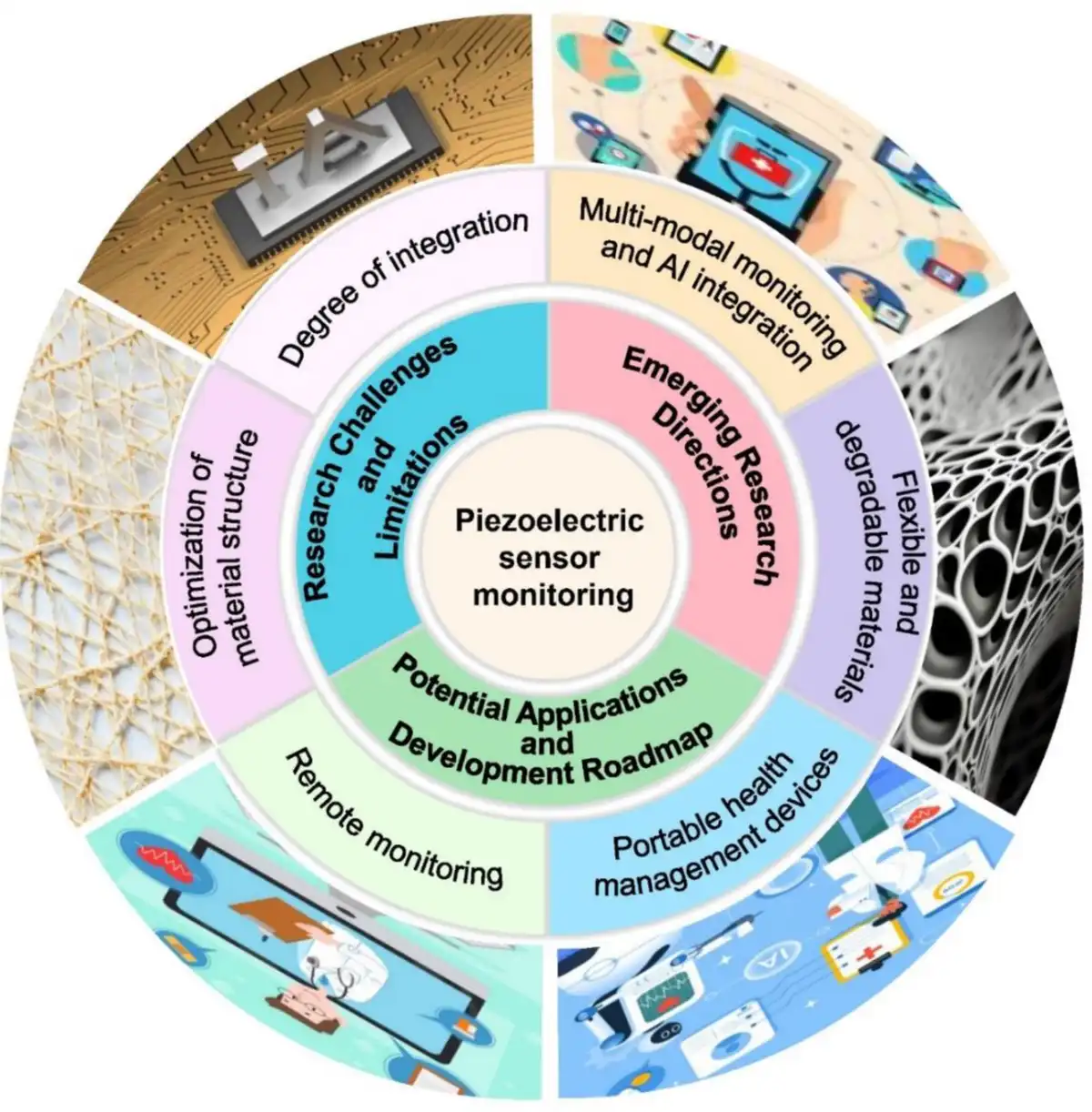
Figure 15.
Overview of piezoelectric sensor monitoring, including research challenges and limitations, emerging research direction, potential applications, and development roadmap.
6.2 Prospects
6.2.1 Advances in multifunctional PENG
Next-generation PENG are poised to transcend their traditional role in energy harvesting by integrating multifunctional capabilities. Hybrid architectures that combine piezoelectric materials with triboelectric, thermoelectric, or optoelectronic elements (eg., PENG-TENG hybrids) will amplify power output and enable multimodal sensing. For instance, a PENG embedded within a drug-eluting hydrogel can simultaneously monitor wound pH, release antibiotics, and generate therapeutic electric fields to accelerate tissue regeneration.[330] Additionally, “smart” PENG integrated into microfluidic or optoelectronic interfaces can facilitate real-time biochemical sensing (eg., glucose, lactate) alongside mechanical signal detection.[331] Innovations in piezoelectric composites, such as PZT-PVDF matrices doped with conductive nanoparticles (eg., graphene, MXenes), will further enhance charge transfer efficiency and enable dual-mode sensing-actuation systems for applications like closed-loop neuromodulation.[332]
Recent advancements in multifunctional PENG have unlocked new frontiers in energy harvesting and self-powered systems, driven by innovations in materials, device architectures, and integration strategies. Significant progress has been made in improving the performance and versatility of PENG through the use of advanced piezoelectric materials, including ZnO nanowires, BaTiO₃ nanoparticles, and PVDF-based polymers, which exhibit high piezoelectric coefficients, flexibility, and biocompatibility.[325] Hybrid structures that integrate PENG with TENG or other energy harvesters have expanded their functionality, enabling simultaneous energy harvesting from multiple sources such as mechanical vibrations, human motion, and environmental stimuli.[329,333] Flexible and stretchable PENG, fabricated using substrates like PDMS and Ecoflex, are paving the way for wearable electronics and biomedical applications, including self-powered health monitors and implantable devices.[334] Furthermore, nanostructured surfaces and optimized electrode designs have significantly enhanced power output and efficiency, enabling PENG to power low-energy electronics and sensors.
The prospects for multifunctional PENG are highly promising, particularly in healthcare and wearable electronics. In medical applications, PENG have the potential to power implantable devices such as pacemakers and drug delivery systems by harvesting biomechanical energy. Wearable electrjlnics, including smart clothing and fitness trackers, can also benefit from PENG’ ability to generate energy from everyday activities. However, challenges remain in improving the durability, reliability, and energy conversion efficiency of PENG, particularly under harsh conditions or sustained mechanical stress. Scalable manufacturing techniques, such as roll-to-roll printing and 3D printing, are critical to commercializing PENG and reducing production costs. Additionally, addressing potential material toxicity and environmental impacts, especially in biomedical applications, is essential to ensuring safe and sustainable deployment.
6.2.2 Role of AI in PENG-powered sensors
AI is revolutionizing PENG-powered sensors, significantly enhancing their energy efficiency, data processing capabilities, and adaptive functionality. PENG, which harvests energy from ambient mechanical sources such as vibrations or body motion, often faces challenges due to low and irregular power output. AI addresses these limitations by optimizing energy management, enabling real-time decision-making, and extracting actionable insights from sensor data. This synergy between AI and PENG is unlocking transformative applications across healthcare, environmental monitoring, industrial IoT, and smart infrastructure.
AI plays a pivotal role in optimizing energy harvesting and power management for PENG, enabling reliable remote monitoring. ML algorithms analyze patterns in mechanical inputs, such as human motion or industrial vibrations, to dynamically adjust PENG parameters, including resonant frequency or electrode configuration, to maximize energy capture.[335] Reinforcement learning models further enhance power management by predicting energy demand and efficiently allocating stored energy, ensuring consistent operation even with intermittent power generation. This AI-driven approach enhances the energy autonomy of PENG-powered sensors, making them ideal for long-term deployment in remote or resource-constrained environments.
AI empowers PENG sensors to perform real-time data analysis on-device, reducing reliance on energy-intensive cloud computing. TinyML, a subset of ML designed for edge devices, enables sensors to process data locally. For instance, wearable PENG sensors can analyze biomechanical data, such as gait patterns or joint movements, to detect abnormalities like falls or arrhythmias without requiring external connectivity. This capability not only improves response times but also enhances privacy and energy efficiency.
AI enhances the adaptability and autonomy of PENG sensors by enabling them to respond to changing environments or user behaviors. Self-learning algorithms allow sensors to continuously refine their performance based on real-time data. For example, PENG-based pressure sensors in smart shoes can learn a user’s walking patterns to optimize energy harvesting while providing personalized gait analysis. Additionally, AI facilitates multimodal sensor fusion, integrating data from PENG with inputs from complementary sensors, such as temperature or biochemical sensors, to enable comprehensive monitoring and decision-making.
In the healthcare sector, AI-driven PENG sensors are driving significant advancements. Wearable and implantable devices can monitor physiological signals, such as HR or respiration, in real time, offering personalized feedback for physical therapy or chronic disease management. AI also supports closed-loop implantable systems, where PENG sensors monitor physiological parameters and autonomously adjust medical interventions, such as pacemakers or drug delivery systems, to enhance treatment efficacy and patient outcomes.
In summary, AI is transforming PENG-powered sensors into intelligent, autonomous systems capable of real-time analysis, adaptive learning, and predictive actions. By optimizing energy harvesting, enabling intelligent data processing, and enhancing functionality, AI unlocks the full potential of PENG across diverse applications. As these technologies mature, AI-driven PENG sensors will play a central role in shaping a smarter, healthier, and more sustainable world, driving innovation in healthcare, environmental monitoring, and industrial IoT.
6.2.3 Sustainable and eco-friendly PENG
The development of sustainable and environmentally friendly PENG represents a pivotal advancement in addressing global energy challenges and reducing environmental footprints. PENG harness mechanical energy from ambient sources—such as vibrations, human motion, wind, or water flow—and converts it into electrical energy, inherently aligning with sustainable development goals by enabling fossil fuel-free power generation. However, realizing their full environmental potential hinges on advancements in material innovation, manufacturing processes, end-of-life management, and integration with green technologies.[336] Recent research has focused on replacing traditional piezoelectric materials, such as lead-based compounds, which pose significant toxicity risks, with biocompatible and biodegradable alternatives. For instance, ZnO nanowires, BaTiO₃, and organic polymers like PVDF or cellulose-based composites offer comparable piezoelectric performance without environmental hazards. Innovations such as biomimetic designs and hybrid materials further enhance energy output while utilizing renewable resources.
Equally critical is the transition toward green manufacturing practices. Techniques such as solvent-free processing, 3D/4D printing with biodegradable resins, and roll-to-roll manufacturing can significantly reduce energy consumption and waste. For example, researchers have developed PENG printed on biodegradable substrates like PLLA or paper, which naturally decompose after use, thereby minimizing electronic waste.[42] Additionally, the incorporation of self-healing materials can extend device lifespans, reducing the need for frequent replacements.[324]
Nevertheless, challenges persist. While lead-free materials are safer, many still rely on rare earth elements such as barium, raising concerns about resource scarcity. Researchers are exploring abundant alternatives, such as keratin derived from human hair or cellulose nanofibers from agricultural waste, although their piezoelectric coefficients currently lag behind those of synthetic materials.[337] Scalability remains another obstacle, as eco-friendly manufacturing methods must balance cost, speed, and performance to compete with conventional electronics. Furthermore, the establishment of regulatory frameworks and standardized recycling protocols for piezoelectric devices is essential to ensure circularity and sustainable end-of-life management. Addressing these challenges will be crucial for advancing PENG as a viable and environmentally responsible energy solution.
6.2.4 Optimization strategies for targeted biomedical applications
Tailoring PENG for specific biomedical diagnostic applications necessitates strategic optimization across key operational parameters to align with the unique demands of physiological monitoring. A primary focus lies in adapting the device’s frequency response characteristics. Given the inherently low-frequency nature of most biomechanical energy sources, such as heartbeats, respiration, or joint movements, optimization often involves structural engineering to enhance sensitivity within these specific spectral ranges. This can be achieved through resonant design modifications, strategic material layering, or the incorporation of flexible architectures that efficiently transduce slow, large-amplitude bodily motions into electrical signals. Conversely, applications targeting higher-frequency phenomena, like muscle tremors or neural oscillations, may prioritize materials and nanostructuring techniques that maximize responsiveness to rapid, subtle vibrations. Concurrently, tuning pressure sensitivity is crucial for diverse diagnostic scenarios. Detecting faint physiological pressures, such as subtle vascular changes or intracranial fluctuations, demands PENG designs with amplified charge generation under minimal mechanical stress. This is frequently pursued through advanced material composites featuring enhanced piezoelectric coefficients, controlled micro/nanostructuring to increase effective strain, and electrode configurations optimized for efficient charge collection from low-force inputs. For applications requiring the monitoring of more pronounced forces, such as gait analysis or musculoskeletal activity, robustness and linearity over a wider pressure range become paramount. Furthermore, enhancing power output and energy conversion efficiency remains a persistent goal, especially for powering integrated sensors or wireless transmission modules within implantable or wearable systems. Strategies here encompass hybrid energy harvesting approaches that synergistically combine piezoelectricity with other mechanisms, sophisticated circuit design for effective impedance matching and energy management, and the development of materials or multilayer configurations that boost charge density generation per mechanical cycle. Ultimately, the successful integration of PENG into practical biomedical diagnostics hinges on a holistic optimization approach, carefully balancing frequency response, pressure sensitivity, and power generation capabilities against constraints like biocompatibility, miniaturization, and long-term stability to achieve clinically relevant performance for the intended physiological target.
To overcome inherent output limitations, hybrid systems combining piezoelectric and triboelectric mechanisms are attracting growing interest. TENG offers several key advantages, including high instantaneous voltage output, excellent responsiveness to irregular and low-frequency biomechanical motions, and broad material compatibility that supports lightweight, stretchable designs. Their simple fabrication and scalability further enhance their suitability for wearable or implantable platforms.[338–339–340] When integrated with PENG, these hybrid devices can leverage complementary strengths—mechanical robustness and frequency selectivity from PENG, combined with high charge density and material versatility from TENGs—enabling more efficient energy harvesting across diverse physiological scenarios. PENG is set to drive a transformative shift from passive healthcare to proactive health management. By bridging material innovation with clinical needs, these devices will enable decentralized, patient-specific diagnostics, empowering individuals to monitor their health in real time while reducing healthcare costs.[341] The integration of PENG with AI, IoT, and sustainable technologies will not only advance precision medicine but also promote equitable access to state-of-the-art medical services. As research transitions from laboratory breakthroughs to practical applications, PENG is set to usher in a new era of intelligent, autonomous, and environmentally sustainable biomedical technologies, ultimately transforming the global healthcare landscape.
Acknowledgments
This research is sponsored by the National Natural Science Foundation of China (No. 12202276), the Fundamental Research Funds for the Central Universities (No. YG2025ZD18), Shanghai Municipal Health Commission (No. 2024ZZ2002), and the Innovative Research Team of High-Level Local Universities in Shanghai. Some visual elements used in Figs. 3 and 15 were sourced from Freepik (https://www.freepik.com).
Conflicts of interests
The authors declare that they have no conflicts of interest.
References
- [1] Baron R, Haick H. Mobile diagnostic clinics. ACS Sensors. 2024;9(6):2777–2792.
- [2] Rogers JA, Someya T, Huang Y. Materials and mechanics for stretchable electronics. Science. 2010;327(5973):1603–1607.
- [3] Wang ZL. On the first principle theory of nanogenerators from Maxwell’s equations. Nano Energy. 2020;68:104272.
- [4] Krishnamoorthy U, Lakshmipathy P, Ramya M, et al. Navigating the future of healthcare with innovations and challenges in implantable battery technology for biomedical devices. Discov Appl Sci. 2024;6(11):584.
- [5] Sheng H, Zhang X, Liang J, et al. Recent advances of energy solutions for implantable bioelectronics. Adv Healthcare Mater. 2021;10(17):2100199.
- [6] Kim J, Salvatore GA, Araki H, et al. Battery-free, stretchable optoelectronic systems for wireless optical characterization of the skin. Sci Adv. 2016;2(8):e1600418.
- [7] Sun X, Li X. Aging and chronic disease: public health challenge and education reform. Front Media SA. 2023;11:1175898.
- [8] Wang X. Piezoelectric nanogenerators—Harvesting ambient mechanical energy at the nanometer scale. Nano Energy. 2012;1(1):13–24.
- [9] Ray TR, Choi J, Bandodkar AJ, et al. Bio-integrated wearable systems: a comprehensive review. Chem Rev. 2019;119(8):5461–5533.
- [10] Zhao L, Wong SY, Sim JY, et al. Triboelectric nanogenerators and piezoelectric nanogenerators for preventing and treating heart diseases. BMEMat. 2023;1(2):e12020.
- [11] Deng W, Zhou Y, Libanori A, et al. Piezoelectric nanogenerators for personalized healthcare. Chem Soc Rev. 2022;51(9):3380–3435.
- [12] Das NK, Veeralingam S, Badhulika S. Zinc ferrite nanoparticle-based wearable piezoelectric nanogenerators as self-powered sensors to monitor human motion. ACS Appl Nano Mater. 2023;6(14):13431–13442.
- [13] Li T, Feng Z-Q, Yan K, et al. Pure OPM nanofibers with high piezoelectricity designed for energy harvesting in vitro and in vivo. J Mater Chem B. 2018;6(33):5343–5352.
- [14] Lee M, Chen C-Y, Wang S, et al. A hybrid piezoelectric structure for wearable nanogenerators. Adv Mater. 2012;24(13):1759–1764.
- [15] Wang ZL, Song J. Piezoelectric nanogenerators based on zinc oxide nanowire arrays. Science. 2006;312(5771):242–246.
- [16] Yang Y, Wang ZL. Hybrid energy cells for simultaneously harvesting multi-types of energies. Nano Energy. 2015;14:245–256.
- [17] Bhadwal N, Ben Mrad R, Behdinan K. Review of zinc oxide piezoelectric nanogenerators: piezoelectric properties, composite structures and power output. Sensors (Basel, Switzerland). 2023;23(8):3859.
- [18] Chen S, Tong X, Huo Y, et al. Piezoelectric biomaterials inspired by nature for applications in biomedicine and nanotechnology. Adv Mater. 2024;36(35):2406192.
- [19] Ali F, Koc M. 3D printed polymer piezoelectric materials: transforming healthcare through biomedical applications. Polymers. 2023;15(23):4470.
- [20] Zhao Y, Jin K-Q, Li J-D, et al. Flexible and stretchable electrochemical sensors for biological monitoring. Adv Mater. 2023:2305917.
- [21] Huang Y, Tang L, Jiang Y. Chemical strategies of tailoring PEDOT: PSS for bioelectronic applications: synthesis, processing and device fabrication. CCS Chem. 2024;6(8):1844–1867.
- [22] Li T, Shi C, Jin F, et al. Cell activity modulation and its specific function maintenance by bioinspired electromechanical nanogenerator. Sci Adv. 2021;7(39):eabh2350.
- [23] Xu S, Wan X, Manshaii F, et al. Advances in piezoelectric nanogenerators for self-powered cardiac care. Nano Trends. 2024;7:100042.
- [24] Chen S, Qi J, Fan S, et al. Flexible wearable sensors for cardiovascular health monitoring. Adv Healthcare Mater. 2021;10(17):2100116.
- [25] Tan M, Xu Y, Gao Z, et al. Recent advances in intelligent wearable medical devices integrating biosensing and drug delivery. Adv Mater. 2022;34(27):2108491.
- [26] Lee H, Choi TK, Lee YB, et al. A graphene-based electrochemical device with thermoresponsive microneedles for diabetes monitoring and therapy. Nat Nanotechnol. 2016;11(6):566–572.
- [27] Cao X, Xiong Y, Sun J, et al. Piezoelectric nanogenerators derived self‐powered sensors for multifunctional applications and artificial intelligence. Adv Funct Mater. 2021;31(33):2102983.
- [28] Dong K, Peng X, Wang ZL. Fiber/fabric‐based piezoelectric and triboelectric nanogenerators for flexible/stretchable and wearable electronics and artificial intelligence. Adv Mater. 2020;32(5):1902549.
- [29] Tan P, Xi Y, Chao S, et al. An artificial intelligence-enhanced blood pressure monitor wristband based on piezoelectric nanogenerator. Biosensors. 2022;12(4):234.
- [30] Askari H, Xu N, Groenner Barbosa BH, et al. Intelligent systems using triboelectric, piezoelectric, and pyroelectric nanogenerators. Mater Today. 2022;52:188–206.
- [31] Wang Y, Tan P, Wu Y, et al. Artificial intelligence‐enhanced skin‐like sensors based on flexible nanogenerators. View. 2022;3(5):20220026.
- [32] Yu Y, Luo C, Chiba H, et al. Energy harvesting and wireless communication by carbon fiber-reinforced polymer-enhanced piezoelectric nanocomposites. Nano Energy. 2023;113:108588.
- [33] Xu S, Hansen BJ, Wang ZL. Piezoelectric-nanowire-enabled power source for driving wireless microelectronics. Nat Commun. 2010;1(1):93.
- [34] Jiang L, Wu B, Wei X, et al. Flexible lead-free piezoelectric arrays for high-efficiency wireless ultrasonic energy transfer and communication. Mater Horiz. 2022;9(8):2180–2190.
- [35] Zhang H, Liu T, Zou X, et al. Real-time data visual monitoring of triboelectric nanogenerators enabled by deep learning. Nano Energy. 2024;130:110186.
- [36] Zhu J, Niu X, Hou X, et al. Highly reliable real‐time self‐powered vibration sensor based on a piezoelectric nanogenerator. Energy Technol. 2018;6(4):781–789.
- [37] Sun Y, Mao J, Cao L, et al. Intelligent cardiovascular disease diagnosis system combined piezoelectric nanogenerator based on 2D Bi2O2Se with deep learning technique. Nano Energy. 2024;128:109878.
- [38] Chen M, Zhou Y, Lang J, et al. Triboelectric nanogenerator and artificial intelligence to promote precision medicine for cancer. Nano Energy. 2022;92:106783.
- [39] Li T, Qu M, Carlos C, et al. High-Performance Poly(vinylidene difluoride)/Dopamine Core/Shell piezoelectric nanofiber and its application for biomedical sensors. Adv Mater. 2021;33(3):e2006093.
- [40] Li T, Yuan Y, Gu L, et al. Ultrastable piezoelectric biomaterial nanofibers and fabrics as an implantable and conformal electromechanical sensor patch. Sci Adv. 2024;10(29):eadn8706.
- [41] Xiao X, Chen G, Libanori A, et al. Wearable triboelectric nanogenerators for therapeutics. Trends Chem. 2021;3(4):279–290.
- [42] Ali M, Bathaei MJ, Istif E, et al. Biodegradable piezoelectric polymers: recent advancements in materials and applications. Adv Healthcare Mater. 2023;12(23):e2300318.
- [43] Ramasubramanian B, Sundarrajan S, Rao RP, et al. Novel low-carbon energy solutions for powering emerging wearables, smart textiles, and medical devices. Environ Sci Process Impacts. 2022;15(12):4928–4981.
- [44] Kulkarni S., Kharisov B, Haghi A, Srivastava V. Next Generation Materials for Sustainable Engineering. Hershey: IGI Global; 2024.
- [45] Vijaya M. Piezoelectric Materials and Devices: Applications in Engineering and Medical Sciences. Boca Raton: CRC Press; 2012.
- [46] Uchino K. Advanced Piezoelectric Materials: Science and Technology. Sawston: Woodhead Publishing; 2017.
- [47] Mason WP. Piezoelectricity, its history and applications. J Acoust Soc Am. 1981;70(6):1561–1566.
- [48] De Gennes P-G. Pierre Curie and the role of symmetry in physical laws. Ferroelectrics. 1982;40(1):125–129.
- [49] Shahinpoor M. Review of Piezoelectric Materials. London: Royal Society of Chemistry; 2020.
- [50] Wu J. Piezoelectric Materials: From Fundamentals to Emerging Applications. Hoboken: John Wiley & Sons; 2024.
- [51] Arnau A, Soares D. Fundamentals of Piezoelectricity, in Piezoelectric Transducers and Applications. Berlin, Heidelberg: Springer; 2009:1–38.
- [52] Šutka A, Sherrell PC, Shepelin NA, et al. Measuring piezoelectric output—fact or friction? Adv Mater. 2020;33(32):2002979.
- [53] Burkard H, Pfister G. Reversible pyroelectricity and inverse piezoelectricity in polyvinylidene fluoride. J Appl Phys. 1974;45(8):3360–3364.
- [54] Giorgio I, Galantucci L, Della Corte A, et al. Piezo-electromechanical smart materials with distributed arrays of piezoelectric transducers: current and upcoming applications. Int J Appl Electromagn Mech. 2015;47(4):1051–1084.
- [55] Zhang Y, Jie W, Chen P, et al. Ferroelectric and piezoelectric effects on the optical process in advanced materials and devices. Adv Mater. 2018;30(34):1707007.
- [56] Damjanovic D. Hysteresis in piezoelectric and ferroelectric materials. Sci Hysteresis. 2006;3:337–465.
- [57] Eerenstein W, Mathur N, Scott JF. Multiferroic and magnetoelectric materials. Nature. 2006;442(7104):759–765.
- [58] Rani A, Bu SD. Piezoelectricity in 2D nanomaterials-crystal structure and polarization direction. Cur Appl Phys. 2024;66:1–23.
- [59] Briscoe J, Dunn S. Piezoelectricity and Ferroelectricity. Berlin, Heidelberg: Springer; 2014.
- [60] Huangfu G, Wang J, Zhang H, et al. Deciphering the effect of defect dipoles on the polarization and electrostrain behavior in perovskite ferroelectrics. Nano Lett. 2024;24(39):12148–12155.
- [61] Lai L, Li B, Tian S, et al. Giant electrostrain in lead‐free textured piezoceramics by defect dipole design. Adv Mater. 2023;35(29):2300519.
- [62] Behera A, Behera A. Piezoelectric materials. Advanced Materials: An Introduction to Modern Materials Science. Berlin: Springer; 2022:43–76.
- [63] Rajabi AH, Jaffe M, Arinzeh TL. Piezoelectric materials for tissue regeneration: a review. Acta Biomater. 2015;24:12–23.
- [64] Li T, Deng S, Liu H, et al. Insights into strain engineering: from ferroelectrics to related functional materials and beyond. Chem Rev. 2024;124(11):7045–7105.
- [65] Wlodkowski PA, Deng K, Kahn M. The development of high-sensitivity, low-noise accelerometers utilizing single crystal piezoelectric materials. Sens Actuators A. 2001;90(1-2):125–131.
- [66] Nemirovsky Y, Nemirovsky A, Muralt P, et al. Design of novel thin-film piezoelectric accelerometer. Sens Actuators A. 1996;56(3):239–249.
- [67] Wang Y-H, Song P, Li X, et al. A paper-based piezoelectric accelerometer. Micromachines. 2018;9(1):19.
- [68] Akiyama M, Tabaru T, Kishi K. Development of a pressure sensor using a piezoelectric material thin film—Application to a combustion pressure sensor for mass-produced cars. Synthesiology (English Ed.2012;5(3):171–180.
- [69] Meng K, Xiao X, Wei W, et al. Wearable pressure sensors for pulse wave monitoring. Adv Mater. 2022;34(21):2109357.
- [70] Huang Y, Fan X, Chen S-C, et al. Emerging technologies of flexible pressure sensors: materials, modeling, devices, and manufacturing. Adv Funct Mater. 2019;29(12):1808509.
- [71] Mattiat OE. Ultrasonic Transducer Materials. New York: Springer Science & Business Media; 2013.
- [72] Zhou Q, Lau S, Wu D, et al. Piezoelectric films for high frequency ultrasonic transducers in biomedical applications. Prog Mater Sci. 2011;56(2):139–174.
- [73] Lei Y, Gao Z, Gan G, et al. A high‐sensitivity, broadband (1A, 1B)‐3 single‐crystal composite ultrasonic transducer. Adv Funct Mater. 2025;35(1):2417084.
- [74] Li T, Wei Z, Jin F, et al. Soft ferroelectret ultrasound receiver for targeted peripheral neuromodulation. Nat Commun. 2023;14(1):8386.
- [75] Maurya D, Yan Y, Priya S. Piezoelectric Materials for Energy Harvesting. Boca Raton: CRC Press; 2015.
- [76] Mahapatra SD, Mohapatra PC, Aria AI, et al. Piezoelectric materials for energy harvesting and sensing applications: roadmap for future smart materials. Adv Sci. 2021;8(17):e2100864.
- [77] Turner BL, Senevirathne S, Kilgour K, et al. Ultrasound‐powered implants: a critical review of piezoelectric material selection and applications. Adv Healthcare Mater. 2021;10(17):2100986.
- [78] Dangi A, Cheng CY, Agrawal S, et al. A photoacoustic imaging device using piezoelectric micromachined ultrasound transducers (PMUTs). IEEE Trans Ultrason Ferroelectr Freq Control. 2019;67(4):801–809.
- [79] Shung KK, Cannata J, Zhou Q. Piezoelectric materials for high frequency medical imaging applications: a review. J Electroceram. 2007;19:141–147.
- [80] Gao X, Yang J, Wu J, et al. Piezoelectric actuators and motors: materials, designs, and applications. Adv Mater Technol. 2020;5(1):1900716.
- [81] Wang S, Zhou S, Zhang X, et al. Bionic stepping motors driven by piezoelectric materials. J Bionic Eng. 2023;20(3):858–872.
- [82] Jin H, Gao X, Ren K, et al. Review on piezoelectric actuators based on high-performance piezoelectric materials. IEEE Trans Ultrason Ferroelectr Freq Control. 2022;69(11):3057–3069.
- [83] Gao W, Yu C. Wearable and Implantable Devices for Healthcare. Hoboken: Wiley Online Library; 2021:2101548.
- [84] Khan A, Joshi R, Sharma MK, et al. The potential of organic piezoelectric materials for next-generation implantable biomedical devices. Nano Trends. 2024;6:100032.
- [85] Jarkov V, Allan SJ, Bowen C, et al. Piezoelectric materials and systems for tissue engineering and implantable energy harvesting devices for biomedical applications. Int Mater Rev. 2022;67(7):683–733.
- [86] Kim S, Lee H. Piezoelectric ceramics with high d33 constants and their application to film speakers. Materials (Basel, Switzerland). 2021;14(19):5795.
- [87] Um K, Lee D.-S. Designing two-dimensional film speakers using piezoelectric materials. In 2011 IEEE International Conference on Consumer Electronics-Berlin (ICCE-Berlin). IEEE; 2011.
- [88] Kumar A, Varghese A, Sharma A, et al. Recent development and futuristic applications of MEMS based piezoelectric microphones. Sens Actuators A. 2022;347:113887.
- [89] Fawzy A, Magdy A, Hossam A. A piezoelectric MEMS microphone optimizer platform. Alexandria Eng J. 2022;61(4):3175–3186.
- [90] Tressler JF. Piezoelectric Transducer Designs for Sonar Applications, in Piezoelectric and Acoustic Materials for Transducer Applications. Berlin: Springer;2008:217–239.
- [91] Mokrý P. 100 years of piezoelectric materials in acoustics: from a sonar to active metasurfaces. In Proceedings of Meetings on Acoustics. Buenos Aires: AIP Publishing;2016.
- [92] Zheng Q, Shi B, Li Z, et al. Recent progress on piezoelectric and triboelectric energy harvesters in biomedical systems. Adv Sci. 2017;4(7):1700029.
- [93] Jin F, Li T, Wei Z, et al. Biofeedback electrostimulation for bionic and long-lasting neural modulation. Nat Commun. 2022;13(1):5302.
- [94] Ahmadpour A, Yetisen AK, Tasoglu S. Piezoelectric metamaterial blood pressure sensor. ACS Appl Electron Mater. 2023;5(6):3280–3290.
- [95] Liu Z, Zhang S, Jin YM, et al. Flexible piezoelectric nanogenerator in wearable self-powered active sensor for respiration and healthcare monitoring. Semicond Sci Technol. 2017;32(6):064004.
- [96] Su Y, Chen G, Chen C, et al. Self‐powered respiration monitoring enabled by a triboelectric nanogenerator. Adv Mater. 2021;33(35):2101262.
- [97] Rasheed A, Iranmanesh E, Li W, et al. An active self-driven piezoelectric sensor enabling real-time respiration monitoring. Sensors (Basel, Switzerland). 2019;19(14):3241.
- [98] Wu P, Chen P, Xu C, et al. Ultrasound-driven in vivo electrical stimulation based on biodegradable piezoelectric nanogenerators for enhancing and monitoring the nerve tissue repair. Nano Energy. 2022;102:107707.
- [99] Maiti S, Karan SK, Kim JK, et al. Nature driven bio-piezoelectric/triboelectric nanogenerator as next‐generation green energy harvester for smart and pollution free society. Adv Energy Mater. 2019;9(9):1803027.
- [100] Yadav A, Patil R, Dutta S. Advanced self-powered biofuel cells with capacitor and nanogenerator for biomarker sensing. ACS Appl Electron Mater. 2023;6(10):4060–4080.
- [101] Li J, Xu L, Zou Y, et al. Self-powered sensors for biomarker detection. Sens Diagn. 2023;2(5):1097–1122.
- [102] Jin DW, Ko YJ, Ahn CW, et al. Polarization‐and electrode‐optimized polyvinylidene fluoride films for harsh environmental piezoelectric nanogenerator applications. Small. 2021;17(14):2007289.
- [103] Mallik N. Piezoelectricity: Characterization. Las vegas: Shineeks Publishers; 2024.
- [104] McGahey CS. Harnessing Nature’s Timekeeper: A History of the Piezoelectric Quartz Crystal Technological Community (1880-1959). Princeton: Citeseer; 2009.
- [105] Tichý J, Erhart J, Kittinger E, Přívratská J. Principles of piezoelectricity. Fundamentals of Piezoelectric Sensorics: Mechanical, Dielectric, and Thermodynamical Properties of Piezoelectric Materials. Berlin: Springer; 2010:1–14.
- [106] Steinem C, Janshoff A. Piezoelectric Sensors. Vol. 5. New York: Springer Science & Business Media;2007
- [107] Zhang S, Yu F. Piezoelectric materials for high temperature sensors. J Am Ceram Soc. 2011;94(10):3153–3170.
- [108] Shee C, Banerjee S, Alagirusamy R, et al. Deployment of piezoelectric transducers for diverse technical applications: a comprehensive review. Results Eng. 2024;25:103881.
- [109] Fernandez SV, Cai F, Chen S, et al. On-body piezoelectric energy harvesters through innovative designs and conformable structures. ACS Biomaterials Sci Eng. 2021;9(5):2070–2086.
- [110] Briscoe J, Dunn S. Piezoelectric nanogenerators–a review of nanostructured piezoelectric energy harvesters. Nano Energy. 2015;14:15–29.
- [111] Liao Y, Yang H, Liao Q, et al. A review of flexible acceleration sensors based on piezoelectric materials: performance characterization, parametric analysis, frontier technologies, and applications. Coatings. 2023;13(7):1252.
- [112] Ahmed R, Mir F, Banerjee S. A review on energy harvesting approaches for renewable energies from ambient vibrations and acoustic waves using piezoelectricity. Smart Mater Struct. 2017;26(8):085031.
- [113] Musa N, Raphael CM, Singh NP, Singh BN. Piezoelectric energy harvesting. Piezoelectric Materials. Singapore: Jenny Stanford Publishing; 2025:221–264.
- [114] Habib M, Lantgios I, Hornbostel K. A review of ceramic, polymer and composite piezoelectric materials. J Phys D: Appl Phys. 2022;55(42):423002.
- [115] Smith GL, Pulskamp JS, Sanchez LM, et al. PZT‐based piezoelectric MEMS technology. J Am Ceram Soc. 2012;95(6):1777–1792.
- [116] Kang M.-G, et al. Recent progress on PZT based piezoelectric energy harvesting technologies. Actuators. Switzerland: MDPI; 2016.
- [117] Sukumaran S, Chatbouri S, Rouxel D, et al. Recent advances in flexible PVDF based piezoelectric polymer devices for energy harvesting applications. J Intell Mater Syst Struct. 2021;32(7):746–780.
- [118] Mohammadpourfazeli S, Arash S, Ansari A, et al. Future prospects and recent developments of polyvinylidene fluoride (PVDF) piezoelectric polymer; fabrication methods, structure, and electro-mechanical properties. RSC Adv. 2023;13(1):370–387.
- [119] Akinwande D, Huyghebaert C, Wang C-H, et al. Graphene and two-dimensional materials for silicon technology. Nature. 2019;573(7775):507–518.
- [120] Yang F, Li J, Long Y, et al. Wafer-scale heterostructured piezoelectric bio-organic thin films. Science. 2021;373(6552):337–342.
- [121] You Y-M, Liao W-Q, Zhao D, et al. An organic-inorganic perovskite ferroelectric with large piezoelectric response. Science. 2017;357(6348):306–309.
- [122] Espinosa HD, Bernal RA, Minary‐Jolandan M. A review of mechanical and electromechanical properties of piezoelectric nanowires. Adv Mater. 2012;24(34):4656–4675.
- [123] Zaarour B, Zhu L, Huang C, et al. A review on piezoelectric fibers and nanowires for energy harvesting. J Ind Text. 2021;51(2):297–340.
- [124] Nguyen V, Zhu R, Yang R. Environmental effects on nanogenerators. Nano Energy. 2015;14:49–61.
- [125] Gu L, Zhou D, Cao JC. Piezoelectric active humidity sensors based on lead-free NaNbO3 piezoelectric nanofibers. Sensors. 2016;16(6):833.
- [126] Salazar R, Serrano M, Abdelkefi A. Fatigue in piezoelectric ceramic vibrational energy harvesting: a review. Appl Energy. 2020;270:115161.
- [127] Avvari PV, Yang Y, Soh CK. Long-term fatigue behavior of a cantilever piezoelectric energy harvester. J Intell Mater Syst Struct. 2017;28(9):1188–1210.
- [128] Li X, Sun M, Wei X, et al. 1D piezoelectric material based nanogenerators: methods, materials and property optimization. Nanomaterials (Basel, Switzerland). 2018;8(4):188.
- [129] Hu D, Yao M, Fan Y, et al. Strategies to achieve high performance piezoelectric nanogenerators. Nano Energy. 2019;55:288–304.
- [130] Liao Y, Wang R, Tian M, et al. Fabrication of polyvinylidene fluoride (PVDF) nanofiber membranes by electro-spinning for direct contact membrane distillation. J Membr Sci. 2013;425-426:30–39.
- [131] Zheng T, Yue Z, Wallace GG, et al. Nanoscale piezoelectric effect of biodegradable PLA-based composite fibers by piezoresponse force microscopy. Nanotechnology. 2020;31(37):375708.
- [132] Rajala S, Siponkoski T, Sarlin E, et al. Cellulose nanofibril film as a piezoelectric sensor material. ACS Appl Mater Interfaces. 2016;8(24):15607–15614.
- [133] Zheng P, Zhang JL, Tan YQ, et al. Grain-size effects on dielectric and piezoelectric properties of poled BaTiO3 ceramics. Acta Mater. 2012;60(13-14):5022–5030.
- [134] Chen X, Xu S, Yao N, et al. 1.6 V nanogenerator for mechanical energy harvesting using PZT nanofibers. Nano Lett. 2010;10(6):2133–2137.
- [135] Chen J, Oh SK, Zou H, et al. High-output lead-free flexible piezoelectric generator using single-crystalline GaN thin film. ACS Appl Mater Interfaces. 2018;10(15):12839–12846.
- [136] Du X, Zhou Z, Zhang Z, et al. Porous, multi-layered piezoelectric composites based on highly oriented PZT/PVDF electrospinning fibers for high-performance piezoelectric nanogenerators. J Adv Ceram. 2022;11:331–344.
- [137] Wang Z, Luo S, Yang L, et al. Intelligent and bioactive osseointegration of the implanted piezoelectric bone cement with the host bone is realized by biomechanical energy. ACS Appl Mater Interfaces. 2024;16(16):20157–20168.
- [138] He H, Fu Y, Zang W, et al. A flexible self-powered T-ZnO/PVDF/fabric electronic-skin with multi-functions of tactile-perception, atmosphere-detection and self-clean. Nano Energy. 2017;31:37–48.
- [139] Li J.-F. Lead-Free Piezoelectric Materials. Hoboken: John Wiley & Sons; 2020.
- [140] Zhu X. Piezoelectric Ceramic Materials: Processing, Properties, Characterization, and Applications. Hong Kong, China: Nova Science Publishers; 2010.
- [141] Sapkal S, Kandasubramanian B, Panda HS. A review of piezoelectric materials for nanogenerator applications. J Mater Sci Mater Electron. 2022;33(36):26633–26677.
- [142] Muralt P, Ledermann N, Paborowski J., et al. Piezoelectric micromachined ultrasonic transducers based on PZT thin films. IEEE transactions on ultrasonics, ferroelectrics, and frequency control, 2005. 52(12):2276–2288.
- [143] Liu Y-T, Li B-J. A 3-axis precision positioning device using PZT actuators with low interference motions. Prec Eng. 2016;46:118–128.
- [144] Mishra SR, Hassani Fard S, Sheikh T, Behdinan K. Electromechanical performance of biocompatible piezoelectric thin-films. Actuators. Switzerland: MDPI; 2022.
- [145] Baraskar BG, et al. BaTiO3-based lead-free electroceramics with their ferroelectric and piezoelectric properties tuned by Ca2+, Sn4+ and Zr4+ substitution useful for electrostrictive device application. Ferroelectr Appl. 2018:113–132.
- [146] Taheripour M, Yasrebi N, Nasresfahani S, et al. Highly sensitive and fast-response volatile organic compounds sensors based on star-shaped BaTiO 3/ZnO heterostructures. IEEE Sens J. 2020;21(4):4225–4232.
- [147] Zhang T, Yang B, Hao M, et al. PDA@ BaTiO₃/CB doping enhances the piezoelectric properties of PVDF membrane for energy harvesting and sensor components. J Environ Chem Eng. 2025;13(2):115335.
- [148] Zhou P, Zheng Z, Wang B, et al. Self-powered flexible piezoelectric sensors based on self-assembled 10 nm BaTiO₃ nanocubes on glass fiber fabric. Nano Energy. 2022;99:107400.
- [149] Lusiola T. Synthesis and Processing of KNN Powders and Thick Films for MEMS Devices. Bedford: Cranfield University; 2012.
- [150] Moghadam BH, Hasanzadeh M, Simchi A. Self-powered wearable piezoelectric sensors based on polymer nanofiber–metal–organic framework nanoparticle composites for arterial pulse monitoring. ACS Appl Nano Mater. 2020;3(9):8742–8752.
- [151] Markgraf E. Organic Piezoelectric Wearable and Implantable Sensors. Evanston: Emmy Markgraf; 2021.
- [152] Medjdoub F. Gallium Nitride (GaN): Physics, Devices, and Technology. Boca Raton: CRC Press; 2017.
- [153] Zhang J, Meguid S. On the piezoelectric potential of gallium nitride nanotubes. Nano Energy. 2015;12:322–330.
- [154] Chen C-Y, Zhu G, Hu Y, et al. Gallium nitride nanowire based nanogenerators and light-emitting diodes. ACS Nano. 2012;6(6):5687–5692.
- [155] Zhou Q, Lam KH, Zheng H, et al. Piezoelectric single crystal ultrasonic transducers for biomedical applications. Prog Mater Sci. 2014;66:87–111.
- [156] Zhang S, Li F, Yu F, et al. Recent developments in piezoelectric crystals. J Korean Ceram Soc. 2018;55(5):419–439.
- [157] Ali MRR, Tigno SD, Caldona EB. Piezoelectric approaches to organic polymeric materials. Polym Int. 2024;73(3):176–190.
- [158] Vijayakanth T, Liptrot DJ, Gazit E, et al. Recent advances in organic and organic–inorganic hybrid materials for piezoelectric mechanical energy harvesting. Adv Funct Mater. 2022;32(17):2109492.
- [159] Xu Q, Gao X, Zhao S, et al. Construction of bio‐piezoelectric platforms: from structures and synthesis to applications. Adv Mater. 2021;33(27):2008452.
- [160] Dai F, et al. Organic biodegradable piezoelectric materials and their potential applications as bioelectronics. Soft Sci. 2023;3(1):N/A–N/A.
- [161] Shin D-M, Hong SW, Hwang Y-H. Recent advances in organic piezoelectric biomaterials for energy and biomedical applications. Nanomaterials (Basel, Switzerland). 2020;10(1):123.
- [162] Liu Y, Khanbareh H, Halim MA, et al. Piezoelectric energy harvesting for self‐powered wearable upper limb applications. Nano Select. 2021;2(8):1459–1479.
- [163] Ahbab N, Naz S, Xu T-B, et al. A Comprehensive Review of Piezoelectric PVDF Polymer Fabrications and Characteristics. Micromachines. 2025;16(4):386–436.
- [164] Gebrekrstos A, Muzata TS, Ray SS. Nanoparticle-enhanced β-phase formation in electroactive PVDF composites: a review of systems for applications in energy harvesting, EMI shielding, and membrane technology. ACS Appl Nano Mater. 2022;5(6):7632–7651.
- [165] Pan C-T, Chang C-C, Yang Y-S, et al. Development of MMG sensors using PVDF piezoelectric electrospinning for lower limb rehabilitation exoskeleton. Sens Actuators A. 2020;301:111708.
- [166] Mao P, Li H, Yu Z. A review of skin-wearable sensors for non-invasive health monitoring applications. Sensors (Basel, Switzerland). 2023;23(7):3673.
- [167] Roopa Manjunatha G, Rajanna K, Mahapatra DR, et al. Polyvinylidene fluoride film based nasal sensor to monitor human respiration pattern: an initial clinical study. J Clin Monit Comput. 2013;27:647–657.
- [168] Hasanzadeh M, Ghahhari MR, Bidoki SM. Enhanced piezoelectric performance of PVDF-based electrospun nanofibers by utilizing in situ synthesized graphene-ZnO nanocomposites. J Mater Sci Mater Electron. 2021;32(12):15789–15800.
- [169] Balasubramanian P, Prabhakaran MP, Sireesha M, Ramakrishna S. Collagen in human tissues: structure, function, and biomedical implications from a tissue engineering perspective. Polymer composites–polyolefin fractionation–polymeric peptidomimetics–collagens, 2013:173–206.
- [170] Kostag M, El Seoud OA. Sustainable biomaterials based on cellulose, chitin and chitosan composites-A review. Carbohydr Polym Tech App. 2021;2:100079.
- [171] Liu T, Wang Y, Hong M, et al. Advances in biodegradable piezoelectrics for medical implants. Nano Today. 2023;52:101945.
- [172] Hussain M, Khan SM, Shafiq M, et al. A review on PLA-based biodegradable materials for biomedical applications. Giant. 2024;18:100261.
- [173] Li T, Zhang J, Jin F, et al. Spontaneous electro-feedback vaporesponsive actuation film inspired by mammal hair. Nano Energy. 2022;94:106933.
- [174] Wu Y, Gao X, Wu J, et al. Biodegradable polylactic acid and its composites: characteristics, processing, and sustainable applications in sports. Polymers. 2023;15(14):3096.
- [175] Gong S, Zhang B, Zhang J, et al. Biocompatible poly(lactic acid)‐based hybrid piezoelectric and electret nanogenerator for electronic skin applications. Adv Funct Mater. 2020;30(14):1908724.
- [176] Perna G, Bonacci F, Caponi S, et al. 3D-Printed piezoelectret based on foamed polylactic acid for energy-harvesting and sensing applications. Nanomaterials (Basel, Switzerland). 2023;13(22):2953.
- [177] Liu R, Huang X, Wang X, et al. Electrical stimulation mediated the neurite outgrowth of PC-12 cells on the conductive polylactic acid/reduced graphene oxide/polypyrrole composite nanofibers. Appl Surf Sci. 2021;560:149965.
- [178] Cuenca-Ortolá I, Martínez-Rojas B, Moreno-Manzano V, et al. A strategy for magnetic and electric stimulation to enhance proliferation and differentiation of NPCs seeded over PLA electrospun membranes. Biomedicines. 2022;10(11):2736.
- [179] Vauhkonen M, Peltonen J, Karaharju E, et al. Collagen synthesis and mineralization in the early phase of distraction bone healing. Bone Mineral. 1990;10(3):171–181.
- [180] David F, Levingstone TJ, Schneeweiss W, et al. Enhanced bone healing using collagen–hydroxyapatite scaffold implantation in the treatment of a large multiloculated mandibular aneurysmal bone cyst in a thoroughbred filly. J Tissue Eng Regen Med. 2015;9(10):1193–1199.
- [181] Lin K, Zhang D, Macedo MH, et al. Advanced collagen‐based biomaterials for regenerative biomedicine. Adv Funct Mater. 2019;29(3):1804943.
- [182] Sezer N, Koç M. A comprehensive review on the state-of-the-art of piezoelectric energy harvesting. Nano Energy. 2021;80:105567.
- [183] Bairagi S. Wearable nanocomposite textile-based piezoelectric and triboelectric nanogenerators: progress and perspectives. Nano Energy. 2023;118:108962.
- [184] Eltouby P, Shyha I, Li C, et al. Factors affecting the piezoelectric performance of ceramic-polymer composites: a comprehensive review. Ceram Int. 2021;47(13):17813–17825.
- [185] Zhang Y, Zhang K, Hou X, et al. Dual crosslinked PMMA/BaTiO 3 polymer nanocomposite dielectrics for flexible film capacitors. New J Chem. 2023;47(6):2886–2898.
- [186] Ojha DP, Joshi B, Samuel E, et al. Supersonically sprayed flexible ZnO/PVDF composite films with enhanced piezoelectricity for energy harvesting and storage. Int J Energy Res. 2023;2023(1):3074782.
- [187] Wang G, Deng Y, Xiang Y, et al. Fabrication of radial ZnO nanowire clusters and radial ZnO/PVDF composites with enhanced dielectric properties. Adv Funct Mater. 2008;18(17):2584–2592.
- [188] Li Y, Sun J, Li P, et al. High-performance piezoelectric nanogenerators based on hierarchical ZnO@ CF/PVDF composite film for self-powered meteorological sensor. J Mater Chem A. 2023;11(25):13708–13719.
- [189] Xu L, Lv J, Yu S. Piezoelectric properties of as-spun poly (vinylidene fluoride)/multi-walled carbon nanotube/zinc oxide nanoparticle (PVDF/MWCNT/ZnO) nanofibrous films. Polymers. 2024;16(17):2483.
- [190] Jin C, Hao N, Xu Z, et al. Flexible piezoelectric nanogenerators using metal-doped ZnO-PVDF films. Sens Actuators A. 2020;305:111912.
- [191] Joshi B, Seol J, Samuel E, et al. Supersonically sprayed PVDF and ZnO flowers with built-in nanocuboids for wearable piezoelectric nanogenerators. Nano Energy. 2023;112:108447.
- [192] Cheng Y, Xu J, Li L, et al. Boosting the piezoelectric sensitivity of amino acid crystals by mechanical annealing for the engineering of fully degradable force sensors. Adv Sci. 2023;10(11):e2207269.
- [193] Lin C, Wu W, Zhu H, et al. Skin‐adhesive flexible force sensors based on piezoelectric poly (L-lactic acid) for human behavior recognition. Adv Mat Tech. 2023;8(14):2202142.
- [194] Qiu P, Li J, Zhang L, et al. Polyethyleneimine-coated MXene quantum dots improve cotton tolerance to Verticillium dahliae by maintaining ROS homeostasis. Nat Commun. 2023;14(1):7392.
- [195] Li J, Hashemi P, Liu T, et al. 3D printed titanium carbide MXene-coated polycaprolactone scaffolds for guided neuronal growth and photothermal stimulation. Commun Mat. 2024;5(1):62.
- [196] Bera S, Guerin S, Yuan H, et al. Molecular engineering of piezoelectricity in collagen-mimicking peptide assemblies. Nat Commun. 2021;12(1):2634.
- [197] Zhang Z, Li X, Peng Z, et al. Active self-assembly of piezoelectric biomolecular films via synergistic nanoconfinement and in-situ poling. Nat Commun. 2023;14(1):4094.
- [198] Li J, Carlos C, Zhou H, et al. Stretchable piezoelectric biocrystal thin films. Nat Commun. 2023;14(1):6562.
- [199] Maeder MD, Damjanovic D, Setter N. Lead free piezoelectric materials. J Electroceram. 2004;13:385–392.
- [200] Zhu Y, Guo S, Ravichandran D, et al. 3D‐Printed Polymeric Biomaterials for Health Applications. Adv Healthcare Mater. 2025;14(1):e2402571.
- [201] Rockett A. Physical vapor deposition. The Materials Science of Semiconductors. Berlin: Springer; 2008:505–572.
- [202] Wasa K. Handbook of Sputter Deposition Technology: Fundamentals and Applications for Functional Thin Films, Nano-materials and MEMS. Norwich: William Andrew; 2012.
- [203] Lyu SC, Zhang Y, Lee CJ, et al. Low-temperature growth of ZnO nanowire array by a simple physical vapor-deposition method. Chem Mater. 2003;15(17):3294–3299.
- [204] Pons M, Boichot R, Coudurier N, et al. High temperature chemical vapor deposition of aluminum nitride, growth and evaluation. Surf Coat Technol. 2013;230:111–118.
- [205] Auciello O., A.I. Kingon A critical review of physical vapor deposition techniques for the synthesis of ferroelectric thin films. In ISAF’92: Proceedings of the Eighth IEEE International Symposium on Applications of Ferroelectrics. IEEE; 1992.
- [206] Kim K, Park J, Kim H, et al. Solid-phase photocatalysts: physical vapor deposition of Au nanoislands on porous TiO2 films for millimolar H2O2 production within a few minutes. ACS Catal. 2019;9(10):9206–9211.
- [207] Seki S, Aoyama T, Sawada Y, et al. Evolution of water vapor from indium-tin-oxide thin films fabricated by various deposition processes. J Therm Anal Calorim. 2002;69:1021–1028.
- [208] Hassan M, Abbas G, Li N, et al. Significance of flexible substrates for wearable and implantable devices: recent advances and perspectives. Adv Mat Tech. 2022;7(3):2100773.
- [209] Mattox DM. Handbook of Physical Vapor Deposition (PVD) Processing. Norwich: William Andrew; 2010.
- [210] Fraga MA, Massi M, Pessoa RS. Sputtered piezoelectric films as materials for flexible devices and sensors: a review. IEEE Sens J. 2023;24(1):28–39.
- [211] Natsume Y, Sakata H. Zinc oxide films prepared by sol-gel spin-coating. Thin Solid Films. 2000;372(1-2):30–36.
- [212] Moriyama M, Totsu K, Tanaka S. Sol--gel deposition and characterization of lead zirconate titanate thin film using different commercial sols. Sensors Materials. 2019;31:2497–2509.
- [213] Ebeoğlugil MF. Processing, characterization and development of rare earth doped lead magnesium niobate ferroelectric ceramic capacitors by sol-gel technique. Turkey: Dokuz Eylul Universitesi; 2011.
- [214] Khan MI, Neha TR, Billah MM. UV-irradiated sol-gel spin coated AZO thin films: enhanced optoelectronic properties. Heliyon. 2022;8(1):e08743.
- [215] Aguirre-Corona RW, Del Ángel-Sánchez K, Ulloa-Castillo NA, et al. β-Phase Enhancement of Force Spun Composite Nanofibers for Sensing Applications. Polymers. 2023;15(17):3580.
- [216] Elyce F, Duinong M, Baco S, et al. Effects of electron beam irradiation on the optical and structural properties of PEDOT: PSS thin films deposited by spin coating technique. Radiat Eff Defects Solids. 2024;168:1–16.
- [217] Hsu C-L, Chen K-C. Improving piezoelectric nanogenerator comprises ZnO nanowires by bending the flexible PET substrate at low vibration frequency. J Phys Chem C. 2012;116(16):9351–9355.
- [218] Purica M. Optical and structural investigation of ZnO thin films prepared by chemical vapor deposition (CVD). Thin Solid Films. 2002;403-404:485–488.
- [219] Liu YJ, Kim HJ, Egashira Y, et al. Using simultaneous deposition and rapid growth to produce nanostructured composite films of AIN/TiN by chemical vapor deposition. J Am Ceram Soc. 1996;79(5):1335–1342.
- [220] Wu W, Wang ZL. Piezotronics and piezo-phototronics for adaptive electronics and optoelectronics. Nat Rev Mater. 2016;1(7):1–17.
- [221] George SM. Atomic layer deposition: an overview. Chem Rev. 2010;110(1):111–131.
- [222] Wang X, Song J, Liu J, et al. Direct-current nanogenerator driven by ultrasonic waves. Science. 2007;316(5821):102–105.
- [223] Liu S, Zhang H, Wang Y, et al. Morphology-enhanced piezoelectric performance of SnS nanobelts for acetaminophen degradation. J Mater Chem A. 2024;12(26):15744–15752.
- [224] Byrappa K, Yoshimura M. Handbook of Hydrothermal Technology. Norwich: William Andrew; 2012.
- [225] Hu H, Huang X, Deng C, et al. Hydrothermal synthesis of ZnO nanowires and nanobelts on a large scale. Mater Chem Phys. 2007;106(1):58–62.
- [226] Zhao W, Wang X, Fan Y, et al. Oil acid-assisted lanthanum ions doping by hydrothermal synthesis for boosting dielectric property of BaTiO3 ceramics. Mater Charact. 2025;220:114695.
- [227] Kim CW, Kang MJ, Van TK, et al. A selective morphosynthetic approach for single crystalline hematite through morphology evolution via microwave assisted hydrothermal synthesis. J Ind Eng Chem. 2017;53:341–347.
- [228] Djurisic AB, Xi YY, Hsu YF, et al. Hydrothermal synthesis of nanostructures. Recent Pat Nanotechnol. 2007;1(2):121–128.
- [229] Xue J, Wu T, Dai Y, et al. Electrospinning and electrospun nanofibers: methods, materials, and applications. Chem Rev. 2019;119(8):5298–5415.
- [230] Adadi N, Yadid M, Gal I, et al. Electrospun fibrous PVDF‐TrFe scaffolds for cardiac tissue engineering, differentiation, and maturation. Adv Mat Tech. 2020;5(3):1900820.
- [231] Lang C, Wang H, Fang J, et al. Recent advances in acoustoelectric conversion of piezoelectric electrospun nanofibers. Nano Energy. 2024;130:110117.
- [232] Li T, Jin F, Qu M, et al. Power generation from moisture fluctuations using polyvinyl alcohol-wrapped dopamine/polyvinylidene difluoride nanofibers. Small. 2021;17(36):e2102550.
- [233] Aldulaimi H, Pircheraghi G, Nemati A. Synthesis and characterization of barium titanate nanoplatelets/polyvinylidene fluoride nanocomposite for piezoelectric properties. Polym Compos. 2024;45(11):9919–9935.
- [234] Mokhtari F, Samadi A, Rashed AO, et al. Recent progress in electrospun polyvinylidene fluoride (PVDF)-based nanofibers for sustainable energy and environmental applications. Prog Mater Sci. 2024;148:101376.
- [235] Azimi B, Milazzo M, Lazzeri A, et al. Electrospinning piezoelectric fibers for biocompatible devices. Adv Healthcare Mater. 2020;9(1):1901287.
- [236] Lan H, Liu H. UV-nanoimprint lithography: structure, materials and fabrication of flexible molds. J Nanosci Nanotechnol. 2013;13(5):3145–3172.
- [237] Jeong B, Han H, Kim HH, et al. Polymer-assisted nanoimprinting for environment-and phase-stable perovskite nanopatterns. ACS Nano. 2020;14(2):1645–1655.
- [238] Alnakhli Z, Liu Z, AlQatari F, et al. UV-assisted nanoimprint lithography: the impact of the loading effect in silicon on nanoscale patterns of metalens. Nanoscale Adv. 2024;6(11):2954–2967.
- [239] Bagheri MH, Khan AA, Shahzadi S, et al. Advancements and challenges in molecular/hybrid perovskites for piezoelectric nanogenerator application: a comprehensive review. Nano Energy. 2024;120:109101.
- [240] Lan H. Large-area nanoimprint lithography and applications. Micro/Nanolithography-A Heuristic Aspect on the Enduring Technology. Rijeka: Intechopen; 2018:43–68.
- [241] Markuniene I, Rabiei M, Nasiri S, et al. Biocompatible piezoelectric PVDF/HA/AgNO3 thin film prepared by the solvent casting method. Sensors (Basel, Switzerland). 2022;23(1):289.
- [242] Kim KN, Chun J, Kim JW, et al. Highly stretchable 2D fabrics for wearable triboelectric nanogenerator under harsh environments. ACS Nano. 2015;9(6):6394–6400.
- [243] Li J, Long Y, Yang F, et al. Multifunctional artificial artery from direct 3D printing with built-in ferroelectricity and tissue-matching modulus for real-time sensing and occlusion monitoring. Adv Funct Mater. 2020;30(39):2002868.
- [244] Li J, Yang F, Long Y, et al. Bulk ferroelectric metamaterial with enhanced piezoelectric and biomimetic mechanical properties from additive manufacturing. ACS Nano. 2021;15(9):14903–14914.
- [245] Pei H, Jing J, Chen Y, et al. 3D printing of PVDF-based piezoelectric nanogenerator from programmable metamaterial design: promising strategy for flexible electronic skin. Nano Energy. 2023;109:108303.
- [246] Zhang N, Wang Z, Zhao Z, et al. 3D printing of micro-nano devices and their applications. Microsys Nanoengineering. 2025;11(1):35.
- [247] Mao M, He J, Li X, et al. The emerging frontiers and applications of high-resolution 3D printing. Micromachines. 2017;8(4):113.
- [248] Sappati KK, Bhadra S. Piezoelectric polymer and paper substrates: a review. Sensors (Basel, Switzerland). 2018;18(11):3605.
- [249] Li Y, Feng W, Meng L, et al. Investigation on in-situ sprayed, annealed and corona poled PVDF-TrFE coatings for guided wave-based structural health monitoring: from crystallization to piezoelectricity. Materials Design. 2021;199:109415.
- [250] Rotan M, Zhuk M, Glaum J. Activation of ferroelectric implant ceramics by corona discharge poling. J Eur Ceram Soc. 2020;40(15):5402–5409.
- [251] Hiruma Y, Nagata H, Takenaka T. Thermal depoling process and piezoelectric properties of bismuth sodium titanate ceramics. J Appl Phys. 2009;105(8):084112.
- [252] Dani SS, Tripathy A, Alluri NR, et al. A critical review: the impact of electrical poling on the longitudinal piezoelectric strain coefficient. Mat Adv. 2022;3(24):8886–8921.
- [253] Lo Presti F, Pellegrino AL, Micard Q, et al. LiNbO3 thin films through a Sol-Gel/Spin-coating approach using a novel heterobimetallic lithium-niobium precursor. Nanomaterials. 2024;14(4):345–360.
- [254] Wang S, Huang J, Wu Y, et al. Growth of wide-bandgap monolayer molybdenum disulfide for a highly sensitive micro-displacement sensor. Nanomaterials. 2024;14(3):275–288.
- [255] Consonni V, Lord AM. Polarity in ZnO nanowires: a critical issue for piezotronic and piezoelectric devices. Nano Energy. 2021;83:105789.
- [256] Li Y, Liao C, Tjong SC. Electrospun polyvinylidene fluoride-based fibrous scaffolds with piezoelectric characteristics for bone and neural tissue engineering. Nanomaterials (Basel, Switzerland). 2019;9(7):952.
- [257] AlTowireb SM, Goumri-Said S. Core-shell structures for the enhancement of energy harvesting in piezoelectric nanogenerators: a review. Sustainable Energy Technol Assess. 2023;55:102982.
- [258] Lee DW, Park DH, Choi J-C, et al. Strain-engineered stretchable substrates for free-form display applications. Soft Sci. 2024;4(4):N/A–N/A.
- [259] Vallem V, Sargolzaeiaval Y, Ozturk M, et al. Energy harvesting and storage with soft and stretchable materials. Adv Mater. 2021;33(19):2004832.
- [260] Yun J, Park J, Ryoo M, et al. Piezo-triboelectric hybridized nanogenerator embedding MXene based bifunctional conductive filler in polymer matrix for boosting electrical power. Nano Energy. 2023;105:108018.
- [261] Mou K, Ji X, Liu J, et al. Using piezoelectric technology to harvest energy from pavement: a review. J Traffic Transp Eng (English Ed.). 2025;12:68–86.
- [262] Mora S, Pugno NM, Misseroni D. 3D printed architected lattice structures by material jetting. Mater Today. 2022;59:107–132.
- [263] Mirghaffari M, Mahmoodiyan A, Mahboubizadeh S, et al. Electro-spun piezoelectric PLLA smart composites as a scaffold on bone fracture: a review. Regene Thera. 2025;28:591–605.
- [264] Zheng X, Shen G, Wang C, et al. Bio-inspired Murray materials for mass transfer and activity. Nat Commun. 2017;8(1):14921.
- [265] Taghizadeh A, Taghizadeh M, Yazdi MK, et al. Mussel‐inspired biomaterials: from chemistry to clinic. Bioeng Transl Med. 2022;7(3):e10385.
- [266] Habboush S, Rojas S, Rodríguez N, et al. The role of interdigitated electrodes in printed and flexible electronics. Sensors (Basel, Switzerland). 2024;24(9):2717.
- [267] Gee C-M, Tseng C-C, Wu F-Y, et al. Flexible transparent electrodes made of electrochemically exfoliated graphene sheets from low-cost graphite pieces. Displays. 2013;34(4):315–319.
- [268] Kocaman Kabil F, Oral AY. Harnessing thermoelectric power in self-healing wearables: a review. ACS Omega. 2025;10(7):6337–6350.
- [269] Moonen PF, Vratzov B, Smaal WTT, et al. Flexible thin-film transistors using multistep UV nanoimprint lithography. Org Electron. 2012;13(12):3004–3013.
- [270] Chen Y, Fang F, Zhang N. Advance in additive manufacturing of 2D materials at the atomic and close-to-atomic scale. NPJ 2D Mater Appl. 2024;8(1):17.
- [271] Bazli M, Ashrafi H, Rajabipour A, et al. 3D printing for remote housing: benefits and challenges. Autom Constr. 2023;148:104772.
- [272] Natta L, Mastronardi VM, Guido F, et al. Soft and flexible piezoelectric smart patch for vascular graft monitoring based on aluminum nitride thin film. Sci Rep. 2019;9(1):8392.
- [273] Li T, Feng Z-Q, Qu M, et al. Core/shell piezoelectric nanofibers with spatial self-orientated β-phase nanocrystals for real-time micropressure monitoring of cardiovascular walls. ACS Nano. 2019;13(9):10062–10073.
- [274] Han L, Liang W, Xie Q, et al. Health monitoring via heart, breath, and korotkoff sounds by wearable piezoelectret patches. Adv Sci. 2023;10(28):e2301180.
- [275] Tang C, Liu Z, Hu Q, et al. Unconstrained piezoelectric vascular electronics for wireless monitoring of hemodynamics and cardiovascular health. Small. 2024;20(3):2304752.
- [276] Ma Z, Jia W, Zhang J, et al. Integrated piezoelectric vascular graft for continuous real‐time hemodynamics monitoring. Adv Funct Mater. 2024;34(48):2409874.
- [277] Yi Z, Liu Z, Li W, et al. Piezoelectric dynamics of arterial pulse for wearable continuous blood pressure monitoring. Adv Mater. 2022;34(16):2110291.
- [278] Min S, Kim DH, Joe DJ, et al. Clinical validation of a wearable piezoelectric blood‐pressure sensor for continuous health monitoring. Adv Mater. 2023;35(26):2301627.
- [279] Zhang J, Zhu P, Ouyang H, et al. High signal to noise ratio piezoelectric thin film sensor based on elastomer amplification for ambulatory blood pressure monitoring. ACS Sensors. 2024;9(3):1301–1309.
- [280] Tian G, Deng W, Yang T, et al. Hierarchical piezoelectric composites for noninvasive continuous cardiovascular monitoring. Adv Mater. 2024;36(26):2313612.
- [281] Liu C, Wang C, Huang M, et al. A closed‐loop nanosystem based on piezoelectric sensor and Pd‐nanoshell photothermal ablation for renal denervation to treat hypertension. Adv Mater. 2024;36(44):2410383.
- [282] Peng C, Chen M, Sim HK, et al. Noninvasive and nonocclusive blood pressure monitoring via a flexible piezo-composite ultrasonic sensor. IEEE Sens J. 2020;21(3):2642–2650.
- [283] Li X, Li Y, Li Y, et al. Flexible piezoelectric and pyroelectric nanogenerators based on PAN/TMAB nanocomposite fiber mats for self-power multifunctional sensors. ACS App Mat Interfac. 2022;14(41):46789–46800.
- [284] Chen Q, Cao Y, Lu Y, et al. Hybrid piezoelectric/triboelectric wearable nanogenerator based on stretchable PVDF–PDMS composite films. ACS App Mat Interfac. 2024;16(5):6239–6249.
- [285] Maity K, Mondal A, Saha MC. Cellulose nanocrystal-based all-3D-printed pyro-piezoelectric nanogenerator for hybrid energy harvesting and self-powered cardiorespiratory monitoring toward the human–machine interface. ACS App Mat Interfac. 2023;15(11):13956–13970.
- [286] Jin L, Liu Z, Altintas M, et al. Wearable piezoelectric airflow transducers for human respiratory and metabolic monitoring. ACS Sensors. 2022;7(8):2281–2292.
- [287] Hasan MM, Rahman M, Sadeque MSB, et al. Self-poled piezoelectric nanocomposite fiber sensors for wireless monitoring of physiological signals. ACS App Mat Interfac. 2024;16(27):34549–34560.
- [288] Divya S, Ramasundaram S, Aruchamy K, et al. Piezoelectric nanogenerators from sustainable biowaste source: power harvesting and respiratory monitoring with electrospun crab shell powder-poly (vinylidene fluoride) composite nanofibers. J Colloid Interface Sci. 2025;679:324–334.
- [289] Ando S, Takagi S, Harada T, et al. Analysis of respiratory properties using the low-frequency piezoelectric sensor in patients undergoing intravenous sedation: a prospective observational study. Trends Anaesth Crit Care. 2024;56:101357.
- [290] Kobayashi T, Matsui T, Sugita I, et al. Noninvasive early detection of systemic inflammatory response syndrome of COVID-19 inpatients using a piezoelectric respiratory rates sensor. Sensors (Basel, Switzerland). 2024;24(22):7100.
- [291] Sun T, Tasnim F, McIntosh RT, et al. Decoding of facial strains via conformable piezoelectric interfaces. Nat Biomed Eng. 2020;4(10):954–972.
- [292] Hong Y, Wang B, Lin W, et al. Highly anisotropic and flexible piezoceramic kirigami for preventing joint disorders. Sci Adv. 2021;7(11):eabf0795.
- [293] Chen H, Guo D, Lei X, et al. One-step laser direct-printing process of a hybrid microstructure for highly sensitive flexible piezocapacitive sensors. ACS App Mat Interfac. 2023;15(17):21435–21443.
- [294] Kim NI, Chen J, Wang W, et al. Skin‐attached arrayed piezoelectric sensors for continuous and safe monitoring of oculomotor movements. Adv Healthcare Mater. 2024;13(15):2303581.
- [295] Li J, Yin J, Wee MGV, et al. A self-powered piezoelectric nanofibrous membrane as wearable tactile sensor for human body motion monitoring and recognition. Adv Fiber Mat. 2023;5(4):1417–1430.
- [296] Natta L, Guido F, Algieri L, et al. Conformable AlN piezoelectric sensors as a non-invasive approach for swallowing disorder assessment. ACS Sensors. 2021;6(5):1761–1769.
- [297] Priyadarshini BS, Mitra R, Manju U. Titania nanoparticle-stimulated ultralow frequency detection and high-pass filter behavior of a flexible piezoelectric nanogenerator: a self-sustaining energy harvester for active motion tracking. ACS Appl Mat Interfac. 2023;15(39):45812–45822.
- [298] Mao Y, Yue W, Zhao T, et al. A self-powered biosensor for monitoring maximal lactate steady state in sport training. Biosensors. 2020;10(7):75.
- [299] Gil B, Anastasova S, Yang G-Z. Low-powered implantable devices activated by ultrasonic energy transfer for physiological monitoring in soft tissue via functionalized electrochemical electrodes. Biosens Bioelectron. 2021;182:113175.
- [300] Zhang T, Liang H, Wang Z, et al. Piezoelectric ultrasound energy–harvesting device for deep brain stimulation and analgesia applications. Sci Adv. 2022;8(15):eabk0159.
- [301] Wang W, Li K, Ma W, et al. Ultrasound-activated piezoelectric nanostickers for neural stem cell therapy of traumatic brain injury. Nat Mater. 2025;24:1137–1150.
- [302] Kim T, Kim HJ, Choi W, et al. Deep brain stimulation by blood–brain-barrier-crossing piezoelectric nanoparticles generating current and nitric oxide under focused ultrasound. Nat Biomed Eng. 2023;7(2):149–163.
- [303] Mac CH, Tai H‐M, Huang S‐M, et al. Orally ingested self‐powered stimulators for targeted gut–brain axis electrostimulation to treat obesity and metabolic disorders. Adv Mater. 2024;36(21):2310351.
- [304] Chen P-C, Young CG, Schaffer CB, et al. Ultrasonically actuated neural probes for reduced trauma and inflammation in mouse brain. Microsys Nanoeng. 2022;8(1):117.
- [305] Xu D, Fu S, Zhang H, et al. Ultrasound‐responsive aligned piezoelectric nanofibers derived hydrogel conduits for peripheral nerve regeneration. Adv Mater. 2024;36(28):2307896.
- [306] Hou JF, Nayeem MOG, Caplan KA, et al. An implantable piezoelectric ultrasound stimulator (ImPULS) for deep brain activation. Nat Commun. 2024;15(1):4601.
- [307] Xu Q, Chen S, Jiang L, et al. Sonocatalytic hydrogen/hole-combined therapy for anti-biofilm and infected diabetic wound healing. Natl Sci Rev. 2023;10(5):nwad063.
- [308] Liu D, Li L, Shi B-L, et al. Ultrasound-triggered piezocatalytic composite hydrogels for promoting bacterial-infected wound healing. Bioact Mater. 2023;24:96–111.
- [309] Fu S, Yi S, Ke Q, et al. A self-powered hydrogel/nanogenerator system accelerates wound healing by electricity-triggered on-demand phosphatase and tensin homologue (PTEN) inhibition. ACS Nano. 2023;17(20):19652–19666.
- [310] Xue H, Jin J, Tan Z, et al. Flexible, biodegradable ultrasonic wireless electrotherapy device based on highly self-aligned piezoelectric biofilms. Sci Adv. 2024;10(22):eadn0260.
- [311] Liang J, Zeng H, Qiao L, et al. 3D printed piezoelectric wound dressing with dual piezoelectric response models for scar-prevention wound healing. ACS Applied Mat Interfac. 2022;14(27):30507–30522.
- [312] Shi X, Peng B, Cai X, et al. Ultrasound-enhanced piezoelectric nanogenerators for wireless electrostimulation therapy in the wound healing. Nano Energy. 2025;139:110940.
- [313] Huang D, Cheng Y, Chen G, et al. 3D-printed Janus piezoelectric patches for sonodynamic bacteria elimination and wound healing. Research (Washington, D.C.). 2023;6:0022.
- [314] Huang M, Li W, Sun Y, et al. Janus piezoelectric adhesives regulate macrophage TRPV1/Ca2+/cAMP axis to stimulate tendon-to-bone healing by multi-omics analysis. Bioact Mater. 2025;50:134–151.
- [315] Deng X, Zhao R, Tang Y, et al. Highly biocompatible polyester-based piezoelectric elastomer with antitumor and antibacterial activity for ultrasound-enhanced piezoelectric therapy. ACS Appl Mat Interfac. 2023;15(48):55308–55322.
- [316] Chen Y, Wang C, Zhang Z, et al. 3D-printed piezocatalytic hydrogels for effective antibacterial treatment of infected wounds. Int J Biol Macromol. 2024;268:131637.
- [317] Brusa E, Carrera A, Delprete C. A review of piezoelectric energy harvesting: materials, design, and readout circuits. Actuators. Switzerland: Multidisciplinary Digital Publishing Institute; 2023.
- [318] Jean F, Khan MU, Alazzam A, et al. Advancement in piezoelectric nanogenerators for acoustic energy harvesting. Microsys Nanoeng. 2024;10(1):197.
- [319] Yang Z, Zhou S, Zu J, et al. High-performance piezoelectric energy harvesters and their applications. Joule. 2018;2(4):642–697.
- [320] Rani S, Khandelwal G, Kumar S, et al. Flexible self-powered supercapacitors integrated with triboelectric nanogenerators. Energy Storage Mater. 2024;74:103977.
- [321] Dong X, Yang Z, Li J, et al. Recent advances of triboelectric, piezoelectric and pyroelectric nanogenerators. Nano-Structures Nano-Objects. 2023;35:100990.
- [322] Rathod VT. A review of electric impedance matching techniques for piezoelectric sensors, actuators and transducers. Electronics. 2019;8(2):169.
- [323] Almarri N, Chang J, Song W, et al. Piezoelectric energy harvesting and ultra-low-power management circuits for medical devices. Nano Energy. 2024;131:110196.
- [324] Oladapo BI, Zhao Q. Enhancing tissue regeneration with self-healing elastic piezoelectricity for sustainable implants. Nano Energy. 2024;120:109092.
- [325] Zhang J, Liu C, Li J, et al. advanced piezoelectric materials, devices, and systems for orthopedic medicine. Adv Sci. 2025;12(3):e2410400.
- [326] Asghari F, Samiei M, Adibkia K, et al. Biodegradable and biocompatible polymers for tissue engineering application: a review. Artif Cells Nanomed Biotechnol. 2017;45(2):185–192.
- [327] Lee S-H, Yoo S, Kim SH, et al. Nature-inspired surface modification strategies for implantable devices. Materials Today Bio. 2025;31:101615.
- [328] Kim D-H, Lu N, Ma R, et al. Epidermal electronics. Science. 2011;333(6044):838–843.
- [329] Zheng Z, Yin H, Wang B, et al. Design of high-performance triboelectric-piezoelectric hybridized mechanical energy harvester inspired by three-phase asynchronous generator. Nano Energy. 2023;108:108236.
- [330] Haidari H, Kopecki Z. Advanced hydrogel for management of bacterial wound infections. Methods in Microbiology. Amsterdam: Elsevier; 2024:1–38.
- [331] Radhakrishnan S, Mathew M, Rout CS. Microfluidic sensors based on two-dimensional materials for chemical and biological assessments. Mat Adv. 2022;3(4):1874–1904.
- [332] Zhang Y, Zhou L, Gao X, et al. Performance-enhanced flexible piezoelectric nanogenerator via layer-by-layer assembly for self-powered vagal neuromodulation. Nano Energy. 2021;89:106319.
- [333] Pang Y, Cao Y, Derakhshani M, et al. Hybrid energy-harvesting systems based on triboelectric nanogenerators. Matter. 2021;4(1):116–143.
- [334] Hanif A, Kim DS. Micro/nanofibers for flexible, stretchable, and strain‐insensitive wearable electronics‐a review. Adv Sensor Res. 2024;4(2):2400133.
- [335] Bulathsinghala R, Ding W, Dharmasena R. Triboelectric nanogenerators for wearable sensing applications: a system level analysis. Nano Energy. 2023;116:108792.
- [336] Jiang X, Liang J, Wang Y, et al. Metal–organic framework based dielectric layer toward highly improving triboelectric charge generation properties. Small. 2025;21(11):2500357.
- [337] Tran CD, Mututuvari TM. Cellulose, chitosan and keratin composite materials: facile and recyclable synthesis, conformation and properties. ACS Sustain Chem Eng. 2016;4(3):1850–1861.
- [338] Ren Z, Liang X, Liu D, et al. Water-wave driven route avoidance warning system for wireless ocean navigation. Adv Energy Mater. 2021;11(31):2101116.
- [339] Ren Z, Ding Y, Nie J, et al. Environmental energy harvesting adapting to different weather conditions and self-powered vapor sensor based on humidity-responsive triboelectric nanogenerators. ACS App Mat Interfac. 2019;11(6):6143–6153.
- [340] An J, Jiang Y, Jiang T, et al. Achieving zero leakage, ultralong lifespan, and intrinsic opening sensing in microvalves through structural superlubrication and triboelectric nanogenerator technologies. Adv Mater. 2025;37(16):2416132.
- [341] Ke Y, Li T, Li J, et al. Heartbeat electro-language: exploring piezoelectric technologies for cardiovascular health monitoring. eScience. 2025:100436.
This article is available under Open Access.
© 2025 The Authors